Black Family Seeks Return of Its Beach Resort Land Near L.A. – The New York Times

This could also be titled, “How Imminent Domain was used as a tool to steal Black land ownership”.
Janice Graham

In 1912, Willa and Charles Bruce bought a plot of land on the Southern California coast.

It was an oceanside lot in an area dotted with sunny blossoms of evening primrose and purple clusters of lupine. The land, made accessible by red trolley cars that trundled to and from the growing metropolis of Los Angeles, was ripe for development.

The Bruces and their son, Harvey, came from New Mexico and were among the first Black people to settle in what would become the city of Manhattan Beach. They built a resort where other Black families could swim, lounge, eat and dance without being subject to racist harassment.

The harassment came anyway, and the resort thrived despite it. But city officials shuttered the enterprise by condemning the land in 1924, claiming to need it for a public park. The Bruces fought the move through litigation, but failed. The city paid them $14,500, and they left their beach and lost their business.

Nearly a century later, their descendants are still seeking restitution.

“I just want justice for my family,” said Anthony Bruce, 38, a descendant of the Bruces who lives in Florida and has childhood memories of visiting the California land his relatives once owned.

Credit…Gabriella Angotti-Jones for The New York Times
Visitors to Bruce’s Beach in 1920.
Credit…Miriam Matthews Photograph Collection – UCLA

“It’s been a scar on the family, financially and emotionally,” said Duane Yellow Feather Shepard, 69, a relative of the Bruces who lives in Los Angeles and is a chief of the Pocasset Wampanoag Tribe of the Pokanoket Nation.

“What we want is restoration of our land to us,” he said, “and restitution for the loss of revenues.”

While the city is not seriously considering the possibility of monetary restitution — officials have said public funds cannot legally be used to pay such claims — property restoration is now on the table. Last week, Janice Hahn, a Los Angeles County supervisor, said she was open to returning the land to the family, ABC7 Eyewitness News reported. The land has been owned by the county since the 1990s and is now the site of a training center for lifeguards.

“This was an injustice inflicted upon not just Willa and Charles Bruce but generations of their descendants who would almost certainly be millionaires if they had been able to keep that beachfront property,” Ms. Hahn said in an emailed statement. She added, “I want the county to be part of righting this wrong.”

Both Mr. Bruce and Mr. Shepard said that restitution was about more just than their family. They pointed to the long history of racism in the United States, and to stories of Black people being robbed of their land or the fruits of their labor.

“We’ve been stripped of any type of legacy, and we’re not the only family that this has happened to,” Mr. Shepard said. “It’s happened all over the United States.”
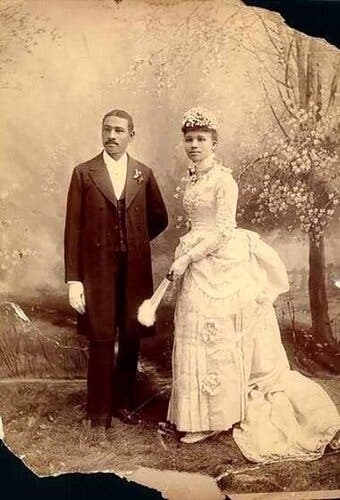
Charles and Willa Bruce on their wedding day.
Credit…Anthony Bruce

Manhattan Beach has been reckoning with the story of the Bruces’ shuttered resort for years. A park there was renamed “Bruce’s Beach” in 2007, and the city erected a plaque to tell the family’s story.

But the plaque credits a white landowner, George Peck, with making it possible for the Bruce family to settle there. It omits reports of Mr. Peck’s attempts to obstruct Black beachgoers’ paths to the shore.

“We definitely need to change the plaque,” said Kavon Ward, 39, an organizer and resident of Manhattan Beach. “But that’s not going far enough for me. We need to figure out how to get this land back to the family it was stolen from.”

Last year, amid nationwide demonstrations prompted by the killing of George Floyd in police custody in Minneapolis, Ms. Ward, who is Black, arranged a picnic at Bruce’s Beach to celebrate Juneteenth.

“I started thinking about the generational wealth that was stripped from that family,” she said. “It happened everywhere around this nation. We keep getting up, but why do we have to keep getting kicked down? Why? For me, it was time for reparations.”
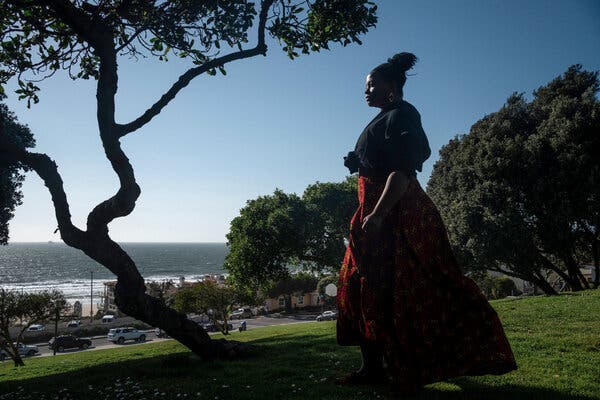
Credit…Gabriella Angotti-Jones for The New York Times

Alison Rose Jefferson, a historian based in Los Angeles, wrote about the Bruces and other families in a book, “Living the California Dream: African American Leisure Sites During the Jim Crow Era.”

“Many people only think about African-American civil rights through economic and political power,” Dr. Jefferson said. “They sometimes forget about the fact that recreation was a big part of the struggle.”

When Willa and Charles Bruce first opened their property to visitors in 1912, it had a small stand that sold food and fizzy drinks. By 1923, the property had a lodge and a beachside cafe, with space upstairs for dancing. Mr. Bruce was often out of town, working as a dining car chef on trains to Salt Lake City. It was Ms. Bruce who bought the property and handled much of the business at the resort.

“Wherever we have tried to buy land for a beach resort, we have been refused,” Ms. Bruce told The Los Angeles Times in 1912. “But I own this land and I am going to keep it.”
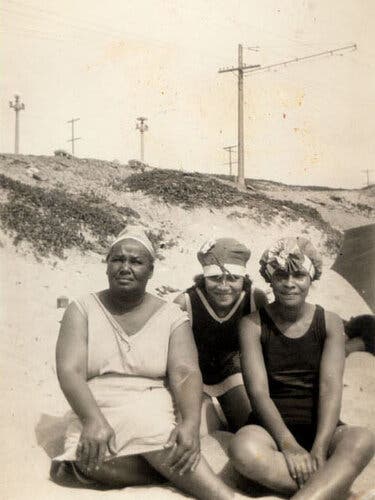
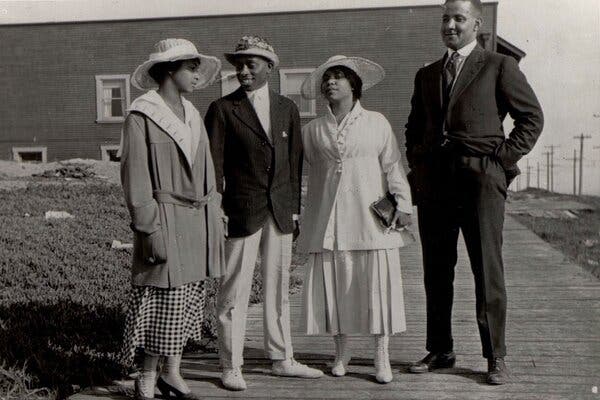
Willa Bruce, left, with her daughter-in-law and her sister in Manhattan Beach in the 1920s.
Credit…California African American Museum

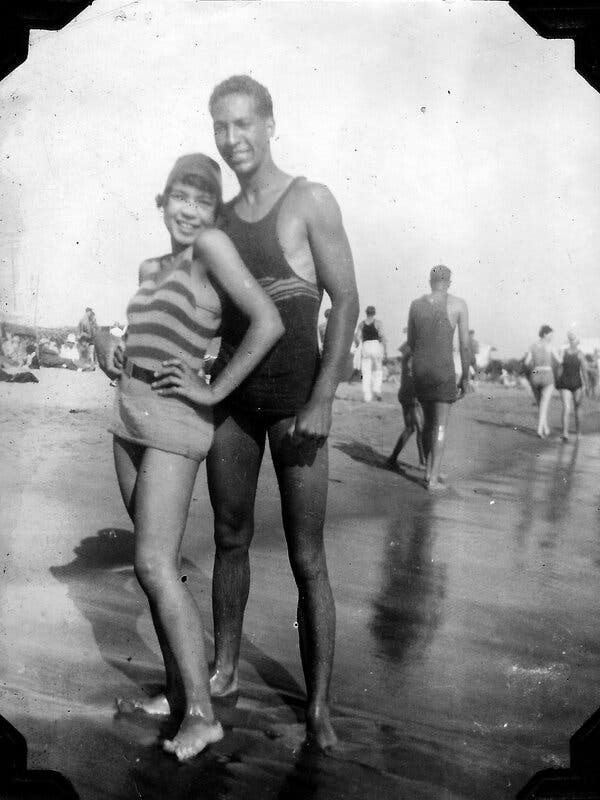
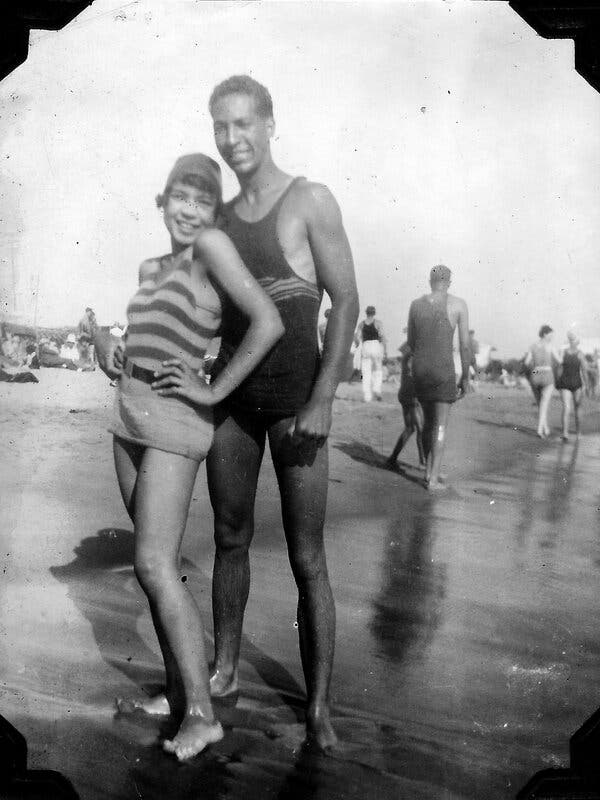
Margie Johnson and John Pettigrew in Manhattan Beach in 1927.

Credit…LaVera White Collection of Arthur and Elizabeth Lewis

The Bruces made their investment in the era of Jim Crow, amid a resurgence of Ku Klux Klan activities across the United States and campaigns of white supremacist terror and lynchings that drove millions of African-Americans away from the South. There was less violence against Black people in California at the time, but discrimination was rampant.

Still, the resort at Bruce’s Beach appeared to prosper. Black-and-white photographs from the era captured beachgoers wearing bathing suits and bright smiles, couples lounging in the shade and families playing in the surf.

In time, a small community of Black landowners bloomed around the resort. According to Dr. Jefferson’s book, these included George Prioleau, a formerly enslaved retired Army major whose family developed a duplex along the shore; Mary Sanders, a caterer from Canada who was known as a skilled entrepreneur; and John and Bessie McCaskill, who hosted elaborate beachside breakfasts.

But some white neighbors and city officials were intent on dismantling the community. Black visitors to the beach endured harassment, slashed tires and arbitrary regulations. The California Eagle, a Black-owned newspaper, reported that the Ku Klux Klan was active along the California shoreline during the 1920s.

Credit…Gabriella Angotti-Jones for The New York Times

And in 1924, the city condemned the Bruces’ property, claiming eminent domain in order to use the land as a park. The couple, both of whom were in their 60s, eventually moved to Los Angeles.

The land they left behind would not be developed as a public park for more than three decades.

Tourists continued to visit Bruce’s Beach after the resort was shuttered. So did members of the N.A.A.C.P., who participated in a “swim-in” to assert their right to the sea in 1927, according to Dr. Jefferson’s book. Several Black beachgoers were arrested that year.

As the decades passed, Manhattan Beach grew to become an affluent city of about 35,000 people, a vast majority of whom are white. According to 2010 census data, less than 1 percent of the population is Black.

In October, Manhattan Beach convened a task force of 13 residents to come up with recommendations for the city to right historical wrongs. Next week, the City Council will meet to discuss those recommendations, which include changing the plaque, erecting an art installation and issuing an apology.

“That’s fine,” Ms. Ward said. “But there are things they could address if they were thinking creatively — if there really was a will to become a more diverse, equitable and inclusive place.” She suggested that officials consider forward-looking measures like a commitment to affordable housing.

At the county level, officials are expected to meet with Bruce family descendants next week to discuss handing over the property, which could also involve monetary restitution or an agreement to lease the land from the family.

But Mr. Shepard said the city that condemned the land should be the one to make amends.

Los Angeles County “is talking about restoring the land to us,” he said. “But the restitution and punitive damages, Manhattan Beach is going to have to pay. We’re going to keep up with them until we get it.”

Sheelagh McNeill contributed research.

What Was the Elaine Massacre? | History | Smithsonian Magazine

The Massacre of Black Sharecroppers That Led the Supreme Court to Curb the Racial Disparities of the Justice System

White Arkansans, fearful of what would happen if African-Americans organized, took violent action, but it was the victims who ended up standing trial

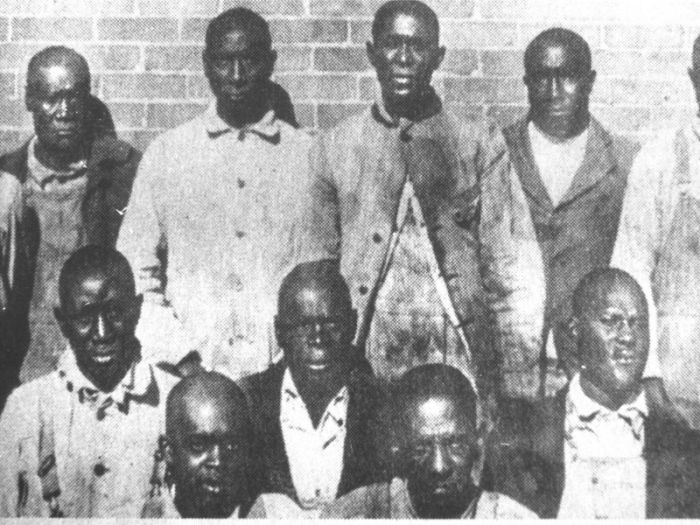
Elaine defendants
Elaine Defendants, Helena, Phillips County, Ark., ca. 1910, (Butler Center for Arkansas Studies, Bobby L. Roberts Library of Arkansas History and Art, Central Arkansas Library System)
SMITHSONIANMAG.COM

The sharecroppers who gathered at a small church in Elaine, Arkansas, in the late hours of September 30, 1919, knew the risk they were taking. Upset about unfair low wages, they enlisted the help of a prominent white attorney from Little Rock, Ulysses Bratton, to come to Elaine to press for a fairer share in the profits of their labor. Each season, landowners came around demanding obscene percentages of the profits, without ever presenting the sharecroppers detailed accounting and trapping them with supposed debts.

“There was very little recourse for African-American tenant farmers against this exploitation; instead there was an unwritten law that no African-American could leave until his or her debt was paid off,” writes Megan Ming Francis in Civil Rights and the Making of the Modern American State. Organizers hoped Bratton’s presence would bring more pressure to bear through the courts. Aware of the dangers – the atmosphere was tense after racially motivated violence in the area – some of the farmers were armed with rifles.

At around 11 p.m. that night, a group of local white men, some of whom may have been affiliated with local law enforcement, fired shots into the church. The shots were returned, and in the chaos, one white man was killed. Word spread rapidly about the death. Rumors arose that the sharecroppers, who had formally joined a union known as the Progressive Farmers and Household Union of America (PFHUA) were leading an organized “insurrection” against the white residents of Phillips County.

Governor Charles Brough called for 500 soldiers from nearby Camp Pike to, as the Arkansas Democrat reported on Oct 2, “round up” the “heavily armed negroes.” The troops were “under order to shoot to kill any negro who refused to surrender immediately.” They went well beyond that, banding together with local vigilantes and killing at least 200 African-Americans (estimates run much higher but there was never a full accounting). And the killing was indiscriminate—men, women and children unfortunate enough to be in the vicinity were slaughtered. Amidst the violence, five whites died, but for those deaths, someone would have to be held accountable.

Out of this tragedy, known as the Elaine massacre, and its subsequent prosecution, would come a Supreme Court decision that would upend years of court-sanctioned injustice against African-Americans and would secure the right of due process for defendants placed in impossible circumstances.

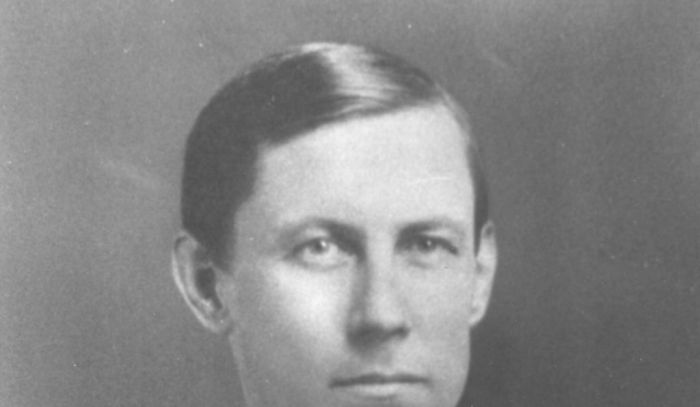
Ulysses Bratton
Ulysses Simpson Bratton, attorney, Little Rock, Ark., ca. 1890 (Butler Center for Arkansas Studies, Bobby L. Roberts Library of Arkansas History and Art, Central Arkansas Library System)

Despite its impact, little about the carnage in Elaine was unique during the summer of 1919. It was part of a period of vicious reprisals against African-American veterans returning home from World War I. Many whites believed that these veterans (including Robert Hill, who co-founded PFHUA) posed a threat as they claimed greater recognition for their rights at home. Even though they served in large numbers, black soldiers “realized over the course of the war and in the immediate aftermath that their achievement and their success actually provoked more rage and more vitriol than if they had utterly failed,” says Adriane Lentz-Smith, associate professor of history at Duke University and author of Freedom Struggles: African Americans and World War I.

During the massacre, Arkansan Leroy Johnston, who had had spent nine months recovering in a hospital from injuries he suffered in the trenches of France – was pulled from a train shortly after returning home and was shot to death alongside his three brothers. In places like Phillips County, where the economy directly depended on the predatory system of sharecropping, white residents were inclined to view the activities of Hill and others as the latest in a series of dangerous agitations.

In the days after the bloodshed in Elaine, local media coverage continued to fan the flames daily, reporting sensational stories of an organized plot against whites. A seven-man committee formed to investigate the killings. Their conclusions all too predictable: the following week they issued a statement in the Arkansas Democrat declaring the gathering in Elaine a “deliberately planned insurrection if the negroes against the whites” led by the PFHUA, whose founders used “ignorance and superstition of a race of children for monetary gains.”

The paper claimed every individual who joined was under the understanding that “ultimately he would be called upon to kill white people.” A week later, they would congratulate themselves on the whole episode and their ability to restore order confidently claiming that not one slain African-American was innocent. “The real secret of Phillips county’s success…” the newspaper boasted, is that “the Southerner knows the negro through several generations of experience.”

To counter this accepted narrative, Walter White, a member of the NAACP whose appearance enabled him to blend in with white residents, snuck into Phillips County by posing as a reporter. In subsequent articles, he claimed that “careful examination…does not reveal the ‘dastardly’ plot which has been charged” and that indeed the PFHUA had no designs on an uprising. He pointed out that the disparity in death toll alone belied the accepted version of events. With African-Americans making up a significant majority of local residents, “it appears that the fatalities would have been differently proportioned if a well-planned murder plot had existed among the Negroes,” he wrote in The Nation. The NAACP also pointed out in their publication The Crisis that in the prevailing climate of unchecked lynchings and mob violence against African-Americans, “none would be fool enough” to do so. The black press picked up the story and other papers began to integrate White’s counter-narrative into their accounts, galvanizing support for the defendants.

The courts were another matter altogether. Dozens of African-Americans became defendants in hastily convened murder trials that used incriminating testimony coerced through torture, and 12 men were sentenced to death. Jury deliberations lasted just moments. The verdicts were a foregone conclusion – it was clear that had they not been slated for execution by the court, they mob would have done so even sooner.

“You had 12 black men who were clearly charged with murder in a system that was absolutely corrupt at the time – you had mob influence, you had witness tampering, you had a jury that was all-white, you had almost certainly judicial bias, you had the pressure of knowing that if you were a juror in this case that you would almost certainly not be able to live in that town…if you decided anything other than a conviction,” says Michael Curry, an attorney and chair of the NAACP Advocacy and Policy Committee. No white residents were tried for any crime.

The outcome, at least initially, echoed an unyielding trend demonstrated by many a mob lynching: for African-American defendants, accusation and conviction were interchangeable.

Nonetheless, the NAACP launched a series of appeals and challenges that would inch their way through Arkansas state courts and then federal courts for the next three years, an arduous series of hard-fought victories and discouraging setbacks that echoed previous attempts at legal redress for black citizens. “It’s a learning process for the NAACP,” says Lentz-Smith. “[There is] a sense of how to do it and who to draw on and what sort of arguments to make.” The cases of six of the men would be sent for retrial over a technicality, while the other six defendants – including named plaintiff Frank Moore – had their cases argued before the United States Supreme Court. The NAACP’s legal strategy hinged on the claim that the defendants’ 14th Amendment right to due process had been violated.

In February 1923, by a 6-2 margin, the Court agreed. Citing the all-white jury, lack of opportunity to testify, confessions under torture, denial of change of venue and the pressure of the mob, Justice Oliver Wendell Holmes wrote for the majority that “if the case is that the whole proceeding is a mask – that counsel, jury and judge were swept to the fatal end by an irresistible wave of public passion,” then it was the duty of the Supreme Court to intervene as guarantor of the petitioners’ constitutional rights where the state of Arkansas had failed.

The verdict marked a drastic departure from the Court’s longstanding hands-off approach to the injustices happening in places like Elaine. “This was a seismic shift in how our Supreme Court was recognizing the rights of African-Americans,” says Curry. After a long history of having little recourse in courts, Moore vs. Dempsey (the defendant was the keeper of the Arkansas State Penitentiary) preceded further legal gains where federal courts would weigh in on high-profile due process cases involving black defendants, including Powell vs. Alabama in 1932, which addressed all-white juries, and Brown vs. Mississippi in 1936, which ruled on confessions extracted under torture.

Moore vs. Dempsey provided momentum for early civil rights lawyers and paved the way for later victories in the ’50s and ’60s. According to Lentz, “when we narrate the black freedom struggle in the 20th century, we actually need to shift our timeline and the pins we put on the timeline for the moments of significant breakthrough and accomplishments.” Despite Moore vs. Dempsey being relatively obscure, “if the U.S. civil rights movement is understood as an effort to secure the full social, political, and legal rights of citizenship, then 1923 marks a significant event,” writes Francis.

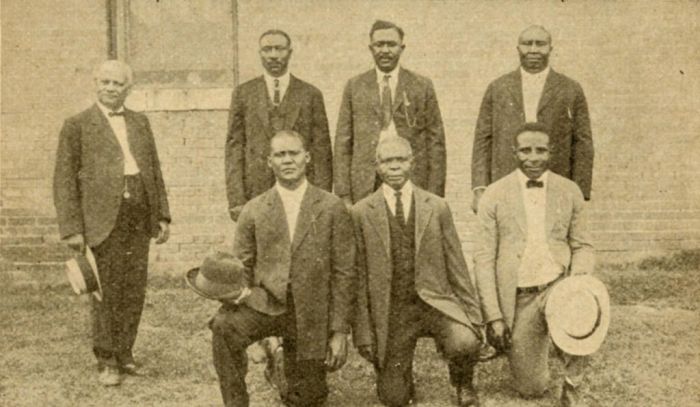
Elaine defendants
Elaine Defendants: S. A. Jones, Ed Hicks, Frank Hicks, Frank Moore, J. C. Knox, Ed Coleman and Paul Hall with Scipio Jones, State Penitentiary, Little Rock, Pulaski County, Ark. ca. 1925, (Butler Center for Arkansas Studies, Bobby L. Roberts Library of Arkansas History and Art, Central Arkansas Library System)

The ruling also carried broad-ranging implications for all citizens in terms of federal intervention in contested criminal cases. “The recognition that the state had violated the procedural due process, and the federal courts actually weighing in on that was huge,” says Curry. “There was a deference that was being paid to state criminal proceedings, then this sort of broke that protection that existed for states.”

The sharecroppers that had gathered in Elaine had a simple goal: to secure a share in the profits gained from their work. But the series of injustices the events of that night unleashed would – through several years of tenacious effort – end up before the nation’s highest court and show that the longstanding tradition of declaring African-Americans guilty absent constitutional guarantees would no longer go unchallenged.

Source: What Was the Elaine Massacre? | History | Smithsonian Magazine

“Aligning Black Policy Priorities Into the Game of Electoral Politics” ::: S.C. Professor Emeritus, Willie Legette :: Sat., March 6, 2021 :: 10 pm ET

Transforming Truth to Power, One Broadcast At a Time

“Aligning Black Policy Priorities Into the Game of Electoral Politics”

Professor Willie Legette

Political Systems Analyst and Organizer


Saturday, March 6, 2021 ∞ 10 pm EST ∞ LIVE

Tune In LIVE Here: http://bit.ly/OCGTruthTalk

Listen & Call In Line: 347-838-9852

Visit us OUR COMMON GROUND on the Web

ABOUT THIS EPISODE 

The coalition Democrats brought together in 2020 was enough to beat Trump—but it’s insufficient for the long-term fights ahead. If 2020 was, as Biden put it, a fight “for the soul of the nation,” the next task for the progressives is even harder: build a multiracial working-class majority big enough to win a transformative agenda that lifts America out of 2020s roiling crises and truly transform people’s lives. That’s how progressives win for the next generation.
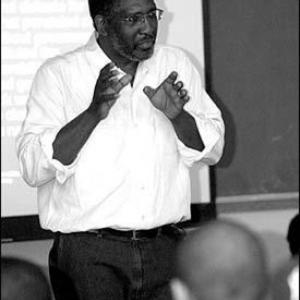
We talk with Professor Willie Legette, political analyst, as to how we might resolve the conflicts and problems of voting for who we “like”, votes that are often divorced from policies that address our political, economic, and community needs. Are we voting electoral race politics and needing class-basis policies? Just how does the “Black vote” calculate? Though we think of ourselves as on a winning team, are we winning? Is there credence to what we call “ the Black vote”? What does it mean? A whole new way of thinking is required. That and a “resistance campaign” against voter suppression.

With his co-author, Adolph Reed, Legette writes that “The disjunction between candidate choices and issue concerns reflects how people are accustomed to making their short-term electoral calculations and how they understand the issues that affect their lives. People take different criteria to candidate selection than to their estimations of the issues that most concern them. In part that is the result of decades of bipartisan neoliberal hegemony in which electoral politics has been drained of serious policy differences. For more than forty years neither Republicans nor Democrats have sought to address Americans’ decreasing standard of living and increasing economic insecurity. Both parties have subordinated voters’ concerns to the interests of Wall Street and corporations. Therefore, in states like South Carolina Democratic party politics is fundamentally transactional, where people are habituated to making electoral choices based on considerations like personal relationships or more local concerns that do not center so much on national policy issues. In effect politics—or at least electoral politics—has been redefined as not the appropriate domain for trying to pursue policies that address people’s actual material concerns like health care, education, jobs, and wages, or housing.

Legette asserts that a narrow view of politics was on display regarding the “black vote” in particular in the runup to the 2016 South Carolina primary when Congressmen James Clyburn (D-SC), John Lewis (D-GA), and Cedric Richmond (D-LA) denounced calls for free public higher education as “irresponsible” because “there are no free lunches.” When Clyburn endorsed Biden in 2020, he took a swipe at Medicare for All, another issue with strong black American support, indicating that the choice this year is Biden vs. Medicare for All. (It may be worth noting that Clyburn, between 2008 and 2018, took more than $1 million from the pharmaceutical industry.)”

“. . . is not the election of a president but the transformation of the country into a place that is more egalitarian, just, and humane, a society where poverty is not possible and where real freedom is enjoyed by all… The kind of popular pressure we need to advance some of the best of Sanders’s platform—free higher education, postal banking, public works, a single-payer health care system, stronger financial regulation, and so on—cannot be built in an election cycle.” – Cedric Johnson, Jacobin magazine,” Fear and Pandering in the Palmetto State”

Johnson problematizes that “black politics” as a framework for understanding either black Americans’ electoral behavior or their class and political interests. He points out that “voting for a presidential candidate… is only a proxy for political interests, which are again multifaceted and shifting.” Black politics, in fact, is a historically specific phenomenon, as Johnson argues elsewhere. It is a label attached to the racialized black interest-group politics that consolidated after the great victories of the 1960s. It is thoroughly a class politics that rests on a premise—and one asserted with increasing intensity as class differences among black Americans become clearer in political debate—that all black Americans converge around a racial agenda defined arbitrarily by political elites and others in the stratum of freelance Racial Voices. We talk with Professor Legette about these assertions and more. As well, I continue to ask where is the Black political infrastructure to move us either in or out of the game?

ABOUT Professor Legette

Willie Legette is Professor Emeritus of Political Science, South Carolina State University; Lead Organizer, Medicare for All-South Carolina; Labor Party candidate for SC Senate;

Common Dreams contributor; journalist and activist.

#trustyourstruggle


“I’ll Be Listening for You”

Janice


We HIGHLY RECOMMEND these LIVE broadcasts:

THIS IS REVOLUTION PODCAST

with Jason Myles & Pascal Robert  ∞  Progressive Talk 

https://www.youtube.com/watch?v=2JWmj2atW1I

Saturdays 10 am :: Tuesdays & Thursdays ::: YouTube  ::: 8pm ET

The ALFO Show   

Friday Night PoliFight

 Friday 10 pm EST

TruthWorks Network


OCG Studios:  http://bit.ly/OCGTruthTalk
Listen or Call – In:  (347) 838-9852
Join us on FACEBOOK and Learn More about this episode
OCG on the Web   OCG YouTube OCG Instagram

OCG Alternative to FB with all the Features  Become a Member

Follow us on Twitter: @JaniceOCG #TalkthatMatters  #TrustYourStruggle

OCG Broadcast Page and Archive of Past OCG Episodes: http://bit.ly/OCGTruthTalk


Straight Down to the Bones | Boston Review

ARTS IN SOCIETY

Straight Down to the Bones

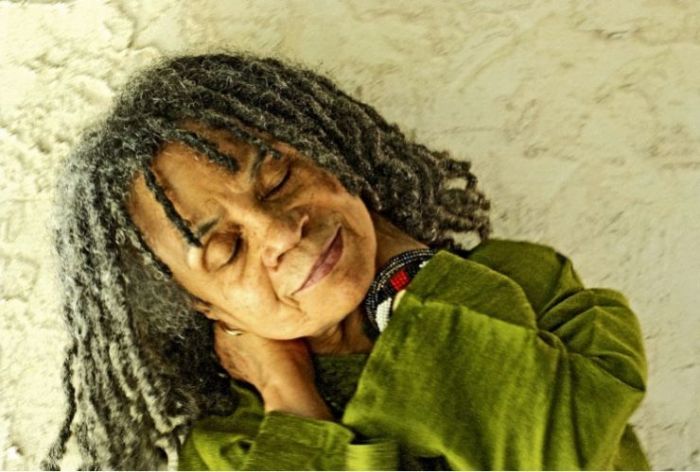
In this searching interview, legendary Black Arts poet Sonia Sanchez discusses the ancestral influences on her work and how art can give us strength.

Includes new audio of Sanchez reading from her work.SONIA SANCHEZ, CHRISTINA KNIGHTThis interview is featured in Boston Review’s new book, Ancestors.ORDER A COPY TODAYEditor’s Note: You can hear Sonia Sanchez read some of her poems at our launch event for Ancestors next Thursday, March 11!

In addition, we are thrilled to announce that Sonia Sanchez will be one of the judges for this year’s creative writing contests. Free for writers from non-Western countries (as well as those experiencing hardship), our short story and poetry contests are open now.

A key figure in the Black Arts Movement and a founder of Black Studies, Sonia Sanchez has authored more than a dozen books of poetry, criticism, and plays. Though I’ve never met Sanchez in person, it is not an exaggeration to say that her life as a poet, playwright, and professor has made my own possible.

Taking a class on the Black Arts Movement as an undergraduate introduced me to the fire behind her language. My graduate training in African American Studies showed me images of her as an impossibly young professor, fighting for the establishment of Black Studies at San Francisco State University. And most recently, in my own life as a young professor in Philadelphia, I’ve seen Sanchez enter a room and be suddenly surrounded by former students, friends, and colleagues, living evidence of her lifelong generosity of spirit. Sanchez radiates brilliance, humor, and integrity, and her work has touched countless lives.It was a joy, then, to speak with her about the many people, living and dead, who have shaped her own journey. In our interview, she discusses mentors and teachers as well as her fierce devotion to her students. She concludes by recalling her writing process for A Blues Book for Blue Black Magical Women (1974), an astonishing volume of poetry shaped by the artist’s dream dialogues with her late mother.—Christina Knight“How could I be a graduate in New York City and never come across these Black books?

”Christina Knight: You have mentioned before that there are lots of people, of various ethnic and racial backgrounds, who have inspired you and your own vision for a more just and peaceful world. Could you talk about who some of those people are—those chosen ancestors—who guide you on your journey? Sonia Sanchez: Some of them are people like Jean Hutson, who was a curator and then chief of the Schomburg Center for Research in Black Culture for decades. When I was finishing my bachelors at Hunter College, I had done some substitute teaching around my neighborhood, and I had this agreement with the principal that I would have a job in September. But I graduated in January, and when you come from a family that’s not wealthy, jobs are very important, are they not? So my dad said, “Well, you’d better go out and get a job.” I looked around in the newspapers and I went to all these places to get a job, and they all said they were filled. But I had the feeling that it had to do with how I looked, you know, my color, right? Someone I was talking to said, “Why don’t you look at the New York Times? They have all of these ads.” So I looked and there was one that said to write in; it was for a writer for a firm. And I thought why don’t I, at that point, play with what I really want to be?So I sent my CV, and I wrote whatever they asked me to write. And I got a telegram on Saturday that said to report to work on Monday; I was hired. So on Monday I went out in my blue suit, and my hat, and my blue pumps, and my blue bag. I had gloves and everything. I went out like a church person, you know what I mean? I got there at 8:30, and I remember waiting outside this door, which was locked. I’m standing there thinking, “Am I in the right place?” And I heard these heels come clicking down the hall. This woman came up to me and said, ‘Can I help you?’” So I took the telegram out and handed it to her.I remember she read it, and then she looked up at me; she looked back down, she read it again, and then she looked back up at me. Then she handed it to me, unlocked the door, and said, “Come in and have a seat.” You know how it is just to be twenty? How young you are at that time? Being eighty-six, now, you look back, and you remember the youngness in your eyes—like, “Whoa, here I am, I’m going to get a job. I’ve been hired to do something that I want to do.” It’s amazing. So I’m sitting there, and a man walks in and says, “Yes, can I help you?” I got up, and I had my letter out, and I handed it to him. And he read the letter and looked at me; he looked down at the telegram and read it again and looked up at me. And you know, I am smiling the whole time. And he handed it back to me and said, “I’m sorry, the job is taken.”With my New York City humor, I said, “Oh, I got it—the telegram said report to

Source: Straight Down to the Bones | Boston Review

‘Black Fatigue: How Racism Erodes the Mind, Body, and Spirit’ With Author Mary-Frances Winters | KUT Radio, Austin’s NPR Station

On this edition of In Black America, producer/host John L. Hanson Jr. speaks with Mary-Frances Winters, founder and president of The Winters Group, Inc., and author of Black Fatigue: How Racism Erodes the Mind, Body, and Spirit.

Black fatigue is the physical and psychological toll on African Americans’ daily lives as a result of systemic racism. The damage wrought by racism isn’t only the atrocities so powerfully condemned in the demonstrations and protests around the world.

Winters talks about African Americans being middle class and that being from a two-parent family does not protect them from systemic racism; how millennials and Generation Z continue to suffer under the hand of systematic oppression; and how, as a baby boomer, she lived through three different generations of racial discrimination and unrest in North America.


Source: ‘Black Fatigue: How Racism Erodes the Mind, Body, and Spirit’ With Author Mary-Frances Winters | KUT Radio, Austin’s NPR Station

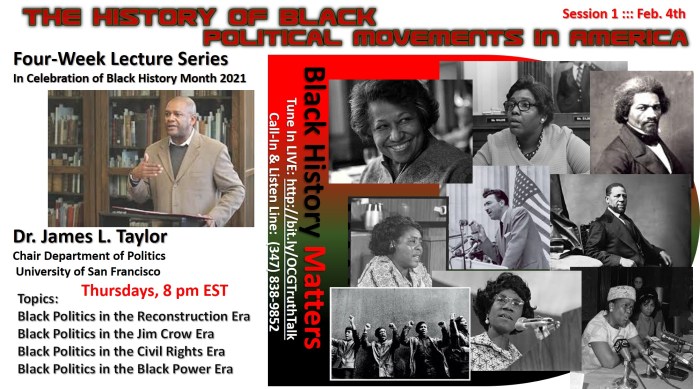
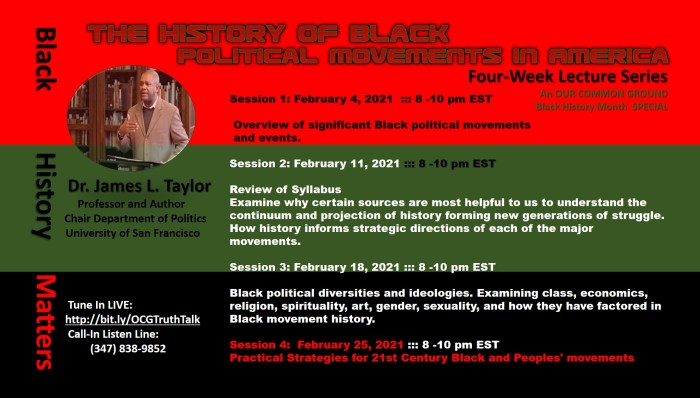
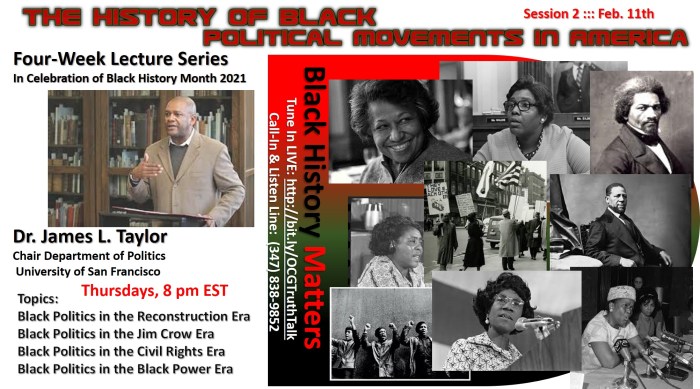
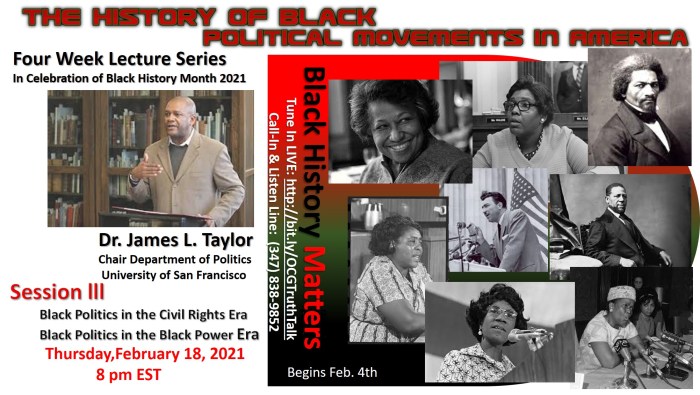
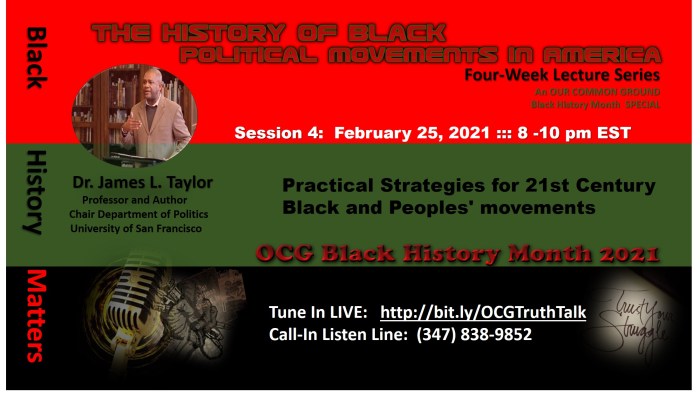
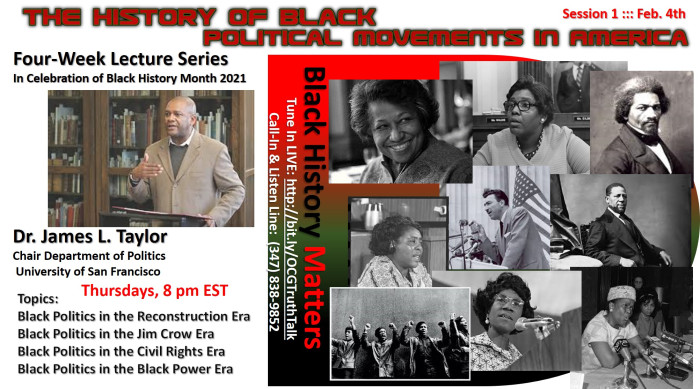
“The History of Black Political Movements in America” ::: Four-Week Lecture Series ::: An OUR COMMON GROUND BHM Special :::

“A History of Black Political Movements in America”
Session lV ::::: February 25, 2021 :::: 8pm EST

OUR COMMON GROUND's avatarOCG

An OUR COMMON GROUND Black History Month 2021

Special

“A History of Black Political Movements”

A Four-Week Lecture Series

Presenter, Dr. James L. Taylor, Ph.D.

Each Session: Thursdays 8- 10 pm EST ::: February 4, 11, 18, 25, 2021

LIVE & InterActive: http://bit.ly/OCGTruthTalk

The Black Power movement grew out of the CIVIL RIGHTS MOVEMENT that had steadily gained momentum through the 1950s and 1960s. It was not a formal movement, however, the Black Power movement marked a turning point in Black-white relations in the United States and also in how Black people saw themselves. Both movements were hailed as significant struggles of Blacks to achieve full equality. They were complex events that took place at a time when society and culture were being transformed throughout the United States, and its legacy reflects that complexity. But what of the legacy political movements that occurred right after the Emancipation of slavery? We…

View original post 554 more words

The Legacy of JIMMIE HORACE “DOC” HORNE :: WPBch FL Tennis Pioneer

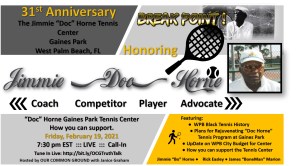
31st Anniversary Jimmie “Doc” Horne Tennis Center

WPB FL

The Legacy of JIMMIE HORACE “DOC” HORNE

Friday, February 19, 2021  ::: 7:30 pm EST

Tune In Here: http://bit.ly/OCGTruthTalk

Listen & Call-In Line:  347-838-9852

The rich history of black people and tennis in the United States goes back close to 110 years. It includes names such as Althea Gibson, Arthur Ashe, Zina Garrison, and Venus and Serena Williams. It also includes some who were little-known that carried the passion of tennis to small communities across the country. Those who infused a love of the game and its roaring competition to Black children and adults alike. Jimmie “Doc” Horne, public teacher, former FAMU competitor was one.

‘ “Doc” Horne’s passion was to help kids play tennis’

Jimmie “Doc” Horne Sr., a tennis standout once barred from white courts in an era of segregation, did not wait for somebody else to design a program to expose city kids in West Palm Beach to the sport. Nor did he wait to be paid. Retiring after 34 years as a teacher in area schools, he just showed up and did it.

In March 2021, he will be inducted into the US Tennis Hall of Fame of the American Tennis Association.
ABOUT THIS SPECIAL  BROADCAST 

OUR COMMON GROUND LIVE

 Tune In Here: http://bit.ly/OCGTruthTalk

In 1990, the city of West Palm Beach proclaimed March 17 as Jimmie “Doc” Horne Appreciation Day. The tennis facilities at Gaines Park are named for him. In 1994, he was one of six recipients of the U.S. Tennis Association’s Community Service Award in the nation.

Early in their careers, Venus and Serena Williams and their father practiced at Gaines Park, said son Jimmie “Bo” Horne.

“He was referred to by Venus and Serena as their tennis grandfather,” he said. “My daddy was resilient. He used to say, ‘If you want to be something in this life, you’ve got to start it.'”

Mr. Horne, who attended Florida A&M, won a state tennis championship in 1947 in the “all black division.” He became the first registered black tennis pro in Florida, according to a family-supplied biography. After serving as a quartermaster in the U.S. Army, he taught woodworking and carpentry for more than three decades at the former Roosevelt High School and North Tech Institute.

“He was an icon of the community,” said Reed Daniel, the campus manager for youth empowerment centers in West Palm Beach. “I’ll always remember him on the court with 10 or 12 kids standing at attention like a little army. He was holding a sign, ‘Tennis is a Quiet Sport.’ I loved that. Some of those kids were too young to read. But they did what he said.”  Only years after he started did Mr. Horne receive even part-time pay for his efforts, Daniel said.

Jimmie “Doc” Horne Sr., a tennis standout once barred from white courts in an era of segregation, did not wait for somebody else to design a program to expose city kids in West Palm Beach to the sport. Nor did he wait to be paid. Retiring after 34 years as a teacher in area schools, he just showed up and did it.  His generosity and commitment helped make him a community legend, say those who gathered to remember him before his burial. Mr. Horne passed on December 2, 2008, at age 88. There are few in the WPB Black community who played tennis who didn’t learn it or at least, in part from “Doc” Horne. In March 2021, he will be inducted into the US Tennis Hall of Fame of the American Tennis Association.

Tonight, we pay tribute to his untiring pursuit and passion for tennis in our community, extending it to the children in our community.  The broadcast will feature a discussion about the Horne Center at Gaines Park named in his honor, discussion with some of his tennis students, his tennis partners, and his son, a celebrated R&B vocalist, performer, and music producer. The Jimmy “Doc” Horne Tennis Center is located at Gaines Park in West Palm Beach. New programs and renovations are under City planning and will be able to accommodate more tennis programs and player convenience. Joining us will be his son, the renowned music icon, “Bo” Horne and, we will talk with Rick Easley and James “Boneman” Marion about their love for the game and the man and how that came about.

We hope that you will join us in our tribute to “Doc” Horne to remember his contributions to tennis in Palm Beach County, West Palm Beach, and the State of Florida. You are invited to call-in (3473-838-9852) and share your recall about the role he played in our community, at school, and on the courts. As a near two-decade tennis student of his, I am proud to have the opportunity to continue and support his work.

“I’ll Be Listening for You”

Janice


OUR COMMON GROUND

“Transforming Truth to Power, One Broadcast At a Time”

OCG Studios:  http://bit.ly/OCGTruthTalk
Listen or Call – In:  (347) 838-9852

Join us on FACEBOOK and Learn More about this episode
OCG on the Web   OCG YouTube OCG Instagram
Follow us on Twitter: @JaniceOCG #TalkthatMatters  #TrustYourStruggle

OCG Broadcast Page and Archive of Past OCG Episodes: http://bit.ly/OCGTruthTalk

HOW TO LISTEN

 Click this Link: http://bit.ly/OCGTruthTalk Choose “on-air” link

  • Call Into this Number to Listen or Speak with Janice and our guests:

                                                (347) 838-9852

Join us in our Active Chatroom

HOW TO CHAT on OUR COMMON GROUND

BY CREATING A BLOG TALK RADIO LISTENER ACCOUNT

To register as a BlogTalkRadio Listener:

Follow This Link – https://secure.blogtalkradio.com/register.aspx?

  1. Register with a unique username, your email and a unique password
  2. Navigate to your email and click on the link in the email from BTR
  3. Sign in with your new listener account
  4. Navigate to the live show at www.BlogTalkRadio.com/OCG
  5. Once you are on the live show main page – scroll down to the bottom and join us in the chat.

Follow us on twitter – www.twitter.com/JaniceOCG

Reflections On Recent Controversy And The Case For #PureReparations | Actify Press

This is longer than a 140-character Tweet, but I respectfully ask that all who participated in exchanges over a statement I made on Twitter on February 4, 2021 concerning #PureReparations, that aroused a firestorm of responses, please read this from start to finish.

Background

This is longer than a 140-character Tweet, but I respectfully ask that all who participated in exchanges over a statement I made on Twitter on February 4, 2021, concerning #PureReparations, that aroused a firestorm of responses, please read this from start to finish. Some of the responses to my statement were serious, thoughtful, and critical, but others were so hostile. I am convinced many of them were written by people who only had, at best, second- or third-hand knowledge of the content of my message.

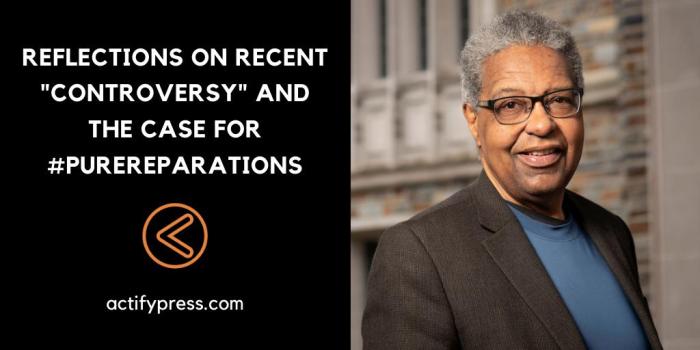
Let me be clear, I remain steadfast that African American reparations in the United States should be designated specifically for black Americans who are descendants of persons enslaved in the United States. It is a position that I have maintained for upwards of 20 years, first articulated with the eligibility criteria I presented in an article published with Dania Frank in 2003 in the American Economic Review. 

The criteria expressed at the time were twofold: 1. An American citizen would have to demonstrate they have at least one ancestor enslaved in the United States. 2. An American citizen would have to demonstrate that for at least ten years before the adoption of a reparations program they self-classified as black, negro, or African American. The first criterion is a lineage standard; the second is an identity standard. Both standards must be met to merit receipt of reparations payments.

Lineage Criteria

In our recent book, From Here to Equality (FHTE)Kirsten Mullen and I modify the identity standard to lengthen the time to at least twelve years (two Senatorial terms) and to include the adoption of a study commission for reparations as one of two events that would trigger the time count on self-classification.

The core objective always has been to include all persons, and their descendants, who have been subjected to the cumulative, intergenerational effects of slavery, legal segregation and white terrorist violence, and post-Civil Rights Era mass incarceration, police executions of unarmed blacks, and ongoing discrimination in the justice claim. This is the community whose ancestors were denied the promised 40 acres as restitution for the years of bondage and as a material springboard for entry into full citizenship in the United States.

Kirsten and I argue further, in FHTE, the best economic indicator of the combined effects of these atrocities is the racial wealth gap.  We propose that elimination of the gap yields the baseline value for a reparations plan—demanding a federal government expenditure of $10 to $12 trillion.  It is a key aspect of our project to generate a research-based standard for determining the size of the bill that is due. We do not identify an upper bound for the bill.

We also insist that priority be given to mobilization of the funds in the form of direct payments to eligible recipients, whether cash transfers, trust accounts, other types of endowments, or some combination thereof.

Necessary Exclusions

The two eligibility criteria necessarily exclude many Americans. The lineage standard will exclude all blacks in the United States who migrated to the United States and became citizens after the end of the Civil War. Their descendants also will not be eligible, in the absence of a parent’s or grandparent’s intermarriage with black Americans having ancestry anchored in US slaveryCounting among blacks excluded would be the relatively small group that migrated to the United States during the Jim Crow years (estimated to be, according to a Smithsonian study, to the right of the decimal point). Also excluded is a much larger group of black immigrants (now approaching ten percent of the nation’s black population) who arrived after 1964, especially coming in large numbers from the 1980s onward.

The identity standard excludes all persons who self-identified as non-black, inclusive of all white Americans, at a point where there was no apparent financial benefit from classifying oneself as black.

Meeting the lineage standard necessitates serious genealogical research. As a result, in FHTE, Kirsten Mullen and I recommend the federal government establish an agency with genealogists with expertise in African American ancestry to provide free services to all persons seeking to establish their reparations claim. Despite that recommendation, we continue to get substantial push back from those who say many black Americans with ancestors enslaved in the US will hit a wall in getting past the 1870 Census to identify their particular ancestors who were held in bondage before 1865. Therefore, I have been giving more thought to modifications in the criterion that would make it easier for all black American descendants of U.S. slavery to be assured of inclusion.

Balloon Reasoning

One possibility that seemed reasonable is the one I advanced that stirred the pot to a boil—include black immigrants who came during the Jim Crow years on the eligibility list. Let me emphasize, I advanced this to prompt discussion. I even referred to this in a later post as a “trial balloon,” which left me open to the somewhat humorous charges that the balloon popped or, quite the opposite, the balloon was made of lead.

Here is the thinking that I pursued: Allowing pre-1950s black immigrants onto the reparations roll eases genealogical proof required of black American descendants of U.S. slavery to establish their lineage claim. You necessarily have a tradeoff between letting a small number of otherwise excluded black folk in the door versus keeping the strong genealogical standard that will demand going past the 1870 “wall.”  Under the former case, with the relaxed lineage standard, a person would have to demonstrate, say, that they have at least two black ancestors who were citizens of the USA before 1950 or 1960.

Then, eligibility would be much easier to establish for all black American descendants of U.S. slavery at the “price” of including a small number of black immigrants who arrived during legal segregation. Let a few in who do not meet the original lineage standard to ensure that all make it in who meet the original lineage standard.

No Mission Creep

I reject the “slippery slope” argument that has it that making this exception opens the gates for every other group to piggyback onto the reparations’ claim. Conditions can be drawn so precisely that no additional groups will become eligible.

Nevertheless, I do take seriously, the following critical response to my “trial balloon”: The limitation of African American reparations to black American descendants of US slavery is a matter of principle that should not be compromised. America’s history of racial injustice has targeted this community so consistently and with such ferocity that we should brook no modification in the criteria, even it remains more difficult for each individual to establish eligibility for the merited compensation.

In fact, I take it so seriously, in a later message, I indicate that I would not advance as an option the proposal any longer, and I will stand committed solely to the original criterion. Unlike what is suggested in a number of messages on Twitter, I never proposed that recent black immigrants should be eligible for reparations from the U.S. government. Nor do I anticipate reneging on that position. . . ”

Additional Considerations

Source: Reflections On Recent Controversy And The Case For #PureReparations | Actify Press