CHILD SEXUAL ABUSE & TRAUMA IN THE AFRICAN-AMERICAN COMMUNITY

See on Scoop.itOUR COMMON GROUND News Board •● ☥●• The Third Eye Parenthesis

ROYAL CIRCLE FOUNDATION

PRESENTS IN ASSOCIATION WITH

BLACK PSYCHIATRISTS OF AMERICA, THE OFFICE OF MINORITY AND NATIONAL AFFAIRS

(AMERICAN PSYCHIATRIC ASSSOCIATION)

&

THE BALTIMORE BLACK MENTAL HEALTH ALLIANCE

A National Conference

CHILD SEXUAL ABUSE & TRAUMA

IN THE AFRICAN-AMERICAN COMMUNITY

(The Shame, The Blame & The Solutions)

MARCH 22-23, 2013

Hilton Baltimore

OUR COMMON GROUND Omnibus‘s insight:

For students, activists, scholars, parents, teachers and victims.

The Shame, The Blame & The Solutions

See on www.royal-circle.org

OUR COMMON GROUND 2013 Season Begins February 2, 2013


2013 Season


OUR COMMON GROUND BEGINS THE 2013 BROADCAST SEASON’

SATURDAY, February 2, 2013   10 pm ET


SPEAKING TRUTH

 The 2013 SEASON

SATURDAY   February 2, 2013    10 pm ET


PhotoFunia-a349


saturdays

We hope that you will join us as we kick off our 2013 Season of LIVE Broadcast. This season, we focus on poverty, hunger, homelessness, prison and prisoners and mental health in Black America. Advancing our VOICE and our WILL. Building solutions in the context of respect for our people’s HISTORY and HOPE. Constructing the path for new law, new public policy and reparations in an on-going dialogue transforming our thinking and our living. It’s what we do on OUR COMMON GROUND.


OUR COMMON GROUND premiering the 2013 Season of LIVE Broadcasts February 2, 2013 – 10 pm ET

Live and Call-In

Broadcasting BRAVE BOLD and BLACK

Celebrating its 28th Year of Broadcast Excellence

Continuing the Legacy of bringing to our audiences the best of informed analysis, discourse, ideas, solutions to the pressing issues of Struggle of Black People.

OCG Meeting House Studios

“Where Friends come to Meet with Comrades”

Jailhouse Blues l The Saturday Evening Post

Jailhouse Blues
 

Pelican Bay State Prison

Pelican Bay State Prison is designed to house California’s most serious criminal offenders. Photo courtesy California State Department of Corrections.


We are facing a crisis in America. The crisis is largely hidden from view, but like a cancer, it threatens the very health of society. We have become a superpower of incarceration. Today we warehouse 2.2 million inmates according to the most recent U.S. Bureau of Justice Statistics report.

That’s more than the entire population of Houston. More than two-thirds that of Chicago.

China, with more than four times the U.S. population, is a distant second with 1.5 million inmates. The United States imprisons 760 people per 100,000. The number for France is 96, Germany 90, and Japan 63. As an NAACP advertisement points out, we are 5 percent of the world’s population and we house 25 percent of the world’s prisoners.

How did we get here? Between 1925 and 1972, our state inmate population increased 105 percent—roughly proportionate to the country’s overall growth. Since 1973, when stiffer sentencing came in—particularly the so-called Rockefeller drug laws providing lengthy minimum sentences for possession of small quantities of banned substances—the number of prisoners has increased more than 700 percent. That’s about 14 times the country’s overall growth.
The costs are staggering. In a survey of 40 participating states, the Vera Institute of Justice concluded that U.S. taxpayers were shouldering an annual bill of $39 billion. And that’s just the direct costs. Indirect costs, which tend to be carried by government agencies other than corrections departments, are incalculable.

“The system is so skewed,” laments Bob DeSena, executive director of Council For Unity, an anti-gang initiative headquartered in New York City. “As a society we are completely focused on punishment. People are willing to spend hundreds of thousands on incarceration, but they don’t want to spend a few dollars on programs that are proven to prevent them from becoming criminals in the first place.”

What to do with criminals—what warrants imprisonment, for how long, and how to reintegrate released men and women—is one of society’s most difficult challenges. In modern times, the great philosophical debate has been whether the mission is to reform or to punish. And possibly no society has cycled quite so widely between the two extremes as America.

The prison reform movement started more than 200 years ago, in the throes of the Industrial Revolution when a surge in the urban population came with a steep rise in crime. At the time, jail was little more than a means of segregating malefactors from the rest of the population. Perpetrators who weren’t killed outright (Pennsylvania, the first state to outlaw capital punishment for theft, didn’t do so until 1786) were dealt with harshly, confined in dungeons or tawdry, violent, and often disease-ridden jails.

One early attempt at reform was nearly as harsh as the system it replaced. New York’s Auburn Prison, built in 1816, was governed by the then-radical notion that prisoners were capable of change. Hence, prisoners were put to work, and community activity was encouraged during the day. But strict silence was enforced at all times, and prisoners were isolated in solitary confinement at night. Prisoners who so much as broke the silence were flogged or hung by their wrists or had their heads locked in iron cages.

More Pages: 1 2 3

The Saturday Evening Post

Votes Behind Bars l The Boston Review

JANUARY/FEBRUARY 2012

Votes Behind Bars

Pamela S. Karlan

123RF Stock Photo

Nearly half a century ago, Isaiah Berlin delivered an extraordinarily influential lecture called “Two Concepts of Liberty.” The negative concept consists in freedomfrom—“warding off interference” from external forces. By contrast, the positive concept consists in freedom to—to be “a doer—deciding, not being decided for.” Democracy requires both forms, but current constitutional doctrine adopts an unduly negative approach.

This is especially the case when it comes to political voice. The Supreme Court has resisted attempts to constrain the political impact of money, most notoriously inCitizens United v. Federal Election Commission (2010). But just as telling is Arizona Free Enterprise Club’s Freedom Club PAC v. Bennett (2011), where the Court hobbled the states’ ability to construct public financing systems. Adjusting the funds available to candidates who accept public financing somehow burdens privately financed candidates’ freedom, according to the justices.

The Court’s rationale in campaign finance cases calls on protection of free speech, which invokes a negative concept of liberty because the freedom of speech guaranteed by the First Amendment is largely exercised without government assistance. Political speech, the Court points out, is “an essential mechanism of democracy, for it is the means to hold officials accountable to the people.” True enough.

Yet voting is surely an equally essential mechanism of democracy, and arguably a more direct means for holding officials accountable, but the Court has upheld laws that burden casting a ballot, a positive liberty. In Crawford v. Marion County Election Board (2008), the Court rejected a challenge to an Indiana law requiring already-registered voters to present government-issued photo identification at the polls. (Disclosure: I helped to represent the plaintiffs in the case.) The justices did not agree on every element of the case, but they accepted Indiana’s argument that ID prevents fraud (after recognizing that Indiana could not point to a single example, ever, of impersonation that an ID requirement would have stopped) and enhances “public confidence” in the election process, a rationale the Court has essentially rejected in the political-spending context.

The Court’s strikingly different treatment of burdens on political spending and on voting reflects this positive/negative divide. Effective exercise of the right to vote depends on affirmative government support. A citizen who is handed an official ballot written in a language she does not understand may effectively be denied the right to vote. If the government uses unreliable voting machines or staffs polling places with badly trained workers, citizens may effectively be prevented from voting by the press of other responsibilities that preclude waiting in line for hours. Voter ID laws disenfranchise individuals who find it difficult or impossible to obtain government-issued documents.

A superficial reading of the Constitution might support the Court’s opinions. Although the Constitution is filled with provisions mentioning the “right to vote,” the most explicit protections are phrased almost entirely in negative terms: they prohibit particular forms of disenfranchisement. The Fifteenth and Nineteenth Amendments, for example, forbid denial of the right to vote “on account of race” or “sex”; the Twenty-Fourth, “by reason of failure to pay any poll tax.”

In light of this language, in 1875 the Supreme Court declared itself “unanimously of the opinion that the Constitution of the United States does not confer the right of suffrage upon any one.” To be sure, the equal protection clause provides one important qualification: the government cannot arbitrarily treat voters unequally. This fall a federal court of appeals relied on the clause to hold that if Ohio permitted military voters to cast early ballots the weekend before the November election, it had to make early voting available to other voters on the same terms. But the court was careful to acknowledge that Ohio had not been constitutionally required to offer early voting at all.

As of 2010, more than 5.85 million American citizens were disenfranchised because of criminal convictions.

The consequences of adopting an essentially negative approach to political voice extend beyond enhanced protection for the political deployment of concentrated wealth and beyond new rules, such as voter ID requirements, that block full participation. The negative approach underwrites a practice that continues to set the United States apart among advanced democracies: disenfranchising millions of citizens due to criminal convictions. Even incarcerated prisoners vote in countries as otherwise diverse as the Czech Republic, Denmark, France, Israel, Japan, Kenya, the Netherlands, and Zimbabwe. In the last dozen years, the highest courts of Canada and South Africa and the European Court of Human Rights have each issued opinions recognizing the voting rights of incarcerated citizens.

As of 2010 more than 5.85 million American citizens were disenfranchised as a result of criminal convictions. Only a quarter of those individuals were then incarcerated. Roughly 30 percent were on probation or parole. The remaining 45 percent were ex-offenders, many disenfranchised for life as a result of felony convictions involving small amounts of drugs or nonviolent crimes that never resulted in prison sentences.

Such extensive disenfranchisement would be distressing in any event, but it becomes even more troubling in light of the dramatic effect that offender disenfranchisement has on the black community. More than 2 million African Americans currently are stripped of their right to vote. That’s more than the number of African Americans who gained the franchise in 1870 thanks to the Fifteenth Amendment. Precedent permits offender disenfranchisement unless challengers can show that states adopted or have maintained their practice for purposefully discriminatory reasons, a nearly insurmountable hurdle. In 2005, for example, the Supreme Court refused to review Florida’s lifetime offender disenfranchisement provision even though the ban had been adopted in 1868 precisely for the purpose of disenfranchising newly freed slaves. Lower federal courts acknowledged this unconstitutional motivation but held that the taint somehow had dissipated by 1968, when Florida renewed the ban without giving any reasons for doing so.

Offender disenfranchisement statutes impair the voting rights of people beyond the offenders themselves. Flawed records and negligent purges result in thousands of eligible voters being excluded. More than 2,400 black voters in Florida were erroneously purged before the 2000 election, dwarfing George W. Bush’s 537-vote margin of victory. And punitive offender disenfranchisement statutes deprive the black community as a whole of political power, which in turn skews election results to the right and creates legislative bodies hostile to civil rights and economic justice for the franchised and disenfranchised alike.

Faced with these problems, some activists and scholars suggest the need for a new constitutional amendment recognizing the affirmative right to vote. I think a better approach lies in reviving the late legal scholar Charles Black’s approach to constitutional reasoning. Black argued that the overall structure of the Constitution presupposes free and fair elections in which all qualified citizens can participate. Individual amendments expanding the electorate reflect this general principle. Abolishing poll taxes, for instance, stands for a fundamental commitment to eliminating barriers to registration and to ensuring that wealth is not the means of accessing politics.

And the Court should apply to offender disenfranchisement statutes a principle it has already recognized elsewhere: whether a punishment violates the Eighth Amendment’s bar on cruel and unusual punishment “is judged not by the standards that prevailed in 1685 . . . or when the Bill of Rights was adopted,” but instead by “the evolving standards of decency that mark the progress of a maturing society.”

Today, continuing to disenfranchise millions of our fellow citizens cannot survive that test.

 
Pamela S. Karlan is Kenneth and Harle Montgomery Professor of Public Interest Law at Stanford Law School.


Finally, Justice at Supermax? If Anyone Can Make the Right Call, It’s This Judge

Finally, Justice at Supermax? If Anyone Can Make the Right Call, It’s This Judge

JAN 3 2013, 3:28 PM ET 

Andrew Cohen


He’s tough. He’s courageous. He tried Timothy McVeigh. Now Richard Matsch takes on another critical case: a civil rights lawsuit alleging prisoner abuse and neglect.

matschban.jpg

Judge Matsch in 1997, during the Oklahoma City Bombing trial. (Gary Caskey/Reuters)

Another year has come and gone, and there they sit, four federal prisoners in tiny jail cells at ADX-Florence in Colorado — the so-called “Supermax” facility known to the world as America’s most secure and famous prison. The men came to Florence for different reasons, including extreme violence, but their causes now are joined. They are plaintiffs in a pending civil rights case for three simple reasons: They each are severely mentally ill; they each have requested adequate medical treatment; and they each have been denied this treatment, often cruelly so, by prison officials.

Those officials, through their lawyers at the Justice Department in Washington and in the U.S. Attorney’s Office in Denver, have spent the past three months trying to end the lawsuit before it really begins — before, that is, the Bureau of Prisons must make its officials available to the plaintiffs’ lawyers for sworn depositions and other forms of pretrial discovery. As a matter of law, the government says, not only are the prisoners not entitled to any substantive remedy; they are not even entitled to inquire further into the bases for the allegations they have made.

For now, with the dismissal briefs and replies finally all submitted two weeks ago, the matter rests with a federal judge in Denver, and here is where the plaintiffs, these wretched men, may have finally caught a break. The judge is U.S. District Judge Richard Matsch, the hero of the Oklahoma City bombing trials, one of the most independent and courageous federal judges in history. He’s not awed by the sweep of unfettered power the Bureau of Prisons holds over these men. And he’s not likely to be impressed by the circular logic of the defense here.

The issue of the transparency and accountability of the Bureau of Prisons is not limited to the Colorado case. Next month, for example, the United States Supreme Court will hear argument in another alarming case in which prison officials are alleged to have abused and mistreated prisoners: another case in which the federal government has asserted broad legal immunity; another instance where there is little legislative oversight over prison business and where the judiciary is being asked to defer to the judgment of bureaucrats who claim they are giving their prisoners all the medical treatment they need and all the legal rights they deserve.

The Men

One such prisoner in the Colorado case is a mentally ill man named Harold Cunningham. He is never going to leave prison — he’s serving a life sentence plus 380 years. But he’s asked prison officials eight times in 11 years for mental health treatment. What’s been the BOP response? From the complaint: “The extent of Mr. Cunningham’s treatment for his mental illness during his 11 years at ADX has consisted of therapy classes on an educational channel on television, and two workbooks: ‘Breaking Barriers’ and ‘Cage Your Rage.'”

When, in 2004, Cunningham asked Bureau of Prisons’ officials for psychiatric treatment, he was given a “telepsychiatry session” in his cell, surrounded by guards, before which he was “handcuffed from behind with shackles on his legs.” He had a similar “session” again this past October, for 15 minutes. Again he was told he would not be treated. What do you think the odds are that such sessions would generate a productive response? What sort of private therapist do you think would countenance counseling a patient in such circumstances? At that time, the complaint notes, there was this exchange between Cunningham and his jailors:

In his appeal, Cunningham wrote, “I am in pain everyday that makes me act out in uncontrollable [sic] ways… Records show that when I’m taking my medication I can function without paint or suffering or incident.” In response, the BOP argued, among other things, that “[i]t is evident you have received prompt, professional medical care consistent with reasonable standards and Bureau of Prisons’ policy.”

The lawsuit seeks to allow lawyers to question prison officials, and staff psychologists, about these conclusions and policies. How does the BOP justify the alleged presence of only two psychologists at ADX-Florence, responsible for the mental health treatment of approximately 450 prisoners? And how does the BOP explain the presence of mentally ill prisoners at Supermax at all, given the terms of its own policy, which states that men “currently diagnosed as suffering from serious psychiatric illnesses should not be referred for placement at… ADX”?

The plight of another plaintiff, Ernest Shaifer, who also has a long history of severe mental illness, illustrates another area of questioning that warrants an explanation from the Bureau. Its policy now precludes the use of psychotropic drugs in the ADX-Florence Control Unit. Shaifer has been in that Unit at Florence since 2004, seeking during that time to be treated for his illness. Despite his repeated requests, the BOP recently concluded that he could not be given medication but would be helped to develop good “coping skills.” He is scheduled to be released in July 2014. Who exactly at the Bureau of Prisons is willing to testify, under oath, that Shaifer will be mentally stable upon release?

Officials from the BOP should also have to explain under oath why they so frequently reject the recommendations of sentencing judges. In the case of another plaintiff, another patently psychotic prisoner, a man diagnosed with PTSD, bipolar disorder, and epilepsy, prison officials blew off two federal judges, each of whom indicated, when sentencing Jeremy Pinson, that he would need significant mental health treatment in prison. There are several prisons within the federal system specifically designed to treat mentally ill prisoners. ADX-Florence, where Pinson is housed, is not one of them. He’s been on suicide watch at least ten times, including most recently last month.

Finally, there is the case of John Narducci, another named plaintiff. When he was four years old, his father was shot and killed in the boy’s home. When he was 11, his mother had a fatal heart attack in front of him. He was the only one at home at the time. He then lived with his stepfather, who killed himself after being caught molesting Narducci’s younger brother. Today, although he suffers from at least four major mental illness, including a Mixed Personality Disorder and symptoms of complex PTSD, the Bureau of Prisons is failing to treat Narducci. He is scheduled to be released in 2015. Who at the Bureau of Prisons is going to testify under oath that he’s no threat to the public?

The Feds

In the face of these allegations, in the face of a complaint filed with examples of systemic abuse and mistreatment, the Obama Administration through its lawyers has recited a litany of legal and factual reasons why the case should be dismissed now, before any prison officials are deposed. The feds argue that the prisoners have not pleaded enough facts, with enough specificity, to permit the case to proceed. The feds argue that the prisoners have sued the wrong prison officials.

They argue that the inmates are getting the mental health treatment they have requested. They argue that prison executives did not know or could not have known the specifics of the cases identified in the complaint. In short, the feds argue that prisoners like these must plead the entirety of their case at the outset of the case, that they must offer up in their initial pleading complete answers to questions only the prison officials themselves could know they are going to ask. Here’s a sample from the feds’ reply brief:

Each Plaintiff must allege facts, specific to him, showing that an official deprived him of basic care, and that the deprivation subjected him to serious harm or a substantial risk of serious harm. For example, an allegation about staffing levels at a prison does not satisfy the objective prong unless the inmate alleges that the staffing levels actually had a significant effect on him. Here, no Plaintiff alleges that he made a request to meet with psychological services and then had to wait an unduly long time, resulting in harm. Nor do any of the Plaintiffs allege that a medical doctor has currently prescribed a medication that a BOP official has refused to provide.

About Cunningham having “telepsychiatry sessions” while shackled in his cell? The feds told Judge Matsch that:

[N]one of the Plaintiffs alleges facts showing that it is constitutional deprivation for an inmate to receive a psychological counseling session in the doorway to his cell, in the presence of correctional officers. Indeed, no Plaintiff suggests that he has asked for any other kind of visit.

What about some of the specific prison officials named in the complaint, the folks whom the prisoners allege were in charge of Supermax policies and procedures? The feds say that many of those officials now are gone from ADX-Florence, transferred to other prisons within the federal system. One of the named defendants whom the feds say should not be part of the lawsuit is Blake Davis, who spent years as an administrator at ADX-Florence. In 2011, he was awarded the BOP’s “National Wardens’ Award for Excellence in Prison Management.” Early last year, he was promoted to a new position within the BOP that oversees many programs, including psychology services for the entire Bureau.

Mostly, for now, the feds are content to take cover behind mountains of legal precedent which make it virtually impossible for these sorts of cases ever to succeed. In the government’s view, prisoners who allege “inadequate” medical “treatment” must show that officials “acted with “criminal recklessness,” in a manner which inflicts punishment. And from a recent Supreme Court case, the feds cite this language: “An official’s failure to alleviate a significant risk that he should have perceived but did not, while no cause for commendation, cannot under out cases be condemned as the infliction of punishment.”

It’s little wonder then that the plaintiffs’ lawyers, experienced civil rights attorneys affiliated with prominent private and public-interest firms, would express this level of frustration in their final brief:

It is conceivable, for example, that Warden Berkebile, or BOP Director Samuels, may not know specifically that Plaintiff Cunningham suffers from a serious mental illness variously diagnosed as Paranoid Schizophrenia, Psychotic Disorder NOS and Personality Disorder NOS; that Mr. Cunningham was given prescriptions for the antipsychotic medication Risperdal and the antidepressant medication Prozac before coming to ADX; or that Mr. Cunningham was placed in the ADX Control Unit in 2001 where he was and continues to be denied appropriate medication and meaningful mental health treatment.

But it is preposterous for the Defendants to ask this Court to declare — essentially as a matter of law — that it is not even plausible that Warden Berkebile and Director Samuels are aware that ADX is filled with mentally ill prisoners in need of treatment and medication that is denied to them as a result of, inter alia, (1) a BOP rule prohibiting the administration of psychotropic drugs to prisoners assigned to the Control Unit; (2) BOP decisions allocating only two psychologists at ADX for approximately 450 prisoners; (3) the general practices of withholding psychotropic medication and mental health treatment for deeply disturbed prisoners throughout the institution; and (4) countless lawsuits filed by individual prisoners seeking relief from these nightmarish practices.

The Judge

As you can see in the Colorado case, and as most every other prisoner rights case suggests, virtually the entire apparatus of law and government is set against these prisoners. Congress has written tough laws which make it terribly hard for inmates to hold their jailors accountable, even where the inmates have viable claims to litigate. The courts, meanwhile, including the United States Supreme Court, have interpreted those protective laws broadly, to further insulate prison officials not just from liability but from any meaningful accountability.

Which brings us to Judge Matsch. He was appointed to the federal bench by Richard Nixon in 1974 and sits today in senior status. He is fiercely independent as a matter of ideology, congenitally skeptical of dubious arguments, and an equal-opportunity terrorizer of under-prepared lawyers. It was Judge Matsch who told the Ku Klux Klan 20 years ago that its representatives could speak at the State Capitol in Denver on Martin Luther King Day. It was Judge Matsch who brokered the school busing deal between whites and minority parents.

And it was Judge Matsch who stared down Timothy McVeigh and Terry Nichols in 1997 when the bombers came to his courtroom to fight the charges against them. It was Judge Matsch whose courageous rulings on evidence and voir direafforded Nichols a fair trial — resulting in a life sentence rather than the death penalty. It was Judge Matsch who refused to allow the McVeigh case to become the circus the O.J. Simpson case had become just two years earlier. Back then, I labeled the judge the “Anti-Ito,” and it’s still an apt description.

The prisoners at ADX-Florence may not prevail on the merits of their case. They may not even get a chance to have their lawyers depose prison officials. But no matter what happens, they will not be able to say that they weren’t able to get their cause before an honest judge. If there is a federal jurist in America who has the integrity and fortitude to stand up to the Bureau of Prisons; if there is a man on the bench who has the courage to hold these bureaucrats accountable for their odious conduct; if there is a judge who will order these officials to be sworn to testify, it’s this judge. His ruling is expected within the next few months.


 – Andrew Cohen is a contributing editor at The Atlantic and legal analyst for60 Minutes. He is also chief analyst and legal editor for CBS Radio News and has won a Murrow Award as one of the nation’s leading legal analysts and commentators. More


This piece is part of The Atlantic‘s continuing series Supermax: An American Gulag.


The Plight of Young, Black Men Is Worse Than You Think

Inmates at the Clinton Correctional Facility in Dannemora, New YorkPhotograph by Mike Groll/AP Photo

Inmates at the Clinton Correctional Facility in Dannemora, New York

Inequality

The Plight of Young, Black Men Is Worse Than You Think

By  on September 28, 2012

The U.S. has the highest incarceration rate of any wealthy nation, with about 2.3 million people behind bars at any given moment. (That’s 730 out of 100,000, vs. just 154 for England and Wales.) There are more people in U.S. prisons than are in the country’s active-duty military. That much is well known. What’s less known is that people who are incarcerated are excluded from most surveys by U.S. statistical agencies. Since young, black men are disproportionately likely to be in jail or prison, the exclusion of penal institutions from the statistics makes the jobs situation of young, black men look better than it really is.

That’s the point of a new book, Invisible Men: Mass Incarceration and the Myth of Black Progress, by Becky Pettit, a professor of sociology at the University of Washington. Pettit spoke on Thursday in a telephone press conference.

On the day Barack Obama was inaugurated in 2009, Pettit said, “there was hope that perhaps the U.S. was becoming a post-racial society.” But it wasn’t true then, and it’s not true now. The gap between blacks and whites remains wide in employment, income, wealth, and health. And as Bloomberg’s David J. Lynch reported earlier this month: “The nation’s first African-American president hasn’t done much for African-Americans.

The unemployment rate and the employment-to-population ratio reported by the U.S. Bureau of Labor Statistics are based on a survey of households—people “who are not inmates of institutions (for example, penal and mental facilities and homes for the aged) and who are not on active duty in the Armed Forces.”

The reported figures are bad enough. The employment/population ratio for black males aged 16-24 was 33 percent in August, vs. 52 percent for white males of the same age group. But the black number is skewed upward by the exclusion of jail and prison inmates. The white number is also skewed upward, but less so because a smaller share of young white males are incarcerated.

“We’ve developed a distorted idea” of how young, black men are faring, Pettit told reporters on the call, which was hosted by the book’s publisher, the Russell Sage Foundation. The BLS methodology didn’t begin to distort the statistics until the mid-1970s, when the incarceration boom began.

I asked Pettit how this problem can be solved. The first thing she recommended was doing more to help young, black men get an education, since there is a strong link between failure in school and a life of crime and imprisonment.

A further idea is to reduce the penalties for nonviolent drug crimes, recommended another academic on the call, Ernest Drucker, who is a scholar in residence and senior research associate at John Jay College of Criminal Justice and adjunct professor of epidemiology at Columbia University’s Mailman School of Public Health. Imprisoning people for drug offenses can damage their ability to earn a living for the rest of their lives, dooming them to a life of poverty and recidivism, said Drucker, author of A Plague of Prisons.

Inimai Chettiar, the third speaker on the conference call, would go a step further and decriminalize acts like “turnstile jumping”—i.e., getting into the subway system without paying. Chettiar is director of the Justice Program at the Brennan Center for Justice at New York University School of Law.

The popular “broken windows” theory of policing says that cracking down hard on minor crimes creates an atmosphere of law and order that helps prevent more serious crimes like robbery, rape, and murder. So Chettiar and others are fighting an uphill battle with their decriminalization argument.

There’s no question, though, that the plight of young, black men is even worse than the statistics generally show.

Coy is Bloomberg Businessweek‘s economics editor.

OCG Feature l “The House I Live In” l A MUST SEE MOVIE l “Must Change Realities”

January, 2013

OCG Feature


The House I Live In

From Executive Producers DANNY GLOVER, JOHN LEGEND, BRAD PITT & RUSSELL SIMMONS

A FILM BYEUGENE JARECKI

As America remains embroiled in conflict overseas, a less visible war is taking place at home, costing countless lives, destroying families, and inflicting untold damage on future generations of Americans. Over forty years, the War on Drugs has accounted for more than 45 million arrests, made America the world’s largest jailer, and damaged poor communities at home and abroad. Yet for all that, drugs are cheaper, purer, and more available today than ever before. Filmed in more than twenty states, The House I Live In captures heart-wrenching stories from individuals at all levels of America’s War on Drugs. From the dealer to the grieving mother, the narcotics officer to the senator, the inmate to the federal judge, the film offers a penetrating look inside America’s longest war, offering a definitive portrait and revealing its profound human rights implications.

While recognizing the seriousness of drug abuse as a matter of public health, the film investigates the tragic errors and shortcomings that have meant it is more often treated as a matter for law enforcement, creating a vast machine that feeds largely on America’s poor, and especially on minority communities. Beyond simple misguided policy, The House I Live In examines how political and economic corruption have fueled the war for forty years, despite persistent evidence of its moral, economic, and practical failures.

EVERY DAY MORE PEOPLE AGREE
THE WAR ON DRUGS HAS FAILED
JOIN  THEM AND MUST CHANGE

Comprehensive in scope, heart wrenching in its humanity, and brilliant in its thesis, Jarecki’s new film grabs viewers and shakes them to their core. The House I Live In is not only the definitive film on the failure of America’s drug war, but it is also a masterpiece filled with hope and the potential to effect change. This film is surely destined for the annals of documentary history.

– SUNDANCE FILM FESTIVAL 2012

FEARLESS! A model of the ambitious, vitalizing activist work that exists to stir the sleeping to wake.

– NEW YORK TIMES

2012′s BEST DOCUMENTARY! The House I Live In should be seen by everybody.

– FORBES

SEARING! One of the most important pieces of nonfiction to hit the screen in years.

– LOS ANGELES TIMES

Expertly researched, brilliantly argued and masterfully assembled, it is easily the documentary of the year.

– TIMES PICAYUNE

Eugene Jarecki’s incisive and incendiary The House I Live In, which won the U.S. documentary Grand Jury Prize at Sundance and might win next year’s doc Oscar, will blow your mind.

Join the movement, Get INVOLVED !!!

Learn More

LEARN MORE HERE

Host A Screening

Look for the 2-Part OUR COMMON GROUND Special Broadcast with the Producers and Consultants on this film in January, 2013.

Subscribe to our Program Newsletter

Women Prisoners Endure Rampant Sexual Violence; Current Laws Not Sufficient

Women Prisoners Endure Rampant Sexual Violence; Current Laws Not Sufficient

Friday, 21 December 2012 00:00

By Eleanor J Bader, Truthout | Report

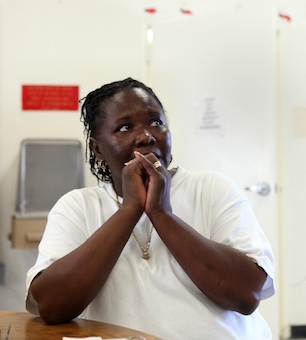
Mary Thompson at the California Institution for Women in Corona, California, in July 2009. (Photo: Monica Almeida / The New York Times)

Do you

Allowing male guards to oversee female prisoners is a recipe for trouble, says former political prisoner Laura Whitehorn. Now a frequent lecturer on incarceration policies and social justice, Whitehorn describes a culture in which women are stripped of their power on the most basic level. “Having male guards sends a message that female prisoners have no right to defend their bodies,” she begins. “Putting women under men in authority makes the power imbalance as stark as it can be, and results in long-lasting repercussions post- release.”

Abuse, of course, can take many forms, from the flagrant – outright rape, groping, invasive pat-downs and peeping during showers or while an inmate is on the toilet – to verbal taunts or harassing comments. And while advocates for the incarcerated have long tried to draw attention to these conditions, they’ve made little to no headway. But that may be changing thanks to the promulgation of rules, finalized in June, to stem the overt sexual abuse of prisoners. The nine-years-in-the-making Prison Rape Elimination Act (PREA) is the first law in US history to address the sexual abuse of those in lock-up, and its passage made clear that the sexual abuse of the incarcerated – men and women – is a pervasive problem in prisons throughout the 50 states. But let’s hold off on PREA for a minute and first zero in on the reality of female incarceration more generally.

According to The Sentencing Project, between 1980 and 2010, the number of incarcerated women ballooned by 646 percent, from 15,118 to 112,797; most were convicted of nonviolent offenses. Add in females who are incarcerated in local jails and the number increases to approximately 205,000. In addition, more than 712,000 women are presently on probation, and another more than 103,000 are on parole.

Prisoners’ rights activists note that, more often than not, these women enter the criminal justice system with long histories of domestic and other abuse. Indeed, a 2007 study by The American Civil Liberties Union found that 92 percent of California’s female prisoners had been abused in some way prior to being taken into custody.

via Women Prisoners Endure Rampant Sexual Violence; Current Laws Not Sufficient.


Support Truthout’s reporting and analysis? Click here to help them continue doing this work in 2013!

Take Police Officers Off the School Discipline Beat – NYTimes.com

OPINION

Schoolhouse to Courthouse

By DONNA LIEBERMAN

Published: December 8, 2012

Take Police Officers Off the School Discipline Beat - NYTimes.com

KENNETH screwed up. The 11th grader made a crude joke about the police officers in his Bronx high school — and an officer overheard.


Sam Kalda

“What did you say?” the officer demanded. “Say it again and I’m going to punch you in the [expletive] mouth.”

“You can’t [expletive] touch me,” said Kenneth, who has Asperger syndrome.

And so it began …

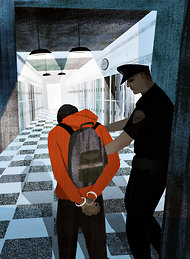
The officer pulled out his nightstick, with one hand, grabbed Kenneth (whose name I’ve changed) by the throat with the other, and pushed him against the wall. Then he pinned the boy’s arms behind his back and pulled him, by the neck of his hoodie, down the fourth-floor hallway.

The officer, who said Kenneth pushed him, arrested Kenneth and drove him to the local precinct, where officers took his photo and his fingerprints, and detained him overnight in a locked cell.

Kenneth says he was not permitted to call his mother — or a lawyer — until much later in the day and it wasn’t until the next morning, when he was taken to court and charged with resisting arrest, that he was read his rights. On the advice of court-appointed counsel, Kenneth pleaded guilty to disorderly conduct and emerged from the incident with an arrest record.

The story is disturbing, but not unusual.

Kenneth’s was one of 882 arrests in New York City public schools during the 2011-12 school year. (The police issued another 1,666 summonses for illegal conduct.) The incidents involved ranged from resisting arrest to possessing marijuana to drawing graffiti. Serious felony arrests were rare.

Public outcry over the arrest of 5-year-old Dennis Rivera in 2008 helped lead to a policy change: the New York City Police Department now primarily uses Velcro handcuffs on elementary school children. But the new, soft cuffs don’t address what my organization, the New York Civil Liberties Union, and others say is a high incidence of excessive police force, unlawful arrest and routine civil rights violations in New York City public schools.

via Take Police Officers Off the School Discipline Beat – NYTimes.com.

“Ending the School-to-Prison Pipeline” Written Testimony l The Lawyers’ Committee for Civil Rights Under Law

lawyerscomm

“Ending the School-to-Prison Pipeline” Written Testimony

DECEMBER 10, 2012  |  LAWYERS’ COMMITTEE FOR CIVIL RIGHTS UNDER LAW  |  LINK TO ARTICLE

Summary. Too many of our most vulnerable youth find themselves caught in the School-to-Prison Pipeline, which has transformed our schools into pathways to incarceration instead of places of learning. Juvenile delinquency can lead to long-term barriers to many life opportunities, such as access to public housing, military service, student financial aid, and professional licenses. Moreover, exclusionary student discipline policies perpetuate the cycle of incarceration within communities of color.

In order to combat the School-to-Prison Pipeline and ensure equal educational opportunities for all children, the Lawyers’ Committee advocates that federal education reform do the following: (1) permit the use of ESEA Title I funds to implement school-wide positive behavior supports; (2) prohibit ESEA funding for exclusionary discipline measures; and (3) improve accountability by mandating inclusion of school discipline data in ESEA state Report Cards.

Read the full written testimony.