The Autobiography Of Miss Jane Pittman author, Ernest J. Gaines, Dies at 86 : NPR

The son of sharecroppers, Gaines was born on a plantation in Pointe Coupee Parish, near Baton Rouge. He attended school for little more than five months out of the year. But that was more education than his family before him had received. He would say later in life that his ear for the stories of his elders was developed as he wrote letters for adults who couldn’t read or write.In the late 1940’s, at the age of 15, his family moved to the northern California city of Vallejo, about 30 miles north of San Francisco.

He told interviewer Lawrence Bridges that in California he could do something that had been forbidden in the South: visit a library. Gaines later attended San Francisco State University.

His early writing earned him a Wallace Stegner fellowship at Stanford University.Gaines returned to Louisiana in 1963, inspired by James Meredith’s bid to enroll in the then-all-white University of Mississippi. He took it as a sign that the South was changing and that he could be a part of that change.”As I’ve said many times before, the two greatest moves I’ve made was on the day I left Louisiana in ’48, and on the day I came back to Louisiana in ’63,” he would later tell an interviewer.

Source: The Autobiography Of Miss Jane Pittman author, Ernest J. Gaines, Dies at 86 : NPR

The Other Toni Morrison | Boston Review

Morrison though was also savvy enough to understand that this would not be enough to motivate Random House to publish her list. Aware that Random House was diversifying authors and readership and that a successful book is also a profitable one (or vice versa), in meetings Morrison pitched book sales over political ideology: “I was not going to . . . disrupt anything. . . . the books were going to make [Random House] a lot of money!”All the while that she was at Random House, Morrison was not only honing her own craft as a novelist, but also as an essayist and critic.

While her fiction unquestionably has transformed the terrain of how we understand black subjectivity—through her unparalleled storytelling about the trials, terrors, and triumphs of black women—her nonfiction (in addition to her editing) also contributed significantly to black freedom struggles.In 1971 Morrison contributed an op-ed to the New York Times called “What the Black Woman Thinks About Women’s Lib” that would presage not only her artistic commitment to the unique status of black women, but also her lifelong engagement with both the promise and shortcomings of feminism:What do black women feel about Women’s Lib? Distrust. It is white, therefore suspect. In spite of the fact that liberating movements in the black world have been catalysts for white feminism, too many movements and organizations have made deliberate overtures to enroll blacks and have ended up by rolling them.

Source: The Other Toni Morrison | Boston Review

Brandt Jean’s hug of Amber Guyger spurs praise, derision, b[Black, white | LEONARD PITTS JR. II Miami Herald

Forgiveness isn’t the problem. One-way forgiveness is. Who forgives black people?

Opinion BY LEONARD PITTS JR. OCTOBER 08, 2019

Brandt Jean hugs Amber Guyger, the former Dallas police officer who shot and killed his brother, at her sentencing hearing. APHere’s the thing about forgiveness.It’s not just something you extend to someone else. It’s also a gift you give yourself, permission to lay down the heavy burden of grudges and rage. And if you’re a Christian, it’s an obligation — albeit a hard one — of faith.One can believe all that, yet still be deeply conflicted by last week’s act of forgiveness in a Dallas courtroom: Brandt Jean, who is black, embraced and absolved Amber Guyger, the white former police officer who had just been sentenced to 10 years for killing his brother, Botham. Guyger had entered Botham’s apartment mistakenly believing it was hers.While some people considered these acts of grace, others, many of them African American, were furious.

Actress Yvette Nicole Brown retweeted a meme that said: “If somebody ever kills me, don’t you dare hug them. … Throw a chair, in my honor.” To which Brown added: “… and then dig me up and throw ME!” Others were angered that Guyger got “only” 10 years.The view from this pew is that none of us has the right to tell Brandt Jean how to grieve his brother or process the hell he’s living through.

As to Guyger’s sentence: It actually seems fair for a crime that was ultimately a tragic mistake, albeit one exacerbated by poor judgment.What makes it seem unfair is that we’ve too often seen black defendants receive far harsher sentences for far lesser crimes. Like Marissa Alexander who, in 2012, fired a warning shot as her reputedly abusive husband advanced on her. She got 20 years for shooting a ceiling.But if these issues are relatively clear cut, the larger one — forgiveness — is anything but. Especially since it sometimes seems that black people — not coincidentally the most religiously faithful group in America, according to a 2014 Pew survey — are forgiving to a fault.A white supremacist massacres nine people in their church. Family members forgive him. A white cop shoots a fleeing black man in the back. The victim’s mother forgives him.

In 1963, white terrorists killed Sarah Collins Rudolph’s sister Addie Mae Collins and three other girls in a bombing at 16th Street Baptist Church in Birmingham. Rudolph forgave them. And so it goes.Forgiveness, you understand, is not the problem. But one-way forgiveness is. Because who forgives black people? Forget forgiveness for wrongdoing. How about forgiveness for simply existing and trying to live unmolested lives? This is what Botham Jean was doing — eating ice cream in his own home — when he was killed by a white woman who blundered upon that prosaic scene and perceived a threat.In dying that way, Jean indicted cherished American myths about equality and unalienable rights. America — much of white America, at least — hates when you do that. One is reminded of what Hilde Walter, a Jewish journalist, was quoted as saying in 1968: “It seems the Germans will never forgive us Auschwitz.” Similarly, it sometimes seems much of white America will never forgive us slavery. Or Jim Crow.

Source: Brandt Jean’s hug of Amber Guyger spurs praise, derision, black, white | Miami Herald   

LEONARD PITTS JR. II Miami Herald  II @LeonardPittsJr1

Author, The Last Thing You Surrender

The Ghosts of Elaine, Arkansas, 1919 | by Jerome Karabel | NYR Daily | The New York Review of Books

The Ghosts of Elaine, Arkansas, 1919

Jerome KarabelArkansas State Archives

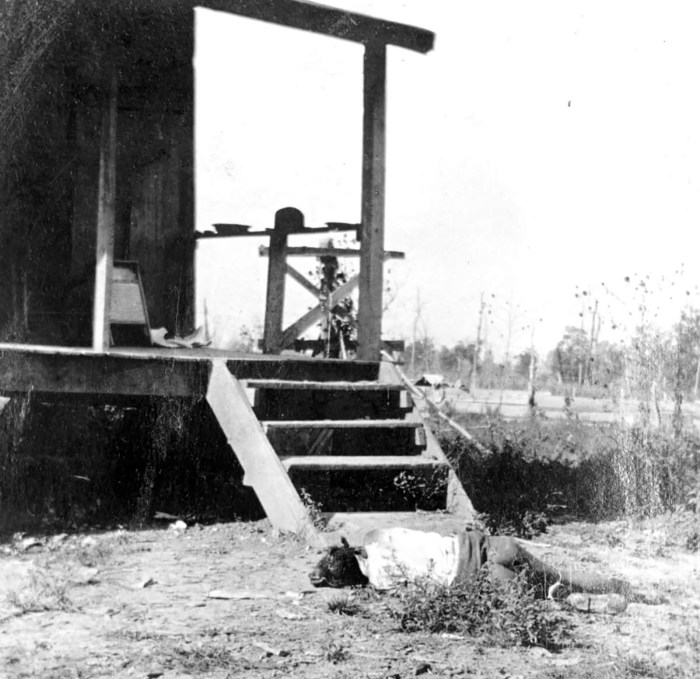
The body of Frances Hall, one of the few victims of the massacre who can be identified by name, thanks to the journalists Robert Whitaker and Ida B. Wells, near Elaine, Arkansas, October 1919

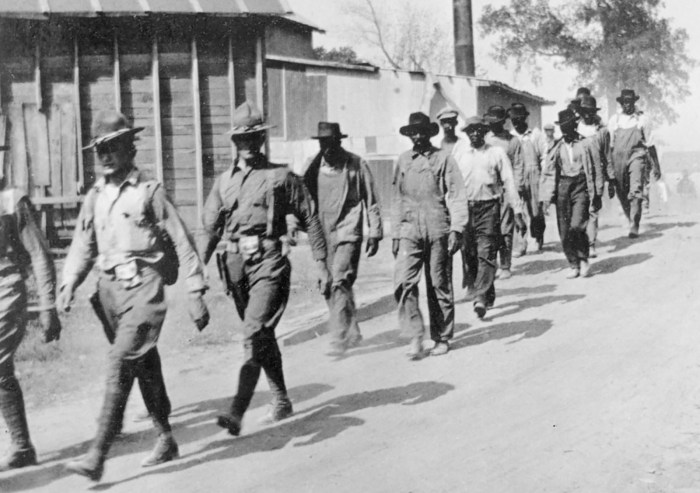
In America’s bloody history of racial violence, the little-known Elaine Massacre in Phillips County, Arkansas, which took place in October 1919, a century ago this week, may rank as the deadliest. The reasons why the event has remained shrouded and obscure, despite a shocking toll of bloodshed inflicted on the African-American inhabitants of Phillips County, speak to a legacy of white supremacy in the US and ruthless suppression of labor activism that disfigures American society to this day.Phillips County, located deep in the Arkansas Delta, was largely rural and three-quarters African-American; in the small town of Elaine, there were ten times as many black residents as white. The African Americans of Phillips County, like those throughout the South, were subjected to segregation and disenfranchisement, those twin pillars of white supremacy. But the black sharecroppers and tenant farmers there were also the victims of a particularly harsh form of repression known as “debt peonage.”

Under this system, they were loaned money or rented land by plantation owners; they were then forced to sell their crops to the owners at below-market rates and to purchase their food and other supplies from over-priced plantation stores, trapping them in a cycle of perpetual debt, with the owners keeping—and often doctoring—the accounts.In the spring of 1919, a group of Phillips County African-American sharecroppers and tenant farmers, many of them veterans who had recently returned from service overseas in World War I, decided to challenge this system by joining a union called the Progressive Farmers and Household Union of America (PFHUA), which had been founded the year before by army veteran Robert Lee Hill, a black tenant farmer in Winchester, Arkansas. The union’s goal was “to advance the interest of the Negro, morally and intellectually,” and its constitution ended with a proclamation: “WE BATTLE FOR THE RIGHTS OF OUR RACE; IN UNION IS STRENGTH.”

Source: The Ghosts of Elaine, Arkansas, 1919 | by Jerome Karabel | NYR Daily | The New York Review of Books

OUR COMMON GROUND Communications & Media

Toni Morrison and What Our Mothers Couldn’t Say | The New Yorker

“My mourning mind, compromised and searching for coincidence, processes the age Toni Morrison was when she died, eighty-eight, as two infinity signs, straightened and snatched right-side up. If we are Morrison-fearing, as some others are with their icons, well, we were socialized by her novels. What an experience, to be mothered on one plane by our Beloved. It’s a plane that occupies the thorny reserve of memory. If you asked your mothers questions about your origins, they responded with irritability. Actually, you knew better than to ask. One thing about being a black girl is, by the time you come around, and your body awakens to feeling historically out of sorts, the matriarchs have been worn out. Their patience to “do language” has dried up. You have been born late to the mystery. Catch up, but how? Morrison motioned to us and got us up to date.

You are always too young to read Morrison. I was eleven. A teacher had grown concerned. From what I can recall of the report, my eyes glazed over in class and I was sinking into my desk, falling inexplicably ill. “Maybe this will make you feel better?” my mother asked. The copy of “The Bluest Eye” that she gave me was distended, graffitied with epiphanies. It had been assigned to her in an E.S.L. class at Kingsborough Community College, burdening her for all time with a misleading impression of the potential of English. Out of a “discredited vocabulary,” as Morrison once termed it, the author coaxed out a superior written tongue—one that, I more than suspect, each black woman writer who has come after her mimics, to varying degrees. My own mimicry was, at first, automatic. That summer, I stayed indoors, truly possessed. I transcribed the whole of “The Bluest Eye,” in notebooks and on loose-leaf paper, at least a dozen times. I memorized whole chapters. My finger pads melted. I ingrained the beat of the novel into the movement of my right wrist.

For years, it went on like this: I would become withdrawn, and my mother would hand me “Sula,” then “Jazz,” then “Beloved.” My early readings of the novels were hungry misuses. Her novels were the boundary between herself and her readers, an instrument of intellectual self-protection, but we violated the boundary, almost deliriously. By the time I was reading Morrison, the novel had allegedly lost its status as an influential factor in the making of society. We didn’t know that. Morrison was our celebrity; it was only right that she appear on “Oprah.” We were poor in imagination, trained to think of our histories as sociological math. Morrison invalidated the lie, which taints black minds especially, that our people are either one way or the other. To her, we were naturally literary and epic. I got inebriated on the image of Pecola Breedlove, who “was a long time with the milk,” soused by a community’s predilection for a certain kind of beauty. The ghost in “Beloved,” swelling as she threatened to overcome the spiteful home at 124 Bluestone Road, made us think gothically. I wanted to build a retreat in the woods, like Denver. I thought that I was destined, one day, to become a Sula Peace, leaving home, and returning under the shelter of a great hat, carting havoc just under my breast.

In a foreword to “Sula,” Morrison wrote, “Outlaw women are fascinating—not always for their behavior, but because historically women are seen as naturally disruptive and their status is an illegal one from birth if it is not under the rule of men.” It is too seldom acknowledged that the greatest novelist this country has ever produced was a single black mother. She had two sons, one who passed before she did, and how many daughters? We know that it is problematic, or maybe just self-indulgent, to claim her as mother. And yet, if the business of mothering is to broker the link between two generations, then what else can she be? During her childhood conversion to Catholicism, she chose the confirmation name that eventually led to “Toni”: Saint Anthony, the patron of the lost. An old-fashioned loss lives between my mother and me, and we tend to it. Ghosts have visited her, and human dramas have haunted her, and erotic moments have freed her, and for reasons both altruistic and proud she will not express these stories to me. I have my own things she will not know. We are secretive. We talk to each other through intermediaries, and their names are Baby Suggs, Guitar, and Milkman. We talk to each other through Morrison.

  • Doreen St. Félix is a staff writer at The New Yorker.

    Read more »


Source: Toni Morrison and What Our Mothers Couldn’t Say | The New Yorker

Is Hip Hop Destroying Black America?

TIME AND TIME AGAIN, THE REAL DECISION MAKERS GET AWAY WITH MURDER WHILE RAP ARTISTS ARE PROJECTED AS THE EMBODIMENT OF EVERYTHING THAT IS WRONG WITH HIP HOP AND YOUNG BLACK MALES.

“If this doesn’t sound like the kind of Hip Hop you’re familiar with, blame the music industry and mainstream media for bombarding you with a steady diet of rappers talking about drugs, sex and violence for over two decades. Blame MTV, BET, and other networks for trying to redefine what Hip Hop is in order to sell it and shove it down the throats of unsuspecting consumers. It’s easy to blame simple minded rappers for promoting negative messages and images while multi billion dollar companies and shrewd businessmen who market these artists are free from criticism. It’s easy to blame someone like Chief Keef who becomes the obvious poster boy for mindless rap while Jimmy Iovine, the head of Interscope Records, keeps a low profile and avoids having to address his part in promoting “death through entertainment”.

It’s easy to protest flavor of the month Trinidad James who raps about Molly, the industry’s latest fashionable drug, while Def Jam’ president Joie Manda proclaims his new discovery as “the cutting edge of what’s happening in the culture today.” It’s easy to blame talentless top 40 rappers for dominating the airwaves of so called hip hop radio stations like L.A.’s Power 106 or New York’s Hot 97 while Rick Cummings, president of programming for Emmis Communications, which owns both stations, isn’t held accountable for his part in broadcasting filth to millions of listeners.Time and time again, the real decision makers get away with murder while rap artists are projected as the embodiment of everything that is wrong with Hip Hop and young Black males.”

Source: Is Hip Hop Destroying Black America?


Sexualizing Young Black Girls, Growing Up Too Fast


“For Black girls like me the transition out of childhood into a complex and ill-defined “womanhood” happens swiftly and without warning. According to a Georgetown Law study released earlier this year, Black girls are stripped of their innocence as early as the age of 5. The study, called “Girlhood Interrupted,” found that survey participants perceived that Black girls need less nurturing, protection, support, and comfort, and that Black girls are more independent and know more about adult topics, including sex. This phenomenon was dubbed “adultification” by the study authors, and they wrote that it refers to “the extent to which race and gender, taken together, influence our perception of Black girls as less innocent and more adult-like than their white peers.”And sadly, America’s fraught history with race plays a role in this: The “adultification” of Black children has its roots in slavery, when Black girls and boys were treated like chattel and subjected to cruel treatment, just like their adult counterparts. And in the case of Black girls, it’s further exacerbated by the often early onset of puberty. As the study reported, “on average, African American girls mature physically at a faster rate than [w]hite girls and as a result can be perceived as older.”

Source: Sexualizing Young Black Girls, Growing Up Too Fast

“ON BEING WHITE AND OTHER LIES” James Baldwin, Essence Magazine 1984

ON BEING “WHITE” • AND OTHER LIES James Baldwin (1924-1987)

baldwinJames Baldwin was the greatest expert on white consciousness in the twentieth century United States. Born in what he described as the “southern community” of Harlem, Baldwin published six novels, including his brilliant treatment of fathers, sons, and religion in Go Tell It on the Mountain (1953), and Giovanni’s Room (1956), a work concentrating on white, gay characters. Baldwin’s early essays, collected in Notes of a Native Son (1955), Nobody Knows My Name (1961), and The Fire Next Time (1963), are works of remarkable range, lucidity, and compassion. But his scandalously underappreciated essays, generously sampled in The Price of the Ticket (1985), push Baldwin’s arguments regarding race and the meaning of America, racism, homophobia, and the “male prison,” and whiteness and the immigrant experience to unprecedented levels of insight. “On Being ‘White’ and Other Lies,” published originally in the popular African-American magazine Essence in 1984, is a dramatic reminder that “becoming American” meant learning to be white in a new way for European immigrants.

“ON BEING WHITE  AND OTHER LIES”  James Baldwin, Essence Magazine 1984

The crisis of leadership in the white community is remarkable—and terrifying—because there is, in fact, no white community. This may seem an enormous statement—and it is. I’m willing to be challenged. I’m also willing to attempt to spell it out. My frame of reference is, of course, America, or that portion of the North American continent that calls itself America. And this means I am speaking, essentially, of the European vision of the world—or more precisely; perhaps, the European vision of the universe. It is a vision as remarkable for what it pretends to include as for what it remorselessly diminishes, demolishes or leaves totally out of account.

There is, for example—at least, in principle—an Irish community: here, there, anywhere, or, more precisely, Belfast, Dublin and Boston. There is a German community: both sides of Berlin, Bavaria and Yorkville. There is an Italian community: Rome, Naples, the Bank of the Holy Ghost and Mulberry Street. And there is a Jewish community, stretching from Jerusalem to California to New York. There are English communities. There are French communities. There are Swiss consortiums. There are Poles: in Warsaw (where they would like us to be friends) and in Chicago (where because they are white we are enemies). There are, for that matter, Indian restaurants and Turkish baths. There is the underworld—the poor (to say nothing of those who intend to become rich) are always with us—but this does not describe a community It bears terrifying witness to what happened to everyone who got here, and paid the price of the ticket. The price was to become “white.”

No one was white before he/she came to America. It took generations, and a vast amount of coercion, before this became a white country. It is probable that it is the Jewish community or more accurately, perhaps, its remnants—that in America has paid the highest and most extraordinary price for becoming white. For the Jews came here from countries where they were not white, and they came here, in part, because they were not white; and incontestably in the eyes of the Black American (and not only in those eyes) American Jews have opted to become white, and this is how they operate. It was ironical to hear, for example, former Israeli prime minister Menachem Begin declare some time ago that “the Jewish people bow only to God” while knowing that the state of Israel is sustained by a blank check from Washington.

Without further pursuing the implication of this mutual act of faith, one is nevertheless aware that the Black presence, here, can scarcely hope—at least, not yet—to halt the slaughter in South Africa. And there is a reason for that. America became white—the people who, as they claim, “settled” the country became white—because of the necessity of denying the Black presence, and justifying the Black subjugation.

No community can be based on such a principle—or, in other words, no community can be established on so genocidal a lie. White men—from Norway, for example, where they were Norwegians—became white: by slaughtering the cattle, poisoning the wells, torching the houses, massacring Native Americans, raping Black women. This moral erosion has made it quite impossible for those who think of themselves as white in this country to have any moral authority at all—privately, or publicly. The multitudinous bulk of them sit, stunned, before their TV sets, swallowing garbage that they know to be garbage, and—in a profound and unconscious effort to justify this torpor that disguises a profound and bitter panic pay a vast amount of attention to athletics: even though they know that the football player (the Son of the Republic, their sons!) is merely another aspect of the money-making scheme. They are either relieved or embittered by the presence of the Black boy on the team. I do not know if they remember how long and hard they fought to keep him off it.

I know that they do not dare have any notion of the price Black people (mothers and fathers) paid and pay. They do not want to know the meaning, or face the shame, of what they compelled—out of what they took as the necessity of being white—Joe Louis or Jackie Robinson or Cassius Clay (aka Muhammad Ali) to pay I know that they, themselves, would not have liked to pay it. There has never been a labor movement in this country, the proof being the absence of a Black presence in the so-called father-to-son unions. There are, perhaps, some niggers in the window; but Blacks have no power in the labor unions. Just so does the white community, as a means of keeping itself white, elect, as they imagine, their political (!) representatives. No nation in the world, including England, is represented by so stunning a pantheon of the relentlessly mediocre.

I will not name names I will leave that to you. But this cowardice, this necessity of justifying a totally false identity and of justifying what must be called a genocidal history, has placed everyone now living into the hands of the most ignorant and powerful people the world has ever seen: And how did they get that way? By deciding that they were white. By opting for safety instead of life. By persuading themselves that a Black child’s life meant nothing compared with a white child’s life. By abandoning their children to 180 BLACK ON WHITE the things white men could buy By informing their children that Black women, Black men and Black children had no human integrity that those who call themselves white were bound to respect. And in this debasement and definition of Black people, they debased and defamed themselves. And have brought humanity to the edge of oblivion: because they think they are white. Because they think they are white, they do not dare confront the ravage and the lie of their history. Because they think they are white, they cannot allow themselves to be tormented by the suspicion that all men are brothers.

Because they think they are white, they are looking for, or bombing into existence, stable populations, cheerful natives and cheap labor. Because they think they are white, they believe, as even no child believes, in the dream of safety Because they think they are white, however vociferous they may be and however multitudinous, they are as speechless as Lot’s wife— looking backward, changed into a pillar of salt. However-1 White being, absolutely, a moral choice (for there are no white people), the crisis of leadership for those of us whose identity has been forged, or branded, as Black is nothing new. We—who were not Black before we got here either, who were defined as Black by the slave trade—have paid for the crisis of leadership in the white community for a very long time, and have resoundingly, even when we face the worst about ourselves, survived, and triumphed over it. If we had not survived and triumphed, there would not be a Black American alive. And the fact that we are still here—even in suffering, darkness, danger, endlessly defined by those who do not dare define, or even confront, themselves is the key to the crisis in white leadership.

The past informs us of various kinds of people—criminals, adventurers and saints, to say nothing, of course, of popes—but it is the Black condition, and only that, which informs us concerning white people. It is a terrible paradox, but those who believed that they could control and define Black people divested themselves of the power to control and define themselves.

497f84c1-4ea4-47ab-9098-654817c93231.jpg

OUR COMMON GROUND with Janice Graham

BROADCASTING BOLD BRAVE & BLACK

Each Saturday  LIVE& Call-In

 10 pm ET

Join us on FACEBOOK and Learn More about us.
OCG on Facebook
Enjoy our archive of all OCG past broadcasts.

OCG on the Web: https://ourcommongroundtalk.wordpress.com/
Community Forum: http://www.ourcommonground-talk.ning.com/
Follow us on Twitter: @JaniceOCG #TalkthatMatters

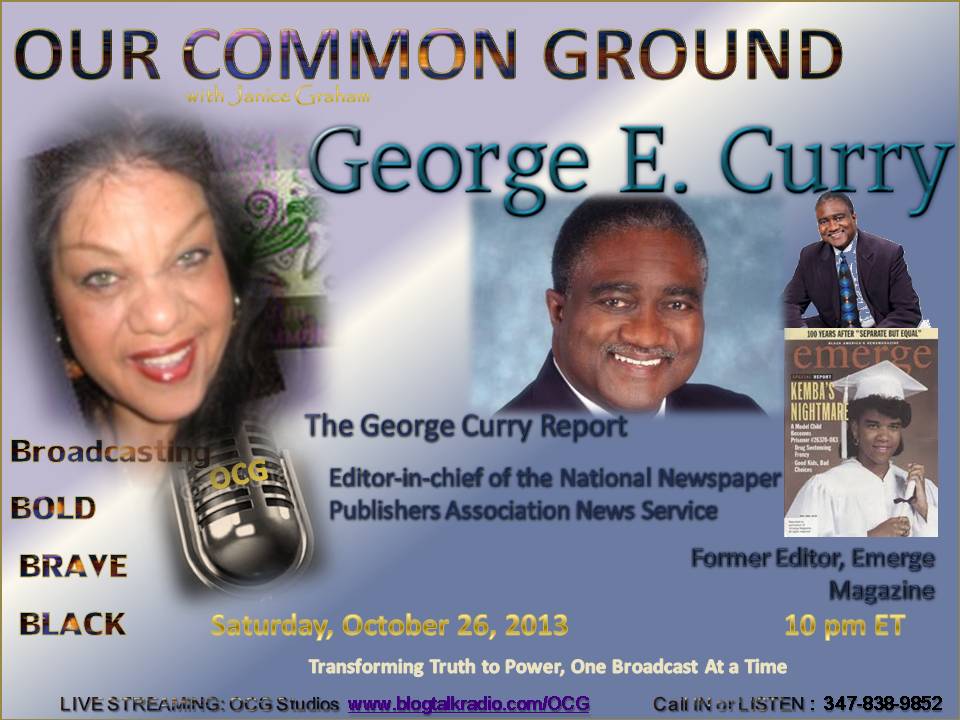
OUR COMMON GROUND “In Conversation with George Curry”

OUR COMMON GROUND with Janice Graham

“Transforming Truth to Power, One Broadcast At a Time”

“In Conversation with George Curry”

October 26, 2013 
10 pm ET                                     LIVE and Call -IN

10-26-13 Curry

About our Guest George Curry

George E. Curry is the editor-in-chief of the National Newspaper Publishers Association News Service. The former editor-in-chief of Emerge magazine, Curry also writes a weekly syndicated column for NNPA, a federation of more than 200 African American newspapers.

Curry, who served as editor-in-chief of the NNPA News Service from 2001 until 2007, returned to lead the news service for a second time on April 2, 2012. His work at the NNPA has ranged from being inside the Supreme Court to hear oral arguments in the University of Michigan affirmative action cases to traveling to Doha, Qatar, to report on America’s war with Iraq.
As editor-in-chief of Emerge, Curry led the magazine to win more than 40 national journalism awards. He is most proud of his four-year campaign to win the release of Kemba Smith, a 22-year-old woman who was given a mandatory sentence of 24 1/2 years in prison for her minor role in a drug ring. In May 1996, Emerge published a cover story titled “Kemba’s Nightmare.” President Clinton pardoned Smith in December 2000, marking the end of her nightmare.

Curry is the author of Jake Gaither: America’s Most Famous Black Coach and editor of The Affirmative Action Debate and The Best of Emerge Magazine. He was editor of the National Urban League’s 2006 State of Black America report.

His work in journalism has taken him to Egypt, England, France, Italy, China, Germany, Malaysia, Thailand, Cuba, Brazil, Ghana, Senegal, Nigeria, the Ivory Coast, Mexico, Canada, and Austria. In August 2012, he was part of the official US delegation and a presenter at the US-Brazil seminar on educational equity in Brasilia, Brazil.
George Curry is a member of the National Speakers Association and the International Federation for Professional Speakers. His speeches have been televised on C-SPAN and reprinted in Vital Speeches of the Day magazine. In his presentations, he addresses such topics as diversity, current events, education, and the media.

Ikard comingBROADCASTING 
BOLD BRAVE BLACK

OUR COMMON GROUND with Janice Graham

“Speaking Truth to Power and Ourselves” 

email: OCGinfo@ourcommonground.com

LISTEN LIVE and Join the OPEN Chat: http://www.blogtalkradio.com/OCG
Community Forum:http://www.ourcommonground-talk.ning.com/
Twitter: @JaniceOCG #TalkthatMatters
Web: http://www.ourcommonground.com/
OCG Blog: http://www.ourcommongroundtalk.wordpress.com/
Pinterest : http://www.pinterest.com/ocgmedia/boards/
Visit our Tumblr Page: http://ourcommonground.tumblr.com/
Facebook: https://www.facebook.com/OCGTALKRADIO

Is ‘Boardwalk Empire’ Trampling the Legacy of Marcus Garvey?

After seeing the name of  the “Universal Negro Improvement Association” pop up on “Boardwalk Empire,” Speakeasy emailed HBO to ask for a comment about why their writers associated a real-life black leader’s group with murder, drugs and other kinds of wrongdoing.

September 29, 2013, 10:00 AM

Is ‘Boardwalk Empire’ Trampling the Legacy of Marcus Garvey?

By Ishmael Reed

“Boardwalk Empire” made a reference to the black leader Marcus Garvey on a recent episode. But it wasn’t a tribute that Garveyites would have appreciated.

“Black Moses, The Story of Marcus Garvey and theUniversal Negro Improvement Association” by E. David Cronon received an endorsement from the celebrated black historian, John Hope Franklin, who wrote the introduction. The book recounts the career of Garvey, a Jamaican immigrant, who launched one of the largest mass movements of blacks before the Civil Rights movement. The book tracks the Jamaican from his beginnings as a journalist to his conviction for mail fraud. Though the case against him was fragile, Garvey doomed his case by acting as his own lawyer.

In the beginning of its new season, “Boardwalk Empire,” introduced a character named Valentin Narcisse (played by actor Jeffrey Wright), a dapper smooth talking character who speaks  with an Caribbean accent. This character uses a white woman to blackmail Chalky White  whose henchman killed the woman’s husband after he pretends to be outraged at finding the black henchman with his wife. Turns out that this was a set up and that this was how the husband and wife got their freak on. In order for Narcisse to keep quiet, Nucky Thompson decides that White has to give Narcisse ten percent of his club’s profits. Returning to New York from New Jersey, Narcisse has the woman killed. Back in Harlem, he is seen negotiating with white gangsters for part of Harlem’s heroin trade. The walls of his office are decorated with the photos of distinguished black men, but this character despite his eloquence and his fancy dress is a hoodlum. We see a banner hanging behind Narcisse that reads “Universal Negro Improvement Association”–which was the real-life name of the real-life black nationalist and self-help organization founded by Garvey. The inclusion of the Universal Negro Improvement Association in a show about crime and violence shocked even me, a person who has written, obsessively, about the depiction of blacks by the media, part of a hundred year old complaint.

After seeing the name of  the “Universal Negro Improvement Association” pop up on “Boardwalk Empire,” Speakeasy emailed HBO to ask for a comment about why their writers associated a real-life black leader’s group with murder, drugs and other kinds of wrongdoing.

Here’s something that Garvey, who campaigned for black empowerment, surely would have noted: the writing staff on “Boardwalk Empire” isn’t a very diverse bunch. Garvey himself might have raised an eyebrow at the fact that virtually none of the people involved with the writing of the series, which plans to explore Garvey’s legacy in future shows, have any black roots (according to HBO, David Matthews, the executive story editor on the show, is biracial).

An HBO spokeswoman said via email “there are no writers of Caribbean heritage on the show but they do an extensive amount of research. Yes, you were correct in noticing the name of the organization and Marcus Garvey’s name comes up in future episodes – this is not a coincidence. ”

One of the most controversial figures in American history, Garvey was criticized by both the NAACP and the Communist Party, who, on other occasions, said nasty things about each other. His model for his self help enterprises was, Booker T.Washington, who, for those in power, was the president of the Black Nation; his being invited by Theodore Roosevelt to dine at the White House caused a scandal.

Garvey’s newspaper, The Negro World, established in January,1918, was called by poet Claude McKay, “ The best edited colored weekly in New York. Emphasizingblack pride, the newspaper published stories about slave rebellions,American and Haitian, and the histories of African Empires,all meant to make blacks feel proud of their racial heritage.

The Negro World,which was published weekly until 1933  was also used by Garvey to criticize his enemies sometimes in such a vitrolic manner that he invited lawsuits.Taking his lead from Washington, who established Tuskeegee College, that blacks operated their own businesses, he rejected capital from whites and used his “magnetic” personality to raise money from the grass roots. At the height of his influence, Garvey was able to draw 25,000 blacks to hear their leader make a speech in Madison Square Garden as part of a convention, which was accompanied by parades and much pageantry.

Already under surveillance by the Government, the flamboyant Garvey got into difficulty when he began a steam ship company”that would link the colored peoples of the world in commercial and industrial intercourse.” His enemies used the business dealings associated with the purchase of steam ships for which he sold stock, to get him done in with the charge of mail fraud.He was sent to an Atlanta prison and served a term there until he was awarded clemency by president Calvin Coolidge. He was deported to Jamaica, Garvey’s ideas influenced not only American blacks likeMinister Elijah Muhammad, and Malcolm X, but foreign leaders like Kwame Nkrumah, the first president of Ghana.

An HBO spokeswoman told us “Nowhere in the story line are we implying Marcus Garvey was involved in gambling or drugs. Valentin Narcisse is a fictional character who is based on someone who was.”

HBO pointed us to an interview in GQ in which Wright said “Dr. Narcisse is kind of a funhouse mirror distortion of an historical figure named Casper Holstein who was, during the early 1920s in Harlem, the king of the numbers game.” He goes on to say “at that time, there was something of a great debate within African-American society, among the great thinkers of the past: W.E.B. Du Bois, Booker T. Washington, Marcus Garvey, and within the Harlem Renaissance about what was the way forward. Within that debate were some pretty vicious personal attacks over complexion, politics, between urbane and rural—a lot of those dynamics are fleshed out within the relationship between Dr. Narcisse and Chalky.”

“Boardwalk Empire” creator Terry Winter said this via email: “Our fictional Valentin Narcisse is associated with Marcus Garvey’s organization, but this is not to imply in any way that Garvey himself was involved in the same types of illegal activities. Without giving away any future story developments, I can say that the Narcisse character was inspired in part by Casper Holstein, a West Indian immigrant who was head of the Harlem numbers racket as well as a philanthropist and political activist. After Garvey was sentenced to prison and the UNIA collapsed, Holstein purchased the building in which the organization was headquartered. As the season progresses, we also focus on J. Edgar Hoover‘s fixation with putting Garvey in jail.”

But except for his buying the mortgage for a building once used by Garvey’s organization, Holstein was not a part of the UNIA. Moreover, there is no evidence that Holstein was involved in the murder of a white woman. Also, connecting him with the heroin trade is bizarre because he died in 1944. Heroin was introduced into Harlem in the 1950s; before that it was used by white males, mostly.

Holstein’s connection with Garvey’s old building came about when Garvey’s movement already had collapsed. Holstein donated a large portion of his fortune towards charitable purposes such as building dormitories at historically black colleges, as well as financing many artists, writers, and poets during the Harlem Renaissance. He also helped  establish a Baptist school in Liberia, and create hurricane relief fund for his native Virgin Islands. He had nothing to do with heroin.

Garvey is an official National Hero of Jamaica. It is a disgrace that HBO connects his UNIA in any form with murder and heroin dealing. In my view, it’s an example of what happens when the writing staffs of Hollywood and television are decades behind in terms of diversity. There are plenty of black historians who could serve as consultants in case they continue to exploit the Garvey story.

George Bernard Shaw had it right. If you don’t tell your stories others will tell them for you and they will “degrade” and “vulgarize” you.

Ishmael Reed’s new play, “ The Final Version” will premiere at the Nuyorican Poet’s Cafe on Dec.12. His online magazine Konch is at  konchmagazine.localon.com