The Façade of the American Dream l Press TV Documentary l Parts 1-4

Documentary

The Façade of the American Dream

Published on Jan 15, 2013

 A cross section of people discuss the fraud of the American dream and how systemic racism keeps millions of people down while offering others hope and opportunity. Executive producer Dr. Randy Short, M.div. and senior director Marzieh Hashemi’s film gives voice to those who believe That African Americans are far from achieving the American Dream in health, education, welfare, and justice.

The documentary features commentary from a number of OUR COMMON GROUND Voices, Dr. Vernellia Randall, Dr. Wilmer Leon, Rev. Graylan Haigler, Dr. Mary Scott, Dr. Charles Norman, Dr. Joseph Richardson, Glen Ford, Atty. Efia Nwangaza, and  Dr. Mary Neal.

WE STILL AIN’T FREE :THE FAÇADE OF THE AMERICAN DREAM

Part 1: This is Why We Have the Blues

Part 2: From School House to Jail House

Part 3: Lack of Wealth, Lack of Health

Part 4: You Aren’t Free

If you like this series, try sharing  your feedback, and encourage PRESSTV to produce documentaries that tell the truth about the African Diaspora and its legacy.

It depicts how the US removed Africans from their country of origin, worked them to death as slaves and today, in schools, is brainwashing them to make believe they are inferior in many aspects.

 The Façade of the American Dream Part 1

This is Why We Have the Blues

 The Façade of the American Dream Part 2

From School House to Jail House

The Façade of the American Dream Part 3

Lack of Wealth, Lack of Health

 The Façade of the American Dream Part 4

You Aren’t Free

ABOUT PRESS TV
PRESS TV produces more than 350 episodes of documentaries annually. PRESS TV documentaries, produced in many countries in the four corners of the world, try to reveal the truth with a different outlook to people around the world. Through these documentaries, PRESS TV presents a different point of view on current world affairs compared with the mainstream media.

The Documentary Department of PRESS TV is interested in selling the broadcasting rights of its documentaries to other television networks, websites, companies, distributors, independent buyers etc.

Check out the “Online Catalogue” to select your favorite film by clicking here!

You can watch Press TV by visiting the following websites:

Press TV watch live services (Worldwide)

OHTV Box (internet Set-top box) (Worldwide)

Livestation (internet platform. Supports PC MAC, Linux and all tablet PCs and smartphones)

Windows Mobile app

Press TV Mobile Page

CHILD SEXUAL ABUSE & TRAUMA IN THE AFRICAN-AMERICAN COMMUNITY l BALT March 22-23, 2013


ROYAL CIRCLE FOUNDATION

PRESENTS IN ASSOCIATION WITH

BLACK PSYCHIATRISTS OF AMERICA, THE OFFICE OF MINORITY AND NATIONAL AFFAIRS

(AMERICAN PSYCHIATRIC ASSSOCIATION)

&

THE BALTIMORE BLACK MENTAL HEALTH ALLIANCE

 A National Conference

CHILD SEXUAL ABUSE & TRAUMA

IN THE AFRICAN-AMERICAN COMMUNITY

(The Shame, The Blame & The Solutions)

MARCH 22-23, 2013

Hilton Baltimore

401 West Pratt Street – Baltimore, MD 21201

(Limited Number of Hotel Rooms Still Available Thru 02/20/13)

For Discounted Hotel Rooms  

 Call:  1-800-HILTONS

GROUP: Royal Circle Foundation Child Abuse Conference

**********

Conference “Early Bird” Registration Now Open!

CALL FOR PAPERS ANNOUNCEMENT, ADVERTISING & EXHIBITORS APPLICATIONS AVAILABLE

(Clink Links Below For Details)

******** 

March 22, 2013 

FRIDAY EVENING RECEPTION & SPECIAL MOVIE SCREENING

“WOLF”

wolf.jpg

A Family Struggles with Child Sex Abuse in the Black Church

FOLLOWING THE MOVIE SCREENING WILL BE A DISCUSSION WITH DIRECTOR & FILMMAKER

Prof. Ya’Ke Smith

yake.jpg
PROFESSOR YA’KE SMITH

PRESS RELEASE

CHILD SEXUAL ABUSE & TRAUMA CONFERENCE ANNOUNCEMENT

REGISTER FOR THIS CONFERENCE HERE

SPONSORSHIP OPPORTUNITIES

PROGRAM ADVERTISEMENT BOOKING FORM

CONFERENCE EXHIBITORS/VENDORS AGREEMENT

***** 

SAVE THE DATE

August 20 – 22, 2013

The Royal Circle Foundation

Presents

AN INTERNATIONAL CONFERENCE

THE HEALTH & MENTAL HEALTH EFFECTS OF HUMAN TRAFFICKING


6_1782_Carpet-weaver14.jpg
Phoro Courtseyof: US Department of State

Busted: 91 Doctors, Nurses, Medical Professionals Charged In $430M Medicare Fraud

Busted: 91 Doctors, Nurses, Medical Professionals Charged In $430M Medicare Fraud

Added by Maria Lloyd on October 5, 2012.Tags:


Ninety-one Doctors, Nurses, and Medical Professionals Are Charged By The Justice Department For A $430 Million-Dollar Medicare Scam- The Largest Ever

Dr. Robert Kolbusz of Chicago (left) and Dr. Joseph Megwa of Dallas (right), were among those facing serious charges for medicare fraud

The U.S. Justice Department and the Department of Health and Human Services discovered alleged false billing schemes involving $230 million in home health services, over $100 million in mental services, and $49 million from ambulance transportation. Ninety-one people, including: doctors, nurses, and other medical professionals, have been charged with committing over $430 million in Medicare fraud in seven U.S. cities. The scheme is the largest of its kind, according to Attorney General Eric Holder. The announcement marks the latest case in a concerted crackdown against Medicare fraud by an inter-agency Medicare fraud strike force.

The charges the suspects face range from healthcare fraud and conspiracy to wire fraud, kickback violations, identity theft and money laundering. In a news conference, Holder said that the case reveals an alarming trend of criminal attempts to steal billions of taxpayer dollars for personal profit.  ”Today’s enforcement actions reveal an alarming and unacceptable trend of individuals attempting to exploit federal health care programs to steal billions in taxpayer dollars for personal gain,” Holder said. Assistant Attorney Lanny A. Breuer agreed, adding: “Today’s coordinated actions represent one of the largest Medicare fraud takedowns in Department of Justice history.” Breuer continued : “We have made it one of the Department’s missions to hold accountable those who abuse the Medicare program for personal profit.”

Medicare Fraud Strike Force operations targeted health care workers in seven cities – Brooklyn, Baton Rouge, Chicago, Dallas, Houston, Los Angeles, and Miami. According to Holder, Dr. Joseph Megwa, was writing 33,000 prescriptions for some 2,000 patients between 2006 and 2011. Dr. Megwa, who practices in Dallas, allegedly signed off these documents without reviewing them, causing $103.3million in false billings. According to the Dallas Morning News, the 58-year-old’s alleged defrauding was the costliest. The doctor, who works at Raphem Medical Practice in Arlington, was indicted on conspiracy and health-fraud. The Justice Department alleges that Megwa helped patients in their homes as he travelled abroad. Two nurses, Ferguson Ikhile, and Ebolose Eghobor, were indicted along with the doctor. The three remain in federal custody.

Similarly, dermatologist Dr. Robert Kolbusz of Chicago, was charged with falsely diagnosing his patients and billing Medicare for treatments that were not given, according to the Chicago Tribune reported. Seven individuals in Houston were charged for giving kickbacks of cigarettes, coupons, and food to Medicare recipients who would in turn just watch TV or play games instead of receiving the services that were billed to Medicare. The fraud allegedly led to $158 million in fraudulent billing.

In Miami, 33 suspects were arrested and charged with fraud of more than $200 million, according to NBC Miami.  Breuer said that owners and operators at one Miami psychiatric hospital gave cash kickbacks to owners of assisted living facilities in order to obtain more patients. They then billed the social insurance plan more than $67million, often for services that were never offered, or patients they never actually had. Breuer added that these 33 medical professionals then billed Medicare for the cash they used as kickbacks for their false patients. Little else is known about those charged in the city.

Holder condemned the fraud as one that “siphons precious taxpayer resources, drives up heath care costs, and jeopardizes the strength of the Medicare program.” He added: “They also victimize the most vulnerable members of society, including elderly, disabled, and impoverished Americans.” The strike force was created under the healthcare reform law as a means of curbing waste, fraud and abuse within the $590 billion Medicare program that provides healthcare benefits to approximately 50 million elderly and disabled beneficiaries.

In February of 2011, 111 medical practitioners were charged in a $225million Medicare fraud, which was the largest of its kind at that time.

Georgia’s Hunger Games

HOME /  POLITICS :  WHO’S WINNING, WHO’S LOSING, AND WHY.

Georgia’s Hunger Games

Fewer than 4,000 adults in the southern state receive welfare, even as poverty is soaring. How Georgia declared war on its poorest citizens—leaving them to fight for themselves.

By |Posted Wednesday, Dec. 26, 2012, at 4:00 AM ET

A soup kitchen line

A soup kitchen line
Photo by Justin Sullivan/Getty Images

When the economy crashed in 2008, millions of Americans lost their jobs. Applications for food stamps soared. So did attendance at emergency food providers—soup kitchens and food pantries—that help the estimated 50 million people, working and non-working, who can’t afford enough groceries to get through the month.

Unlike in past economic downturns, though, the welfare rolls barely budged. Where 15 years ago 68 percent of poor Americans received cash via Temporary Assistance to Needy Families (as welfare was officially renamed in 1996), today only 27 percent of Americans with incomes low enough to qualify for cash benefits receive them. As the New York Times’ Jason DeParle discussed in a front-page article earlier this year, the resulting welfare gap has left at least 4 million families with neither jobs nor cash aid.

The size of the welfare gap, however, varies widely from state to state. In states like California and Maine, which have focused on getting their poor citizens into jobs programs, about two-thirds of those eligible still receive welfare. On the opposite end of the spectrum is Georgia, which over the past decade has set itself up as the poster child for the ongoing war on welfare. Even as unemployment has soared to 9 percent and 300,000 Georgia families now live below the poverty line—50 percent higher than in 2000, for a poverty rate that now ranks sixth in the nation—the number receiving cash benefits has all but evaporated: Only a little over 19,000 families receiving TANF remain, all but 3,400 of which were cases involving children only. That’s less than 7 percent, making Georgia one of the toughest places in the nation to get welfare assistance.

What’s Georgia’s secret? According to government documents, interviews with poor Georgians, and those who work with them, it’s a simple one: Combine an all-Republican state government out to make a name for itself as tough on freeloaders; a state welfare commissioner so zealous about slashing the rolls that workers say she handed out Zero candy bars to emphasize her goal of zero welfare; and federal rules that, regardless of who’s in the White House, give states the leeway to use the 1996 law’s requirement for “work activities”—the same provision thatRepublicans have charged President Obama wants to unfairly water down—to slam the door in the face of the state’s neediest.

What this has created is a land that welfare forgot, where a collection of private charities struggle to fill the resulting holes. For the Atlanta Community Food Bank, that means sending out more than 3 million pounds of canned goods, bread, and other groceries each month to churches in and around Atlanta to help feed the state’s growing number of poor and near-poor. The food bank’s staff also helps arrange for free tax prep services, and helps the city’s poor apply for food stamps and Medicaid. One thing they don’t discuss, though, is welfare. “We don’t talk about TANF anymore,” says food bank advocacy and education director Laura Lester. “We don’t even send anybody in to apply, because there’s just no point.”

It’s a state of affairs that’s left an increasing number of Georgians with nowhere to turn. Teresa, a single mom of a 2-year-old living in a domestic violence shelter, tells of how she broke down and applied for cash benefits after fleeing an abusive relationship—only to be chastised by state welfare officers who asked, “Wouldn’t you rather work?” Eventually, Teresa says, “I was sitting there crying—I just didn’t know what else to do. I said, you’ve gone from letting people sit on their butt and collect money to the very opposite of that.”

Ultimately, it didn’t matter. In the end, she was rejected for failing to fill out her paperwork correctly.

*    *    *

One of the common misconceptions about welfare reform is that once Newt Gingrich and Bill Clinton had settled their grand bargain back in 1996, a new regime was put in place: If you won’t work (or at least look for work), you’ll no longer get a government check. In fact, though, welfare reform is less a single law than 50 separate experiments, as Washington provided states with a broad framework under which they are free to set their own rules on time limits, grant levels, and work requirements for those seeking help.

Immediately after the new law was put in place, the welfare rolls plunged by two-thirds—though no one could say for certain whether this was because people were leaving the rolls for jobs or merely sinking deeper into poverty. And though the slide eased a bit nationally after the economy cooled around 2001, the welfare gap—the number of people poor enough to receive benefits who weren’t actually getting them—still amounted to nearly two-thirds of those below the poverty line.

SINGLE PAGE

Page: 1 | 2 | 3 | 4 | 5

No reason to celebrate Tim Scott l Scholar Activist Bill Fletcher

No reason to celebrate Tim Scott


billFletcher2.jpg

Bill Fletcher Jr.


(NNPA)—The polite side of me congratulates Tim Scott on being named Senator for the state of South Carolina.  Alright, now that we have that out of the way, let’s get down to business.
The appointment of Scott was a move that reminded me of the Republican choice to head the Republican National Committee—Michael Steele—in the aftermath of Barack Obama’s first election in 2008. The RNC seemed to want to go out of their way to demonstrate that they could put a Black person into a responsible position now that the country had elected an African-American. In the aftermath of the re-election of President Obama, and the increasing support he is receiving among people of color (as voting blocs), the Republicans seem to, once again, want to demonstrate that they are not the party of whiteness…well, sort of.
The concern for Black America on this appointment is that we fall into the trap of ignoring Scott’s politics in the name of supporting “another Black man.” This is a mistake that many of us have made over the years with one of the most egregious examples being the support gained by Clarence Thomas from too many African-Americans when he was appointed to the Supreme Court. Many of us, naively, seemed to believe that Thomas would “do the right thing” once he had the job security of a Supreme Court appointment. Instead we have been treated to an adamantly conservative justice. He has not only been of no help to Black America; he has been a hindrance.
Senator Tim Scott has not sided with the interests of Black America. His politics are not particularly different from outgoing Senator Jim DeMint. Scott essentially embraces the politics of the Tea Party. He happens to have Black skin.
For understandable reasons, we of Black America are frequently willing to give another Black person who achieves high office the benefit of the doubt. We are always concerned about double standards and the sorts of racist assaults that Black elected (and appointed) officials regularly experience. This reality, however, cannot lead us to ignore the actual “content of the character” of such individuals. Whether the person is Tim Scott, Clarence Thomas, or for that matter, Susan Rice and Barack Obama, we need to scrutinize their politics and their policies. This means being prepared to challenge those who, regardless of their face, smile, speeches, or place of birth, advance the interests of the 1 percent over the rest of us.
Happy New Year!
(Bill Fletcher Jr. is a senior scholar with the Institute for Policy Studies, the immediate past president of TransAfrica Forum, and the author of “They’re Bankrupting Us”—And Twenty Other Myths about Unions. He can be reached at papaq54@hotmail.com.)


Women Prisoners Endure Rampant Sexual Violence; Current Laws Not Sufficient

Women Prisoners Endure Rampant Sexual Violence; Current Laws Not Sufficient

Friday, 21 December 2012 00:00

By Eleanor J Bader, Truthout | Report

Mary Thompson at the California Institution for Women in Corona, California, in July 2009. (Photo: Monica Almeida / The New York Times)

Do you

Allowing male guards to oversee female prisoners is a recipe for trouble, says former political prisoner Laura Whitehorn. Now a frequent lecturer on incarceration policies and social justice, Whitehorn describes a culture in which women are stripped of their power on the most basic level. “Having male guards sends a message that female prisoners have no right to defend their bodies,” she begins. “Putting women under men in authority makes the power imbalance as stark as it can be, and results in long-lasting repercussions post- release.”

Abuse, of course, can take many forms, from the flagrant – outright rape, groping, invasive pat-downs and peeping during showers or while an inmate is on the toilet – to verbal taunts or harassing comments. And while advocates for the incarcerated have long tried to draw attention to these conditions, they’ve made little to no headway. But that may be changing thanks to the promulgation of rules, finalized in June, to stem the overt sexual abuse of prisoners. The nine-years-in-the-making Prison Rape Elimination Act (PREA) is the first law in US history to address the sexual abuse of those in lock-up, and its passage made clear that the sexual abuse of the incarcerated – men and women – is a pervasive problem in prisons throughout the 50 states. But let’s hold off on PREA for a minute and first zero in on the reality of female incarceration more generally.

According to The Sentencing Project, between 1980 and 2010, the number of incarcerated women ballooned by 646 percent, from 15,118 to 112,797; most were convicted of nonviolent offenses. Add in females who are incarcerated in local jails and the number increases to approximately 205,000. In addition, more than 712,000 women are presently on probation, and another more than 103,000 are on parole.

Prisoners’ rights activists note that, more often than not, these women enter the criminal justice system with long histories of domestic and other abuse. Indeed, a 2007 study by The American Civil Liberties Union found that 92 percent of California’s female prisoners had been abused in some way prior to being taken into custody.

via Women Prisoners Endure Rampant Sexual Violence; Current Laws Not Sufficient.


Support Truthout’s reporting and analysis? Click here to help them continue doing this work in 2013!

African American Leaders Deliver Agenda For Obama’s Second Term

African American Leaders Deliver Agenda For Obama’s Second Term

December 4, 2012 | Filed under: Headlines | Posted by: Editorial_Staff

African America leaders de

liver “black agenda”

Following a four-hour closed door meeting Monday, the leaders of four African American advocacy groups emerged looking pleased to announce a collective wish list they plan to deliver to President Barack Obama for his second term.

The “black agenda,” as the groups have called their wish list on Twitter, starts with ensuring the fiscal cliff doesn’t disproportionately hurt African Americans. That’s something Marc Morial, president and CEO of the National Urban League, has worried about before. But Morial also listed five new priorities that came out of what he called Monday’s “historic gathering.” Those include: working for parity for Blacks in education, health care and the economy; reforming the criminal justice system; and protecting and defending voting rights.

The White House did not immediately respond to request for comment about whether the president would make these priorities a focus during his second term.

But according to Morial, the voting rights priority is key. “When our community was challenged by voter suppression…they reacted with power, with dignity and with force,” he said.

via African American Leaders Deliver Agenda For Obama’s Second Term.

America’s 50 Worst State Legislatures | Mother Jones

America’s 50 Worst State Legislatures

Because it’s never good when your state’s greatest legislative achievement is “WrestleMania Appreciation Week.”

—By Tim Murphy | Wed Dec. 5, 2012 3:03 AM PST

144

Library of Congress

Mitt Romney was channeling former Supreme Court Justice Louis Brandeis when he gushed, at the first presidential debate in Denver, that “states are the laboratory of democracy.”

Perhaps he meant meth labs.

Still under the influence of the 2010 conservative landslide, state lawmakers over the last 12 months alternatively sought to ban abstract concepts, combat invisible threats, and generally strip away rights from the constituents who sent them to their respective chambers. In a year in which Washington was synonymous with inaction, America’s state legislatures offered the best possible argument for gridlock. After all, sometimes getting things done can be a lot worse than the alternative.

No statehouse was immune from crazy. But a few stood out above the rest. Here’s a quick look at the worst of the worst. Rankings are purely scientific:

via America’s 50 Worst State Legislatures | Mother Jones.

Families United for Racial and Economic Equality


Mission & History

“You don’t need an army. You don’t need to know important, influential people. You don’t even need to be rich to leave a mark on history and make change happen!” –FUREE member


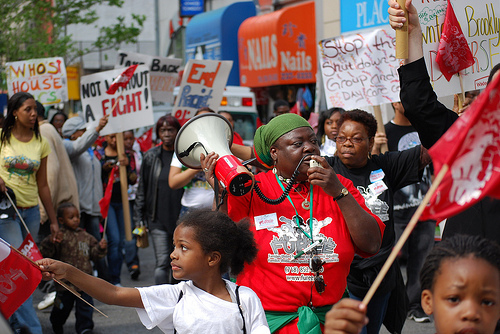
Families United for Racial and Economic Equality (FUREE) is a Brooklyn-based multi-racial organization made up almost exclusively of women of color.  We organize low-income families to build power to change the system so that all people’s work is valued and all of us have the right and economic means to decide and live out our own destinies. We use direct action, leadership development, community organizing, civic engagement and political education to win the changes our members seek. Our guiding principle is that those directly affected by the policies we are seeking to change should lead the organization.


Mission & History | Families United for Racial and Economic Equality.

For public housing residents after Sandy, ‘a slow-motion Katrina’ | San Francisco Bay View

For public housing residents after Sandy, ‘a slow-motion Katrina’

November 10, 2012

The gas is on, so Richard Bates can cook by candlelight, but life has been hard in Brooklyn’s Red Hook Houses and for tens of thousands of other public housing residents without heat, water or power since Hurricane Sandy hit. No lights or elevators function in their 12-story buildings. – Photo: Ruth Fremson, New York Times

by Lucas Kavner

Brooklyn, N.Y. – Ask anyone living in Cobble Hill or Carroll Gardens or Park Slope earlier this week, and they would tell you that they have power, hot water and wi-fi. In fact, most of the $1 million-plus townhouses and local businesses in Brooklyn’s wealthier neighborhoods never lost any basic necessities, even during the worst of the storm.

The gas is on, so Richard Bates can cook by candlelight, but life has been hard in Brooklyn’s Red Hook Houses and for tens of thousands of other public housing residents without heat, water or power since Hurricane Sandy hit. No lights or elevators function in their 12-story buildings. – Photo: Ruth Fremson, New York Times

But the Gowanus Houses, a low-income public housing complex owned and operated by the New York City Housing Authority (NYCHA), which falls almost at the intersection of those three neighborhoods, is an exception. During flooding from Hurricane Sandy, water seeped into the basement of one of the larger buildings, shorting out electrical cables that were located there and destroying its boiler. It took days before the water was even drained and the damage assessed, despite the fact that the complex houses almost 3,000 residents.

Power was restored on Friday, but its 12-day absence created severe conditions in the area, according to Councilman Stephen Levin, who represents the district where the Gowanus Houses is located. Many on the highest floors couldn’t get down without climbing 14 flights of stairs. Elderly residents with debilitating diseases and respiratory problems were literally stuck for a week, surviving off of food, medical supplies and flashlights donated primarily by individual volunteers, who have been working for these residents every day since Sandy hit.

One Occupy Sandy volunteer discovered a family without heat, warming their apartment with an open stove. Levin said a young girl with epilepsy was not able to plug in her nebulizer, while another woman, whose son is asthmatic, needed an electrical oxygen machine.

And as of Wednesday morning, more than a week after Sandy hit, at least two of the buildings at the Gowanus Houses were still without power, though a few residents said that number was actually five, and many others were without hot water and heat. Comparatively, power had been restored to most NYCHA complexes last week, including those in Lower Manhattan, Queens and other parts of Brooklyn.

via For public housing residents after Sandy, ‘a slow-motion Katrina’ | San Francisco Bay View.