The Mississippi Delta’s History of Black Land Theft – The Atlantic

The Great Land Robbery

The shameful story of how 1 million black families have been ripped from their farms
Zora J. MurffVANN R. NEWKIRK II


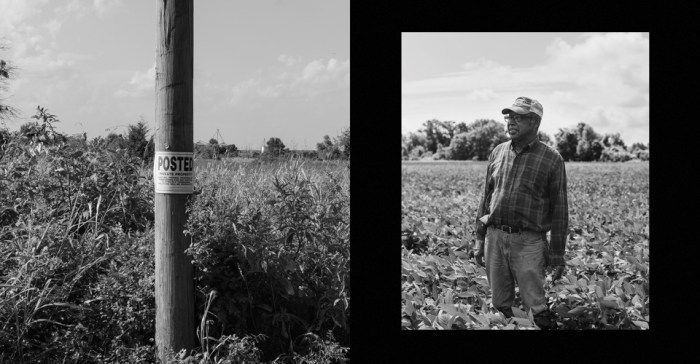
 A sign on a utility pole to deter hunters, near the old Scott-family homestead, Drew, Mississippi; Willena’s brother Isaac Daniel Scott Sr. amid soybeans in Mound Bayou.

I. Wiped Out

“You ever chop before?” Willena Scott-White was testing me. I sat with her in the cab of a Chevy Silverado pickup truck, swatting at the squadrons of giant, fluttering mosquitoes that had invaded the interior the last time she opened a window. I was spending the day with her family as they worked their fields just outside Ruleville, in Mississippi’s Leflore County. With her weathered brown hands, Scott-White gave me a pork sandwich wrapped in a grease-stained paper towel. I slapped my leg. Mosquitoes can bite through denim, it turns out.

Cotton sowed with planters must be chopped—thinned and weeded manually with hoes—to produce orderly rows of fluffy bolls. The work is backbreaking, and the people who do it maintain that no other job on Earth is quite as demanding. I had labored long hours over other crops, but had to admit to Scott-White, a 60-something grandmother who’d grown up chopping, that I’d never done it.

“Then you ain’t never worked,” she replied.
The fields alongside us as we drove were monotonous. With row crops, monotony is good. But as we toured 1,000 acres of land in Leflore and Bolivar Counties, straddling Route 61, Scott-White pointed out the demarcations between plots. A trio of steel silos here. A post there. A patch of scruffy wilderness in the distance. Each landmark was a reminder of the Scott legacy that she had fought to keep—or to regain—and she noted this with pride. Each one was also a reminder of an inheritance that had once been stolen.

Drive Route 61 through the Mississippi Delta and you’ll find much of the scenery exactly as it was 50 or 75 years ago. Imposing plantations and ramshackle shotgun houses still populate the countryside from Memphis to Vicksburg. Fields stretch to the horizon. The hands that dig into black Delta dirt belong to people like Willena Scott-White, African Americans who bear faces and names passed down from men and women who were owned here, who were kept here, and who chose to stay here, tending the same fields their forebears tended.

But some things have changed. Back in the day, snow-white bolls of King Cotton reigned. Now much of the land is green with soybeans. The farms and plantations are much larger—industrial operations with bioengineered plants, laser-guided tractors, and crop-dusting drones. Fewer and fewer farms are still owned by actual farmers. Investors in boardrooms throughout the country have bought hundreds of thousands of acres of premium Delta land. If you’re one of the millions of people who have a retirement account with the Teachers Insurance and Annuity Association, for instance, you might even own a little bit yourself.

TIAA is one of the largest pension firms in the United States. Together with its subsidiaries and associated funds, it has a portfolio of more than 80,000 acres in Mississippi alone, most of them in the Delta. If the fertile crescent of Arkansas is included, TIAA holds more than 130,000 acres in a strip of counties along the Mississippi River. And TIAA is not the only big corporate landlord in the region. Hancock Agricultural Investment Group manages more than 65,000 acres in what it calls the “Delta states.” The real-estate trust Farmland Partners has 30,000 acres in and around the Delta. AgriVest, a subsidiary of the Swiss bank UBS, owned 22,000 acres as of 2011. (AgriVest did not respond to a request for more recent information.)

Unlike their counterparts even two or three generations ago, black people living and working in the Delta today have been almost completely uprooted from the soil—as property owners, if not as laborers. In Washington County, Mississippi, where last February TIAA reportedly bought 50,000 acres for more than $200 million, black people make up 72 percent of the population but own only 11 percent of the farmland, in part or in full. In Tunica County, where TIAA has acquired plantations from some of the oldest farm-owning white families in the state, black people make up 77 percent of the population but own only 6 percent of the farmland. In Holmes County, the third-blackest county in the nation, black people make up about 80 percent of the population but own only 19 percent of the farmland. TIAA owns plantations there, too. In just a few years, a single company has accumulated a portfolio in the Delta almost equal to the remaining holdings of the African Americans who have lived on and shaped this land for centuries.

This is not a story about TIAA—at least not primarily. The company’s newfound dominance in the region is merely the topsoil covering a history of loss and legally sanctioned theft in which TIAA played no part. But TIAA’s position is instrumental in understanding both how the crimes of Jim Crow have been laundered by time and how the legacy of ill-gotten gains has become a structural part of American life. The land was wrested first from Native Americans, by force. It was then cleared, watered, and made productive for intensive agriculture by the labor of enslaved Africans, who after Emancipation would come to own a portion of it. Later, through a variety of means—sometimes legal, often coercive, in many cases legal and coercive, occasionally violent—farmland owned by black people came into the hands of white people. It was aggregated into larger holdings, then aggregated again, eventually attracting the interest of Wall Street.

Willena Scott-White’s son Joseph White cutting grass at the edge of a field on Scott-family land, Mound Bayou, Mississippi (Zora J. Murff)
Owners of small farms everywhere, black and white alike, have long been buffeted by larger economic forces. But what happened to black landowners in the South, and particularly in the Delta, is distinct, and was propelled not only by economic change but also by white racism and local white power. A war waged by deed of title has dispossessed 98 percent of black agricultural landowners in America. They have lost 12 million acres over the past century. But even that statement falsely consigns the losses to long-ago history. In fact, the losses mostly occurred within living memory, from the 1950s onward. Today, except for a handful of farmers like the Scotts who have been able to keep or get back some land, black people in this most productive corner of the Deep South own almost nothing of the bounty under their feet.

II. “Land Hunger”

land has always been the main battleground of racial conflict in Mississippi. During Reconstruction, fierce resistance from the planters who had dominated antebellum society effectively killed any promise of land or protection from the Freedmen’s Bureau, forcing masses of black laborers back into de facto bondage. But the sheer size of the black population—black people were a majority in Mississippi until the 1930s—meant that thousands were able to secure tenuous footholds as landowners between Emancipation and the Great Depression.

Driven by what W. E. B. Du Bois called “land hunger” among freedmen during Reconstruction, two generations of black workers squirreled away money and went after every available and affordable plot they could, no matter how marginal or hopeless. Some found sympathetic white landowners who would sell to them. Some squatted on unused land or acquired the few homesteads available to black people. Some followed visionary leaders to all-black utopian agrarian experiments, such as Mound Bayou, in Bolivar County.

It was never much, and it was never close to just, but by the early 20th century, black people had something to hold on to. In 1900, according to the historian James C. Cobb, black landowners in Tunica County outnumbered white ones three to one. According to the U.S. Department of Agriculture, there were 25,000 black farm operators in 1910, an increase of almost 20 percent from 1900. Black farmland in Mississippi totaled 2.2 million acres in 1910—some 14 percent of all black-owned agricultural land in the country, and the most of any state.

The foothold was never secure. From the beginning, even the most enterprising black landowners found themselves fighting a war of attrition, often fraught with legal obstacles that made passing title to future generations difficult. Bohlen Lucas, one of the few black Democratic politicians in the Delta during Reconstruction (most black politicians at the time were Republicans), was born enslaved and managed to buy a 200-acre farm from his former overseer. But, like many farmers, who often have to borrow against expected harvests to pay for equipment, supplies, and the rent or mortgage on their land, Lucas depended on credit extended by powerful lenders. In his case, credit depended specifically on white patronage, given in exchange for his help voting out the Reconstruction government—after which his patrons abandoned him. He was left with 20 acres.

In Humphreys County, Lewis Spearman avoided the pitfalls of white patronage by buying less valuable wooded tracts and grazing cattle there as he moved into cotton. But when cotton crashed in the 1880s, Spearman, over his head in debt, crashed with it.

Around the turn of the century, in Leflore County, a black farm organizer and proponent of self-sufficiency—referred to as a “notoriously bad Negro” in the local newspapers—led a black populist awakening, marching defiantly and by some accounts bringing boycotts against white merchants. White farmers responded with a posse that may have killed as many as 100 black farmers and sharecroppers along with women and children. The fate of the “bad Negro” in question, named Oliver Cromwell, is uncertain. Some sources say he escaped to Jackson, and into anonymity.

Like so many of his forebears, Ed Scott Sr., Willena Scott-White’s grandfather, acquired his land through not much more than force of will. As recorded in the thick binders of family history that Willena had brought along in the truck, and that we flipped through between stretches of work in the fields, his life had attained the gloss of folklore. He was born in 1886 in western Alabama, a generation removed from bondage. Spurred by that same land hunger, Scott took his young family to the Delta, seeking opportunities to farm his own property. He sharecropped and rented, and managed large farms for white planters, who valued his ability to run their sprawling estates. One of these men was Palmer H. Brooks, who owned a 7,000-acre plantation in Mississippi’s Leflore and Sunflower Counties. Brooks was uncommonly progressive, encouraging entrepreneurship among the black laborers on his plantation, building schools and churches for them, and providing loans. Scott was ready when Brooks decided to sell plots to black laborers, and he bought his first 100 acres.

Unlike Bohlen Lucas, Scott largely avoided politics. Unlike Lewis Spearman, he paid his debts and kept some close white allies—a necessity, since he usually rejected government assistance. And unlike Oliver Cromwell, he led his community under the rules already in place, appearing content with what he’d earned for his family in an environment of total segregation. He leveraged technical skills and a talent for management to impress sympathetic white people and disarm hostile ones. “Granddaddy always had nice vehicles,” Scott-White told me. They were a trapping of pride in a life of toil. As was true in most rural areas at the time, a new truck was not just a flashy sign of prosperity but also a sort of credit score. Wearing starched dress shirts served the same purpose, elevating Scott in certain respects—always within limits—even above some white farmers who drove into town in dirty overalls. The trucks got shinier as his holdings grew. By the time Scott died, in 1957, he had amassed more than 1,000 acres of farmland.

Scott-White guided me right up to the Quiver River, where the legend of her family began. It was a choked, green-brown gurgle of a thing, the kind of lazy waterway that one imagines to be brimming with fat, yawning catfish and snakes. “Mr. Brooks sold all of the land on the east side of this river to black folks,” Scott-White told me. She swept her arm to encompass the endless acres. “All of these were once owned by black families.”

Members of the extended Scott family. From the right: Isaac Daniel Scott Sr. and his wife, Lucy Chatman-Scott; Willena Scott-White; and Willena’s son Joseph White, with his daughter, Jade Marie White. (Zora J. Murff)

III. The Great Dispossession

that era of black ownershipin the Delta and throughout the country, was already fading by the time Scott died. As the historian Pete Daniel recounts, half a million black-owned farms across the country failed in the 25 years after 1950. Joe Brooks, the former president of the Emergency Land Fund, a group founded in 1972 to fight the problem of dispossession, has estimated that something on the order of 6 million acres was lost by black farmers from 1950 to 1969. That’s an average of 820 acres a day—an area the size of New York’s Central Park erased with each sunset. Black-owned cotton farms in the South almost completely disappeared, diminishing from 87,000 to just over 3,000 in the 1960s alone. According to the Census of Agriculture, the racial disparity in farm acreage increased in Mississippi from 1950 to 1964, when black farmers lost almost 800,000 acres of land. An analysis for The Atlantic by a research team that included Dania Francis, at the University of Massachusetts, and Darrick Hamilton, at Ohio State, translates this land loss into a financial loss—including both property and income—of $3.7 billion to $6.6 billion in today’s dollars.

This was a silent and devastating catastrophe, one created and maintained by federal policy. President Franklin D. Roosevelt’s New Deal life raft for agriculture helped start the trend in 1937 with the establishment of the Farm Security Administration, an agency within the Department of Agriculture. Although the FSA ostensibly existed to help the country’s small farmers, as happened with much of the rest of the New Deal, white administrators often ignored or targeted poor black people—denying them loans and giving sharecropping work to white people. After Roosevelt’s death, in 1945, conservatives in Congress replaced the FSA with the Farmers Home Administration, or FmHA. The FmHA quickly transformed the FSA’s programs for small farmers, establishing the sinews of the loan-and-subsidy structure that undergirds American agriculture today. In 1961, President John F. Kennedy’s administration created the Agricultural Stabilization and Conservation Service, or ASCS, a complementary program to the FmHA that also provided loans to farmers. The ASCS was a federal effort—also within the Department of Agriculture—but, crucially, the members of committees doling out money and credit were elected locally, during a time when black people were prohibited from voting.

Through these programs, and through massive crop and surplus purchasing, the USDA became the safety net, price-setter, chief investor, and sole regulator for most of the farm economy in places like the Delta. The department could offer better loan terms to risky farmers than banks and other lenders, and mostly outcompeted private credit. In his book Dispossession, Daniel calls the setup “agrigovernment.” Land-grant universities pumped out both farm operators and the USDA agents who connected those operators to federal money. Large plantations ballooned into even larger industrial crop factories as small farms collapsed. The mega-farms held sway over agricultural policy, resulting in more money, at better interest rates, for the plantations themselves. At every level of agrigovernment, the leaders were white.

Major audits and investigations of the USDA have found that illegal pressures levied through its loan programs created massive transfers of wealth from black to white farmers, especially in the period just after the 1950s. In 1965, the United States Commission on Civil Rights uncovered blatant and dramatic racial differences in the level of federal investment in farmers. The commission found that in a sample of counties across the South, the FmHA provided much larger loans for small and medium-size white-owned farms, relative to net worth, than it did for similarly sized black-owned farms—evidence that racial discrimination “has served to accelerate the displacement and impoverishment of the Negro farmer.”

In Sunflower County, a man named Ted Keenan told investigators that in 1956, local banks had denied him loans after a bad crop because of his position with the NAACP, where he openly advocated for voting rights. The FmHA had denied him loans as well. Keenan described how Eugene Fisackerly, the leader of the White Citizens’ Council in Sunflower County, together with representatives of Senator James Eastland, a notorious white supremacist who maintained a large plantation there, had intimidated him into renouncing his affiliation with the NAACP and agreeing not to vote. Only then did Eastland’s man call the local FmHA agent, prompting him to reconsider Keenan’s loan.

A landmark 2001 investigation by the Associated Press into extortion, exploitation, and theft directed against black farmers uncovered more than 100 cases like Keenan’s. In the 1950s and ’60s, Norman Weathersby, a Holmes County Chevrolet dealer who enjoyed a local monopoly on trucks and heavy farm equipment, required black farmers to put up land as collateral for loans on equipment. A close friend of his, William Strider, was the local FmHA agent. Black farmers in the area claimed that the two ran a racket: Strider would slow-walk them on FmHA loans, which meant they would then default on Weathersby’s loans and lose their land to him. Strider and Weathersby were reportedly free to run this racket because black farmers were shut out by local banks.

More: The Mississippi Delta’s History of Black Land Theft – The Atlantic

White supremacy is where my PTSD and intrusive thoughts intersect – The Black Youth Project

“The trending topics on Twitter over the last year are evidence enough that I’m not going to be able to manage this by poking holes in my own stream of consciousness. I can’t use mind games to reprogram myself when there’s a plethora of trauma porn in my Facebook feed for my brain to soak in and terrorize me with.The only thing that’s changed since last year when I first started to write about my PTSD is that I’ve realized that the problem isn’t how I engage whiteness in my capacity as an organizer or as an intentionally visible Black person. It’s whiteness period. The head-on collision between my PTSD and these intrusive thoughts is consistently triggered by white supremacy.How do you take a break from racialization?How do you divest from the imperial core that you’re living in?How do you put the legacy of the transatlantic slave trade on the back burner? You don’t.”

Source: White supremacy is where my PTSD and intrusive thoughts intersect – The Black Youth Project

White People Need to Understand That Helping Is Not the Same as Controlling

He told me that White people need the humility to understand that helping is not the same as controlling. Not only should we not assume the lead, we must also possess and exercise the humility to be told what to do, what is best, what is right—and what is wrong.We need to help support communities gain the power to control their own destiny, not “help” them by assuming that control for ourselves.And we need to be honest.

IF WHO WE TRULY ARE DOES NOT ALLOW US TO TEACH, SUPPORT, CARE, LOVE AND FIGHT FOR BLACK AND BROWN KIDS, THEN WE NEED TO GO DO SOMETHING ELSE.

If who we truly are does not allow us to teach, support, care, love and fight for Black and Brown kids, then we need to go do something else.These were not easy things for me to hear. I was triggered, defensive and unsure. Which was precisely the reaction that demonstrated how comfortable I had been telling others what to do and how to be, but how little experience I, as a White man, had being on the opposite side of the conversation.

Source: White People Need to Understand That Helping Is Not the Same as Controlling

How Racism Takes 7 Different Forms

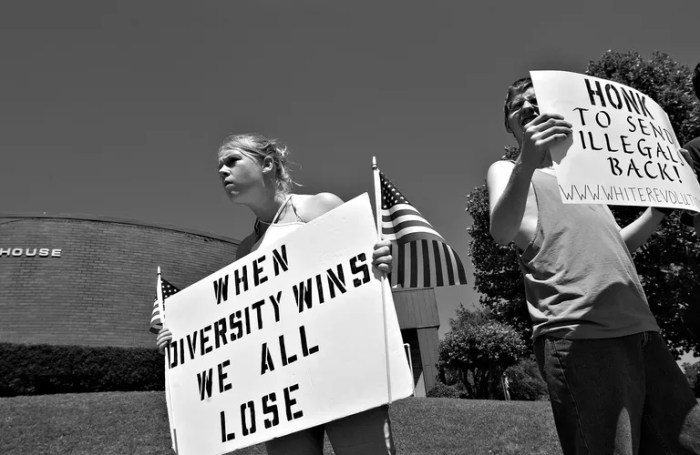
Members of the Arkansas based white pride organization ‘White Revolution’ meet with locals to protest illegal immigration on May 21, 2005 in Danville, Arkansas. avid S. Holloway/Getty Images

“Racism exists when ideas and assumptions about racial categories are used to justify and reproduce a racial hierarchy and racially structured society that unjustly limits access to resources, rights, and privileges on the basis of race.

Racism also occurs when this kind of unjust social structure is produced by the failure to account for race and its historical and contemporary roles in society.Contrary to a dictionary definition, racism, as defined based on social science research and theory, is about much more than race-based prejudice—it exists when an imbalance in power and social status is generated by how we understand and act upon race.”

Source: How Racism Takes 7 Different Forms

I Wanted to Know What White Men Thought About Their Privilege. So I Asked. – The New York Times

“I finally got up my nerve to ask a stranger directly about white privilege as I was sitting next to him at the gate. He had initiated our conversation, because he was frustrated about yet another delay. We shared that frustration together. Eventually he asked what I did, and I told him that I write and teach. “Where do you teach?” he asked. “Yale,” I answered. He told me his son wanted to go there but hadn’t been accepted during the early-application process. “It’s tough when you can’t play the diversity card,” he added.Was he thinking out loud? Were the words just slipping out before he could catch them? Was this the innocence of white privilege? Was he yanking my chain? Was he snapping the white-privilege flag in my face? Should I have asked him why he had the expectation that his son should be admitted early, without delay, without pause, without waiting? Should I have asked how he knew a person of color “took” his son’s seat and not another white son of one of these many white men sitting around us?I was perhaps holding my breath. I decided to just breathe.”

More 

Slavery Reparations Could Cost Up to $14 Trillion, According to New Calculation

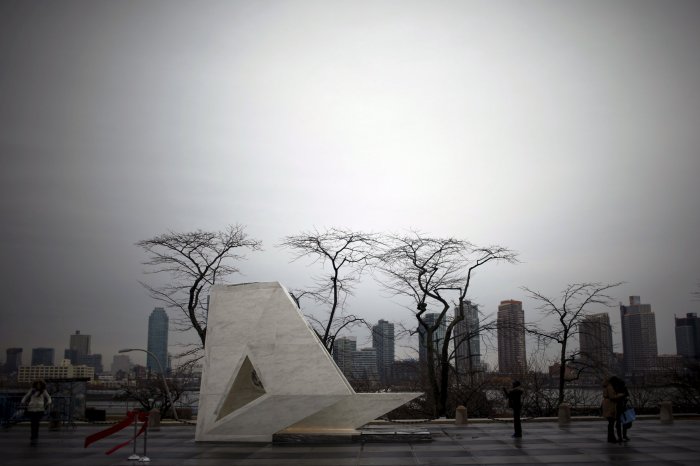
The Permanent Memorial to Honor the Victims of Slavery and the Transatlantic Slave Trade, in New York City, acknowledges a tragic chapter in the nation’s history. Some have argued that reparations for slavery would help heal long-festering racial strife. EDUARDO MUNOZ / REUTERS

” In 1865, toward the end of the Civil War, Union Army General William Tecumseh Sherman promised slaves that they’d receive 40 acres and a mule. Land was even set aside, but the promise was recanted by President Andrew Johnson. Ever since, the issue of reparations has come up many times, often fiercely debated. Although most Americans generally don’t support reparations, according to University of Connecticut researcher Thomas Craemer, it matters greatly how the question is worded, who would get reparations and in what form. For example, the idea of reparations paid in educational benefits are more popular than others, Craemer says.

On the other hand, one of the cases often made against reparations is that it’d be impractically difficult to calculate how to fairly take and give so many years after the fact. But in a new paper, published in the journal Social Science Quarterly, Craemer makes the case that there are other examples of historical reparations paid many decades later after “damages” were incurred. He also has come up with what he says is the most economically sound estimate to date of what reparations could cost: between $5.9 trillion and $14.2 trillion.

Craemer came up with those figures by tabulating how many hours all slaves—men, women and children—worked in the United States from when the country was officially established in 1776 until 1865, when slavery was officially abolished. He multiplied the amount of time they worked by average wage prices at the time, and then a compounding interest rate of 3 percent per year (more than making up for inflation). There is a range because the amount of time worked isn’t a hard figure.

Previous estimates of reparations have ranged from around $36 billion to $10 trillion (in 2009 dollars), Craemer says. Those calculations mostly looked at wealth created by slaves as opposed to services provided, resulting in underestimates. Craemer believes that “the economic assumptions underlying [his method] are more sound” than those used in previous papers.

The paper also illustrates several historical examples in which reparations were paid, many decades later, despite being initially unpopular—showing that repayment of age-old claims is not without precedent . . .

Reparations will never bring one life back, and it’s totally inadequate to the terror of the [past], but having a meaningful symbol of reparations is a good thing, not just for recipients but for the people who provide it,” he says.”

Source: Slavery Reparations Could Cost Up to $14 Trillion, According to New Calculation

Howard University Statement About Walking Dogs On The Yard

“We are aware of the concerns regarding dog walking across campus. Howard is a private institution nestled in the heart of an urban city and we’ve shared a long-standing positive relationship with our evolving community for more than 150 years, which we look forward to continuing in the future.

We saw the news stories, too. Move the campus, my ass. This is Howard. Open-campus, but we’re private and we make the rules ‘round here. We’ve been in the game for years, educating and affecting DC’s culture and the nation’s culture focusing on us and now these gentrifying ass white people show up, change up the neighborhood, try to shut down the go-go IN THE MIDDLE OF A COMMERCIAL DISTRICT IN A MAJOR U.S. CITY and decide that we need to be concerned about them. To quote one of our most famous students, Sean “Puffy” Combs, “we ain’t goin’ nowhere, we ain’t goin’ nowhere, we can’t be stopped…” They better go on with that bullshit. We were here first. Shit, real talk, we came before Columbus. They might be changing up DC, but this here is Howard.”

Source: Howard University Statement About Walking Dogs On The Yard

White Privilege and White Disadvantage – Race, Racism and the Law

Simply stated, “poor people and people of color,” as well as its variants, imply that being poor is like being non-white. Now, if being poor is, in fact, like being non-white, then poor white people are like people of color. Significantly, if poor white people are like people of color, then the concept of white privilege becomes a bit misleading, if not altogether inaccurate. As Part II explains, white privilege refers to advantages that white people are supposed to receive by virtue of the fact that they are white. The concept presupposes that all white people–even the poor ones–have privileges on account of their race. However, if being poor is like being non-white, and if poor white people are like people of color, then it may not make sense to conceptualize poor white people as being privileged relative to people of color. If poor white people’s class disadvantage puts them in a social position that is similar to that occupied by people of color, then white privilege may not be something that they enjoy. Further, if white privilege is not enjoyed by poor white people, then it may make little sense to call it white privilege– inasmuch as white privilege implies that the privilege flows from being a member of the white race. It may make more sense to admit the error involved in the concept of white privilege and come up with a different concept altogether–something like affluent white people’s privilege or white class privilege.

Source: White Privilege and White Disadvantage – Race, Racism and the Law

Many People are Too Broke for Bankruptcy. A New Report Suggests Some Fixes. — ProPublica


All sorts of bad things happen when bankruptcy is out of reach for people, as we showed in a series of stories. People turn to unscrupulous operators who file phony bankruptcy cases, as happens often in Los Angeles. Particularly in the South, they turn to a form of bankruptcy that features a payment plan and that often ends in failure, leaving debtors worse off than when they filed. (African Americans are especially prone to that problem.) And finally, many people don’t file at all — and just hope that a debt collector doesn’t seize their wages.

Source: Many People are Too Broke for Bankruptcy. A New Report Suggests Some Fixes. — ProPublica

Research Shows Entire Black Communities Suffer Trauma After Police Shootings ::: TruthOut

Research Shows Entire Black Communities Suffer Trauma After Police Shootings

Following several nationally publicized police killings of unarmed Black Americans in the United States, Eva L., a fitness instructor who identifies as Black, started to experience what she describes as “immense paranoia.” She would often call in sick, because she feared risking an encounter with police upon leaving her house. She also started to second-guess her and her husband’s decision to have children.

“Seeing Black bodies murdered and physical/emotional violence online and on the news” was a trauma she could no longer bear, Eva says. “I was terrified of bringing a child into the world we live in and experience as Black people. I thought not having kids was a truer sign of love than risk them being harmed by this world.”

A recent study sponsored by the University of Pennsylvania — released just before the anniversaries of the deaths of Eric Garner (2014), Michael Brown (2014), John Crawford (2014), and Philando Castile (2016) — found that there could be millions like Eva, for whom these killings have been a mental health trigger.

Research included data from the Mapping Police Violence Projectdatabase for police killings between 2013 and 2016 and information from the Behavioral Risk Factor Surveillance System of over 103,000 Black Americans. The results indicate that police killings of unarmed Black Americans are having a population-level impact on the mental health of Black Americans.

According to researchers, the incidents may contribute to 1.7 additional poor mental health days per person every year, or 55 million more poor mental health days every year among Black Americans across the United States. That means the mental health burden for African Americans caused by police killings of unarmed Black victims is nearly as great as the mental health burden associated with diabetes. African Americans have some of the highest rates of the disease, which contributes annually to 75 million days of poor mental health among them.

Eva started seeing a therapist who diagnosed her as having generalized anxiety and post-traumatic stress disorder. It’s been two years now, and she admits that her progress toward healing has been slow, yet steady.

Jacob Bor, co-author of the study and assistant professor at the Boston University School of Public Health, says the responses in his social circle to police killings of unarmed Black victims is what interested him in conducting this study. Bor noticed that White people were able to comprehend “the injustice on an intellectual level but did not experience the same level of trauma.”

The study findings confirmed Bor’s personal observations. The research team did not observe spillover mental health effects in White respondents from police killings. It should also be noted that among respondents of either race, there were no spillover effects for police killings of unarmed White people or killings of armed Black people.

The research is essential in considering our own personal experiences, says Bor, adding that the findings speak to the overall “value of different people’s lives.” This society “has a long history of state-sanctioned violence” toward racially marginalized groups, he says.

The mental health sector is only now researching the impact of police brutality, a concern that has affected African Americans for decades. “Clinicians can go through medical school without [gaining] any experience in treating the effects of racism,” Bor says. Studies like his, he adds, can help to create long overdue critical mainstream discussions about the effects of racism on mental health, such as, “How do we in public health, society, and among the clinical and mental health services support people when these incidents occur?” and “Can a profession dominated by White providers effectively treat the emotional struggles of ‘living while Black’ in this country?”

According to Bor, these discussions are needed to implement change. “Among many White Americans, there is an empathy gap … and a failure to believe when people of color say ‘this hurts me,’” he says.

Adding to the deficiency of culturally competent therapists, poverty and other formidable socio-economic challenges — also stemming from structural racism — remain steadfast barriers to African Americans accessing mental health care, according to the American Psychological Association.

New York City’s first lady, Chirlane McCray, has also become a passionate advocate for what she describes as a movement for “culturally competent mental health care.”

“When you talk about people of color, who are obviously facing discrimination and legacy of racism and poverty in huge numbers, you are talking about something that is really tough to overcome,” McCray says.

Inadequate care undermines benefits from policies and resources designed to mitigate the burdens of systemic oppression. “Mental illness along with substance abuse disorders are hardship multipliers,” she says. Struggling unsupported with “mental illness can make everything that much harder.”

For example, holding on to affordable housing, staying enrolled in college, and even surviving encounters with law enforcement can be extremely more difficult for those suffering from mental illness or trauma, McCray says. In fact, the most recent annual numbers from the Washington Post’s database of fatal police-shooting victims indicate that “nearly 1 in 4 of those shot was described as experiencing some form of mental distress at the time of the encounter with police.”

“Mental health is the ultimate intersectional concern,” McCray says. “It is reflected in all of our policies … education, housing, school, relationships.”

In 2015, she and her spouse, Mayor Bill de Blasio, launched Thrive NYC, a $850 million mental health program that incorporates 54 initiatives. Among the program’s several core objectives is the aim to address the stigma around mental illness and increase access to treatment across the city. McCray believes that ThriveNYC’s community focused approach is one of several necessary steps toward reaching historically under served groups.

“Culturally competent care to me is all about trust,” McCray says. “It improves early identification, accessibility, and outcomes.” Also, she says, “People have to be seen.” From her advocacy experience she has observed that “people have to feel that they can turn to someone that they trust.”

Connecting people with the appropriate resources, however, means surmounting many challenges. “There is great deal of work to be done to eliminate the stigma,” McCray says. There is also the matter of affordability and infrastructure. “We’ve never had a well-coordinated mental health system in our country — ever. People who have the money find ways to manage.” She says she wants to fight for everyone to get the resources they need to cope.

Eva recognizes that her path to healing has taken a significant amount of work and support beyond the means of many African Americans. “Access to therapy is a privilege,” she says. “I know that most people can’t afford weekly sessions at $150-plus.” Yet, she adds, “[going through therapy] is the only reason why I’m OK planning for kids at 32.”


Tasha Williams writes about economics and technology. Follow her on Twitter: @riseupwoman.