Women’s lives don’t matter: The lesson of Marissa Alexander

TUESDAY, OCT 1, 2013

Women’s lives don’t matter: The lesson of Marissa Alexander

Laws fail to effectively stop violent men or protect us — that’s why we have to stand up for ourselves

BY 

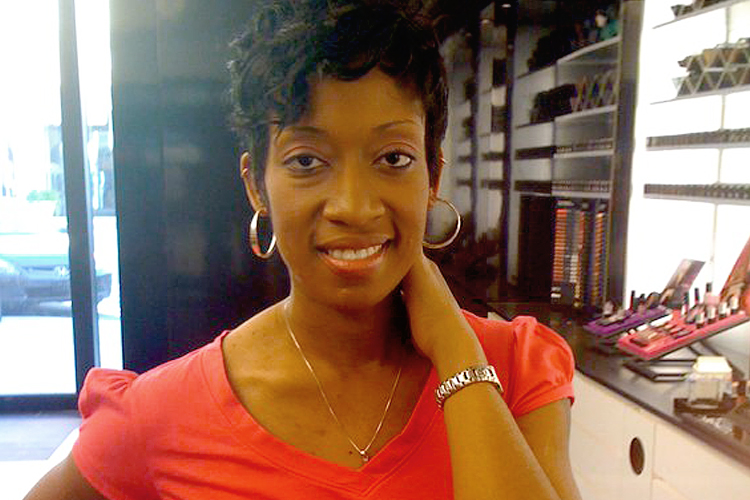
Women's lives don't matter: The lesson of Marissa AlexanderMarissa Alexander (Credit: AP/Lincoln B. Alexander)

I am passionate about domestic violence, because I am a childhood survivor of domestic violence. I know all too well the ways in which men like my father, many of whom are themselves subjugated on the basis of race and class, use home spaces to assert dominance and control that they are not able to wield in the larger world.

I know intimately the terror of being under surveillance in one’s own home, of the prerogative that many men assert to control the comings and goings of their partners and children, often through the threat of violence and force. I have seen how difficult it is to stand your ground, when society is structured to give men economic and political control over private, domestic space. I know what the journey to survivor status looked like for my mother, and the way that my father’s violence demoralized him and ruined our relationship.

I think of the women survivors of gun violence that I personally know (and of the gun violence that snuffed out my father’s life at the age of 33, as he ironically tried to prevent another woman and her children from becoming the victims of domestic violence at the hands of another man).

I think of two high school classmates, a white girl named Mary Dee and a black girl named Jackie, both killed by fatal gunshots in murder-suicide scenarios involving their partners. I think of a class of first-year, college-age African-American women (18 and 19 year olds) that I taught several years ago, in which fully one-quarter of them admitted to having been in violent relationships in high school.

I think about all the stories that are almost too terrifying to remember and much too personal to confess.

Last week, a judge ordered a new trial for Marissa Alexander, a 33-year-old African-American woman from Florida currently serving a mandatory 20-year sentence for firing a warning shot into the wall to scare off her violent and abusive husband.

The new trial order comes just in time for our annual October commemoration of Domestic Violence Awareness Month, and it calls attention to startling new statistics released from the Violence Policy Center. In 2011, 1,707 women were murdered by men in single victim, single offender incidents. In 94 percent of these cases, these women were murdered by men they knew, and in 51 percent of the cases, they were murdered by guns. Sixty-one percent of these victims were wives or intimate acquaintances of their killers. This means that intimate partner relationships constitute one of the most significant contexts through which women experience violence within our culture.

The disproportionate amounts of violence toward black women, who are 2.5 times more likely to be killed by an intimate partner than their white female counterparts, were significant enough to warrant their own section of the report. In 2011, 470 black women were killed in single victim/single offender homicides. In cases where the relationship could be determined, 94 percent of black women knew their killers.

That number is entirely consistent across racial categories, because most violent crime is intraracial. On the one hand, that fact would seem to highlight the erroneous nature of designations like “black-on-black” crime, an incendiary term use to pathologize black people, while failing to acknowledge that among white people most crime is “white-on-white” crime.

Beyond the racially problematic dimensions of these kinds of demographic designations, there is the problem of gender. Black women are never the subject of either community or national discussions about “black-on-black” crime, which is largely focused on stopping the epidemic of homicidal violence among young black men. The invisibilization of black women from discourses about victims of violence makes it hard to actually see black women as victims.

In Marissa Alexander’s case, she inadvertently encountered her husband, a man against whom she had a restraining order, when she went to their home to retrieve her clothes unaware that he would be there. When he showed up, she felt threatened, went to her car to retrieve her gun, and then fired a shot into the wall in order to scare him away. Perhaps, this is why the judge also ruled that Alexander cannot use a “stand your ground” defense in her own trial.

The failure of the law to protect Marissa Alexander from her husband, who has admitted under oath to treating her violently, placed her in a difficult set of circumstances. There is no reason that she should be serving 20 years in prison for defending herself against a violent attacker. Yet, she was sentenced through a combination of overzealous prosecuting, by the same Florida district attorney, Angela Corey, who had to be convinced through national protests and marches to prosecute Trayvon Martin’s killer, and extremely punitive mandatory minimum sentencing laws that require some crimes in which a gun is used to carry a 20-year sentence.

Yet again, Angela Corey, and the Florida justice system in general, seem to have a hard time distinguishing victims from perpetrators.

In an ironic twist, Shellie Zimmerman, wife of acquitted killer George Zimmerman, has also had trouble finding any protection on the basis of Florida’s domestic violence laws.  In early September, Shellie Zimmerman called 911 to report that George Zimmerman was brandishing a gun at her and her father, as she attempted to remove her belongings from their home after filing for divorce. Mrs. Zimmerman never saw the actual weapon, but instead observed her husband using threatening body language, while gesturing toward his waistband. She concluded that he had a gun, and since he is legally entitled to carry his gun after being acquitted of Trayvon Martin’s murder, that seems like a credible conclusion on her part. To date, no charges have been filed against George Zimmerman, even though this is not his first run-in with the law on charges of domestic violence.

Fifty-one percent of female homicide victims are killed with guns. In a world where women’s lives matter, robust gun control would be non-negotiable. But in a world where women’s lives don’t matter, Marissa Alexander doesn’t have any ground on which to stand, nor a fighting chance at freedom.

Lest folks convince themselves that these kinds of occurrences are anomalous, I would encourage you to spend some time this month talking to the women you know about the violence they have experienced at the hands of men in their own lives.

Marissa Alexander stood up for herself. She did not retreat. She refused any longer to take her husband’s shit. Unaided by laws that can effectively stop violent men in their tracks, all women survivors reach a point where they refuse to take it anymore. Even as we work to transform our culture of misogynistic violence into a world safe for women to inhabit, we must stand with and for those women who are standing up for themselves.

Brittney CooperBrittney Cooper is a contributing writer at Salon. Follow her on Twitter at@professorcrunk.

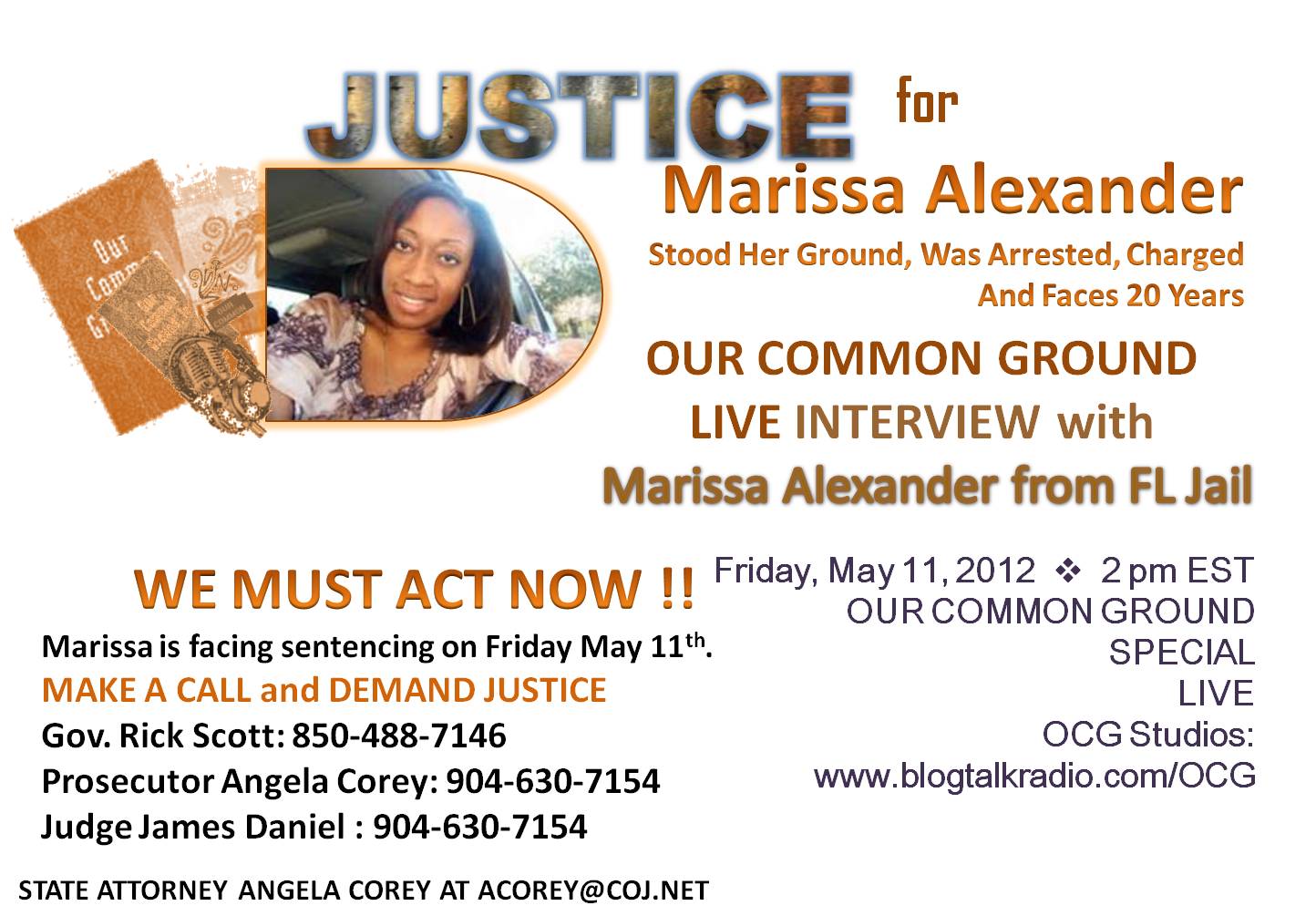
LISTEN LIVE TO OUR LIVE INTERVIEW WITH Ms. Alexander hours following her sentencing.

5-12 aCTION aLERT

#BlackPowerIsForBlackMen: Letters from Brothers Writing to Live \/ The Femin

#BlackPowerIsForBlackMen: Letters from Brothers Writing to Live

August 15, 2013

By 

By Brothers Writing to Live

fistsWe are a collective of black men dedicated to challenging the ideas of black masculinity and manhood through the written word. Through our work, we explore the ugliest parts of ourselves and our community, in the hope that we can illuminate the beauty that we know exists as well. We challenge each other daily to create and be more than what this racist, patriarchal society has raised us to be. But simply wanting it will not do. It requires tons of hard work, and much of that work includes listening to our sisters, black women, who tend to bear the brunt of our messiness. Unfortunately, in this regard, we have been woefully absent.

When the hashtag #Blackpowerisforblackmen, created by Ebony.comeditor Jamilah Lemeiux, took over Twitter, it was a clear sign that we haven’t been doing enough. Thousands of our sisters (and brothers) tweeted for hours about the imbalance in our community.  We, black men, tend to pride ourselves on our anti-white racial supremacy activism but often fail to reach out and consider the pain and trauma faced by the women in our lives. Our culture actively denigrates the very existence of black women. We take their love, support, nourishment, and spiritual presence for granted. As a whole, black men have not reciprocated our love and support in a way that affirms the humanity and dignity of black womanhood in the face of white supremacy, patriarchy, heterosexism, homophobia, transphobia, misogyny, sexual violence, and physical and verbal abuse.

#Blackpowerisforblackmen became the call, and as black men dedicated to fighting alongside our sisters, we have taken up the responsibility of answering. As individuals, we recognize where we have fallen short, and as a community we make a promise to participate in deep self-reflection and correction.

This ain’t just an apology; it’s a commitment.

___________________________________
Dear @BougieBlackGurl, You tweeted the following: “I am supposed to give a cookie to the BM who are involved in their children’s lives while Single BW carry the blame #blackpowerisforblackmen”
father
When my daughters were babies—they are now 10 and 14—I used to relish the attention that I received when I was with them in public.  The expectations held out for Black fathers have often been so low, that Black men who even show a small amount of attention to their children are lauded; I can’t say that I didn’t enjoy being thought of as special.Yet being at daycare, or volunteering at school, I was also able to witness the women—often single mothers—who don’t parent for the prestige of it, but because it’s what they are supposed to do.  Save Mother’s Day and the Hip-Hop Awards Show shout-out (often uttered after rhetorically bashing a “baby-mama”), there is very little attention to those women who put in the work, because if they don’t, nobody else will.  And of course if they don’t, these women are blamed for failing, not only their children or their family, but the “Race” itself.And this is one of the ways that male privilege functions—that which is ordinary and mundane is deemed as exceptional when done by men. When these everyday activities are done by women, they are demeaned and devalued—and all we have to do is look at what we pay folks who work in so called “women’s professions” or the fact that we so devalue parenting that we think that those women who are raising children on their own, and perhaps on Federal or State assistance, should be required to work outside of the home, because apparently parenting is not really work.
__________________________

Dear Monifa Bandele (@monifabandele), You tweeted the following: “#blackpowerisforblackmen when trying to discuss gender privilege is black male bashing.”

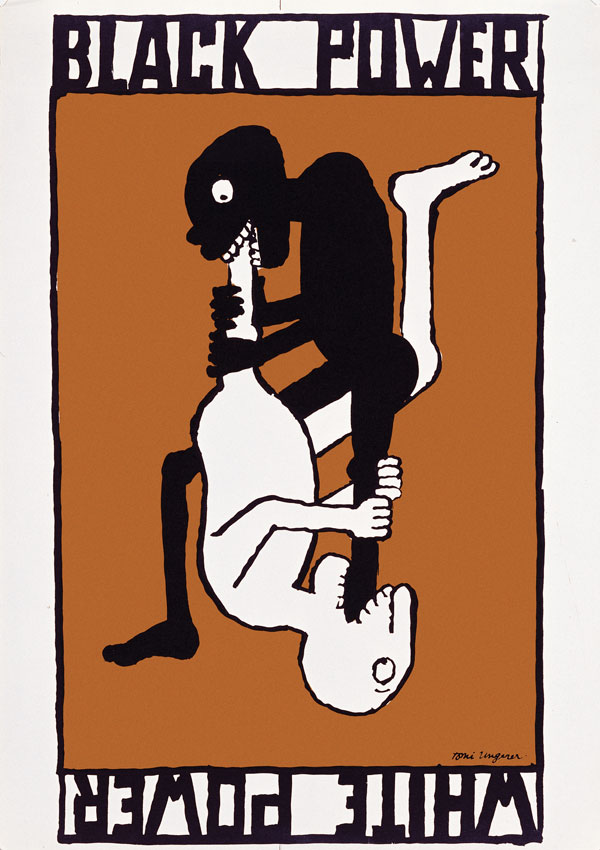
Tomi Ungerer: black Power / White Power Poster

Tomi Ungerer: black Power / White Power Poster

I had one of those moments like the old folks do in church where all I could do was sway and say to myself “well ain’t that the truth.” It’s most disheartening because a quick glance at our past or present shows us just how dedicated black women have been to addressing the black men in this country. But when sisters speak up and ask us to consider the ways in which we have contributed to their oppression, we consider it an affront to our fragile sense of community and an attack on our manhood.

Undoubtedly, there were the brothers reacting with the predictable “not me!” responses. But those individual “not me’s!” aren’t enough to drown out the massive indifference to black women’s suffering at the hands of black men. We defend to the hilt the culture we’ve created around a toxic vision of masculinity, but can’t muster up a tenth of that energy to get into the streets and demand our sisters stop being raped, and then we pretend we don’t know what privilege is.

I heard one brother flat out say sexism isn’t the problem in our community. If ever there was a moment we could use a drop squad, that was it. We can pretend away the sexism and misogyny we inflict upon black women. We mirror the worst of the defense of racism when we do and enact untold damage to the bodies and psyches of the women who have loved us most. We can stand back and pretend, as black men, we’re the only ones under attack, as we’ve done, or we can acknowledge our culpability in oppressing black women and dedicate ourselves to striving for better. The choice should be clear.

Mychal (@mychalsmith)
____________________________

Dear @YoloAkili, “#BlackPowerisForBlackMen Becuz I can’t think of ONE national march that black men organized becuz a black woman was raped or killed.”

I must have reread your tweet a hundred times today. I understood fully, maybe for the first time, that black men who profess a love for black women can’t have it both ways. The truth is too true and the stakes are too high. We can’t, as I did, call Kendrick’s verse one of the dopest lyrical performances of the year when the song is bubbling with spectacular disses of black women and black femininity, then wonder why we never organized around the killing or rape of a black woman.

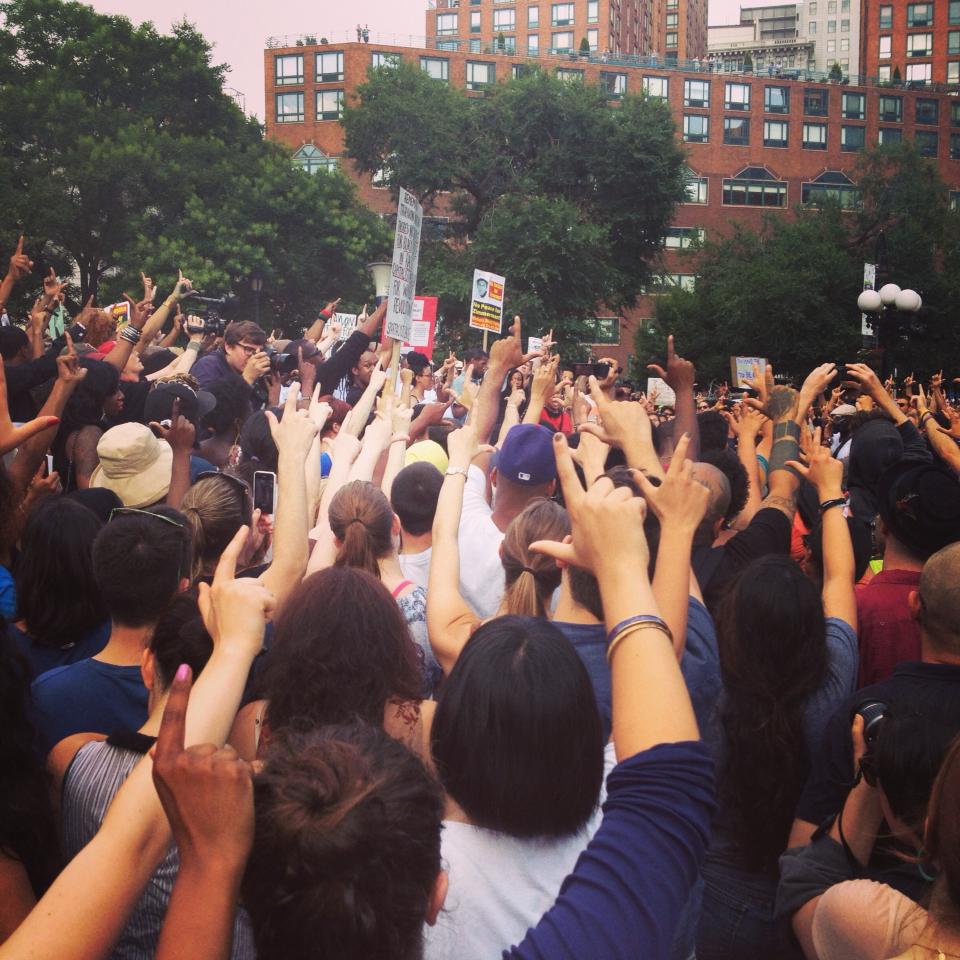
Photograph by: Darnell Moore (NYC March for Trayvon Martin 2013)

Photograph by: Darnell Moore (NYC March for Trayvon Martin 2013)

We can’t watch and participate in the national obliteration and shaming of Rachel Jeantel and wonder why we never organized around the killing or rape of a black woman. We can’t lie, cheat on, or manipulate black women while convincing black women it’s so hard for us then wonder why we never organized around the killing or rape of a black woman. We can’t literally and figuratively kill and rape black woman for fun, for free, for checks, for claps from our niggas, and wonder why we never organize around the killing or rape of black woman.

No art, no person, no relationship, no sexual fantasy that kills and rapes black women is going to stop black women from being killed, hurt, and raped. If our consumption and creation doesn’t affirm, accept, and explore the complicated lives of black women, we can’t be bout that life. No exceptions. Never. Shameful that after all this life, and education, and art creation, your tweet made me know that we really ain’t been bout shit. We really been encouraging black women’s death while leaning on black women for survival. Sorry ain’t enough.

Kiese (@KieseLaymon)

_________________________

Dear @PrestonMitchum, ”@PrestonMitchum: #blackpowerisforblackmen because as sad as it already was, what if Trayvon were a woman?”

What if Trayvon were a woman? After reading your tweet, I contemplated that question for hours. I thought about everything I read about Trayvon Martin. I thought about all the conversations I had about Trayvon Martin. I tried to remember similar conversations about female-identified individuals. They really didn’t exist. And when they did, they were framed in the context of blaming the victim for something “she” should have done to prevent the horrendous actions perpetrated against her. If Trayvon were a woman, the story would have been told though the lens of a male because our society always allows men to speak for women, believing this act gives women a voice. We have yet to truly move past ideas of coverture and do the work to train our sons, husbands, brothers, and male friends to  view women not as property but as equal partners.silence

The silencing of women is so deafening that even in life and death we want to dictate the terms of how a women can give life or how we would tell her story in death. I don’t profess to understand the myriad ways my male-privilege continually operates to suppress and oppress women but I can celebrate all women and I can do the work to love women as Rainer Maria Rilke teaches. — “Love is the commitment to be the witness to someone else’s joy in life, not to be that joy.”

Wade (@Wade_Davis28)

________________________

Dear @Blade_Varzity, ”#blackpowerisforblackmen Can someone explain exactly how BM are stopping BW from addressing ANY of these issues they’re tweeting about?”

scaleBlade, I have come to realize that sometimes we as people,who exist on the scale of oppression (I am a Black man of immigrant parentage from a ghetto in Brooklyn who spent 1/3 of his life in prison), are so easily blinded by our own marginalized place on that scale that we are unable to see how we contribute to the oppression of others. I say this not as an indictment on you in any way, but as an expression of understanding and realization of the shrewd nature of the hierarchy of oppression and our subconscious infatuation with our own oppression.

As Black men in a patriarchal, white supremacist world it’s so easy not to realize our own male privilege because in comparison to white male (and female) privilege, we think our whatever-privilege is minuscule. But, however minuscule, it DOES exist, particularly in the eyes of Black women, and especially when we, black men, don’t acknowledge our role in their oppression as Black Women.

Like I said Blade, this is not an accusation just an observation. Peace, bruh. 

Marlon (@marlon_79)

_________________________

Dear Yolo Akili Robinson (@YoloAkili), You tweeted the following: “#BlackPowerisForBlackMen becuz even in the Black LGBT community MALE voices (cis/trans) r still privileged over all women&genderqueer folks.”

Damn, bro! Your words hit me hard—in the best way possible.

I am a gay black man who has been skilled at calling out white racism and heterosexism as weapons that have stifled my own senses of freedom. I even try to do the type of self-work necessary to understand my complicity in sexism and the part I play in maintaining the patriarchy, but I know that I can do and be better.

hrcI can do better at not only calling out sexism, misogyny, transphobia, rape culture, and so much else, but I can be a better brother to my cis and trans sisters (regardless of their sexual identities) by not taking up too much space (when I know that some spaces are often made available to me precisely because I am a black gay cis man). That is the work, my work, for sure.

We black gay men have models of the “better,” however. My brother Kai M. Green (@Kai_MG) reminded me that some of our black gay male elders (who, too, benefited from the unearned privilege of maleness) worked hard to think and practice feminism. Kai tweeted: “#blackpowerisforblackmen bcuz we 4get Joseph Beam and Marlon Riggs were Blk feminists 2. Feminism isn’t just for cis women–>we ALL need it!” Yes, feminism is for all of us. I am in community with women I can learn with/from, remain accountable to, and engage transformative personal and social justice work alongside. I want my sisters and critically conscious brothers, as my brother Kiese once wrote, “to knock my hustle” when need be. I will do the same for you and others. That is the only way I can grow. The only way that we can be better. The only way that I/we might truly show up as allies in the struggle to end patriarchy, the power-driven reign of “the man” (and not just the one imagined as white, but also the one who stares us black men back in the face when we look in the mirror).

Darnell (@moore_darnell)

________________________

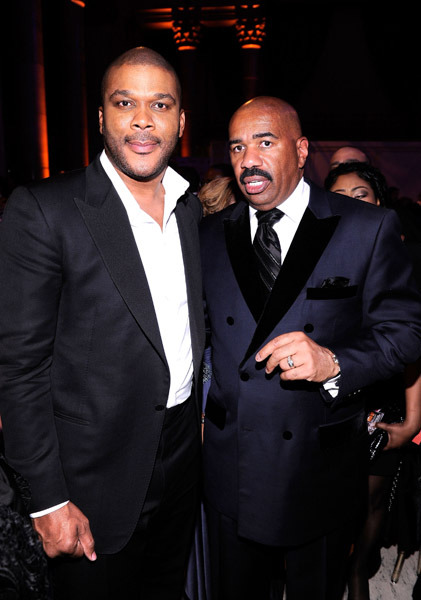
Dear Raequel Solomon (@systris2h), ”cause tyler perry and steve harvey are deemed worthy of telling US how we should be living? #blackpowerisforblackmen”

Your tweet is complicated and my feelings towards both Tyler Perry and Steve Harvey are as complicated. I’m assuming the “US” that you are referring to is black women; but even if that isn’t the case, the black community at large is still deeply affected by these two men and the public platforms they occupy. I don’t know who is deeming Perry and Harvey as “worthy” and again, I’m assuming because of the hashtag that accompanied your tweet you may have meant black men are. But I’m completely convinced what is responsible for this “christening” of Harvey and Perry’s black sagaciousness is not a population, but an institution and a doctrine.tyler-perry-steve-harvey

Black living is messy and difficult and is more trial and error than anything else. Anything or body that says otherwise is standing on the side of black powerlessness as opposed to black power. What is also crucial in my conceptualizing this tweet is the context that black media has carved into this moment of post-racial hopscotch and difference’s reduction. The sheer number of black faces and spaces in American media is slim to none and the ability to choose with a convicted agency is placed in jeopardy as a result. But a choice is nonetheless being made.

It would be misguided and misinformed to approach this tweet without sensitivity to gender’s role in producing it. Yes, Steve Harvey and Tyler Perry are black men and, yes, black men have participated in the patriarchal tradition of speaking for and over black women, but issues of hegemony and capitalist seduction aside, the consumers of products made by these two men make a choice to support their products and never should we, as black people, attack the people choosing or producing the product, but instead the product itself. Bottom line is this – the interrogation of the function and usefulness of the tangible products that make up a black social reality is a fundamental method to form and maintain black power in this profit-driven, privately influenced market we know as America.

Peace,

Hashim Khalil Pipkin (@ablkCharlieBrwn)

___________________________

Dear Charlene Carruthers (@charlenecac),

You tweeted, “#blackpowerisforBlackmen because Frederick Douglass, Booker T. Washington and Denmark Vesey would never end up in a sex tape spoof.” You also tweeted, “Uncle Rush and Co. didn’t just pick a nameless black woman. They picked our ‘Black Moses.’ The gun wielding guide to freedom.”

You made me revisit Audre Lorde’s call for women to make use of the erotic as a source of power, a source of power that because of patriarchy, misogyny, and white supremacy has been deemed solely pornographic. There is power in the erotic—it is a site of reproduction, a site of intimacy (intimate relationships with lovers, intimate relationships with kin, intimate relationships with violence, loss and death), and a site of struggle. The erotic terrain is a site of embodied knowledge. That Black men like Uncle Rush and Co. feel it is funny to make a sex tape starring Harriet Tubman is violent and sick. They went back and sexually violated a historical figure and then disappeared the evidence (the video), but the deed was done and those ghosts will continue to haunt us like so many other “nameless Black women,”–-we must speak up. The struggle that Black women have had and continue to endure in order to gain access to their erotic power is real.tumblr_mcl7neINkP1rpkenpo1_400

Although Audre Lorde’s call was to women, it is clear that men, Black men especially, need to interrogate the erotic as well (Thank you Alexis Pauline Gumbs for this lesson). The erotic for Black men has been distorted by a violent type of pornography perpetuated by Black men as well as others—it is the notion that Black manhood is only fully realized when men through domination take control of their houses, their women, and their stuff. The erotic as a source of knowledge cannot be fully reached until we, Black men, let go of our ideas about reclamation of some ideal manhood that was taken from us. We must let go of manhood as ownership. We spend so much time trying to reclaim some sense of humanity through manhood that we don’t see how we become the oppressors in our quests to reclaim.

If we could only realize that everything we need, we have. But then that is scary, because what is it that Black men have that we don’t want to face? Lorde stated that the erotic “lies in a deeply female and spiritual plane.” Hortense Spillers says, “It is the heritage of the mother that the African-American male must regain as an aspect of his own personhood–the power of the ‘yes’ to the ‘female’ within.”

For Black men to really be able to interrogate the erotic, we must face the real truth of our vulnerability, too. Because though we will not see a sex tape spoof of Booker T. Washington, we know that historically and in the present day, Black men’s bodies also archive dis-(re)membering sexual traumas. We too were made to bend over and open up, taking in whatever the master decided to feed us that night. But if we cannot face that in ourselves and in our bodies because we only see it as emasculation, then we lose our erotic power. We lose the power to unite with Black women. We lose the power to ultimately unite with our full selves. We lose the power to analyze the ways in which we become oppressors because we are no longer able to see Black male privilege–we only see white racism and white men. We reach for that white power not realizing we have access to something much greater, much more generative, right here in our own bodies as Black men.

Black men need to do as Hortense Spillers says and interrogate that being that we are encouraged to despise, the being that we fear will destroy our manhood, that Black woman that lies deep in us—this strength is also this vulnerability.

We are not enemies, Black men and women. Black men need to recognize that critique is love. Love asks us to grow. We need to grow.

I want you to trust me.

I understand that the love of a Black woman is a privilege often times devalued, but I value you and your love. I value the love of Harriet Tubman. I value the love of my mother—Black love, tough love, deep love, mama love, granny and auntie love, lover love, sweet potato pie love, I’m tired from working all day love, get the holy ghost and pass out love, get school clothes for baby while you still wear that same ol’ raggedy dress and make it look good love, stay up all night and watch over me when I’m sick love, I’m tired of yo’ triflin’ ass I’m leavin’ love, I’m hurt love, I’m exhausted but I’m still gonna make you dinner love, You locked up so I’mma hold it down for you love, gansta love, Black professional don’t have time to cook but let’s share a glass of wine love, I will carry your stash love, I will go down on your behalf love, I will testify in court love, young love, hot love, you getting on my nerves love, love love, Black women’s love is God love.

I will do my part to reflect that love. I will hold you when I am strong and when I am weak. I stand with you. And I vow to you that no quest for freedom of mine will begin with the devaluation of your body, spirit or intellect. I vow to listen to you. I vow to stay open to being checked, but I will not wait on you to check me. I will work to check myself too, because I understand that feminism isn’t just about your liberation, it’s about OUR liberation. If my manhood becomes a placeholder for my humanity, we are doomed. But I want to live, love.

<3Kai (@Kai_MG)

______________________

Several members of the Brothers Writing to Live Collective

Several members of the Brothers Writing to Live Collective

Brothers Writing to Live is a group of black cis and trans-men who hail from spaces across the United States. We come from myriad neighborhoods, diverse familial backgrounds, and different life worlds. We are different, indeed. And, yet, in so many ways we are the same. We are black male identified writers whose notions of blackness, manhood, and writing are as assorted as our multifaceted lives. Whether we have come from the red clay roads of Mississippi or the cement paved streets of New York City, through our writings we have mapped out similarities regarding the ways that racism, gender restrictions, capitalism, heteropatriarchy, ableism, economic disenfranchisement, heteronormativity, criminal (in)justice systems, and so much else has shaped the men that we have become and yet to be. This campaign has united the following black male writers:

Kiese Laymon, Writer & Professor at Vassar College

Mychal Denzel Smith, Writer, Mental Health Advocate, & Cultural Critic

Kai M. Green, Writer, Filmmaker, & Ph.D Candidate at USC

Marlon Peterson., Writer & Youth & Community Advocate

Mark Anthony Neal, Writer, Cultural Critic, & Professor at Duke University

Hashim Pipkin, Writer, Cultural Critic, Ph.D. Candidate at Vanderbilt University

Wade Davis, II, Writer, LGBTQ Advocate, & Former NFL Player

Darnell L. Moore, Writer & Activist

The “Unsophisticated” Mirror of Rachel Jeantel thefeministwire

The Feminist Wire

The “Unsophisticated” Mirror of Rachel Jeantel

July 22, 2013

By 

By Lauren G. Parker

The prosecution needed to represent Rachel Jeantel as much as they represented Trayvon Martin because her assumed unintelligence and subsequent worthlessness were inadvertently assigned to him. Aware of this, prosecution attorney Bernie de la Rionda attempted, but failed, to insist upon her credibility in his closing statements. Before queering a Dr. King quote by saying that she “should not be judged by the color of her personality but by the content of her testimony,” he told the jury that she was “a little unsophisticated” and “uneducated.”Rachel_Jeantel_rtr_img

By insulting her to gain credibility, he complied with the idea that she was insignificant and by default, so was Martin’s life. Such inherently assumed superiority over Jeantel from the prosecution’s closing statement, the defense’s humiliating tactics and venomous commentary from cyber voyeurs was deeply remnant of a passage from Toni Morrison’s The Bluest Eye in which Morrison stated:

 All of us—all who knew her—felt so wholesome after we cleaned ourselves on her. We were so beautiful when we stood astride her ugliness. Her simplicity decorated us; her guilt sanctified us, her pain made us glow with health, her awkwardness made us think we had a sense of humor. Her inarticulateness made us believe we were eloquent. Her poverty kept us generous. Even her waking dreams we used—to silence our own nightmares. And she let us, and thereby deserved our contempt. We honed our egos on her, padded our characters with her frailty, and yawned in the fantasy of our strength.

Afraid to embrace those realities, many dwelled on their critiques of Jeantel’s dialect. Here, too, there was a deep politic that neither the talented-tenth, code-switching middle class Black folks who claimed to be ashamed by her nor those who maintained the racist ideology that she was merely another ignorant, fat black woman, could bear to acknowledge. James Baldwin’s 1979 essay, “If Black English Isn’t A Language, Then Tell Me, What is?” best presented this truth where he states,

…language is also a political instrument, means, and proof of power. It is the most vivid and crucial key to identify: It reveals the private identity, and connects one with, or divorces one from, the larger, public, or communal identity.

He further explains,

Language, also, far more dubiously, is meant to define the other–and, in this case, the other is refusing to be defined by a language that has never been able to recognize [them]. People evolve a language in order to describe and thus control their circumstances, or in order not to be submerged by a reality that they cannot articulate.

Just as many have never considered that Trayvon Martin, who we know for a fact was followed by George Zimmerman, was standing his own ground, many who shared Juror B-37’s condescending viewpoint and “felt bad” for Rachel who was “using phrases [they] never heard before” have not considered themselves ignorant for not understanding her. Those same individuals may never challenge the absurdity of having deemed themselves the standard of comparison; nor will they realize that they misnamed her “uneducated” in order to hide from the paralyzing fear of a heavy-set, dark skinned teenager unwilling to bow to their assumed superiority.

Rachel Jeantel cannot be reduced to just a witness in a popular trial because what she endured in court and from the media were private acts made public: the mocking and silencing of black women and girl’s stories as well as the devaluing of their traumas. In response to critics, Jeantel shared with Piers Morgan that  “[My critics] should be appreciating [me]. You should learn from this situation. If it happened to you or your family, would you step up or would you just say ‘oh, it ain’t my business’?” To my mind, she has remained brilliant and strong in spite of the overwhelming grief of losing a friend and then being publicly labeled as ignorant–as a national embarrassment–because she, like James Baldwin, knows that  “it is [never] the black child’s language that is in question, it is not [their] language that is despised: It is [their] experience.”

______________________________________

L_G_Parker-The_'Unsophisticated'_Mirror_of_Rachel_Jeantel-lgpLauren G. Parker is an undergraduate, intended Creative Writing major at George Mason University. Currently, she is co-coaching Richmond, Virginia’s internationally competing youth slam poetry team.


4 Amazing Black Women They Don’t Tell You About in School l AlterNet

4 Amazing Black Women They Don’t Tell You About in School

It’s doubtful that the names Elizabeth “Mum Bett” Freeman, Callie House, Josephine St. Pierre Ruffin or Johnnie Tillmon even draw a glint of recognition but they should.
March 17, 2013 |

As with Black History Month, the focus on already well-known figures has been an ongoing criticism of Woman’s History Month. When it comes to black women, Sojourner Truth, Harriet Tubman, Ida B. Wells and Rosa Parks are on repeat. What makes these much-needed theme months thrive, however, is the spirit of discovery. It’s doubtful that the names Elizabeth “Mum Bett” Freeman, Callie House, Josephine St. Pierre Ruffin or Johnnie Tillmon even draw a glint of recognition but they should. In their own ways, each of these women made important contributions to the ongoing struggle for freedom and justice.

Even as a slave, Elizabeth Freeman, known as Mum Bett most of her life, had the audacity to sue for her freedom. Born into slavery in Claverack, New York around 1742, Freeman, at a reported six months old, was sold, along with her sister, to John Ashley of Sheffield, Massachusetts, a judge in the Massachusetts Court of Common Pleas. Enslaved to Ashley until she was almost 40, Freeman was spurred to action when the mistress of the house Hannah Ashley tried to hit her sister with a heated kitchen shovel. Freeman intervened and was hit instead, leaving the house, vowing to never come back.

Aware of the 1780 Massachusetts state constitution and its declaration of all men being free and equal from Sheffield’s many conversations, Freeman sought the services of Theodore Sedgwick, an attorney with anti-slavery sentiments. In 1781, a Massachusetts court awarded Freeman and another of Ashley’s slaves named Brom their freedom in Brom and Bett v. J. Ashley, Esq., even requiring Ashley to pay damages.

This set a major civil rights precedent. W.E.B. DuBois even claimed Freeman, who adopted the name after her legal victory, as his maternal great-grandmother – even though this connection was by marriage – as she was such an important figure to him. Freeman passed away in 1829.

Born into privilege in Boston in 1842, Josephine St. Pierre Ruffin used her education and background to uplift black women. Married at age sixteen to George Lewis Ruffin (who would later become Harvard Law School’s first black male graduate, the first African-American elected to the Massachusetts state legislature and to the Boston City Council, and the first African-American municipal judge in Boston), Ruffin, a suffragist, helped Julia Ward Howe and Lucy Stone form the American Woman Suffrage Association in Boston in 1869. After her husband’s death in 1884, Ruffin, also a journalist and early member of the New England Women’s Press Association, became even more active, launching Women’s Era, believed to be the nation’s first newspaper published by and for black women, serving as editor and publisher from 1890 to 1897.

With her daughter, Florida Ruffin Ridley, and Boston principal, Maria Baldwin, she launched the New Era Club for black women in either 1893 or 1894 depending on the source. In 1895, Ruffin helped organize the National Federation of Afro-American Women, convening its first national conference in Boston attended by 100 women representing 20 clubs in 10 states. A year later, in 1896, the organization merged with the Colored Women’s League to form the National Association of Colored Women’s Clubs.

Although a member of several white women’s clubs, Ruffin advocated for black women as a suffragist. She rejected recognition as a delegate at a major conference in 1900, for example, because organizers only sought to confer the role due to her membership in several prominent white women’s clubs. Instead, Ruffin chose to stand up for the validity of black women’s clubs like her own New Era.

Active in other areas, Ruffin was also a founding member of the Boston branch of the NAACP. She passed away in 1924 at age 81.

Callie House, born Callie Guy in slaveholding Rutherford County, Tennessee in 1861, is still relatively unknown, despite the book about her lifeMy Face Is Black Is True: Callie House and the Struggle for Ex-Slave Reparations by Mary Frances Berry. But House, a laundress operating out of Nashville in the 1890s, is an important figure in the reparations movement.

In 1894, House, along with Isaiah Dickerson, who had worked with white political activist William Vaughn around reparations in Omaha, Nebraska, organized the National Ex-Slave Mutual Relief, Bounty, and Pension Association. Open to all, the Ex-Slave Pension Association, working nationally and locally, filled the void of the Freedmen’s Bureau, providing burial services as well as care for the sick and disabled to its membership in addition to advocating for legislation for ex-slave pensions.

Because of her success, House became a target. In 1899, the U.S. Post Office, emboldened by theComstock Act of 1873, issued a fraud order against House and the Ex-Slave Pension Association. Continued federal intimidation forced House to step down as assistant secretary of the Ex-Slave Pension Association in 1902 but did not stop her from organizing more local chapters throughout the South. The wind left her sail, however, when Alabama Congressman Edmund Petus’s reparations legislation failed in 1903.

Pressing on, however, House worked with attorney Cornelius Jones and sued the Treasury Department for just over $68 million in cotton taxes tied to slave labor in Texas, but the case they filed in 1915 was ultimately dismissed. In 1916, House and other Ex-Slave Pension Association officers were indicted for allegedly using the postal service to defraud ex-slaves by promising that pensions and reparations were forthcoming. Convicted by an all-white, all-male jury, House was sentenced to a year and one day which she served in a Missouri penitentiary from November 1917 to August 1918, obtaining an early release for good behavior. Returning to Nashville as a laundress, House died ten years later, but her pioneering and early contributions to the reparations movement should not be forgotten.

Born the daughter of an Arkansas sharecropper in 1926, Johnnie Tillmon never let lack stop her. Leaving her first husband in Arkansas for California, with her children in tow, Tillmon, who did not have a high school education, found herself on welfare where she learned first-hand of indignities — such as welfare inspectors rummaging through refrigerators and showing up at midnight to catch male company — that women suffered. Through anonymous letters, Tillmon organized more than 300 of her Watts housing project neighbors in protest in 1963, leading to the formation of the Aid to Needy Children-Mothers Anonymous shortly thereafter, which later inspired the creation of the National Welfare Rights Organization—an organization that one-time boasted over 25,000 members, mostly black women. Tillmon Blackston served as Executive Director starting in 1972 until the organization’s demise in 1974.

Tillmon injected the particular rights and concerns of poor black women into the national feminist and civil rights dialogue. In the pivotal essay “Welfare is a Women’s Issue,” published in Ms. magazine in 1972, Tillmon argued that because 99 percent of families on Aid to Families with Dependent Children were headed by women, welfare was indeed a women’s issue. In addition, she brought attention to issues of birth control and the sterilization of poor black women, as well as the economic exploitation of poorly educated women. She even called then-California Governor Ronald Reagan out for referring to welfare recipients as “lazy parasites.”

In a time when it was posh to bash the so-called black welfare queen, Tillmon, who passed away in 1995 at age 69, pushed back, dedicating her life in various capacities to bringing much-needed awareness to the struggles of poor black women.

Tillmon’s contributions, as well as those of Elizabeth Freeman, Josephine St. Pierre Ruffin and Callie House, may be unsung today — but there is no denying that each of these women played more than their part in uplifting their race and their gender, as well as in elevating the moral standard by which all human beings cooperating in a humane society should be measured.

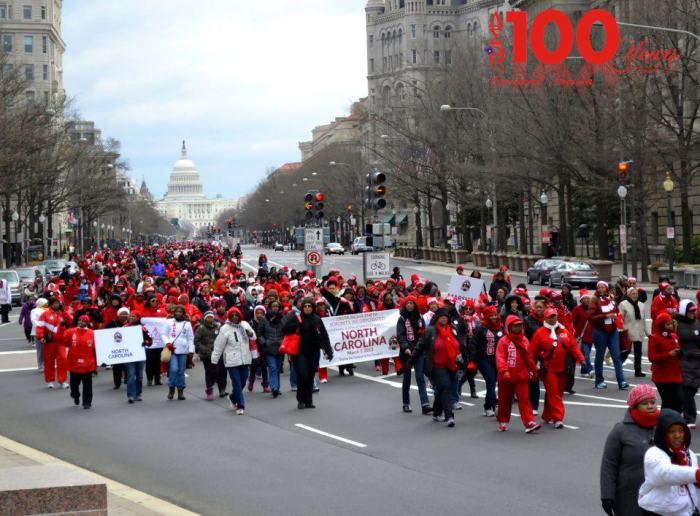
The Day the Deltas Marched into History

WP Opinions

Opinions

The Day the Deltas Marched into History


By Mary Walton


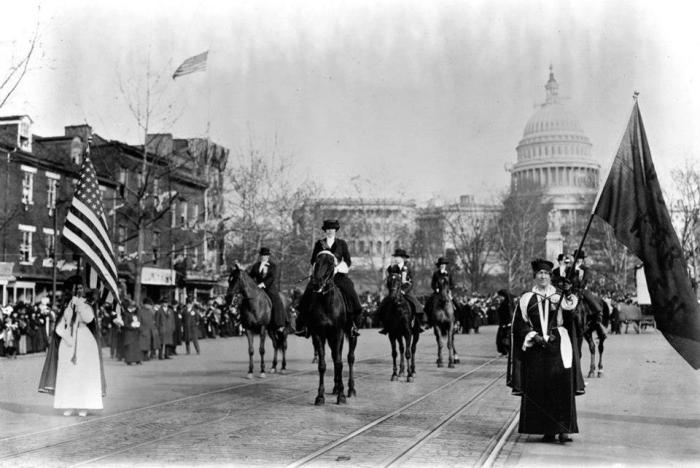
Lured by the promise of a parade unlike any Washington had seen, the first spectators began to arrive at 9 a.m. March 3, 1913, six hours early. By the time the trumpets sounded, some 250,000 people lined Pennsylvania Avenue.Leading the way from the Capitol to the Treasury Department was a horse-drawn float bearing a banner that read, “We demand an amendment to the constitution of the United States enfranchising the women of the country.” It would be followed by more floats, nine bands, four mounted brigades, three heralds with trumpets and somewhere between 5,000 and 8,000 women.

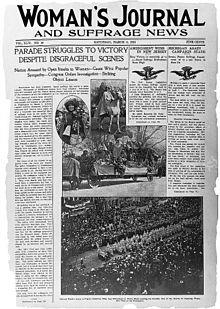
Organized in two months by Alice Paul, a driven, young Quaker, the capital’s first suffrage parade was timed to put pressure on Woodrow Wilson on the day before his inauguration.
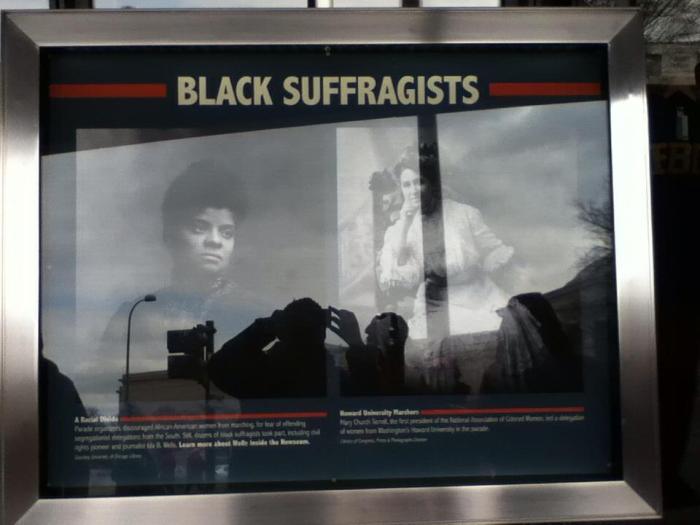
Everyone was welcome to participate, including men, with one exception. In a city that was Southern in both location and outlook, where the Christmas Eve rape of a government clerk by a black man had fanned racist sentiments, Paul, a white woman, was convinced that other white women would not march with black women. In response to several inquiries, she had quietly discouraged blacks from participating. She confided her fears to a sympathetic editor: “As far as I can see, we must have a white procession, or a Negro procession, or no procession at all.”Aware they were not wanted, fearful they might be attacked, 22 founding members of Delta Sigma Theta, a new Howard University sorority, joined the procession anyway. Among black activists, the prevailing view was that if white women needed the vote to secure their rights, black women needed it even more. One adviser was Mary Church Terrell, a founder of the NAACP and an activist for women’s rights. When the sorority was founded Jan. 13, she wrote its secret oath.Memories of parades fade like old photographs. But for those who were least welcome, the 1913 suffrage parade has become a touchstone. Says Ella McNair, the Deltas’ director of public relations, “Everybody who has been a member of this organization knows about the march. They could have had a social, they could have had a tea. But they did not choose that. They were committed to advocacy and social action.”

Marking their historic role a century ago, and also celebrating the centennial of their founding, thousands of Deltas plan to fill Pennsylvania Avenue today along with members of other women’s organizations.

If Paul had her druthers, there would have been no black marchers. But just days before the parade, she became more receptive to the possibility. What brought matters to a head was a letter from Nellie M. Quander, a schoolteacher and Howard graduate, who said that Howard women wanted to take part. Usually prompt to reply, Paul took a week to respond. She suggested Quander “call” at the headquarters of Paul’s parent organization, the National American Woman Suffrage Association. Records do not reflect a meeting.

Complaints of discrimination reached the association, which wired orders to permit black marchers. Paul had no choice. Representing the sorority in negotiations, Terrell agreed that the Deltas would march next to the New York delegation.

Meanwhile, panicky reports came from white suffragists in Chicago that Ida B. Wells-Barnett, the celebrated author of an anti-lynching campaign and an African American, planned to join the procession. When the Illinois unit mustered, leaders instructed Wells-Barnett to walk with an all-black group. Tears forming, Wells-Barnett refused to take part unless “I can march under the Illinois banner.” By all accounts she solved the issue herself, defiantly joining the unit in mid-parade.

At that point, few would have noticed. The parade was a shambles.

From the outset, authorities had been worried about the threat to security from male onlookers, particularly hard-drinking southern Democrats celebrating the election of a Virginia-born president. They suggested holding the event the day after the inauguration, perhaps on 16th Street, a safe distance from the Bowery. But Paul rallied supporters and went to the press. Open Pennsylvania Avenue to the women, urged the Washington Times, because that was where the men marched. Paul got her way.

The violence erupted minutes after the parade began. The crowd broke through steel cables and spilled into the street. Men, many of them drunk, spit at the marchers and grabbed their clothing, hurled insults and lighted cigarettes, snatched banners and tried to climb floats. Police did little to keep order. Observed one of Paul’s supporters, “I did not know men could be such fiends.” Galloping to the rescue, Army cavalry from Fort Myer cleared a path, and the parade continued on, albeit well behind schedule.

Paul was far from displeased. The parade, including the violence, was front-page news across America, drawing attention to suffragists and their cause. For its part, a fledgling sorority hatched just six weeks earlier could already claim a proud history.

Mary Walton is the author of “A Woman’s Crusade: Alice Paul and the Battle for the Ballot.”

delta3

suffrage2 suffrage3
deltas suffrage dst

Victims Of Violent Military Rapes l National Review Rebuttal to NYT Coverage

National Review: Victims Of Violent Military Rapes Struggle In Life Because Of ‘Their Own Bad Decision-Making’

By Adam Peck on Feb 28, 2013 at 6:15 pm

A victim of M.S.T. profiled by the New York Times.

In Thursday’s paper, the New York Times ran theharrowing story of Tiffany Jackson, a female veteran grappling with the effects of military sexual trauma. Jackson had been violently raped while deployed overseas at the Suwon Air Base in South Korea, and upon her return to the states had difficulty finding and keeping a job, struggled with drugs and alcohol and fought uphill battles to keep her anger at bay. All of which, according to a growing consensus of researchers and psychologists, are common manifestations of post-traumatic stress disorder brought about by M.S.T.

But expert opinion is not enough to convince the scribes at National Review Online, which issued its own rebuttal to the Times piece and proclaimed — without a shred of evidence — that the hardships befallen upon Jackson and as many as 1 in 5 of all female servicemembers are attributable to their upbringing in underprivileged communities and not to their sexual assaults. And they engage in an especially pernicious form of victim-blaming in the process:

Now here is a tentative alternative hypothesis: Some of these women come from environments that made their descent into street life overdetermined, whether or not they experienced alleged sexual assault in the military. To blame alleged sexual assault for their fate rather than their own bad decision-making is ideologically satisfying, but mystifying. Having children out of wedlock, as a huge proportion of them do, also does not help in avoiding poverty and homelessness…

But let’s say that for these homeless female vets, it really was their sexual experiences in the military that caused their downward spiral into, as the Times puts it, “alcohol and substance abuse, depression and domestic violence.” Why then have those same feminists who are now lamenting the life-destroying effects of “MST” insisted on putting women into combat units?

Writer Heather MacDonald fails to acknowledge once in her almost 1000-word post that there is a problem at all, preferring instead to leverage the horrific rate of sexual assault and violent rape against women in the military as a means to attack gender equality in the armed forces. Nastier still, she attacks the “feminists” who are fighting for greater accountability and protections for the thousands of women who enlist.

Of course, the National Review Online has a strong lineage of sexist, misogynistic and racistremarks. In January, the conservative publication blamed the Sandy Hook elementary school shooting on the fact that women ran the school, and for years kept author John Derbyshire in their employ despite vocally questioning whether or not women should have the right to vote.


Ella Baker and the Limits of Charismatic Masculinity l Black Agenda Report

Ella Baker and the Limits of Charismatic Masculinity

 Pascal Robert

Tue, 02/19/2013

by Pascal Robert

Ella Baker, the consummate organizer, “was very critical of the hot shot Black preachers who would seem to mesmerize their audience with soaring oratory, then leave and expect others to implement an agenda.” She put forward a grassroots critique of overwhelmingly male Black leadership, and showed “more wisdom, courage, and vision then almost all of them.”

Ella Baker and the Limits of Charismatic Masculinity

by Pascal Robert

This article originally appeared on Mr. Robert’s website, Thought Merchant.

She believed in giving people the power to choose their direction and make demands.”

In perhaps one of the most important biographies of a civil rights leader published, Professor Barbara Ransby has conveyed the epic life and struggle of a woman whose sheer skill, leadership, and ability to mobilize the marginalized and dispossessed to full participation in their fight for human dignity is almost unprecedented in American history. In her book, Ella Baker & The Black Freedom Movement, Professor Ransby documents the life of Ella Baker, a Black woman born to a middle class family in North Carolina in 1903 who, after witnessing the staunch spiritually based dedication of her mother to serving the poor in the South, transforms into a sheer force of will that worked with all the major civil rights organizations of her time, and helped mobilize to create two of the most crucial to the Civil Rights Movement: The Southern Christian Leadership Conference (SCLC) and the Student Nonviolent Coordinating Committee (SNCC).

Before we continue to heap praise or Hosannas on men like Dr. Martin Luther King, Jr., Wyatt T. Walker, Stokely Carmichael, Malcolm X, Paul Robeson, Thurgood Marshall, W.E.B. DuBois, or any of these other gentlemen we idolize as embodiments of masculine heroism, we should know about one woman, of many, who had more wisdom, courage, and vision then almost all of them: Ms. Ella Baker.

Baker believed in empowering the most common person, whether a sharecropper, teenager, or illiterate vagrant with skills to make demands on the political establishment.”

What made Baker’s method of organizing both effective and revolutionary is that it completely dismissed the traditional paradigm of leadership that had plagued the Black community from its earliest history in North America, stemming mostly from the Black Church: charismatic masculine leadership based on oratory and exhibitionism. Baker believed in empowering the most common person, whether a sharecropper, teenager, or illiterate vagrant with skills to make demands on the political establishment. Baker believed that people did not need fancy leaders with degrees and pedigree to tell them what was best for them. She believed in giving people the power to choose their direction and make demands, and put pressure on institutions without depending on big shots with fancy suits. In her book Professor Ransby notes:

At every opportunity [Ella] Baker reiterated the radical idea that educated elites were not the natural leaders of Black people. Critically reflecting on her work with the NAACP, she observed, “The Leadership was all from the professional class, basically. I think these are the factors that have kept it [the NAACP] from moving to a more militant position.”

Moreover, Ella Baker was very critical of the hot shot Black preachers who would seem to mesmerize their audience with soaring oratory then leave and expect others to implement an agenda. As Ransby further notes at one point Ella Baker asked Dr. King directly “…why he allowed such hero worship, and he responded simply, that it was what people wanted. This answer did not satisfy Baker in the least.”

Ella Baker did not mince words on her thoughts of Dr. King’s leadership style and vocally spoke out on its limitations:

Baker described [Dr. King] as a pampered member of Atlanta’s black elite who had the mantle of leadership handed to him rather than having had to earn it, a member of a coddled ‘silver spoon brigade.’ He wore silk suits and spoke with a silver tongue.

…In Baker’s eyes King did not identify enough with the people he sought to lead. He did not situate himself among them but remained above them.

“…Baker felt the focus on King drained the masses of confidence in themselves. People often marveled at the things King could do that they could not; his eloquent speeches overwhelmed as well as inspired.”

Obama has been as anemic in delivering real change and effective at stifling progress as Ella Baker worried Dr. King would have been.”

The limitations of this charismatic masculinity noted by Ella Baker are profound, particularly in today’s political age when we have a president like Barack Obama who often tries to channel the traditions of charismatic leadership and oratory from the Black tradition. Ironically, Obama has been as anemic in delivering real change and effective at stifling progress as Ella Baker worried Dr. King would have been. So perhaps in a strange twist, we have found a similarity between King and Obama after all.

Often in America, when discussing prominent Black trailblazers who fought the injustices of segregation and racial oppression, we see the same images of a variety of men. I somewhat jokingly call them our superhero black male icons. This phenomenon mimics the more noxious western patriarchal fascination with viewing history as a series of events being shaped and guided by the hands of a strong capable man embodying all our fantasies about leadership, masculinity, and sometimes fatherhood.

The danger of such imagery is that it often both obscures and denies the scope of nuanced factors, issues, and circumstances in shaping the events from which our societies were born. Furthermore, such narratives often exclude any consideration of female agency in effecting the great events that have transpired over time.

Barbara Ransby should be applauded for putting a halt to this tradition and setting the record straight with her towering biography Ella Baker & The Black Freedom Movement. As a man still troubled with patriarchal sexist notions, this book opened my eyes to ways in which the roles of women are often neglected and intentionally obscured. Let us all read the story of Ella Baker and make sure such injustices do not continue.

Pascal Robert is an Iconoclastic Haitian American Lawyer, Blogger, and Online Activist for Haiti. For years his work appeared under the Blog Thought Merchant: http://thoughtmerchant.wordpress.com/ You can also find his work on the Huffington Post here: http://www.huffingtonpost.com/pascal-robert/ He can be reached via twitter at: https://twitter.com/probert06 @probert06 or thoughtmerchant@gmail.com


Related Links

V-Day l ONE BILLION RISING l World Wide February 14, 2013

vDAYABOUT V-Day

English | Deutsch | Español | Français

To read V-Day founder Eve Ensler’s bio, click here

V-Day is a global activist movement to end violence against women and girls. V-Day is a catalyst that promotes creative events to increase awareness, raise money, and revitalize the spirit of existing anti-violence organizations. V-Day generates broader attention for the fight to stop violence against women and girls, including rape, battery, incest, female genital mutilation (FGM), and sex slavery.

Through V-Day campaigns, local volunteers and college students produce annual benefit performances of The Vagina Monologues, A Memory, A Monologue, A Rant and A Prayer, Any One Of Us: Words From Prison, screenings of V-Day’s documentary Until The Violence Stops, and the PBS documentary What I Want My Words To Do To You, Spotlight Teach-Ins and V-Men workshops, to raise awareness and funds for anti-violence groups within their own communities. In 2012, over 5,800 V-Day benefit events took place produced by volunteer activists in the U.S. and around the world, educating millions of people about the reality of violence against women and girls.

Performance is just the beginning. V-Day stages large-scale benefits and produces innovative gatherings, films and campaigns to educate and change social attitudes towards violence against women including the documentary Until The Violence Stops; community briefings on the missing and murdered women of Juarez, Mexico; the December 2003 V-Day delegation trip to Israel, Palestine, Egypt and Jordan; the Afghan Women’s Summit; the March 2004 delegation to India; the Stop Rape Contest; the Indian Country Project; Love Your Tree; the June 2006 two-week festival of theater, spoken word, performance and community events UNTIL THE VIOLENCE STOPS: NYC ; the 2008, V-Day 10-year anniversary events V TO THE TENTH at the New Orleans Arena and Louisiana Superdome; the Stop Raping Our Greatest Resource: Power To The Women and Girls of the Democratic Republic of Congo Campaign; theV-Girls Campaign, and the V-Men Campaign.

In Africa, the Middle East, and Asia, V-Day commits ongoing support to build movements and anti-violence networks. Working with local organizations, V-Day provided hard-won funding that helped open the first shelters for women in Egypt and Iraq; sponsored annual workshops and three national campaigns in Afghanistan; convened the “Confronting Violence” conference of South Asian women leaders; and donated satellite-phones to Afghan women to keep lines of communication open and action plans moving forward. V-Day was instrumental in the founding of Karama, a program working in Egypt, Sudan, Morocco, Tunisia, Algeria, Jordan, Syria and Lebanon that works to build upon and strengthen efforts to end violence against women by bringing together local women’s organizations and other civil society groups in collaboration, analysis and advocacy at national, regional and international levels.

In conjunction with the 15th anniversary, V-Day launched its most ambitious campaign to date – ONE BILLION RISING. The concept of the campaign is simple. If you take into account the statistic that 1 out of 3 women will experience violence in her lifetime, you are left with the staggering statistic that over 1 billion women on this planet will be impacted by violence. On V-Day’s 15th Anniversary, 2.14.13, we are inviting ONE BILLION women and those who love them to WALK OUT, DANCE, RISE UP, and DEMAND an end to this violence. V-Day wants the world to see our collective strength, our numbers, our solidarity across borders.

VDAY2The V-Day movement is growing at a rapid pace throughout the world, in 167 countries from Europe to Asia, Africa and the Caribbean and all of North America. V-Day, a non-profit corporation, distributes funds to grassroots, national and international organizations and programs that work to stop violence against women and girls. In 2001, V-Day was named one of Worth Magazine‘s “100 Best Charities,” in 2006 one of Marie Claire Magazine‘s Top Ten Charities, and in 2010 was named as one of the Top-Rated organizations on GreatNonprofits. In fourteen years, the V-Day movement has raised over $90 million.

The ‘V’ in V-Day stands for Victory, Valentine and Vagina.

To learn more about how to organize a V-Day event, click here.

A Black Feminist Comment on The Sisterhood, The Black Church, Ratchetness and Geist l The Feminist Wire

A Black Feminist Comment on The Sisterhood, The Black Church, Ratchetness and Geist

January 28, 2013

By 

Unknown-1There’s been much talk about TLC’s new show The Sisterhood, a reality show about the lives and struggles of Ivy Couch, Domonique Scott, Christina Murray, DeLana Rutherford, and Tara Lewis, five pastor’s wives in the Atlanta area.  While some critics are threatening to boycott the show, and others are framing it as evidence of black [male] preachers loosing their way (which I guess is synonymous with the Black Church loosing its way, but that’s another issue), millions of others, myself included, a former “first lady” and black feminist scholar of religion, race and media, are flocking faithfully to the television screen on Tuesday nights with popcorn and bottled water in hand.

And let me be clear: like many, I’m “sick and tired of being sick and tired” of the operative mediation of the global racist and sexist imagination through black women’s corporeal realities.  I’m tired of mass mediated notions of “black womanhood” being both the adjective and the noun that modifies and constricts space, time and meanings. I’m tired of black women consistently serving as—through both overdetermination and consent—televisual artifacts for establishing white, black and other “normalcy.”  And yes, I’m sick and tired of black women functioning as cultural mediums for soothing primal fears, representational tropes for suckling the collective fascination with black female sexuality, and work horses for demonstrating a mastery of unscrupulousness and otherness.  I’m tired.

SisterhoodAnd yet, I’m also admittedly drawn in to this show and others like it, week after week.  Like so many others before them, Ivy, Domonique, Christina, DeLana, Tara and many other reality TV women, inspire all kinds of repulsions, attractions and anxieties.  However, they also satiate [some of] our ratchet taste buds.  Can we have a moment of honesty?  The Sisterhood is a hit show.  And this isn’t because no one’s watching it.

So what’s the draw?  The Sisterhood creates a conflict between public politics, private realities and personal taste.  However, this war between the emperors’ coat of high culture and the everydayness of his nakedness is nothing new.  This ongoing juxtaposition highlights the ever increasing tensions between the “cultured” and the “ratchet;” the former drawing attention to so-called taste, tact, refinement, civilization and genius, and the latter calling attention to the so-called vulgar.  While the former is purported to arise out of the Geist – the intellectual inclinations – of our times, the latter is purported to spring forth from the worst of black culture.  However, what better communicates the spirit of the time than the ratchet?  And no, I don’t mean the ways that ratchet gets deployed to project a collage of derogatory meanings onto black women’s bodies.  I’m referring to the ways that ratchetness often undergirds the ricocheting of raw emotions and missiles of unfiltered truths.

The-SisterhoodTo uncritically bash The Sisterhood is to toe the expected party line.  To demonize the show is not only an attempt to maintain a position of moral superiority, but an assay to construct and limit meaning for the audience—an audience that may in fact connect with the human qualities of the ratchetness therein.  And trust me, I get the critiques regarding black female representations in media.  This needs to be called out everyday all day—but not while asphyxiating black women’s complex identities with mythological notions of black women’s heroic genius.  In short, binary oppositions don’t work.  They set up “us” versus “them” politics, which are both totalizing and reductive.  I think a better suggestion might be to think about the heroic qualities of black women’s genius, that is if you buy this argument, as at times being a bit ratchet. Identities and tastes shift in shades of grey, not monochrome.  That said, we don’t need another schemata.  And we damn sure don’t need another exceptionalist social fiction to cancel out our complex subjectivities, which can neither be packaged nor wholesaled, by the way.

images-3The Sisterhood isn’t “hurting the church image…[or] giving God a bad name.” Religious people have already done that.  Neither is it “abominable and offensive to the Christian/African American communities.”  I can think of a few other things, all ending with “isms” or “phobia,” to fit that bill.  And finally, it’s not evidence of black [male] preachers or the historical Black Church loosing its way–I haven’t even mentioned how the eve/gender politics here are troubling at best.  And to be sure, I’m not saying wether the Black Church or the black [male] preacher has lost their way or not.  That’s an entirely different conversation.  For starters, I think I’d first need to know what the “way” once was or imagined to be.  And truly, The Sisterhood isn’t even a representation of the Black Church.  As far as I can see, there are only two wives from historical black churches (hold this thought) on the series–whose church would likely define themselves in such a way, Ivy and Domonique.

The Sisterhood is evidence of our obsession with brown women’s lives and our pornotropic desire to lift their curtains and see everything.  In addition, it’s evidence of the fluidity between religion and culture, and the myriad ways that each cross-pollinates the other, thus broadening, limiting and confusing all kinds of meanings.  An example of this is the construction of the “first lady” concept for the show, a Black Church conception structured in both politics of respectability and patriarchal dominance, aimed at constructing alternative identities–distinct from the hypersexual/sexual savage trope–for black women, particularly during the early twentieth century.  As with the FLOTUS, it’s a title of respect for wives in religious contexts that are often theo-socially hostile to women in general.  With regard to black women, there’s a long history here apropos race, gender, sex, sexuality, respectability and wifehood.  However, I’ll save the politics of race, ladyhood and wifedom for another day.

images(Side note: background, I’d be interested to see how the “first lady” title operates for Christina, a Dominican woman married to a black new wave evangelical pastor, and DeLana, a white southern woman who, akin to her co-pastor husband, seems to fancy all things “plantation” (27:56 mark) and soft Christian rock.  I’d be even more interested in seeing how this works for Tara, a black body builder married to a Jewish Christian former pastor, both of whom appear to be working with a different set of gender politics.  But this, again, is another story.)

images-1

Ultimately, The Sisterhood is evidence of not only our obsession with brown women’s lives, the constant interpolation of religion in culture and vice versa and the static nature of meanings in our society, but our very own and ever expanding frailties, contradictions and complexities as human beings.  These women represent the thorny nature of our inner selves, particularly when situated in hostile, novel, and/or uncomfortable environments.  Sure.  Ivy, Domonique, Christina, DeLana, and Tara aren’t really sisterly (or are they?) and they argue like the women in the Basketball Wives and Real Housewives franchise.  But wouldn’t you if pimping your story on reality television somehow became a necessity, or if you found yourself in the midst of a group of others who were geographically, theologically, racially, economically, politically, contextually, and socially different than you?  Would you not have differences of opinions and take up, forcefully at that, different positonalities?  Seriously.  Are we above drama and contradictions?  Have we never been pushed to the edge to the point where we want to or choose to take it there?  Are our lives without mistakes, conflict, struggles, pain, stresses and moments of dehumanization?  Show me a person devoid of these realities and I’ll show you a straight up liar.  Yes.  That simple.

UnknownThe bottom line for me is this: these women are human.  They are women with problems from autonomous churches that differ, at minimum, theologically.  And like it or not, for Christians and others, theology shapes how people understand themselves in the world. Yes, it shapes both Tara’s unyielding “prayerbush” (s/o to Birgitta Johnson) at the 37:18 mark of the 4th episode and Domonique’s ongoing quest to live out and within her own truth.

Consciously or not, theology re-appropriates politics and ways of seeing by constructing a veil that recolours reality with simultaneous taken for granted notions of truth, hope, transcendence, capitalism, injustice and intolerance.  Moreover, the “first lady” position often serves as a protective shield against disagreement.  That is, Ivy, Domonique, Christina, DeLana, and Tara are likely used to participating in discourses where their politics and ways of seeing go unchallenged, especially within their congregations.

images-2But what happens when removed from that context?  Basically, shit goes awry—just as it would with any other group of strangers with different theo-political-socio-cultural-historical backgrounds and value systems.  My favorite on the show is Domonique. Not simply because she keeps it all the way real and clearly isn’t afraid to get it poppin with her co-stars, but because her struggle between the politics of respectability, the structures of dominance that frame her sexual past, and her quest for financial independence and selfhood are real.

Wherever we land in terms of this show being good or bad or something in between, it’s pretty significant to see a reality TV show centered on people of faith who are flawed with real issues.  Perhaps we might interpret The Sisterhood  not as an “abomination,” but as an imperfect, yet useful intervention–for the Black Church, black popular culture and black folk living in various communities.  These ladies disrupt the monolithic image of the puritanical (and irrational) religious person on one hand, and the exemplary religious heroic genius on the other.  These tropes are death-dealing.  No one can live them…or live up to them.  Let’s face it, we are messy inter-subjective beings with troubles, longings, complications, and inconsistencies–just like Ivy, Domonique, Christina, DeLana, and Tara.

And this is why we watch—and yes, with popcorn and bottled water in tow.  Because, unlike the black [male] mega church prosperity gospel preacher constantly being shoved down our throats (pun intended) as the symbol of black churches U.S.A, these folks—these women, are trying to make it and make sense of their messy lives—just like us.  And hey, like so many others in academe, the Black Church and without, they want to do it on TV.  That said, perhaps we’ve all lost our way.

 Dr. Tamura Lomax is an OUR COMMON GROUND Voice. She was guest in our “Black Women in the Prism” series

11-13 Lomax

FREE Marissa Alexander Petition Drive l Sign the Petition

 FREE Marissa Alexander Petition Drive

Change.org Petition ALERT

marissa1

Community groups remain concerned about the case of Marissa Alexander, a woman who was given quite a few years in prison for a situation in which it appeared that she had no other options.  Alexander received 20 years in prison after firing warning shots at a man who she believes had come to harm her. No one was hurt, but Alexander was still sent away for a very long time.

The incident took place in 2010 and Marissa says she was simply standing her ground in the state of Florida, where standing your ground appears to be legal.   But the judge said he had no choice but to give the woman 20 years in prison, even though she is the mother of three children.  The length of the sentence was due to the fact that she’d fired a gun while committing a felony.

Various groups have been fighting for Marissa’s release and say that her case is part of the reason that mandatory minimums should be abolished.  They argue that since no one was hurt and she was only trying to protect herself from an abusive husband, her actions were entirely justified.

The petition, which is at Change.org,  says that Alexander’s sentence was excessive and exceedingly harsh.

It was also suggested by the judge in this case that Ms. Alexander “could have found some other way to flee the home,” yet the law states that “those who feel threatened, have no duty to retreat,” further lending to the ambiguity of this judgment against Ms. Alexander.

Something has to be done regarding all women who defend themselves against their abusers. Too often they receive little understanding and sympathy from the systems supposedly set up to protect them.  Women who are victims of domestic violence need a voice, and it is our intent to be that voice for Marissa and any other potential victim of domestic violence or any other form of injustice.  

PLEASE SIGN THIS PETITION

We interviewed Marissa Alexander on OUR COMMON GROUND in an exclusive from her jail in Florida, less than an hour after she was sentenced.

 Listen to our interview with Marissa.

5-12 aCTION aLERT