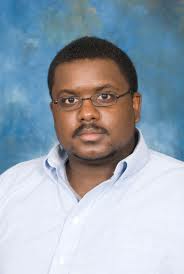
“Talking about White Privilege Is Not Profound, Its Just for Profit” Dr. Tommy J. Curry

THE NATIONALIST

“Talking about White Privilege Is Not Profound, Its Just for Profit”

By: Dr. Tommy J. Curry

tcurry1

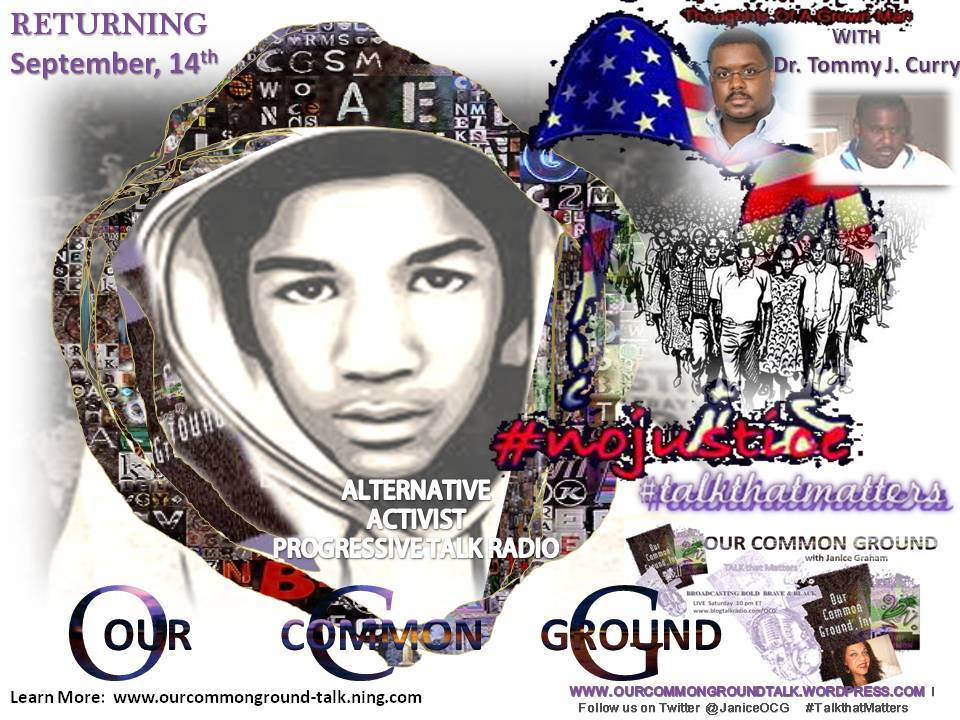
Dr. Tommy J. Curry Coming to OCG September 14, 2013

There is a growing economy for discussions about white privilege in this country that are employing Black and brown intellectuals and whites who profess anti-racism, to be the missionaries that save white souls. white privilege, or the idea that white individuals are born with unearned benefits and advantages, over others has been making its way through out the public media as well as the classroom. On the face of it, this seems like a radical conversation. Black, brown and some white people calling out white liberals and conservatives for their racism, and starting “real” conversations about race that air on MsNBC,CNN and even the Huffington Post. But conversations about white privilege are not really conversations about race, and certainly not about racism—its a business—WHERE BLACKS MARKET THEMSELVES AS RACIAL THERAPISTS.

See the first discussions of white privilege like W.E.B. DuBois’s Black Reconstruction (1935) or George Lipsitz’s The Possessive Investment in whiteness, or even Cheryl Harris’s “whiteness as property,” came from the radical Black intellectual tradition (race-crits, Black nationalists, Pan-Africanists) that did not believe that whites would simply donate their power and act against their global racial interests to be good people IN THE EYES OF BLACKS, people they owned and still imprison.  DuBois, and Lipsitz understood there is an antipathy and power in being against Blacks. Like George Jackson said, regarding the ILLUSION many Black academics have in romanticizing their ability to solve racism, “the white race, the economic elites of America, are not going to let themselves be educated out of existence. But today, you sound radical, progressive and insightful by MARKETING YOURSELF as therapist for whites, and know nothing about the actual conditions, structures, and ills that concretely effect the lives of Blacks. You can even talk about white privilege and not even know the names of the Black thinkers, the literature, the context, or the history the term comes from, and get acclaim for only citing white celebrities like Peggy McIntosh or Tim Wise.

It’s not genius to say in an oppressive society there are benefits being in the superior class instead of the inferior class. That’s true in any hierarchy, being on the top is better than being on the bottom, but the speaker of white privilege gets to pretend that America is not oppressive, they love America, they just want whites to surrender their privilege so we can be equal. See the revolutionary doesn’t have white friends: the government killed MLK, Assata is called a terrorist, Derrick Bell is erased from a field he started, because they spoke about the actual racial and economic tyranny of corporations, governments, the military and the white public,  but the for profit revolutionary wants to be commodified by whites…that Black friend that feels like they cured the racist white, while that same white person gets to point to these very relationships as proof they are healed and show to other whites they are the “white ally.”

Conversations about white privilege are simply moral appeals to the conscience of whites who have shown themselves to be committed to racism and social inequity IN THE IDLE HOPE THAT THEY change their mind. The implication of talking about privilege suffers from a childlike naiveity, it suggests that simply exposing racism and the privilege of whiteness to the white mind motivates whites to no longer act in their own self interest. See like the liberal utopia born out of integration, there is an unjustifiable assumption that telling whites about their social position means they are willing to surrender their power to appease a pop culture account of oppression. Think about the dishonesty of this approach. Black people, oppressed people, know there is a fundamental difference between being oppressed/Black and not oppressed, a citizen, white. We call for “national conversations on race,” where these public intellectuals get credit for starting conversations that amount to little more than allowing white America the opportunity to deny the actual realities Black America suffer from. And regardless of the outcome they come out LOOKING LIKE PROPHETS. This issue is white supremacy, and anti-Black death…trying discussing that…and see if your oppressor recognizes you then.

I remember at a recent APA I sat next to a feminist of color trying to get her white male student who couldn’t get a job in the white figures he studied and wrote a book on, and never studied race, racism, or Black philosophy, a job. This professor felt comfortable telling him if you start talking about white privilege, where she claimed the field was going, he could land a race job easily.  Think about this. So all the Black, Brown, and Indigenous scholars who study the raw histories of oppression and resistance lose out because they don’t want to give white liberals and conservatives a guilt trip. This is a powerful example of how as an academic discussion white privilege distracts the oppressed, and empowers the oppressor class to be employed in discussing systems they have no real interest in dismantling.

“The Nationalist”

Returning 9-14-13

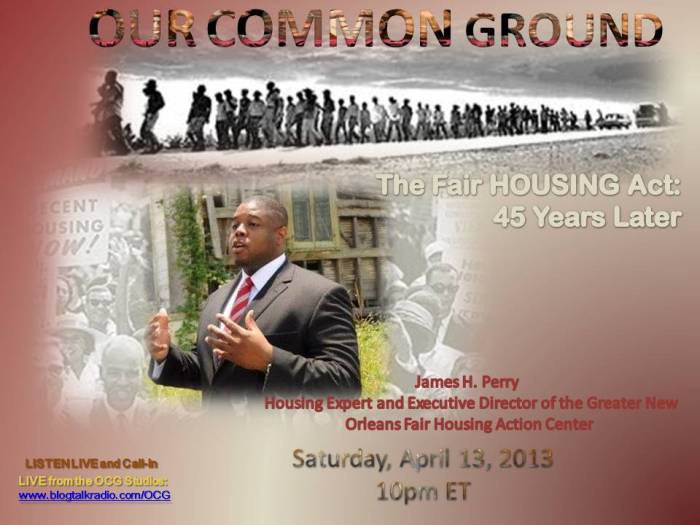
“45 Years Later: The Fair Housing Act” with James Perry – April 13, 2013 – 10 pm ET LIVE

OUR COMMON GROUND with Janice Graham

“45 Years Later: The Fair Housing Act”

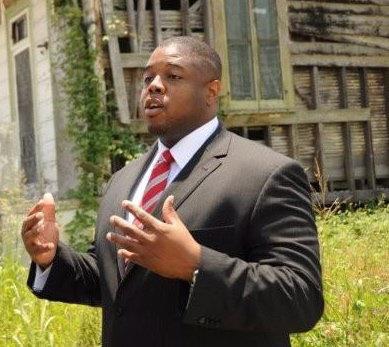
 Guest: James H. Perry

Executive Director of the Greater New Orleans Fair Housing Action Center (GNOFHAC)

04-13 Perry2

April 13, 2013 10pm ET 

LIVE and CALL-In

about JAMES H. PERRY

Jim PerryJames Perry is the Executive Director of the Greater New Orleans Fair Housing Action Center (GNOFHAC). Perry is a housing expert. He founded the Gulf Coast Fair Housing Center in Mississippi when he was 26 years old. He led the Greater New Orleans Fair Housing Action Center through two of America’s greatest disasters-Hurricanes Katrina and Rita. Under Perry’s leadership, the Center favorably settled an historic class action lawsuit resulting in compensation of more than $500 million for Katrina victims. Perry has testified before congress eight times and was a candidate in the 2010 New Orleans Mayoral election.

Perry serves on the Board of Directors of the National Fair Housing Alliance, the National Low Income Housing Coalition, the Gulf Coast Fair Housing Center and chairs the Louisiana Housing Alliance Board of Directors. He holds a Bachelors in political science from the University of New Orleans and a Juris Doctorate from the Loyola University School of Law.

The Greater New Orleans Fair Housing Action Center is a private, non-profit civil rights organization established in the summer of 1995 to eradicate housing discrimination throughout the greater New Orleans area.

America’s poor and middle-class are mired in the fall out of a crumbling economic foundation. Housing discrimination in new forms contribute to the fall out causing massive homelessness, including children, veterans and elderly. A new and vicious kind of resilience to compassionate themes in our politics, lends a hand to this threat. Foreclosures which rise out of predatory lending and greed, plague the well-being of the Black and Brown working class. Housing discrimination has a new and more virulent strain. Join us tonight to take a look with James Perry.

OUR COMMON GROUND with Janice Graham

“Speaking Truth to Power and Ourselves”

BROADCASTING BRAVE BOLD BLACK

Community Forum: http://www.ourcommonground-talk.ning.com/
Twitter: @JaniceOCG #TalkthatMatters
Web: http://www.wordpress.ourcommongroundtalk.com/

Connecting the Dots to a Frightening Future l Dr. Wilmer Leon l Black Agenda Report

Connecting the Dots to a Frightening Future

 Tue, 01/22/2013 – 22:16 — Wilmer J. Leon III

by Dr. Wilmer J. Leon III

Austerity, perpetually high unemployment and other aspects of the New Domestic Order are creating a new “precariat” – a class condemned to permanent precariousness and insecurity.

Connecting the Dots to a Frightening Future

by Dr. Wilmer J. Leon III

They are saddled with debt from school loans, working two and three jobs at subsistence wages with no health care, no pension, and no sense of permanency or security.”

Post Racial America, New Normal, Austerity, and The Precariat Class.

These concepts, when discussed individually, make for interesting dialogue. Moreover, when assessed in a larger context, these same concepts should become a cause for concern.

Right after Senator Obama became President there were many discussions and articles written about a Post Racial America. Had we evolved into an America devoid of racial preference, discrimination, and prejudice?During the 2008 presidential campaign The New York Times published an article by Matt Bai entitled Is Obama the End of Black Politics? The premise of the article was that in 2008, 60 years after Strom Thurmond left the Democratic Party over the issue of integrating the armed forces and 45 years after Dr. King’s “I Have a Dream Speech” the Democratic party was poised to deliver its nomination for the nation’s highest office to an African-American. Bai’s article asked if Obama’s nomination somehow signaled the end of Black politics?

The answer to Matt Bai’s question is; of course not. America cannot be closer to being post racial when a candidate for president has to run a deracialized campaign in order to make the masses comfortable with the obvious aesthetic. We are not in a post-racial America when the unemployment rate in the African American community is more than double the national average and the wealth accumulation of the average European American family is 20 times that of the average African American family. The dangerous subtext to that question is that it ignores the struggle for justice and equality that African Americans still face. It also reinforces the conservative view that the government should no longer enact and enforce legislation guaranteeing the rights of minorities.

We are not in a post-racial America when the unemployment rate in the African American community is more than double the national average.”

As the American economy has remained stagnate with 1.3 percent growth, the national unemployment number has stayed close to 8%, 17% in the African American community. Close to 5.4 million people have dropped out of the workforce and now analysts and commentators have started talking about a “New Normal.” Americans are supposed to get used to dismal rates of growth and high unemployment while the stock market soars and American corporations sit on record cash balances. According to CNBC, corporate “cash balances have swelled 14 percent and are on track toward $1.5 trillion for the Standard & Poor’s 500, according to JPMorgan. Both levels would be historic highs.”

These record amounts of cash being stockpiled by corporations are not “trickling down” to the working and middle-classes. The “job creators” are not creating jobs. According to Pimco Investment founder Bill Gross. “It’s time to recognize that things have changed and that they will continue to change for the next—yes, the next 10 years and maybe even the next 20 years.” This is the “new normal” and it’s not good.

The solution being proposed by conservatives and subtly endorsed by President Obama to address the financial crisis is “austerity.” Austerity is the policy of deficit-cutting by lowering spending via a reduction in the amount of benefits and services provided by the government. Instead of focusing on what to save, they are debating what to cut.

The ‘job creators’ are not creating jobs.”

In challenging times such as these the government should be investing in the economy not cutting back.Reductions in government spending tend to increase unemployment which increases demands on social programs or “safety-net” programs. Increased unemployment also reduces tax revenue. As with the Great Depression, short-term government spending, financed by deficits may be required to support economic growth when consumers and businesses are unwilling or unable to do so.

When you start to connect the dots between, New Normal and Austerity, you see a new picture. There is a new class of existence being created in this country. Professor Guy Standing calls this new class the “precariat”. “Millions of workers, mainly young and educated are being habituated to a life of unstable labor and uncertainty, a precarious existence…The precariat is wanted by multinationals and many corporations”…because their precarious existence makes them easy to exploit. They are saddled with debt from school loans, working two and three jobs at subsistence wages with no health care, no pension, and no sense of permanency or security.

As the African American community continues to be plagued by disproportionate rates of unemployment, poverty, hunger, wealth disparities, incarceration rates and other social ills the development of a precariat class will prove to be catastrophic. African Americans and many others would continue as Dr. King said in 1963, to live “…on a lonely island of poverty in the midst of a vast ocean of material prosperity…languishing in the corners of American society and find(ing) (themselves) an exile in (their) own land.”

The development of a precariat class will prove to be catastrophic.”

If the underclass, working class and precariat become dissatisfied with their existence what will they do? Will there be an uprising from the masses? What would the government do? How would the government protect its interests and repel the domestic uprising?

When you assess the implications of a Post Racial America, the New Normal, Austerity and The Precariat Class in a larger context, you begin to see a different America than the one being portrayed in mainstream media. When you connect these dots with a government that is engaging in warrantless wiretapping, calling for the ability to indefinitely detain American citizens, stop and frisk laws, and an American Attorney General who states that the president has the authority to assassinate American citizens any place in the world without judicial review, you get a very frightening picture. The picture reflects a battle between democracy and fascism and the battle for democracy should begin now.

Dr. Wilmer Leon is the Producer/ Host of the nationally broadcast call-in talk radio program “Inside the Issues with Wilmer Leon,” and a Teaching Associate in the Department of Political Science at Howard University in Washington, D.C. Go to www.wilmerleon.com or email: wjl3us@yahoo.com.www.twitter.com/drwleon, and Dr. Leon’s Prescription at Facbook.com.

© 2013 InfoWave Communications, LLC

“Living Legendz” Telling OUR STORY, RECORDING OUR PATH” l Filmmaker, Nicholle La Vann

OUR COMMON GROUND with Janice Graham

WITNESSES FROM THE BRIDGE Series


      Filmmaker, Nicholle La Vann

 “Living Legendz” Telling OUR STORY, RECORDING OUR PATH”

 March 30, 2013      10pm ET  LIVE and CALL-In

    “WITNESSES FROM THE BRIDGE”

                      “They came to Change a Nation and Lift Up A People”

                                   The Women of the Black Power Movement

 ABOUT ” Living Legendz” and Award-Winning Filmmaker, Nicholle La Vann

 FREEDOM and JUSTICE WARRIOR

“Living Legendz” is documentary that highlights the lives of Abiodun Oyewole, Dr. Leonard Jeffries and Jamal Joseph and their contributions to their community and culture.

“Living Legendz”  The documentary series explores the lives of African and Latino American icons. So much of Black and Latino history has been lost or not documented leaving others to tell our stories.

The filmmaker, Nicholle La Vann, says, ” It is my responsibility to be that keeper of our history and provide a platform where their lives and accomplishments can be heard.”

La Vann is a an award winning filmmaker with a Master of Fine Arts from the City University of New York in Media Arts Production. As an artist of visual culture, Nicholle is interested in the intersection between the digital environment and media social issues. As a video artist, she focuses on the impact of injustice and youth development while integrating related factors such as poverty. Nicholle’s interest continues to be in the area of facilitating dialogues between people. Which mean challenging existing assumptions as well as searching for new ways of addressing current issues.  La Vann continues to give back through teaching documentary workshops in New York City and Toronto and screenings that provide feedback discussions with audiences.

She is a warrior storyteller with a modern day weapon. Recording the best of our aspirations in the 21st Century.

She notes that, “Too much emphasis has been put on our appearance and not enough on our mindset.  It is my goal to inspire audiences of all races with a special interest on my own. The amount of knowledge that children learn in school is not always accurate nor true, depending on where the source comes from.”

Living Legendz is a sponsored project of Fractured Atlas, a non-profit arts service organization. Contributions for the purposes of Living Legendz must be made payable to Fractured Atlas and are tax-deductible to the extent permitted by law.

Your contributions in support of this project are appreciated.

http://www.indiegogo.com/projects/living-legendz

about Filmdress Filmz

 Filmstress Filmz is a creative multimedia production company specializing in social marketing.  We work with an array of agencies, corporations and non-profit organizations, and government agencies to build and educate cause marketing campaigns through a wide range of video productions. Our  work includes Public Service Announcements (PSAs), documentary shorts, music videos and internet streaming video.  Our projects address social issues rarely heard in mainstream media. We offer broadcast quality media for television, community screenings, fundraisers, presentations, conferences, film festivals and workshops. 

Join us in this conversation with Filmmater, Nicholle La Van about  this important recording of our history and storyteller, a  contemporary warrior in Black History.

LIVE:  OCG Meetinghouse: http://www.blogtalkradio.com/OCG

For More Information: http://www.ourcommongroundtalk.wordpress.com

Community Forum

 @JaniceOCG #TalkthatMatters

Web   

DOWNLOAD OUR APP Here

http://7f3186db-1b59-417d-989e-5feaed15b224.conduitapps.com/#

Dr. Ben Carson, Great Surgeon but a Bad Icon for the Political Collective l Dr. Wilmer Leon

Dr. Wilmer Leon: Dr. Ben Carson, Great Surgeon but a Bad Icon for the Political Collective

 wilmer112

by OUR COMMON GROUND VOICE, Dr. Wilmer J. Leon III

Black Politics on the Web

 “Nobody is starving on the streets (of America).  We have always taken care of them.  We have churches which actually are much better mechanisms for taking care of the poor because they are right there with them.  This is one of the reasons we give tax breaks to churches…” Dr. Ben Carson – CPAC Speech 2013

In modern culture, an icon is a symbol – i.e. a name, face, picture, or even a person readily recognized as having some well-known significance or embodying certain qualities.  That face or person begins to represent something else of greater significance through literal or figurative meaning. With his speech at the 2013 National Prayer Breakfast and his recent CPAC speech, Carson has become the new Black conservative darling.  He’s a great pediatric surgeon but a terrible icon for the political collective.

Dr. Ben Carson has an incredibly compelling and motivational story.  Born into poverty in Detroit in 1951 and raised by a single mother with a third-grade education, Carson became the first surgeon to separate conjoined twins and the youngest to head a surgical department.  His focus, work ethic, and commitment to excellence should be emulated by as many as possible.

One problem with Dr. Carson and others like him – i.e. Justice Thomas, Michael Steele, Wardell Connerly and Condoleezza Rice is how they have lent their voices and their personal narratives to conservatives in ways that allow them to undermine the social safety net in America.  The argument is that these individuals have overachieved in spite of the odds; therefore, the inability of the poor in America to rise into the middle class or beyond is due to personal failure, lack of drive, initiative, and dependence upon the system. Carson, Rice, and Thomas made it; why can’t you?

Another problem with their “realities” is their failure to recognize and/or admit how they benefitted from “the system” at some point in their struggle.  For example, Wardell Connerly grew his business in part with assistance from the 8(a) Program.  Justice Thomas was a beneficiary of Affirmative Action.  I don’t know if Carson’s mother ever received any public assistance during his childhood but if she did not I am certain some of his neighbors did. Is he ready to cast them all as lazy and totally dependent upon the government?

We love to hear stories about people overcoming great odds to achieve success. What is ignored when reciting the stories of the Carson’s, Thomas’, and Rice’s of the world is depth of the chasm that lied between Africans in America and later the African American community and white America. There have always been personal successes in the midst of the collective or group struggle. During the 18th century while hundreds of thousands and later millions of Africans in America where bound by the shackles of slavery, individuals such as Olaudah Equiano aka “Equiano, the African” and James Forten found success on American shores.  Did the success of Equiano, Forten and others negate the suffering and systemic oppression of those enslaved?  Obviously not.

Today, in spite of all of the disturbing data documenting the disparity between the African American community and Whites, such as eighteen percent unemployment, African Americans being fifty-three percent of those incarcerated and only thirteen percent of the population, the wealth disparity, high school drop-out rates, college graduation rates, home foreclosure rates, etc. the likes of a Wardell Connerly, Shelby Steele, or Clarence Thomas stand before conservatives and argue that we no longer need Affirmative Action, Head Start, and other social programs.

Individual success should never become the standard of measure of success for the collective. It is only through group success that the African American community will truly become politically and economically empowered.

Dr. Ben Carson made some very inaccurate and dangerous statements during his CPAC speech that cannot go unchallenged.  He stated as referenced above, “Nobody is starving on the streets (of America)”.  According to Bread for the World, “14.5 percent of U.S. households struggle to put enough food on the table. More than 48 million Americans—including 16.2 million children—live in these households…Among African-Americans and Latinos, nearly one in three children is at risk of hunger.”  Has he forgotten that in 1951 he may have been one of those hungry children?

He also stated, “Many people don’t know this but socialism started as a reaction to America because people in Europe, they looked at us and said, “”wait a minute look at those Americans…people like Henry Ford, Kellogg, Vanderbilt…they’ve got so much money…”” it needs to be redistributed.”  Actually, the term socialism is attributed to Pierre Leroux and Robert Owen around 1827.  Henry Ford was not born until 1863.  Socialist models and ideas espousing common or public ownership have existed since antiquity. Karl Marx, considered by many to be the founder of modern socialism first published Das Kapital in 1847.  Henry Ford was 4 years old.  Socialism was actually a reaction to the Industrial Revolution which started in Britain around 1760.

Carson said, “People don’t want to talk about God…let’s let everybody believe what they want to believe.”  Actually, the basis of the free exercise clause of the First Amendment is the freedom to believe.  It is one of the few absolute protections that the Constitution provides.  There is a big difference between belief and practice. If Carson understood the Constitution he would know that.

Dr. Ben Carson has a very motivational story but his political analysis and message lack real understanding of the issues necessary to be taken seriously.  It is dangerous to use the success of an individual(s) as the basis of a sociological or economic indictment of an entire class of individuals.  A reporter once asked Dr. Carson why he never talked about race to which he responded, “…because I’m a neurosurgeon”.  Well, Dr. Carson, I’ll make a deal with you, I’ll stay out of the operating room if you leave the political analysis and dialogue to trained professionals.

Dr. Wilmer Leon is the Producer/ Host of the nationally broadcast call-in talk radio program “Inside the Issues with Leon,” and a Lecturer  in the Department of Political Science at HowardUniversity in Washington, D.C.  Go to http://www.wilmerleon.com or email: wjl3us@yahoo.comwww.twitter.com/drwleon and Dr. Leon’s Prescription at Facebook.com

© 2013 InfoWave Communications, LLC

Black Politics on the Web

“Inside the Issues With Wilmer Leon” Political Scientist Wilmer J. Leon, lll, Ph.D. is a Political Commentator, Nationally Syndicated Columnist with the National Newspapers Publishers Association (NNPA) and the Host of the nationally broadcast three-hour call-in talk radio program Inside The Issues with Wilmer Leon” airing live nationally every Saturday at 11am est. on Sirius/XM Satellite Radio channel 128 “The Power.” The show rebroadcasts on Sundays at noon. A Teaching Associate in the Department of Political Science at Howard University in Washington, Dr. Leon writes and delivers commentary for a variety of national media outlets including Root.com, TheGrio.com, TruthOut.org, CNN, NPR.org, MSNBC, The Maynard Institute.com,Politicsincolor.com and many others. Dr. Leon’s primary areas of expertise are Black Politics and Public Policy. He has a BS degree in Political Science from Hampton Institute, a Masters in Public Administration (MPA) from Howard University, and a Ph.D. in Political Science from Howard University.

wilmer promo

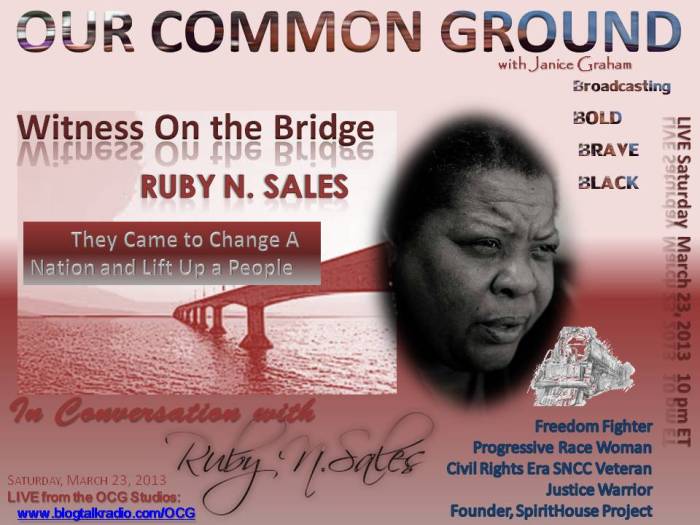
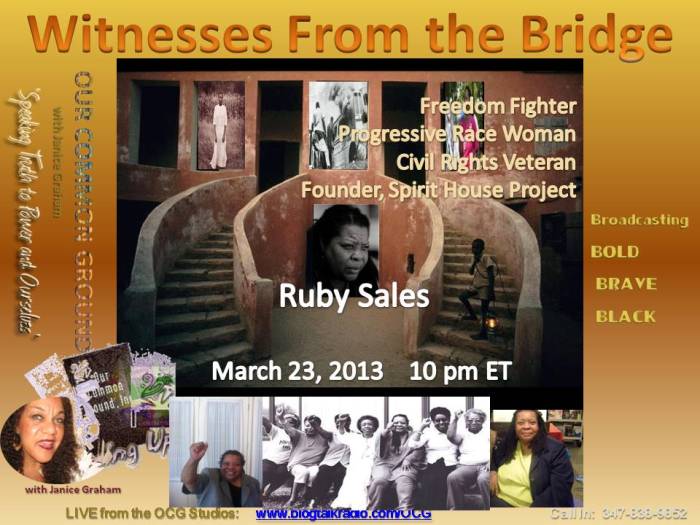
Witness On the Bridge l In Conversation with Ruby N. Sales l March 23, 2013 l OUR COMMON GROUND

OUR COMMON GROUND with Janice Graham

WITNESSES FROM THE BRIDGE Series


03-09 RubySales2

In Conversation with Ruby N. Sales


Civil Rights and Liberation Activist – Community Activist and OrganizerCommunity Education and Development Leader

 Human Rights Activist

March 23, 2013       10pm ET

LIVE and CALL-In

“WITNESSES FROM THE BRIDGE”
“They came to Change a Nation and Lift Up A People”
The Women of the Black Power Movement

about RUBY N. SALES

FREEDOM and JUSTICE WARRIOR

sales
Ruby Nell Sales is a highly-trained, experienced, and deeply-committed social activist, scholar, administrator, manager, public theologian, and educator in the areas of Civil, Gender, and other Human Rights. She is an excellent public speaker, with a proven track record in conflict resolution and consensus building. Ms. Sales has preached around the country on race, class, gender, and reconciliation, and she has done ground-breaking work on community and nonviolence formation. Ms. Sales also serves as a national convener of the Every Church A Peace Church Movement.

Along with other SNCC workers, Sales joined young people from Fort Deposit, Alabama who organized a demonstration to protest the actions of the local White grocery-store owners who cheated their parents. The group was arrested and held in jail and then suddenly released. Jonathan Daniels, a White seminarian and freedom worker from Episcopal Divinity School in Cambridge, Massachusetts was assassinated as he pulled Sales out of the line of fire when they attempted to enter Cash Grocery Store to buy sodas for other freedom workers who were released from jail. Tom Coleman also shot and deeply wounded Father Richard Morrisroe, a priest from Chicago. Despite threats of violence, Sales was determined to attend the trial of Daniels’ murderer, Tom Coleman, and to testify on behalf of her slain colleague.

As a social activist, Sales has served on many committees to further the work of reconciliation, education, and awareness. She has served on the Steering Committee for International Women’s Day, Washington, D.C.; the James Porter Colloquium Committee, Howard University, Washington, D.C.; the Coordinating Committee, People’s Coalition, Washington, D.C.; the President’s Committee On Race, University of Maryland; and the Coalition on Violence Against Women, Amnesty International, Washington, D.C. She was a founding member of Sage Magazine: A Scholarly Journal on Black Women. Sales received a Certificate of Gratitude for her work on Eyes on the Prize. Additionally, she was featured in Broken Ground: A Film on Race Relations in the South, by Broken Ground Productions. From 1991-1994, Sales founded and directed the national nonprofit organization Women of All Colors, dedicated to improving the overall quality of life for women, their families, and the communities in which they live. Women of All Colors organized a week-long SisterSpeak that brought more than 80 Black women together to set a national agenda.

In 2000, Dan Rather spotlighted Sales on his “American Dream” Segment. In 1999, Selma, Alabama gave Sales the key to the city to honor her contributions there. In 2007, Sales moved to Columbus, Georgia, where she organized: a southern summit on racism; a national write-in campaign to save Albany State from being merged into a White college; a grassroots and media campaign to shed light on the death of seventeen year old, Billye Jo Johnson, who allegedly killed himself on a dark road in Lucedale, Mississippi when a deputy stopped him for speeding; Long Train Running Towards Justice, which celebrated the work of Black teachers during segregation and explored the ways that the Black school culture has been destroyed by White officials under the guise of desegregation; and a meeting with students at Savannah State to assist them in organizing and mobilizing a move by officials to merge Savannah State with a White college.

03-09 RubySalesIn 2009, the History Makers named her a History Maker for her contributions to civic affairs. The Veterans of Hope Project selected her to be a part of its video series. Her video “Standing Against the Wind” has been shown at colleges around the nation.

Sales serves as the founder and director of the SpiritHouse Project. SpiritHouse Project is a national organization that uses the arts, research, education, action, and spirituality to bring diverse peoples together to work for racial, economic, and social justice, as well as for spiritual maturity.

about SPIRITHOUSE Project

SpiritHouse Project houses The Jonathan Daniels and Samuel Young Institute for Racial Justice, which (1) supports and prepares a new generation of peace and justice workers who want to discern a call to social justice and nonviolence; (2) strengthens their courage, hope, resolve, and reason to do this work; (3) prepares them to play leading roles in public policy debates about issues such as poverty, prison industrial complex, militarism, the shrinking budget for human needs, voting rights, privacy and judicial issues, and neo-conservatism; and (4) helps grassroots communities meet their urgent need for trained and committed volunteers or staff. Throughout her career, Sales has mentored young people and provided support and venues for an intergenerational community of developing and seasoned social justice performing and creative artists. Sales has a deep commitment to providing the education, practical experiences, and frame of references to contest racism and add their voices to a public conversation on the many streams of oppression that emerge from it.

SpiritHouse also houses SisterAll Programs that bring Black women together in assemblies, classrooms, and performance spaces to renew our historical roles as a community of activists, spiritual guides, and leaders who stand and work on the front lines for racial, economic, and human rights using the tools of nonviolence and participatory democracy. SisterAll One was a community-building project that called together black female scholars, activists, artists, students, workers, practitioners, and lay and ordained spiritual leaders between the ages of 18 and 35, alongside older Black women who have been long distance runners for justice.

Ruby Sales’ Spirit House Project interns will share what they have learned in their work tracking the different points of connection within the Prison Industrial Complex and Criminal Justice Reform.

Spirit House is located at 1884 Ponce De Leon Avenue NE #1, Atlanta, GA 30307

Join us in the conversation with one of our most powerful, prolific and important figures in contemporary Black History.

LIVE: OCG Meetinghouse: http://www.blogtalkradio.com/OCG

For More Information: http://www.ourcommongroundtalk.wordpress.com/

OUR COMMON GROUND with Janice Graham

“Speaking Truth to Power and Ourselves

“BROADCASTING BRAVE BOLD BLACK

Community Forum: http://www.ourcommonground-talk.ning.com/

Twitter: @JaniceOCG #TalkthatMatters                   Web: http://www.wordpress.ourcommongroundtalk.com/

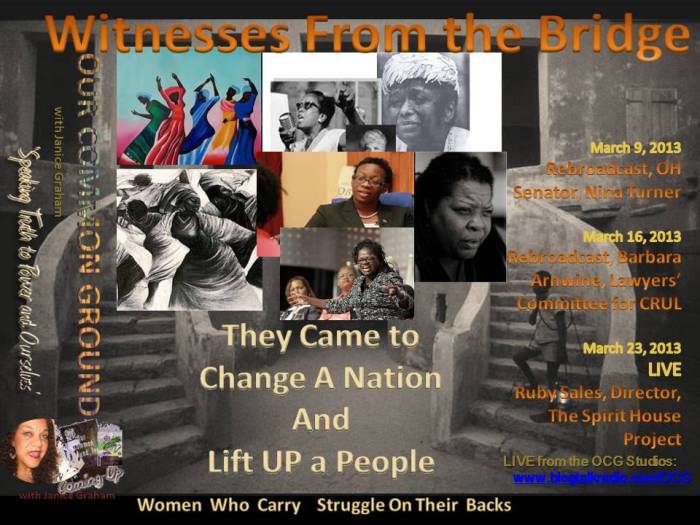
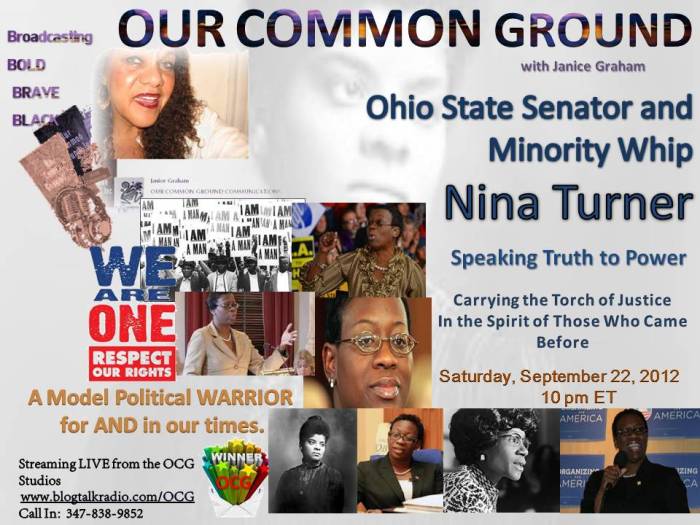
Witness From the Bridge l OH State Senator Nina Turner

ourcommonground

03-9 witnesses

LISTEN LIVE HERE

March 9, 2013

Rebroadcast, OH Senator, Nina Turner

9-19 Nina Turner3

COMING UP on OUR COMMON GROUND

PhotoFunia-a349

March 16, 2013

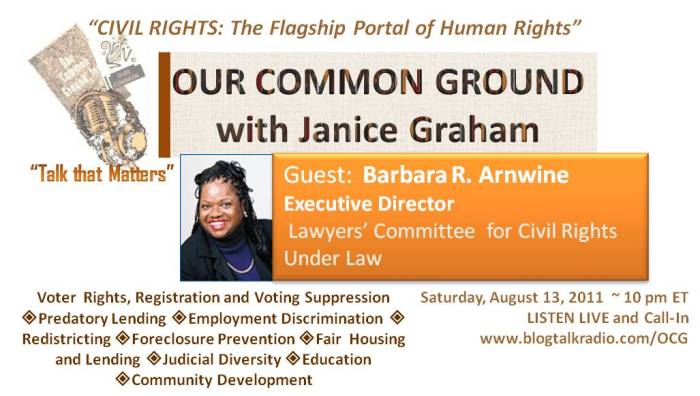
Rebroadcast, Barbara Arnwine, Lawyers’ Committee for CRUL

Arwine

March 23, 2013

Ruby Sales, SNCC and Civil Rights Movement Veteran, Freedom Warrior, Director, Spirit House Project

03-09 RubySales

April 6, 2013

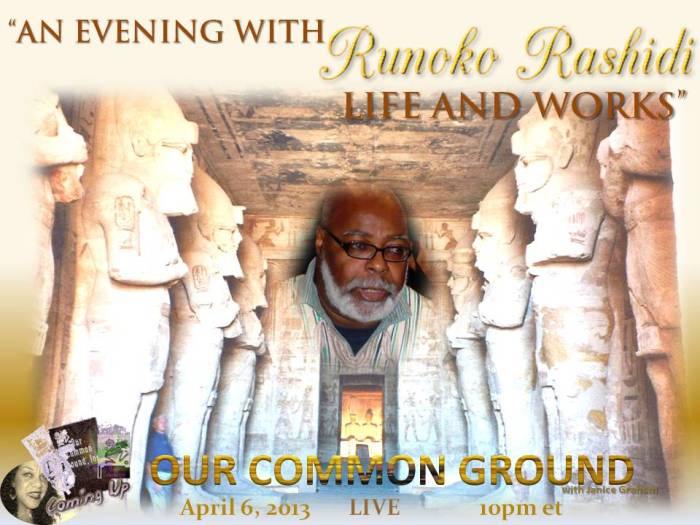
“An Evening with Runoko Rashidi: His Life and Work”

04-06 Coming up Rashidi2

The Rev. Dr. Jeremiah Wright and the Audacity of Truth l Dr. Wilmer Leon l “Inside the Issues”

06obamaThe Rev. Dr. Jeremiah Wright and the Audacity of Truth

Saturday 22 March 2008

by: Dr. Wilmer J. Leon III, t r u t h o u t | Perspective

Follow Dr. Leon on FB

    Over the past week or so, mainstream media have turned much of their attention to the fiery sermons of the Rev. Dr. Jeremiah Wright. Dr. Wright is pastor to Senator Barack Obama (D-Illinois) and his family. He was also, until recently, pastor of the Trinity United Church of Christ of Chicago.

Most of the discussion and commentary about Dr. Wright’s sermons have come from a predominantly white media. The points of discussion have centered on what they consider to be the “vile, racist and un-American things” said by Dr. Wright. Very few, if any, of the discussions have focused on the historical basis and accuracy of what Dr. Wright actually said.

The major problem with the discussions is they have been largely one-sided. The media have used the imagery of Dr. Wright, clad in African garb, shouting in the cadence of an old-time fire and brimstone minister and playing to the camera as a scare tactic. Has this become the “Willie Hortonization” of Senator Barack Obama? The reporting and commentary on Dr. Wright’s words have been presented from the perspective of people who either have no appreciation for the African-American historical experience or a personal agenda when it comes to presenting these issues.

Dr. Wright is under attack for saying such things as “… the government gives them the drugs, builds bigger prisons, passes a three strikes law, and then wants us (African-Americans) to sing ‘God Bless America.’ No, no, no; not ‘God Bless America,’ God damn America … for killing innocent people; God damn America for treating its citizens as less than human….” These are very strong words, delivered at what many are calling a possible turning point in American history with regard to America’s willingness to elect an African-American candidate. While the mainstream media have found no merit in any of Dr. Wright’s statements, let’s examine their merit from a historical basis.

When people read the Constitution, the supreme law of the United States, they see the oldest governing constitution in the world. They see a great document that has articulated the precepts of life, liberty and happiness that all in this country try to follow. What is often overlooked are the parts of the Constitution that laid the foundation for hundreds of years of slavery and oppression for African-Americans; the constitutional framework for human beings to be treated as less than human. It’s these sections of the Constitution that America has never truly atoned for and still refuses to make right.

Article I, Section 2 of the Constitution stated, “Representatives and direct taxes shall be apportioned among the several states which may be included within this union, according to their respective numbers, which shall be determined by adding to the whole number of free persons, including those bound to service for a term of years, and excluding Indians not taxed, three fifths of all other Persons.” This was known as the Three-Fifths Compromise and laid the groundwork for African slaves brought into America as forced labor to be defined as non-persons.

Article I, Section 9 allowed the importation of slaves to continue in America for twenty-one years after ratification of the Constitution by declaring: “The Migration or Importation of such Persons as any of the States now existing shall think proper to admit, shall not be prohibited by the Congress prior to the Year one thousand eight hundred and eight, but a tax or duty may be imposed on such Importation, not exceeding ten dollars for each Person.” This section only outlawed the importation of slaves once the domestic stock of slaves could be replenished by natural birthrates and importation would no longer be needed; again, treating its citizens as less than human.

Article IV, Section 2 stated, “No Person held to Service or Labour in one State, under the Laws thereof, escaping into another, shall, in Consequence of any Law or Regulation therein, be discharged from such Service or Labour, But shall be delivered up on Claim of the Party to whom such Service or Labour may be due.” This was enforced by Congress on September 18, 1850, when the Fugitive Slave Act was passed, allowing Southern states to reclaim slaves that had escaped to the North.

The Three Fifths Compromise and the Fugitive Slave provisions were superseded by constitutional amendments only after their damage to African-Americans had been done and the benefit to America had been served.

It is very easy to wrap oneself in the history and glory that is America and forget that from 1619 to 1868 (249 years) African-Americans suffered under the brutality and oppression of government-supported chattel slavery. In 1857, as Dred Scott, a slave, petitioned the US Supreme Court for his freedom, Chief Justice Roger Taney wrote, “beings of an inferior order (African-Americans), and altogether unfit to associate with the white race, either in social or political relations, and so far inferior that they had no rights which the white man was bound to respect.”

Even after the 13th Amendment abolished slavery in 1865, the 14th Amendment granted their citizenship, and the 15th Amendment grated them the right to vote, from 1876 to 1965 (89 years) African-Americans continued to suffer under state-supported Jim Crow oppression in America. This was codified in 1896 by another Supreme Court decision, Plessy v. Ferguson, which upheld the constitutionality of racial segregation under the doctrine of separate but equal. These vestiges of slavery and oppression still plague many sectors of the African-American community, and the sense of white privilege they created continues to foster a false sense of white entitlement.

This is just the historical background for Dr. Wright’s comments. During his lifetime he has dealt with segregated schools, separate and unequal education, and discrimination in housing, employment and lending. He has witnessed civil rights protesters beaten by the police, ravaged by dogs, brutalized by fire hoses and COINTELPRO. Since his birth in 1941, an estimated 40 African-Americans have been lynched in this country. He was 14 years old when Emmett Till was brutally murdered and 23 years old when James Chaney, Andrew Goodman and Michael Schwerner were killed. Americans continue to deal with racial profiling, driving while black, the disproportionate rate of incarceration of African-Americans, the suspension of habeas corpus, warrantless wiretapping and other constitutional violations.

Regarding Dr. Wright’s comments about drugs and AIDS, let’s not forget the Tuskegee Syphilis Experiments. From 1932 to 1972, the US Public Health Service (PHS) conducted an experiment on 399 black men in the late stages of syphilis. These men, for the most part illiterate sharecroppers from one of the poorest counties in Alabama, were never told what disease they were suffering from or of its seriousness. In his May 16, 1997, apology, President Bill Clinton said:

“The United States government did something that was wrong – deeply, profoundly, morally wrong. It was an outrage to our commitment to integrity and equality for all our citizens … clearly racist.”

With this historical understanding, it is not too far-fetched to think that the US government could be involved in similar activity as it relates to AIDS.

What has been conspicuously absent from the discussions about Dr. Wright’s comments in mainstream media is any analysis of the validity of his comments based upon his personal history and life experiences. It is very easy for white commentators such as Bill O’Reilly to dismiss his sermons as racist diatribes, since O’Reilly has no interest in trying to understand the plight of people of color in America.

Dr. Wright has also said, “We have supported state terrorism against the Palestinians and black South Africans, and now we are indignant because the stuff we have done overseas is brought right back into our own front yard; America’s chickens are coming home to roost….” Well, let’s examine the record.

The Arms Exports Control Act prohibits the president from furnishing military aid to any country which engages in a consistent pattern of gross violations of internationally recognized human rights. In spite of all of the evidence supporting claims of the Israeli government’s human rights abuses of the Palestinian people, for FY2005 the United States provided $2.22 billion in military aid. This aid to Israel has a dramatic effect on Israel’s policies towards the Palestinians. It is the US funding that pays for the guns and ammunition, F-16 bombers and Apache helicopters that are used to carry out Israel’s occupation of Palestinian land and people.

According to The Boston Globe, in 1984, just after Ronald Reagan’s re-election, Bishop Desmond Tutu referred to the Reagan administration’s support for the South African government as “Immoral, evil and totally un-Christian.” Reagan ignored the rising number of Americans who were calling for American companies to stop doing business there. The president of so-called sunny optimism attempted to blind Americans with his policy of “constructive engagement” with the white minority regime in Pretoria. All constructive engagement did was give the white minority more time to mow down the black majority in the streets and keep dreamers of democracy, such as Nelson Mandela, behind bars.

History is replete with examples of the United States arranging to depose foreign leaders. In 1909, President Taft ordered the overthrow of Nicaraguan President Jose Santos Zelaya. According to Stephen Kinzer, “In Iran, Guatemala, South Vietnam and Chile, diplomats and intelligence agents replaced generals as the instruments of American intervention.” More recent examples of US intervention would be the invasion of Panama and the illegal invasion of Iraq.

Some may take issue with the earlier statement, “… the government gives them the drugs, builds bigger prisons, passes a three strikes law, …” by asking, “is Rev. Wright accusing the US government of supplying drugs to the black community?” This story has been well-documented in the 1996 San Jose Mercury News expose entitled “Dark Alliance: The CIA Complicity in the Crack Epidemic.”

I can understand people being uncomfortable with the comments made by the Rev. Dr. Jeremiah Wright. White Americans have also been lied to, miseducated and desensitized about the plight of African-Americans. With the help of the social conservative agenda, many have developed a “deaf ear” when it comes to issues regarding race. The truth, especially an ugly truth that forces Americans to examine the precepts of America, “with liberty and justice for all,” and compare them with the hypocrisy of the American reality can be troubling. For far too long, Americans have been lulled into a false sense of security. Americans have believed history as told by the oppressor and failed to understand the reality of the oppressed.

Dr. Wright is not un-American. He embodies what America was founded upon, the free exchange of ideas in the public space, speaking truth to power, challenging America to be the best that it can be. The Rev. Dr. Jeremiah Wright’s views might not reconcile with many Americans’ perceptions of America, but they must not be discarded as the ranting of an angry man. His statements were founded in the historical truths that African-Americans have and continue to live through.

Listen ON DEMAND our Interview with Dr. Wilmer Leon

wilmer promo

OUR COMMON GROUND with Janice Graham WITNESSES FROM THE BRIDGE l Florence L. Tate Civil Rights Activist, Journalist, and Press Secretary

OUR COMMON GROUND with Janice Graham

WITNESSES FROM THE BRIDGE

“They came to Change a Nation and Lift Up a People”

The Women of the Black Power Movement

OUR COMMON GROUND with Janice Graham

Each Saturday all through March 10 pm ET

Guest, Florence L. Tate
Civil Rights Activist, Journalist, and Press Secretary
She became the FBI’s Most Wanted Press Secretary
Opening the files of the Civil Rights and Black Power Movement and her life in our struggle.

ABOUT Florence L. Tate

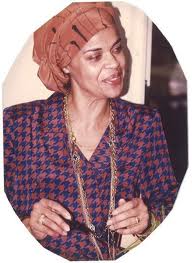
Florence Tate 2Florence L. Tate, Civil Rights Activist, Journalist, and Press Secretary

She recounts Life from Days in Jim Crow South to the1984 Jesse Jackson Presidential Bid in New Memoir.

Many would think becoming an octogenarian reserves one the right to rest on her laurels — but Florence L. Tate, 81, says, “There’s still work to be done.”

The former Civil Rights activist, Dayton Daily News reporter, and press secretary for the historic 1984 Jesse Jackson Presidential campaign has lived through seven decades of American epochs – and now she’s writing about her impressive experiences and achievements in a new memoir – tentatively titled, The FBI’s Most Wanted Press Secretary Opens Her Files on Civil Rights, the Black Power Movement, and Black Partisan Politics.

At a time when our country should be experiencing a sense of accomplishment at realizing the fruits of Dr. Martin Luther King, Jr.’s work — evidenced by the election of the first African American President –Tate feels instead that the racial unease and tension revealed by events like the current drama surrounding the George Zimmerman/Trayvon Martin case signify America still has a long way to go in race relations.

“The country has gone backwards from the time of Dr. Martin Luther King’s ‘I Have a Dream’ speech; we have regressed. There’s been an attempt to take things back to the pre-Civil Rights days,” says Tate.

In her memoir, Tate draws upon her extensive experience integrating major companies like Bell Telephone, and Globe Industries, working with seminal civil rights groups including SNCC (Student Nonviolent Coordinating Committee) and CORE (Congress for Racial Equality).

As the first African American female journalist at the Dayton Daily News, she also covered current events — including the Dayton riots that occurred during the “summer of ‘68” race riots that swept across the country.

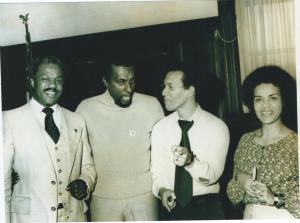
The work that brought her into close confidence with key activist figures — such as Stokely Carmichael and H. Rap Brown — also eventually brought Tate, a middle class Dayton housewife and mother of three children, under the surveillance of the Federal Bureau of Investigation – evidenced by the giant file she received from the FBI when she petitioned for them decades after her civil rights and Pan Africanist work.

Tate wasn’t all that surprised by her voluminous FBI file. “We suspected we were under surveillance because, for example, we would pick up the phone, to try to use the phone, and there would be a silence there… we didn’t know, but we suspected… We suspected there would be people in the meetings, sometimes people who gave off vibes that they were not there to work with us… they were there to spy on us. And figures like Stokely Carmichael were always being followed by the FBI; they didn’t even try to hide it. They would sit outside in cars – for example, if he were at a meeting at my house, or wherever he was, they would be sitting outside my house. When I got my FBI file, then I knew exactly when they had been watching, spying…or infiltrating.”

Tate’s memoir chronicles her journey — from growing up under segregation in the South from the 30s through the mid-50s — to moving north in the late 50s…to finally become an influential figure in the small but dedicated civil rights movement ground work happening in Mid Western cities like Dayton.

tate3“The civil rights activists were working in parts of the country other than the south – where the ground work was well publicized. Little or no publicity was given to the work being done in Mid Western cities like Dayton, Ohio,” she shares.

Related experiences — as Communications Director of the National Urban Coalition, and National Information Coordinator for ’72 African Liberation Day Coordinating Committee — landed Tate the role of Press Secretary in Marion Barry’s first campaign in his successful bid for Mayor of Washington D.C. in 1978, and Press Secretary during his first two years in office. Later she would repeat that role for Jesse Jackson’s 1984 Presidential campaign — during which time she traveled with him to Damascus, Syria during his historic rescue mission to free downed U.S. Air Force pilot Lt. Robert Goodman.

Tate also writes of another major life-defining segment of her journey: her experiences with mental and physical health issues. These include battling breast cancer, suffering a major stroke after the birth of her third child.

Tate says she hopes her memoir will encourage young people – and especially young women – to understand and act on their power to impact the world around them. But like a true mother, grandmother – and now, great-grandmother — she admits her main reason for penning her memoir is for her children.

“My children and grandchildren have repeatedly asked me to write my biography — so they will know who I am…so they can know who they are.”

Octogenarian Florence L. Tate Recounts Life from Days in Jim Crow South to the1984 Jesse Jackson Presidential Bid in New Memoir Many would think becoming an octogenarian reserves one the right to rest on her laurels — but Florence L. Tate, 81, says, “There’s still work to be done.”

OUR COMMON GROUND with Janice Graham

“Speaking Truth to Power and Ourselves”

BROADCASTING BRAVE BOLD BLACK

Community Forum: http://www.ourcommonground-talk.ning.com/
Twitter: @JaniceOCG #TalkthatMatters
Web: http://www.wordpress.ourcommongroundtalk.com/

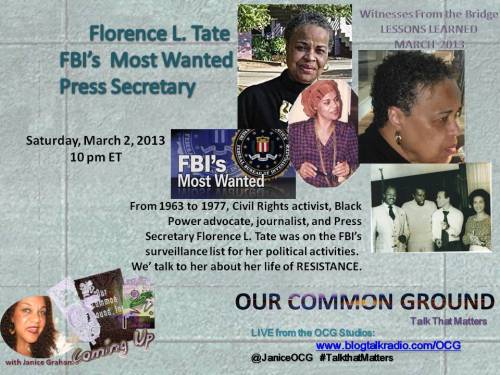
“Witnesses On the Bridge l Florence L. Tate, ” FBI’s Most Wanted Press Secretary” l March 2, 2013

MARCH 2, 2013

“Witnesses On the Bridge – Lessons Learned”

OUR COMMON GROUND with Janice Graham 

OUR COMMON GROUND kicks off “Witnesses On the Bridge – Lessons Learned”

March, 2013 Series

Florence L. Tate, ” FBI’s Most Wanted Press Secretary”

LIVE   10 pm ET

03-02 Tate

ABOUT Florence Tate
Many would think becoming an octogenarian reserves one the right to rest on her laurels — but Florence L. Tate, 81, says, “There’s still work to be done.”

The former Civil Rights activist, Dayton Daily News reporter, and press secretary for the historic 1984 Jesse Jackson Presidential campaign has lived through seven decades of American epochs – and now she’s writing about her impressive experiences and achievements in a new memoir – tentatively titled, The FBI’s Most Wanted Press Secretary Opens Her Files on Civil Rights, the Black Power Movement, and Black Partisan Politics.

At a time when our country should be experiencing a sense of accomplishment at realizing the fruits of Dr. Martin Luther King, Jr.’s work — evidenced by the election of the first African American President –Tate feels instead that the racial unease and tension revealed by events like the current drama surrounding the George Zimmerman/Trayvon Martin case signify America still has a long way to go in race relations.

“The country has gone backwards from the time of Dr. Martin Luther King’s ‘I Have a Dream’ speech; we have regressed. There’s been an attempt to take things back to the pre-Civil Rights days,” says Tate.

In her memoir, Tate draws upon her extensive experience integrating major companies like Bell Telephone, and Globe Industries, working with seminal civil rights groups including SNCC (Student Nonviolent Coordinating Committee) and CORE (Congress for Racial Equality).

As the first African American female journalist at the Dayton Daily News, she also covered current events — including the Dayton riots that occurred during the “summer of ‘68” race riots that swept across the country.

The work that brought her into close confidence with key activist figures — such as Stokely Carmichael and H. Rap Brown — also eventually brought Tate, a middle class Dayton housewife and mother of three children, under the surveillance of the Federal Bureau of Investigation – evidenced by the giant file she received from the FBI when she petitioned for them decades after her civil rights and Pan Africanist work.

Tate wasn’t all that surprised by her voluminous FBI file. “We suspected we were under surveillance because, for example, we would pick up the phone, to try to use the phone, and there would be a silence there… we didn’t know, but we suspected… We suspected there would be people in the meetings, sometimes people who gave off vibes that they were not there to work with us… they were there to spy on us. And figures like Stokely Carmichael were always being followed by the FBI; they didn’t even try to hide it. They would sit outside in cars – for example, if he were at a meeting at my house, or wherever he was, they would be sitting outside my house. When I got my FBI file, then I knew exactly when they had been watching, spying…or infiltrating.”

Tate’s memoir chronicles her journey — from growing up under segregation in the South from the 30s through the mid-50s — to moving north in the late 50s…to finally become an influential figure in the small but dedicated civil rights movement ground work happening in Mid Western cities like Dayton.

“The civil rights activists were working in parts of the country other than the south – where the ground work was well publicized. Little or no publicity was given to the work being done in Mid Western cities like Dayton, Ohio,” she shares.

Related experiences — as Communications Director of the National Urban Coalition, and National Information Coordinator for ’72 African Liberation Day Coordinating Committee — landed Tate the role of Press Secretary in Marion Barry’s first campaign in his successful bid for Mayor of Washington D.C. in 1978, and Press Secretary during his first two years in office. Later she would repeat that role for Jesse Jackson’s 1984 Presidential campaign — during which time she traveled with him to Damascus, Syria during his historic rescue mission to free downed U.S. Air Force pilotLt. Robert Goodman.

Tate also writes of another major life-defining segment of her journey: her experiences with mental and physical health issues. These include battling breast cancer, suffering a major stroke after the birth of her third child — and the subsequent 50-year-long battle with clinical depression triggered by that stroke.

Tate says she hopes her memoir will encourage young people – and especially young women – to understand and act on their power to impact the world around them. But like a true mother, grandmother – and now, great-grandmother — she admits her main reason for penning her memoir is for her children.

“My children and grandchildren have repeatedly asked me to write my biography — so they will know who I am…so they can

Learn more about Florence. Listen in on March 2, 2013.
The FBI’s Most Wanted Press Secretary