Talking about white Privilege is not Profound, its just for profit. φ Dr. Tommy J. Curry

curryvoicesTalking about white Privilege is not Profound, its just for profit.

By: Dr. Tommy J. Curry

There is a growing economy for discussions about white privilege in this country that are employing Black and brown intellectuals and whites who profess anti-racism, to be the missionaries that save white souls. white privilege, or the idea that white individuals are born with unearned benefits and advantages, over others has been making its way through out the public media as well as the classroom. On the face of it, this seems like a radical conversation. Black, brown and some white people calling out white liberals and conservatives for their racism, and starting “real” conversations about race that air on MsNBC,CNN and even the Huffington Post. But conversations about white privilege are not really conversations about race, and certainly not about racism—its a business—WHERE BLACKS MARKET THEMSELVES AS RACIAL THERAPISTS.

See the first discussions of white privilege like W.E.B. DuBois’s Black Reconstruction (1935) or George Lipsitz’s The Possessive Investment in whiteness, or even Cheryl Harris’s “whiteness as property,” came from the radical Black intellectual tradition (race-crits, Black nationalists, Pan-Africanists) that did not believe that whites would simply donate their power and act against their global racial interests to be good people IN THE EYES OF BLACKS, people they owned and still imprison. DuBois, and Lipsitz understood there is an antipathy and power in being against Blacks. Like George Jackson said, regarding the ILLUSION many Black academics have in romanticizing their ability to solve racism, “the white race, the economic elites of America, are not going to let themselves be educated out of existence. But today, you sound radical, progressive and insightful by MARKETING YOURSELF as a therapist for whites, and know nothing about the actual conditions, structures, and ills that concretely affect the lives of Blacks. You can even talk about white privilege and not even know the names of the Black thinkers, the literature, the context, or the history the term comes from, and get acclaim for only citing white celebrities like Peggy McIntosh or Tim Wise.

It’s not genius to say in an oppressive society there are benefits being in the superior class instead of the inferior class. That’s true in any hierarchy, being on the top is better than being on the bottom, but the speaker of white privilege gets to pretend that America is not oppressive, they love America, they just want whites to surrender their privilege so we can be equal. See the revolutionary doesn’t have white friends: the government killed MLK, Assata is called a terrorist, Derrick Bell is erased from a field he started, because they spoke about the actual racial and economic tyranny of corporations, governments, the military and the white public, but the for profit revolutionary wants to be commodified by whites…that Black friend that feels like they cured the racist white, while that same white person gets to point to these very relationships as proof they are healed and show to other whites they are the “white ally.”

Conversations about white privilege are simply moral appeals to the conscience of whites who have shown themselves to be committed to racism and social inequity IN THE IDLE HOPE THAT THEY change their mind. The implication of talking about privilege suffers from a childlike naiveity, it suggests that simply exposing racism and the privilege of whiteness to the white mind motivates whites to no longer act in their own self interest. See like the liberal utopia born out of integration, there is an unjustifiable assumption that telling whites about their social position means they are willing to surrender their power to appease a pop culture account of oppression. Think about the dishonesty of this approach. Black people, oppressed people, know there is a fundamental difference between being oppressed/Black and not oppressed, a citizen, white. We call for “national conversations on race,” where these public intellectuals get credit for starting conversations that amount to little more than allowing white America the opportunity to deny the actual realities Black America suffer from. And regardless of the outcome they come out LOOKING LIKE PROPHETS. This issue is white supremacy, and anti-Black death…trying discussing that…and see if your oppressor recognizes you then.

I remember at a recent APA I sat next to a feminist of color trying to get her white male student who couldn’t get a job in the white figures he studied and wrote a book on, and never studied race, racism, or Black philosophy, a job. This professor felt comfortable telling him if you start talking about white privilege, where she claimed the field was going, he could land a race job easily. Think about this. So all the Black, Brown, and Indigenous scholars who study the raw histories of oppression and resistance lose out because they don’t want to give white liberals and conservatives a guilt trip. This is a powerful example of how as an academic discussion white privilege distracts the oppressed, and empowers the oppressor class to be employed in discussing systems they have no real interest in dismantling.

Dr. Tommy J. Curry, The Nationist

9-14-13 Curry4


Has Civil Rights Activism Been Replaced by Endless Panels? Φ Crew of 42

Has Civil Rights Activism Been Replaced by Endless Panels?

Posted On 09 Apr 2014
  Ask yourself: Have you ever seen a photo of Dr. Martin Luther King, Jr. sitting on a panel? On the eve of the 50th anniversary of the signing of the Civil Rights Act we should ask ourselves: Has activism been replaced by “paneling” and hot air?

At every annual convention.  At every luncheon.  At every conference. There is the panel discussion as the centerpiece of the “agenda.”  And for the most part, these sessions repeat already known information and no calls to action.

Where the centerpiece of the American civil rights movement of the 1950s and 1960s was results based physical activities such as marches, boycotts and civil disobedience, the centerpiece now appears to be lots and lots of talking.

The activities of five decades ago yielded big results — like the Civil Rights Act — few of those big results and political victories can be seen today. And the problems, for the African American community in particular, are getting larger. 

Can panels create change and get results at a time when the wealth gap between black and white is the worst in 40 years and the dropout and incarceration rates remain at crisis levels?  Can marches get the same results they did in the 1960s as a more money and tech driven political landscape drives agendas?

Were it not for Rev. William Barber’s Moral Mondays there would be no consistent activism at all.  But even with those events one has to ask: Are the marches yielding tangible results?  It’s likely Dr. King didn’t have time for panels.  The actions Dr. King took got results and won victories.  Like the signing of the Civil Rights Act of 1964.

Lauren Victoria Burke is the creator of the blog Crewof42 and is the Managing Editor of Politic365.com. Ms. Burke has enjoyed employment with USAToday.com and ABC News and holds a B.A. in History from The American University. Contact: LBurke007@gmail.com. Twitter: @Crewof42

– See more at: http://www.crewof42.com/slide/has-civil-rights-activism-been-replaced-by-endless-panels/#sthash.onItQYKK.dpuf

When Black News Disappears: White Holds on Black Intellectuals’ Minds and Misinforming the Black Public

When Black News Disappears: White Holds on Black Intellectuals’ Minds and Misinforming the Black Public

Friday, 24 May 2013 09:49By Dr Tommy J CurryRacism Review | Op-Ed

As an historical entity, the Black press has not only offered critical commentaries and political critiques of the sempiternal racism of the modern world, but  correctives as to how white newspapers, opinion-makers, legislators, and most importantly the white public sought to justify their complacency towards and support for anti-Black racism and the sexual brutalization of Black men, women, and children. Today, however, the post-Obama lullabies of racial détente and the progressive liberal passivity of Black intellectuals have allowed the structural and ideological manifestations of white supremacy to remain unquestioned despite their persistence alongside the growing realities of Black death. For example, when Trayvon Martin was killed, Melissa Harris Perry thought it prudent to use the tragedy as a moment to teach white folks “how to talk about Black death”—she literally created a checklist for whites rather than deal with the horrors facing young Black men and boys in their communities.

Currently, the post-racial idea has contoured Black news into a narrow politically progressive ideology. This ideology is thematically geared towards convincing the Black public that the symbols of racial progress are in fact actual progress. This contest over “symbols,” rather than exposing the propaganda of the liberal endeavor, allows Black academics to retreat into their own ideologically predetermined blog’s rendering of “Black” events, so that their views, be it feminist, leftist, or progressive, are legitimized. Meanwhile, the Black public remains victimized by the political interests of multiple entities; each with their agenda rooted in de-radicalizing Black consensus and normalizing Black deaths, specifically the death of Black men, as having nothing to do with racism, merely accidental rather than systemic. As I have argued previously, Black academics and news personalities are rewarded for pimping out “the delusion of hope” to Black people while racism increases alongside the normalization of their death, incarceration, and poverty.

Has the Black Press Lost Its Way?

Since slavery, Black abolitionists, ministers, and revolutionaries understood the need for “Black perspectives,” on the racist evil that plagues America. The Christian theology that justified the horrors of slavery was indicted, and the white Christian, the earliest imperialist, was not held to be the savior of civilization but its greatest detractor whose abuse and degradation of Blacks was rooted in their imperial lust for power and profit. As David Walker says in Article I of The Appeal:

“I have been for years troubling the pages of historians, to find out what our fathers have done to the white Christians of America, to merit such condign punishment as they have inflicted on them, and do continue to inflict on us their children. But I must aver, that my researches have hitherto been to no effect. I have therefore, come to the immoveable conclusion, that they (Americans) have, and do continue to punish us for nothing else, but for enriching them and their country. For I cannot conceive of anything else”

With the rise of Freedom’s Journal, the Black press took on the radical mission of liberation that up to that point was confined to pamphlets, and the now revered slave narrative. The Black press, its editors and writers, were among the most notable Black thinkers of the 1800’s and beyond. T.Thomas Fortune’s (1856-1928) The New York Age was the training ground for no less an intellectual than W.E.B. DuBois. It was a publication where Fortune’s radicalism which advocated for Black self-determination and security, even by armed resistance if necessary, was center stage. It not only gained him notoriety among Black journalists but earned him the admiration of the young Ida B. Wells-Barnett (1862-1931) who would continue to develop his political philosophy of agitation and help build the first civil rights organization for Black rights; the Afro-American League. This radicality was present in most of the Black journalists at the turn of the century. Henry McNeal Turner and John Edward Bruce exemplified a political tone that was only matched by the radicality of the 1960’s and 1970’s in the founding and growth of the Black Panther Party and the journalistic accounts of the Black Power Movement. As my student, Ms. Judith Bohr, points out in her master’s thesis “A People’s History of Philosophy: The Development and Ideological Segregation of Black Nationalism,” the violence against Blacks in society, be it at the hands of police state militarism or the prison industrial complex, necessitates a compliant and complacent account of reality. As she states,

“The media assists in this erasure of police violence through their portrayals of African Americans as a danger to society…Whites’ fear, however, is for their privilege and not for their safety…Propaganda in the media functions through erasure and through distortions of the state’s as well as the public’s motivations for racial violence” (Bohr 2011, 30).

Thus, the de-radicalization of Black news and the complacency of the Black journalistic endeavor—its commodification into  predetermined categories, that ironically have academic currency despite being driven by political interests—does little to inform, much less improve, the conditions of Black people. The silence of mainstream Black news on the systemic political and economic divisions, divisions made necessary by the militaristic racist endeavors of the U.S. government, even under a Black Obama administration, is imperative in preventing the Black public from engaging the concrete American condition confronting Blacks, immigrants, and the poor.

Most recently, SiriusXM decided to change Sirius 128—The Power to urban driven entertainment programming under the new title of the Urban View. In doing so SiriusXM eliminated ReddingNewsReview, an independent Black political commentary dedicated to exposing the contradiction between Black political representation in the Obama era and Black political exploitation under Obama’s administration. The change in the lineup effectively changed the Power 128 from the “News and Issues” category to the Urban View 110 a “African American Talk and Entertainment” channel. Reacting to this change, Wade Simmon wrote a splendid editorial asking, “Is SiriusXM Trying to Undermine Black Power?” The effect of this censorship could be isolated, but it again begs the question as to why independent Black radio and press that dares to question the status quo of America’s race problem is so easily engulfed by liberal reformist agendas that take Obama’s symbolism to be of more importance than the actual economic and political viability of mass Black agendas.

Despite the criticisms one may make of Redding, the reality is that Black Americans lack a non-partisan interpretation of the Black condition that does not retreat into the ideologies of the blogosphere, where select academics, married to predetermined paradigms of reading Blackness, meet and greet. The Black public is usually deemed irrelevant in these deliberations from the outset. They are to be “spoken about” authoritatively, but rarely “spoken from,” since these Black people are outside the academy, and lack the supposed knowledge/education to “understand” the complexities of Black life. Independent Black radio, reaching back to the Ralph “Petey” Greene and radicals like Robert F. Williams, sought transgressive messages against empire and racism. Whereas today, many Black elites, the Melissa Harris Perrys of the world, confine discussions of racism to their specific opportunities to gain social capital and recognition from whites; choosing to ignore both the material consequences of the liberal agenda for Black people at home and its militaristic program against darker peoples abroad. ReddingNewsReview, like that ofVoxunion, sought to disrupt that narrative.

The same way Ida B. Wells-Barnett decided to report the horrors of Black reality, anti-Black violence through lynching, and the weakness of Black leadership in the 1890’s, so too did Redding in the 21st century. At the very bottom of Black politics, there is a need to recognize that the manipulation of Black media—the Black press and radio—to further the political agendas and social legitimacy of specific parties, namely the democratic party’s claim that they represent the Black/Browning of America, does nothing to arrest the imperial agendas this presidency like all presidencies before it continue to engage in the world over. As Dr. Jared Ball argues in his talk on “Colonialism and Media Psychological Warfare,” media, or rather propaganda, is at the heart of America’s white supremacist empire.

Conclusion:

Race-crits, critical sociologists, and Black, Brown, and Indigenous scholars cannot continue to embrace the symbolism of progress without making those symbols resonate with the actual economic, political, and extra-legal conditions of Black existence. There is a very real contradiction between the symbolism of Obama’s reign and the worsening plight of Blacks under Obama’s reign. Rather than being at odds with the type of progressivism that perpetuates the poverty, the apparati of state sponsored violence, and social repression, the Black press has taken to excusing it—pointing out the extraordinary cases of violence that shock us most, but leaving the racist narrative written into the foundation of America’s democracy, militarism, imperialism, and capitalist lust untouched.

ABOUT Dr. Tommy J. Curry

Professor of Philosophy, Texas A&M University

Tommy J. Curry’s work spans across the various fields of philosophy, jurisprudence, Africana Studies, and Gender Studies. Though trained in American and Continental philosophical traditions, Curry’s primary research interests are in Critical Race Theory and Africana Philosophy. In Critical Race Theory, Curry looks at the work of Derrick Bell and his theory of racial realism as an antidote to the proliferating discourses of racial idealism that continue to uncritically embrace liberalism through the appropriation of European thinkers as the basis of racial reconciliation in the United States. In Africana philosophy, Curry’s work turns an eye towards the conceptual genealogy (intellectual history) of African American thought from 1800 to the present, with particular attention towards the scholars of the American Negro Academy and the Negro Society for Historical Research.

In Biomedical ethics, Curry is primarily interested government regulation, the ethical limits of government intervention in the practice of medicine, and democratic potentialities that arise from collaborative doctor-patient diagnoses and regenerative medicine like stem cells. Currently his research focuses on the linking the conceptualization of ethics found in the Belmont Report to Civil Rights and social justice paradigms.

Subscribe to The Nationalist and read more of Dr. Tommy J. Curry

Follow him on Twitter

curryvoices

Pessimistic Themes in West’s Necrophobic Aesthetic by Dr. Tommy J. Curry

curryvoicesPessimistic Themes in West’s Necrophobic Aesthetic

: Moving Beyond Subjects ofPerfection to Understand the New Slave as a Paradigm of Anti-Black Violence.(Forthcoming The Pluralist)

by  Dr. Tommy J. Curry

This intersectional allusion to the bourgeois Black woman, her indemnification against all critique, has long been the unquestionable norm operating within the political assertions of Black feminism and the allegedly conceptual pluralization had in claiming intersectionality as a method. Carole Boyce Davies describes this tendency as condification; “a project perhaps, a behavioral process which marks the rise of a certain neo-colonial elite in the U.S. imperial context, operating for the benefit of the dominant state and its rulers” (14). Davies argues that “Condification marks the limit …but can also be seen as the ultimate manifestation of a domestic black and/or feminist bourgeois discourse” (14), and presents a concrete crisis for Black feminist calls for social, economic, and political equality, since there is no accountability to the buttressing up of empire and inequality in their march towards capitalist freedom. Davies is not alone in this analysis of Black feminism; Elaine Brown has gone as far as to say: “feminism,” assuming this word, which I don’t assume (let’s just call it that for now, women’s liberation, the liberation of all human beings), is part of my agenda. If you take their analysis, as strict analysis, you can end up having a woman like Condoleezza Rice. So they are incorrect in their ideological commitment. Condoleezza Rice would be the ultimate Black feminist icon. So they’re wrong” (3). Power within the system is justified as gender progress, and rationalized as the necessary trajectory of political progress. There are no criteria for liberation, only the accumulation of representatives that are Black and female who command the recognition of systems previously blind to their existence. The now common practice of lifting the immaterial subject, the ideal abstraction of the (Black) feminist self, represented by the mere utterance of race, class, and gender, destroys our ability to truly understand the suffering of Black people. The Black man, the Black woman, and the Black child who survive in the bare conditions of wretchedness nurtured by anti-Blackness—the poverty, death, and violence of racial oppression—are never seen. They are spoken about as factors, but never considered to be the primary subjects motivating study. Intersectionality, its synonymy with the ideal bourgeois Black woman, is an errant axiom that denies Black study for the elevation of one (powerful, Black, female) identity taken to be the finality of all Black morality.”

Introduction

The release of Kanye West‘s Yeezus  was indelibly marked by the provocation of his song entitled the ―  New Slave ,‖ which introduced a  pessimistic terminology deployed against the paradoxical condition that Black freedom from enslavement only recaptured Black people psychically in the neo-liberal entanglements of poverty, servitude, and corporatism. His analysis,not unlike currently en vogue theories of Afro-pessimism, or Critical Race Theory‘s  (racial)realist lens maintains that despite all the rhetoric and symbols of progress to the contrary, Black people are simply not free in America. West‘s  performance of ―New Slave,‖on Saturday NightLive was only amplified by the  Not For Sale  insignia projected behind him.
 As a symbol ofindependence, disengagement; a resistance against commodification, West announced hisconfrontational posture towards the industry; a posture which ignited the Hip-Hop communityand academia alike over this artistic radicalism. However, such a provocation, despite itsrhetorical flare and allure, was immediately cast as disingenuous and inauthentic. Kanye West isa Black man torn at moments by his brilliance and at times by his banality. His work is not beinganalyzed in Hip-Hop Studies and philosophical aesthetics because it is not worthwhile;
 — his analysis of anti-Black death, corporatism, and neo-liberal aspiration is enough to warrant morethan one serious study of his art. West is not studied because he lacks sufficient correctness orexhibits minimalist thoughts about the world around him, rather West is not studied because his body, his Black male body, lacks the symbolic currency to motivate reverence for his thinking.The New Slave implicates all arenas of knowledge and political production hailing from theacademy, and while his life and public proclamations are at tension with some of his work, itnonetheless necessities serious study, rather than sophistry and condemnation. This article is anattempt to draw out some of the themes concerning anti-
Black racism in West‘s ―New Slave and the double meaning this work has given that it was co-
authored with Che ―Rhymefest Smith.
It is my view that West‘s work establishes the continuity of enslavement beyond the artificial political and social changes that are attributed to racial progress and social equality.

READ AND DOWNLOAD THE FULL AND  FINAL PAPER 


ABOUT Dr. Tommy J. Curry

Professor of Philosophy, Texas A&M University

Tommy J. Curry’s work spans across the various fields of philosophy, jurisprudence, Africana Studies, and Gender Studies. Though trained in American and Continental philosophical traditions, Curry’s primary research interests are in Critical Race Theory and Africana Philosophy. In Critical Race Theory, Curry looks at the work of Derrick Bell and his theory of racial realism as an antidote to the proliferating discourses of racial idealism that continue to uncritically embrace liberalism through the appropriation of European thinkers as the basis of racial reconciliation in the United States. In Africana philosophy, Curry’s work turns an eye towards the conceptual genealogy (intellectual history) of African American thought from 1800 to the present, with particular attention towards the scholars of the American Negro Academy and the Negro Society for Historical Research.

In Biomedical ethics, Curry is primarily interested government regulation, the ethical limits of government intervention in the practice of medicine, and democratic potentialities that arise from collaborative doctor-patient diagnoses and regenerative medicine like stem cells. Currently his research focuses on the linking the conceptualization of ethics found in the Belmont Report to Civil Rights and social justice paradigms.

Subscribe to The Nationalist and read more of Dr. Tommy J. Curry

Follow him on Twitter


OCG Freedom Note >> Thinking About Black History Month 2014

Runoko Rashidi

“Our history and culture is our immune system.”
–Marimba Ani

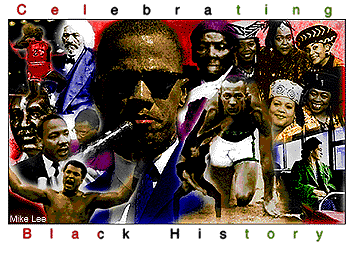
Copy (2) of bl_hist_logoThinking About Black History Month 2014

According to whether or not the year leaps or not, February 28th marks the end of what should always be a national celebration of the achievements and contributions made by African-Americans in America – National Black History Month. Despite slavery, government imposed oppressive conditions under which they were made and the lack of routine appropriate vehicles of credit and recordkeeping for tremendous accomplishments, and efforts of denial, it is clear that African-Americans have lifted America in extraordinary ways. In education, politics, science and arts, literature and philosophy there is no absence of an abundance of achievement by our people.  Every American or foreign visitor has experienced our footprint and infusion of cultural richness in the short and painful time of our existence in this nation.

The extraordinary people, inventions, music, dance, art and thoughts of our people recorded or passed along orally are treasures that we all share. Black History Month has become a tradition.  I was a young girl when it was still Black History Week and the only public acknowledgement was within segregated schools and communities, and Black publications. Growing up Black in the South the facts and episodes of our history, the people, their images and their oration was made sacred by my parents, grandparents and people in our community. People like Ida B. Wells, Thurgood Marshall, Jackie Robinson and W.E.B. DuBois were honored and familiar visitors at our breakfast and dinner table. My Mother spoke of the women and for such a long time, I really thought that they were her friends who lived elsewhere.  My Father spoke bleeding his expression with the words of dead men, Carver, Garvey and Douglas recalling their words as though they had relayed them directly to him. Telling the tales of a Harlem in Renaissance, of a budding Malcolm and the lives women crooners named Billie, Sarah who sang with  the Duke, and laughed with Dizzy and Louie. My Dad danced the Savoy and lounged the Paradise and boldly breathed the air of Black progress and pain.  The books, the authors, required and yearned for, bought, shared and placed on shelves for prosperity.  The speeches learned and kept close to the heart.  The people, and the events that they recalled was  testimony validating and affirming the character of the lives of Black folks. Enumerating Black worth in America and checking the validity of the equation.  An account so carefully recorded- a burden so deftly carried. Black people waiting for the Pittsburgh Courier and the Ebony magazine for assurance that they were real.

03-1 2black history So many years later, I not only seek our history to bind my life, but see into it as I navigate forward. This is what we do during this month of February. We raise it up, make it a sacred light illuminating the pathways of our future. It makes us real in the universe, assured that we will always have a special brand of hope which is ours and ours alone. All through the year, we must spend our time putting our lives, the echo of who we are into the record, sorting it and ordering it to build the bridges that will take us safely across.

Thanks for joining with us at OUR COMMON GROUND, or supporting our efforts at OUR COMMON GROUND to honor the ritual to lift up the journal of the Black experience in America. #HistoryMatters

Janice Graham

OUR COMMON GROUND Media & Communications

TruthWorks Network Radio


America vs. the World >> Margaret Kimberley, Freedom Rider

Published on Thursday, February 27, 2014 by Black Agenda Report

America vs. the World

The word imperialism fell into disuse in recent decades. If it seems slightly retro, that is only because there aren’t enough Americans committed to telling the ugly truth about their government.

During the Cold War era we were told that communism increased in influence via a domino effect, knocking down nations one by one and forcing them into Moscow’s or Beijing’s orbit. In the 21st century there is a new domino theory which puts every part of the world into America’s cross hairs.

Barack Obama has succeeded in expanding America’s influence in ways that George W. Bush and Dick Cheney could only dream about. The neo-conservative project for a new American century has reached full fruition under a Democratic president, who now has many notches on his gun. He and the rest of the NATO leaders began the trail of destruction with Libya, tearing that country asunder under the guise of saving it.

Using lies and their servants in the corporate media, they constructed a tale of a tyrant and a people yearning for protection. That evil success emboldened them and their Gulf monarchy allies further and they decided that Syria would be the next domino.

That plan didn’t work quite as well as Obama and the rest of the murder incorporated team thought it would. When the British parliament said no to new military adventures Obama was left sputtering on national television. He was forced to back down from an adamant position he had taken just days earlier.

The semi-comedic setback was only temporary because the monster must be fed at all cost. The system can no longer sustain itself and brute force is the only out. There is nothing old fashioned about imperialism. This malevolent force is still alive and well.

George W. Bush made efforts to overthrow the democratically elected Bolivarian revolution in Venezuela when he plotted with the opposition against the late Hugo Chavez. Obama is clearly more committed to violence than his predecessor and has helped to stir up right wing Venezuelans who want to rid themselves of Nicolas Maduro. Maduro has been weakened by the ginned up protests and is now forced into talks with an opposition that won’t be satisfied until he is dead and gone too.

The Venezuelan people have voted for their revolution numerous times. The U.S., a country that never ceases to call itself a democracy, has thwarted their clearly expressed will time and time again. But that is the essence of empire after all.

While armed force against Syria was temporarily blocked, the West, the Persian Gulf monarchies, Israel, and jihadists have not given up their effort to topple the Bashir al-Assad government in Syria. The savage war has made thousands of Syrians homeless and starving refugees, all because the empire needs its next domino.

Not only does the United States meddle in its own backyard, it also relentlessly interferes on the other side of the world in far away Ukraine. Popular discontent against that country’s president became a successful effort to bring that country into the western sphere of economic influence but with the awful strings of austerity attached. Ukraine has the choice of going bankrupt or being bailed out and dying a slow death à la Greece.

While the machinations were afoot, president Obama warned Vladimir Putin away with threats of sanctions. The scenes of sometimes violent street protests in Ukraine made a fortuitous tableau for the United States which claimed the infamous “responsibility to protect” which never protects anyone who actually needs help and which has brought so much suffering to people around the world. Every invasion, occupation and disruption in recent years can be laid at the feet of the United States and its allies. Iraq has been destroyed quite literally, Iran has been destroyed economically. Libya was taken out and Syria is on the brink.

The United States quite openly makes it clear that it wants to have its way in the world. If Russia attempts to use its influence then it is vilified and caricatured as a cruel dictatorship controlled by a tyrant. No matter how many elections Chavez and now Maduro won, they are called dictators by American talking heads.

A superpower can foment conflict anywhere it wants to at anytime it chooses. Venezuelans must knuckle under or face the prospect of more turmoil and violence. Ukraine must sign onto economic policies which have already proven disastrous. The United States leaves its fingerprints in these and many other places and that is the essence of imperialism. It is all about control with the rawest brute force available.

The United States hasn’t officially made Venezuela or any other a colony but it doesn’t have to do that. It just has to show that it is boss and the dominos will fall wherever it chooses.

© 2014 Black Agenda Report
Margaret Kimberley

Margaret Kimberley’s Freedom Rider column appears weekly in BAR. Ms. Kimberley lives in New York City, and can be reached via e-Mail at Margaret.Kimberley(at)BlackAgendaReport.C

When Bad Things Happen to Beautiful Minds

Sister of the Yam

POLITICS. HIP HOP. AND THE OCCASIONAL LOVE POEM.

When Bad Things Happen to Beautiful Minds

 kanye-west-808s-heartbreak-kaws-1[1]

For lack of a better reference, the moment felt like Lauryn Hill circa 2000: Kanye West spitting his characteristically impulsive but nod-worthy truths–my favorite that night was his deft critique of “rap beef” –riddled by the painfully familiar feeling that what we were also witnessing was a beautiful mind unraveling.

Some who watched the Kanye West-Jimmy Kimmel interview this past Thursday, who had been keeping close watch of the many other interviewstweetspaparazzi attacks, and fashion statements that brought Kanye to Kimmel’s desk that night, and who were perhaps also nostalgic for the pre-kilt, pre-Kim, College Dropout Kanye that used to croon about family dinners and the graveshift of dead-end jobs, observed in Kanye a dangerously heightened mix of mania and megalomania; heard a wired, rambling incoherence; and chronicled those twenty plus minutes as exhibit Z that Kanye West is indeed battling some sort of mental health crises.

Others picked up on a mouth racing to keep up with a mind in constant overdrive; they tuned into Kanye’s fearless, biting critique; and cheered along the self-proclaimed Genius-Underdog sparring with the lovable Everyman type that always seems to win these kinds of debates.

Both interpretations of that night–that Kanye was emitting his last fumes before meltdown or that he is deep beyond reproach–are freighted with their own particular dangers. On one hand, we risk participating in a rich tradition of silencing and managing rightfully angry people of color who dare to speak up by calling them crazy. On the other hand, fawning hero-worship can doom us to pulling up a chair and whipping out the popcorn to shit shows that could very well be prevented; Michael Jackson and Whitney Houston hang heavy in my mind as the parables for how fatal that kind of spectatorship can truly be.

Positioning oneself in the gray is often indicia of cowardice, but here I am in this whack limboland of hedge and no answers: neither hypotheses fully work for me.


That night I saw a man who was wounded. Who never expected his naked struggle for legitimacy would become fodder for late-night mockery or that it would hurt that much–that he, as an adult man with serious indictments against an industry that made and now mangles him, would be infantalized into a whiny, ranting child. I saw a man deeply frustrated by an industry that has smugly siloed bright black and brown men into the white noise of hip-hop so that it can exoticize, imitate, appropriate, and snub them safely from afar. I saw a man who was lonely and misunderstood, who had had been stripped of his support system and now floats about unmoored. I saw a man who thought his creativity and hard word would somehow immunize him from the garden variety isms that topple heroes and unmentionables alike. I saw a man who, like many talented men of color, whether they hide out in Ivy League institutions or behind mics, has never been held accountable for the gaps in his logic and the tangles in his heart strings–for the materialism, misogyny and violence that hobbles his otherwise brave and sophisticated wisdom about race and class in this country. (But that goes for Common, Nas, Tupac and Kendrick Lamar too). I saw a man who wears his vanity like a XXL T-shirt as armor for the much smaller, more vulnerable man underneath. I saw a man who is so transfixed by needing affirmation from White America, so obsessed with his worthiness and seriousness as an artist, an intellectual and a man that he can’t quite calibrate, stake out terms for himself, laugh at the jokes that will surely come, or brave the insults that will never end. And I saw a man who can’t help but still be, many albums and awards later, the creative boy in the back of classrooms, saving up for Gucci loafers, standing up against gangster bullies and inventing those self-survival myths and mechanisms that get you out but never quite set you free.


Black America is mad at Kanye because he didn’t properly learn the lesson that every person of color must learn to remain sane in an insanely racist world–how not to offer your neck to the guillotine. Quite frankly, we’re confused: did Kanye think his art, his name, his stuff, his women-as-props would exempt him from blackness? Did he think his laying out of dreams, the unbridled honesty and that faux Little Engine That Could confidence could be the brave preemptive moves that would keep him safe? Further, we’re exhausted by his lack of groundedness . Kanye cannot seem to locate himself in a long history of great people doing great things while hearing as many–if not more and more serious–no’s than he. Lack of perspective is a male privilege and also the white privilege Kanye will never have and should never fight for.

Terrifyingly, Kanye’s sins for White America are much simpler: he dared to call himself great without their permission. For that, he is an asshole.  For that, he is dangerous. For that, he is crazy.

ink-blot-colored-small[1]

Deciding what Kanye is–”crazy”, genius, or troubled–is important because this is, of course, much bigger than Kanye. He stands next to Lauryn Hill, Dave Chapelle, and others with beautiful minds and broken spirits. I do not think it is coincidence that all three–Kanye, Lauryn, Dave and we can even throw Michael Jackson in–have been accused of “craziness” at the height of critiquing the ugliness and the isms of the industries and audiences that have propelled them to fame. I think we should understand that “crazy” is the Atomic Bomb of the English language, that it’s a no-return obliteration of personhood and credibility. And we should also remember that ”crazy” has been a way of managing female sexual desirequeer eroticism and political ideology; yesterday’s history is today’s wet paint. As Dave once said, “the worst thing to call somebody is crazy. It’s dismissive. ‘I don’t understand this person. So they’re crazy.’ That’s bullshit.”

I believe in considering Dave’s follow up to that thought: “These people are not crazy. They’re strong people. Maybe their environment is a little sick.”drwdx-pw5_ru-deyv-shapell-aktery-dave-chappelle[1]

And that–the sick environment–is the one thing that never, ever gets enough play: if, as we speculate, all these beautiful, beautiful minds are breaking, undoing themselves, unfurling like tightly wound string, we owe it to ourselves to at least ask if something drives them to it. Certainly, mental illness is complex and at times turns on with no external switch, but we have testimony from artists we respect and admire, that something is rotten in Hollywood.

As Lauryn said after her hiatus from music, “When artists experience danger and crises…everyone easily accepts that there was something either dysfunctional or defective with the artist, rather than look at, and fully examine, the system and its means and its policies of exploiting/’doing business’.”

Over the course of a short decade, so many celebrities have fallen apart before my eyes: shaving their heads, ripping apart cameras, tearing off clothes, eating themselves into bloated existence or not eating themselves into invisible non-existence, drinking and drugging fast lives and slow deaths, basically begging us to listen in the most literal, primal languages possible, and we still keep diagnosing symptoms instead of curing the disease and the whole thing seems wild to me.

If mental illness is a dialectic between the person and the space,  then its source is not wholly the artist nor Hollywood, but I know that what Kanye and so many others deserve is the clean slate and the fighting chance Kanye kept quoting Richard Pryor to talk about.

LaurynHill[1]

If this past Thursday was only an open-aired breakdown of mental health, then we need better language. Because though we complain mental health in this country and for black folks in particular isn’t talked about, that’s not entirely true: we talk about it all the time; we just talk about it poorly. If finding oneself on the edge deserves a life-sentence of being called “crazy,” of being dismissed, written off, and laughed at, of not being heard, then no wonder the shame and the silence. Particularly for artists, whose whole careers and identities are based on being experienced, interpreted, listened to and gazed upon: mattering.  Truth is, there are those who are dying from, but more curiously living with, mental illness in our midst; they are flying our planes, shaking our hands, watching our kids, loving us, and staring back at us from mirrors. And some of the great mindswe most admire produced art, theories, and inventions despite and because of battles with mental illness. Furthermore, achieving mental health is often a lifetime of strenuously and intentionally maintaining the balance; there is not one discrete day you are sick and one discrete day you are well. Given the enormity, pervasiveness, and constantly looming threat of mental illness, we have to figure out a way for people to matter even if they have not sought or successfully phased out of treatment. We can’t just keep calling people “crazy” as the lever we pull to extradite them into irrelevance. The balance is hard but important: how to hear folks when they need help, how to hear folks even if they need help, how to empower them to seek help, how to be the help they seek, and how to know when we can’t be.

If this Thursday was also about something bad happening to a beautiful mind and that something bad is, as Lauryn puts it, “a machine that overlook[s] the need to to take care of the people who produce the sounds that have a lot to do with the health and well-being of society,” then we still need transformation.  We not only need to imagine and create a celebrity culture that does not drive the talented, the strong, and the brave into hiding but we also need to collectively figure out how to survive that heartless, breathless machine in the meantime. For Kanye, the machine is the fashion and the music industries, but for any one of us, it could be the university or the office or the political regime. If we become as angry as we deserve to be, then the isms we fight will rob us of our life joy. We have to somehow figure out how to resist and dissent without allowing that enterprise to swallow us whole and turn us stale and I have faith we can win this war without quotable tweets or serving as the one-person congregation of the Church of our own self-proclaimed Godliness. Kanye once said that he, like Dave Chapelle, has to laugh to keep from crying and I suggest that he works harder on that laugh–not for the Kimmels but for Kanye.

Black Rage, Gender, and Allyship

Black Rage, Gender, and Allyship

Aya de Leon

Black people are angry.  Anyone who is going to be our ally in the fight against racism needs to understand that. Not every black person walks around angry, or is aware of their anger.  Fury looks and sounds and hangs differently on people of African heritage shutterstock_146783792with differences of class, ethnicity, generation, geography, gender, sexuality, and trauma history.  But for many of us, we’re angry, and we have good reason after hundreds of years of slavery, racism, colonization, jim crow, neo-colonialism, exploitation, and degradation.  This is not an abstract, academic, intellectual racism; this is about hundreds of years of our ancestors bringing racist violence home.  In the US, slave masters beat us with whips and we beat our children with belts.  Slave masters raped and incested African women, and sexual abuse became epidemic in black families.  Slave masters worked us to death and now we work ourselves to death, and we are furious.  For hundreds of years, we have had to swallow the rage or risk getting killed by white people.  And we swallowed it, and killed each other and ourselves.  Men take the rage out on each other, on women and children, women take the rage out on each other and on children, and children take the rage out on each other, particularly those younger.  Shit rolls down hill.  We have a hard time loving ourselves and a hard time building loving, lasting relationships with each other.

In order to heal from racism, black people need hardcore healing spaces with a big, safe, container to do rage work, to get it out of our bodies.  It’s not about sitting and talking about it in a nice middle class therapist’s office, or going for a jog, it’s about finding a safe place to scream our voices raw, kick and flail, and let that beast out.  One black woman who does this work is Ruth King, author of Healing Rage – Women Making Inner Peace Possible.

Men need spaces to work on rage, as well.  My partner is an African heritage man who doeshealing work with black men. When I asked him to talk to me about black men’s rage, he said that black men are filled with sorrow.  But they are culturally prohibited from expressing sorrow, because such displays of vulnerability make them targets of violence and homophobia.  So the society has shown them that rage is their best option for pushing back against racism—the only option other than acquiescence.  So many of them take the only option that is offered.  He said that men need to work with other men to face these feelings.  Men have the breakthroughs when other men let them know it’s okay to be vulnerable and they can actually show and get in touch with the sorrow.  Women can be allies to this process, but the key is for men to be emotionally vulnerable with each other, not for women to be vulnerable.

Black rage is a response to racism.  White guilt is a response that many white people have to racism, and the two have a dynamic interaction.  White guilt doesn’t reflect a principled stance against racism, and a commitment to end it and undo its effects.  White guilt is more of a childlike uh-oh, we’re in trouble, where the white person goes around feeling bad and expecting/projecting some sort of anger or punishment from people of African heritage.  This can lead to fawning and accommodating behaviors in communities and relationships.  Again, this is not about a principled stance against racism, this is about an anxious wish to avoid conflict with an individual person of African heritage.  At other times, part of the racist gaze is to project anger onto black people regardless of their emotional reality at any given moment.

If you plan to be an ally to people of African heritage, you need to be able to handle black rage.  Big, heaping truckloads of it.  And by handle, I mean be able to keep thinking clearly and act decisively in the presence of rage.

This is precisely what did not happen last week at the Brecht Forum in Brooklyn at a panel titled “What Do We Mean When We Say Privilege, Ally & Comrade?  Exploring the Difficulty of Difference & Movement Building.”  I first read the account of one black woman panelist, Dr. Brittney Cooper, who challenged a black male panelist, Kazembe Balagun about his sexism.  He yelled at her, menaced her, and threw a glass of water on her.  An entire room full of people sat silent in the face of this gendered violence.

Here’s Cooper, in her own words:

Left to sit there, splashes of water, mingling with the tears that I was embarrassed to let run, because you know sisters don’t cry in public, imploring him to “back up,” to “stop yelling,” to stop using his body to intimidate me, while he continued to approach my chair menacingly,  wondering what he was going to do next, anticipating my next move, anticipating his, being transported back to past sites of my own trauma, traumas that have been especially fresh and difficult this Domestic Violence Awareness Month…

I waited for anyone to stand up, to sense that I felt afraid, to stop him, to let him know his actions were unacceptable…

I learned a lesson: everybody wants to have an ally, but no one wants to stand up for anybody.

Eventually three men held him back, restrained him, but not with ease. He left. I breathed. I let those tears that had been threatening fall.

One black man further berated Professor Cooper, and the biggest gesture of solidarity was when the third panelist, a white woman, silently inched her chair closer to Cooper.

Many others have expressed solidarity with Cooper after the fact.

By way of compassion, I suspect that the entire crowd was completely triggered and regressed to some childhood state in the face of black male rage unleashed.  White allies need to work on whatever childhood baggage they bring to the table.  Perhaps it is the terrified memories of their own parents’ rage.  Or maybe they are still stifled by the frequent middle/upper class prohibitions against strong feelings that meant their own childhood rage got shut down.  While I have compassion for anyone who is triggered, I hope that everyone in that room who can see clearly in hindsight that they should have said/done something decisive to intervene.  I hope they can tell that because they were far too scared to act in integrity with their values, they need to go seek some kind of emotional help.

But beyond the emotional shortcomings of the community, I want to challenge some of the underlying thinking that often allows this kind of thing to go unchecked.  White people feel guilty, and will refuse to take principled stands against expressions of black rage.  It’s one thing for black people to take responsibility for our rage and find an appropriate therapeutic or healing context (could be counseling, could be ritual, could be somatics, could be any number of things).  This is a situation where the person or group of people have agreed to be witness and container to the rage you are prepared to express in an attempt to heal yourself, that is rage with consent.  It is, however, a completely different proposition for black people to go around leaking and firing their rage at anyone in range, anyone who challenges them, anyone who is vulnerable, or anyone who unwittingly pushes the wrong button.  As Audre Lorde said, “use without the consent of the used is abuse.”

Starting with the Black Power Movement, some black men have had a narrative that black liberation is about their freedom to express rage.  So-called allies have co-signed this, from former Black Panther Eldridge Cleaver writing about going around raping white women as a revolutionary act (he “practiced” on black women first, to get it right) to the Brecht forum allowing a black man with a history of verbal and physical raging to be on a challenging panel about allyship.  Our allies need to take a principled stand that rage is understandable, but rage needs to be healed and patterns of venting rage without consent need to be interrupted.  There is no noble political principle being served by allowing people to abuse others.  This doesn’t mean that all displays of anger need to be shut down.  It’s important to allow emotional space outside of white, middle class cultural norms (sometimes people get angry, and that can be a good thing) but it’s different for people to have a pattern of raging as part of how they work in community.  Our allies need to be able to tell the difference, offer resources, set limits, and hold lines against abusive behavior.

There is a particular historical dynamic that can happen sometimes with black men’s rage and white women’s guilt.  In this particular dynamic, black men express rage about racism and white women feel guilty, and offer themselves (sexual access, emotional caretaking, free labor) to black men in some sort of private reparations campaign.  Clearly there is no larger agenda being served about ending racism, but it’s easy for women’s training as caretakers and fear of violence to get ignited in these situations.  In reality, I have seen this dynamic happen in relationships between black and white women, and even occasionally between black women and white men, as long as the white person has strong childhood socialization to respond to rage by feeling responsible and offering caretaking.

So while the pattern is primarily one of black men, it is not exclusive to black men.  I have seen this same pattern run with powerful black women in white dominated organizations, as well.  Confused white leaders have been liberal with abusive patterns, convinced that it was somehow good for white people to be targeted with this rage.  Those same white leaders were somehow unconvinced that there was a problem with the raging, when the black women targeted black people, as well.

I have also seen black rage, particularly African American rage (from the people whose ancestors were enslaved in the US South) target other people of color or of African heritage, whom they deemed as somehow not black enough, not really of color, somehow closer to white people, deserving of being targeted with rage, disdain, dismissal, or disregard.  This rage has undermined or destroyed many coalitions with other people of color, not to mention destroying untold numbers of black organizations.

It is not allyship if white people think we can’t possibly control ourselves; white racism holds that this is the best we are capable of.  There’s a particular way that this liberalism and confusion works with regard to black women and men, that white people/organizations generally can’t manage to be allies to both black women and men.  Starting in the 70s, feminist organizations notoriously would ally with black women’s mistreatment at the hands of black men in a way that was a little too gleeful about black men’s monstrosity.  Or, like the Brecht forum, would tolerate black men’s rage in ways that left black women targeted and alone.

I have also been part of community organizations that are predominantly white and have trouble hanging on to black men.  Instead of addressing systemic racism in the organization, they use a strategy of placating and lowering their standards to keep black men involved.  No matter how unaccountable African heritage men in the community or organization may be (missing meetings, not communicating, thoughtlessly inconveniencing leaders), it seemed the bar could always be lowered, the expectations could always be revised, so no one expressed displeasure at this lack of accountability.  The black men meet a wall of complacent white compassion.  Leaving the black women in the community to be the bad cops, the ones who actually have some expectations.

In my personal life, I remember when my partner and I went to couples’ counseling.  We had a white, middle class, gentile therapist.  He and I are both physically big people and were quite emotionally angry.  I used to joke that we were 500 lbs of angry blackness on that poor white woman’s couch.  The therapist was completely frozen in the face of our black rage.  The two of us would sit in the sessions and fight, and she had very little to say.  We didn’t progress much until we started seeing a Jewish therapist, the child of Holocaust survivors.  She wasn’t even remotely scared of us.  She could think and act decisively in the face of black rage.  I celebrate her work with us, not only because it saved our marriage, but also because it helped us through our common trauma so that we could both become people capable of being loving to each other.

Coming out of these and other experiences, I have high standards for white allies.  In both of these spaces, I have met white people who can stand up to black rage, to black hopelessness, and to black sorrow.  If we aim to end racism, white allies need to start getting themselves in better shape.  Do the emotional work; never leave a sister unsupported in the face of such violence.  Interventions don’t have to be perfect, but they do need to happen.  Speak the truth.  Even if your voice shakes.

About the Author:

Aya de Leon
Aya de Leon is director of the Poetry for the People program, teaching creative writing at UC Berkeley. In the early 1980s, she was a teen leader in the anti-nuclear movement in Northern California. In the late 80s, she was a college feminist activist. In the early 90s, she was a young adult leader community organizing for racial justice in Roxbury, MA. Since then she has been a cultural worker, receiving critical acclaim from her politically charged performance work in the Village Voice, Washington Post, American Theatre Magazine, the SF Chronicle, SF Bay Guardian, and East Bay Express. Her work has been featured on Def Poetry, in Essence Magazine, and she blogs for Bitch Magazine. In 2004, she put in her bid for the White House in her solo show “Aya de Leon is Running for President.” She has participated in and supported many different movements with her own blend of arts, activism, community organizing, facilitation of healing from trauma, youth work, and leadership development. She is currently working on a sexy feminist heist novel about redistribution of wealth. She blogs at ayadeleon.wordpress.com and is on twitter @AyadeLeon. More work by Aya de Leon on anti-racist allies: We Need to Raise the Bar on Being an Ally , and On Being Friends With White People

Photo: betto rodrigues /Shutterstock.com

Worse Than Apartheid: Black in Obama’s America

Worse Than Apartheid: Black in Obama’s America

by Jon Jeter

Por Ahora


Tue, 10/29/2013


The U.S. Black-white wealth gap is larger than in South Africa at the height of apartheid. The statistic is all the more remarkable when considering that South Africa virtually mandated gross inequality by law, while in the U.S. the great chasm exists “within a political economy that is at least nominally democratic” and packed with Black elected officials, including “the sitting head of state.”

The wealth gap narrowed to a ratio of 7 to 1 in 1995 before ballooning to 22 to 1 following a housing market collapse five years ago.”

For every dollar in assets owned by whites in the United States, blacks own less than a nickel, a racial divide that is wider than South Africa’s at any point during the apartheid era.

The median net worth for black households is $4,955, or about 4.5 percent of whites’ median household wealth, which was $110, 729 in 2010, according to Census data. Racial inequality in apartheid South Africa reached its zenith in 1970 when black households’ median net worth represented 6.8 percent of whites’, according to an analysis of government data by Sampie Terreblanche, professor emeritus of economics at Stellenbosch University.

Widely recognized as an expert on inequality, Terreblanche described the racial wealth gap in the U.S. as “shocking,” in an email, and noted that it would exceed apartheid’s by an even larger margin had the white-minority not categorized mixed-race South Africans as “coloured” during the white-minority’s 46-year rule.

Household wealth is the accumulated sum of assets – houses, cars, bank, investment, and retirement accounts – minus the aggregate value of debt, including mortgages, auto loans, and credit card balances. It’s more comprehensive than income, which measures the year-to-year earnings from wages, dividends, and profits. Since the US Census began publishing the figures nearly a quarter century ago, the chasm in wealth between whites and blacks has always yawned far wider than disparities in income, but narrowed to a ratio of 7 to 1 in 1995 before ballooning to 22 to 1 following a housing market collapse five years ago. African-descended people account for about 14 percent of the population in the US but only 1.4 percent of the wealthiest 1 percent.

Inflated largely by speculators’ frenzied investments in usurious mortgage loans, the real-estate bubble’s inevitable implosion triggered the worst economic downturn since the Great Depression and, the most profound dispossession of African Americans’ material wealth since the slave trade.

Here in the US, redlining, gentrification and foreclosure have been just as potent as South African bulldozers.”

To be sure, virtually no American who works for a living has emerged from the financial crisis unscathed. But for blacks, today’s political and economic climate is tantamount to a perfect storm: persistent unemployment, low wages, and a growing dependency on household debt have conspired with a restructured postwar economy to weaken every rung on the ladder – labor unions, the manufacturing sector, education, public sector employment, homeownership and marriage – that blacks have historically relied on to climb out of the muck of poverty.

What’s most astonishing about America’s yawning racial chasm is that the U.S. has eclipsed apartheid-like levels of inequality within a political economy that is at least nominally democratic, and a generation of black post-civil rights elected officials that includes the sitting head of state. Conversely, apartheid brought the hammer; until voters of all races went to the polls for the first time in 1994, the law of the land prohibited blacks from voting, holding public office, owning property, joining progressive political movements, and miscegenation.

But on a molecular level, apartheid shares with monopoly capital the same genetic markers, cultural narratives, and immutable identity. To annex land coveted by whites, the apartheid state simply razed entire black neighborhoods to the ground, and rebuilt them as sprawling gated communities. Here in the US, redlining, gentrification and foreclosure have been just as potent as South African bulldozers. Fifty-three percent of all black homebuyers in 2006 were saddled with subprime mortgages, compared to 49 percent of Latinos and 26 percent of whites.

Treating black South Africans as essentially guest workers, apartheid “pass laws” required blacks to produce employment documents for any white person – gendarme and 11-year-old white girls alike – who demanded it. You need not be a Marxist to see the clear parallels between that Draconian measure and the stop-and-frisk policies employed by the New York City Police Department, or the wide berth afforded white vigilantes such as George Zimmerman. Similarly, payday loan stores began to materialize in the inner cities of Chicago, Detroit, Atlanta and New York at roughly the same time they began to open for business in Johannesburg, Durban, Port Elizabeth and Cape Town. The result is that South Africa’s blacks, wanting the good life that was denied to them by apartheid, are today sinking in consumer debt just as are blacks are in this country.

For blacks, today’s political and economic climate is tantamount to a perfect storm.”

Much like the ubiquitous payday loan shops, racial inequality in the US is so profound that it has become unremarkable, almost banal.

There is seldom a single white passenger on the weekday 295 bus that leaves the Menlo Park train station at 7:32 am, dropping off mostly Latinas who clean million dollar homes in the Silicon Valley neighborhood. At the New Orleans airport, the jazz trio that greets passengers appears phenotypically all white men, while all the employees at the Copeland’s Gourmet Kitchen are African American, save one, the shift manager. Similarly, if you ride the uptown 5 train and get off at 51st and Lexington Avenue in midtown Manhattan during the afternoon rush hour, you will see a study in contrasts: the mostly black and brown homeless people in tattered clothing huddled, still and silent, in the soup line at St. Bart’s Episcopal Church, while across the street, the chatty white employees pour from the Bank of America office tower, dressed to the nines.

“Our nation is moving toward two societies,” the Kerner Commission concluded in its 1968 report on the causes of the nationwide civil disturbances that had begun three years earlier in Los Angeles, “one black, one white— separate and unequal.”

Forty-five years later, it’s a wrap.

Jon Jeter was the Washington Post bureau chief for southern Africa from 1999 to 2003, and is the author of Flat Broke in the Free Market: How Globalization Fleeced Working People.  He can be reached atjeterjon@gmail.com.

Chauncey DeVega “Race, Sex and BDSM . . .”

TUE AUG 14, 2012

Race, Sex, and BDSM: On “Plantation Retreats” Where Black People Go to Serve Their White “Masters”

by   chaunceydevega       Follow

plantationretreat1

Those who have loved and dated across the color line have to negotiate the realities of race in our society, and by extension, its impact on their relationships. For many, this is done through explicit conversations. For others, these dialogues come implicitly, through gestures, and taken for granted shared assumptions.

But how many folks actually talk about how race impacts their own sexuality, attraction, physicality, or notions of the erotic?

We live in a society that is structured around many different hierarchies of power, authority, and difference. As Foucault brilliantly observed, Power is not sitting out there in the ether, an abstraction that we just talk about in philosophy classes. Power acts through and upon bodies. Certain people are racialized in American society for example. Their bodies are locations of power–and yes resistance. Likewise, certain types of bodies are marked as “normal,” while others are deemed “different” or “abnormal.”

The “popular” imagination holds many assumptions about particular types of bodies. The black male body is something to be policed, controlled, and feared. It is both envied and despised. The Asian female body is “erotic” and “submissive.” The black female body alternates between being fecund, always available, and out of control, while simultaneously being marked as “masculine,” asexual, and unattractive. Latinas are “hot” and “sexy.” White bodies of a certain type are taken as the baseline for what is considered “beautiful” or “normal.”

Ironically, the bodies of black and brown people which are considered beautiful or attractive by the white gaze are judged as such either by how “different” they are from white norms (the exotic or savage) or how close these racialized bodies–almost like impostors or stand-ins–are to the normalized white body.

The very language we use to discuss race, the physical, and the sexual, is a quotidian example of Power in action. But, how are matters complicated when a significant part of a given person’s sexuality, and sense of the erotic, is centered on playing with the dynamics of dominance and submission?

Consider the following passage from the Colorlines article “Playing with Race”:

Contrary to popular notions, BDSM is not about abuse. It’s consensual and trusting and people refer to it as “play” (as in “I want to play with you”). The point of BDSM is not sexual intercourse. In fact, when Williams recalls her first experience as a masochist seven years ago, she says she met her partner, a white man, at a bar and “fell in love at first sight.” They made their way back to his hotel. “For the first time I felt someone could see who I really was.” And that was someone who found it erotic to be a submissive to her partner.In recent years, Williams has added another element to her repertoire as a masochist. She’s begun to engage in what is called “race play” or “racial play”—that is getting aroused by intentionally using racial epithets like the word “nigger” or racist scenarios like a slave auction.

Race play is being enjoyed in the privacy of bedrooms and publicly at BDSM parties, and it’s far from just black and white. It also includes “playing out” Nazi interrogations of Jews or Latino-on-black racism, and the players can be of any racial background and paired up in a number of ways (including a black man calling his black girlfriend a “nigger bitch”).

White master seeking black slave, however, seems the more popular of the combinations.

I could not engage is such types of role-playing. My personal politics would not allow it; my libido would not respond.That is my choice. I do not deny others their pleasure.

raceplay3However, as someone interested in the relationship between race, politics, and racial ideologies, I am fascinated by how individuals negotiate white supremacy and Power.

Are people like Williams or Mollena more “evolved” and “progressive” than those of us who cannot decouple the realities and burdens of race from their bodies and psyches in the present? Alternatively, could this deep sense of both owning and living in a racialized body, be turned into a location for pleasure and catharsis:

Vi Johnson, the black matriarch of BDSM, has presented on race play at kinky conferences and she believes the appeal is different for each person. “When you’re being sexually stimulated, you’re not thinking that what’s stimulating you is a racist image, ” she says. “You’re just getting turned on.”So, for some, she says, race play is about playing with authority and for others, it might be humiliation.

Well-known sexuality and SM educator Midori, who is Japanese and German, often presents her theory that humiliation in BDSM is linked to self-esteem. Take the woman who likes it when her boyfriend calls her a “slut,” Midori says. Perhaps the woman internalized the idea that “good girls don’t,” but she enjoys her sexuality. Because the boyfriend sees her in all her complexity, Midori says, when he calls her a slut, “he is freeing her of the social expectations of having to be modest.”

That’s different than having some stranger (and jerk) calling you a slut. The stranger doesn’t see the full woman. It’s similar with race play, Midori says. By focusing, for example, on a black man’s body, while he’s bound as a slave, she’s bolstering his own perception of himself as strong and powerful…

Her workshop demonstrations have included full auction scenes mimicking those of the Old South. In them, she is the plantation mistress inspecting a black man for “purchase.” He’s in shackles and “I slap him on his face and push him down on the ground, make him lick my shoes,” she says, emphasizing that she only does the demonstration after the “psychological” talk.

In the interest of transparency, I am a sex positive person (at least according to the survey onyourmorals.org). In many ways, I am also a bit of a libertine and a hedonist who is comfortable in both exclusive and open relationships. I also have certain predilections and tastes that more “vanilla” folks could find “kinky” or “different.” Ultimately, I am just myself, and do not know how to pretend to be anyone else.I am also full of contradictions and complications as sexuality and the erotic are not neatly bounded constructs (for example, I do not like watching interracial porn where white men have aggressive sex with black women as chattel slavery looms too large in my mind; however, I have no problems watching black men have aggressive sex with white women). I have also dated many women from a range of racial backgrounds: I love women; I love variety.

I share those details not to titillate; rather, because while I am rendering a judgement of sorts, I would not want to sound “judgmental.” The difference is a subtle, but nonetheless, an important one.

One of the questions I will be asking Viola Johnson from the Carter Johnson Leather Librarywhen I interview her in the next few weeks (fingers crossed) is how do we separate more “healthy” types of race play from those encounters that are rooted in disdain for the Other and white supremacy. Are these just inter-personal contracts or do these types of sexual relationships gain power (and are made erotic) precisely because of how they signal to larger societal taboos?

If the website Fetlife is any indication, there is apparently a not insubstantial number ofpeople who engage in sexual roleplaying and BDSM using the motif of chattel slavery in the antebellum South. A cursory review of the member profiles suggests that many of these people are white supremacists. This is apparently not a deterrent to the black men and women who want to “serve” these white masters.

plantation2Here a white “slave owning” master offers some insight on race play and “plantation retreats”:

My major kink-interest is in chattel slave-ownership in today’s world but following the historical models of 8,000 years of historical slave-ownership tradition (from Greek-Roman through modern day)…along with everything that might relate to it (which sometimes can go pretty far into the realm of BDSM activities, depending on the partner). I’m very knowlegable in the field of historical slavery.Some of my other non-kink interests include history and philosophy, classic cars, music, science, singing and writing lyrics, architecture, comparative culture, language, reading and counseling..

I get a lot of questions about “Plantation Retreat”…so here are some basic facts:

My goal in creating and hosting Plantation Retreat is to provide a safe and welcoming, private place (and opportunity) for White Masters and plantation slaves/niggers to meet and explore their mutual fantasies. I get a lot of questions and answer many individual questions. To simplify things…here is some general basic information:

The gathering lasts for up to 2 weeks this year, with the main gathering around the 4th of July…folks can stay as long or as short a time as they want (some stay even longer). Masters can stay at the compound here or in a hotel if they want to (as can any personal slaves that they bring with them or any other slave that is ordered to do so).

Slaves arriving on their own stay here and are considered (and protected) as property of the plantation or my personal property.

Slaves sign up for a specific length of service. Slaves can specify what their limits are or that they will serve in any way the Master/guests desire. Sex is not required, but depends on individual choice (as do other activities). Most Masters desire to use slaves sexually in addition to normal domestic services. Some slaves are used only for hard labor. A slave’s assignments and duties are based on its experience and ability-level (some require whipping or punishment). Masters have their own king or queen bed (up to 5 available); slaves sleep where they are told to sleep (unless they are ordered into a Master’s bed and allowed to sleep there). Normally a slave sleeps at the foot of a Master’s bed, but some can be chained or caged elsewhere.

The minimum requirement for slaves is that they be obedient and respectful of all Masters and work to give the Masters and enjoyable time. This can be anything from preparing and serving drinks and meals, doing housework or yard work, to providing sexual relief on demand, to hard labor in the compound (depending on the slave’s previously-stated limitations). Slaves should expect Masters to be totally comfortable and free in using humiliating or degrading racist speech in referring to or speaking to mud-slaves. It’s not all punishment and misery for slaves…there is plenty of time for camaraderie and playful fun also. Some slaves even form a brotherly bond with the other slaves that serve with them. Masters also form lasting bonds and friendships based on their mutual interests and sharing slaves.

It’s just a small friendly gathering of White Masters at my house/compound….being served by mud-slaves as might have been in a modern version of slave-days. one might call it a situation of consensual non-consent/slavery. Slaves can set their limits and the time they will be in service as slaves in advance…. and also what they expect to learn and experience from the experience. The more that a slave lets me know about itself in advance, the better I can guide its growth from the experience.

Backstage racism mates with BDSM, the eroticization of the black body, and finds a place online through a variant of cyber-racism. Amazing. We do in fact live in interesting times.White supremacy is a mental illness. Western (and global) society is sick with it. All of us, across the color line, have been impacted by white supremacy and white racism. But who are we to judge how adults in a consensual relationship decide to work through its pain and ugliness?

As is per my tradition, here are some concluding questions.

Have any of you engaged in race play? For those of you in inter-racial relationships, how do you negotiate these bigger questions of race and the erotic? If our kinks and sexual predilections are in some way a function of life experience, trauma, early childhood experiences, etc. what happened in the life of a black person who is willing to play a slave for the pleasures of white racists?

WHO IS CHAUNCEY DEVEGA ?

Chauncey Devega is an OUR COMMON GROUND Voice . . . of himself, he offers

“I am the editor and founder of We Are Respectable Negroes.
I am also a race man in progress, Black pragmatist, ghetto nerd, cultural critic and essayist.
I have been a guest on the BBC, Ring of Fire Radio, Ed Schultz, Joshua Holland’s Alternet Radio Hour, the Thom Hartmann radio show, the Burt Cohen show, and Our Common Ground.My essays have been featured by Salon, Alternet, the New York Daily News, and the Daily Kos.

103 Comments / 103 New