Secret Societies and the Fight for Black Freedom :: JStor

Secret Societies and the Fight for Black Freedom

Dating to the pre-Revolutionary era, mutual aid and benevolent societies supported Black Americans and the fight for civil rights and justice.

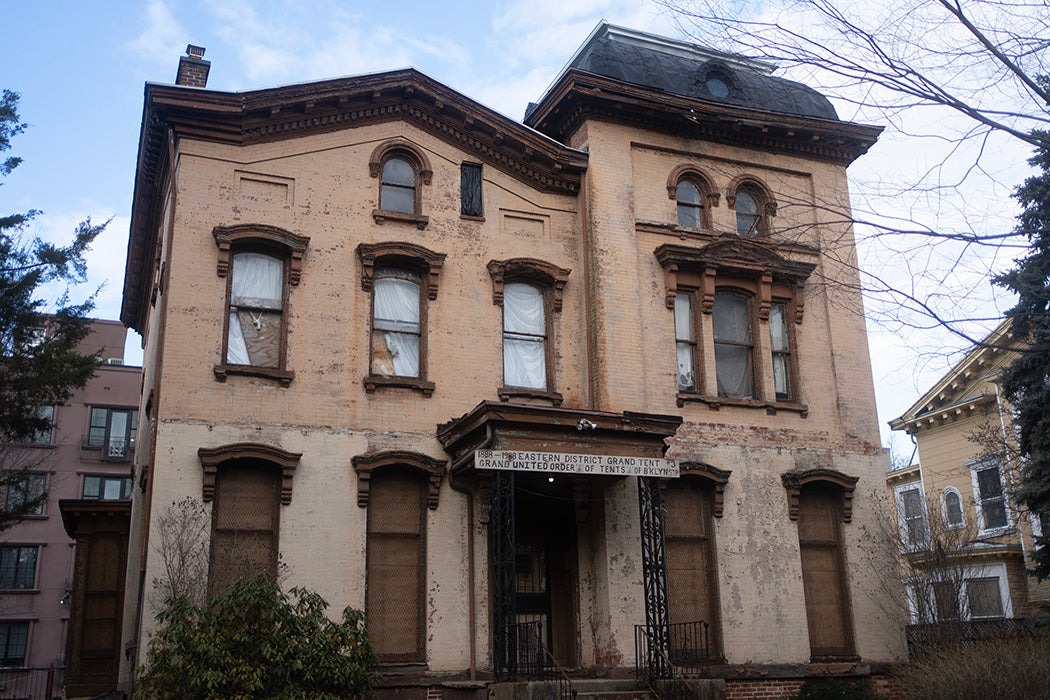
The United Order of the Tents in Brooklyn, 2023

Jonathan Aprea

Secret Societies and the Fight for Black Freedom

By: Ashawnta Jackson 

February 3, 2023

 Share Tweet Email Print

The United Order of the Tents, a secret society for Black women dating back to the nineteenth century, has been in the news lately as its members fight to save their Brooklyn headquarters. Though often obscured in history, organizations like the Tents served an important role, supporting (and in many cases, continuing to support) powerful systems for organizing and fighting for civil rights. As historian Paul Lawrence Dunbar writes, “Because there were few opportunities for blacks to participate in the wider society; political, social, and educational goals found an outlet in the institutions of the black community.”

As Dunbar explains, Black people in North America began organizing as early as 1693. People enslaved in Massachusetts united in the Society of Negroes, which, although an organization for Black people, was created under the leadership of Cotton Mather, a minister and slave owner. As such, the group was less concerned with freedom than benevolent societies that would follow it. For example, its rules strictly prohibited providing shelter or aid to those who escaped from slavery.

Groups that were established by and for free Black people had other ideas.

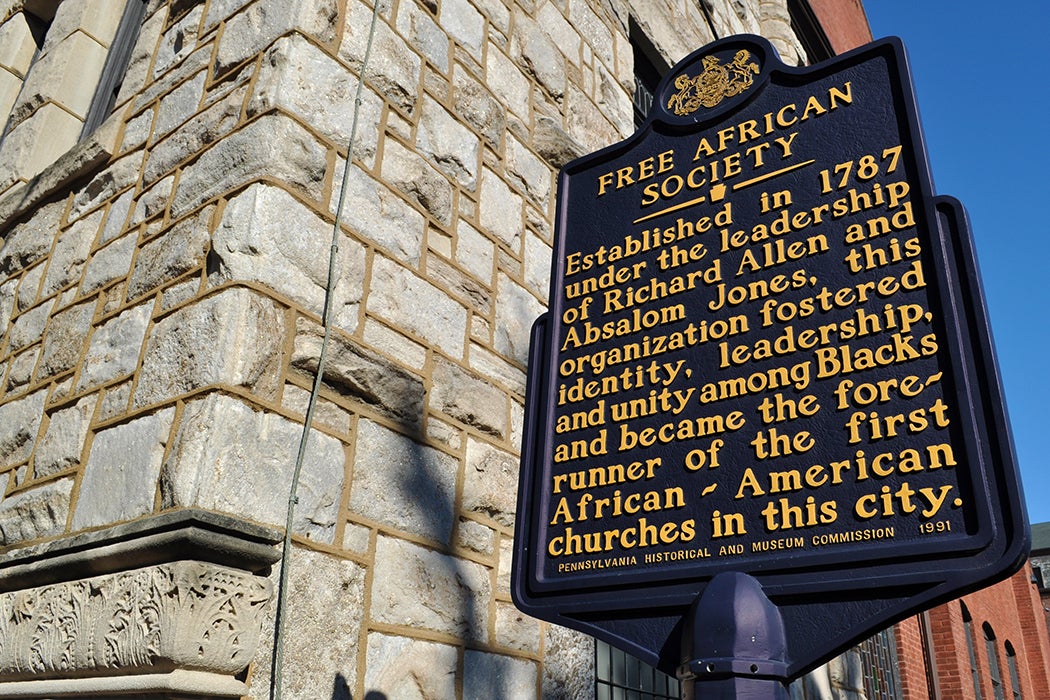
Historical Marker at 6th and Lombard Sts. Philadelphia PA
Historical Marker at 6th and Lombard Streets, Philadelphia, Pennsylvania via Wikimedia Commons 

The Free African Society of Philadelphia and the African Free School of New York were both established in 1787. The former provided mutual aid, while the latter “was founded to educate New York City’s black children.” Both of these organizations chose to include “African” in their names, signaling something new as well.

“The names given to these early black organizations and institutions illustrate the importance places on maintaining their African heritage,” Dunbar explains.

Though not strictly religious groups, many of these early organizations were associated with churches, some more closely than others.

Though many of these societies required membership dues, so not all Black people could afford to participate, because of the number of them, “membership was possible for a substantial number of [B]lacks because of the large number of groups and the different levels within the groups.”

Even so, the cost could be prohibitive, Dunbar acknowledges. “During the 1830s, the initiation fees to join an organization ranged from one to eight dollars, and the monthly membership dues were from 12 to 25 cents, which was somewhat excessive for some [B]lacks.”

Though not strictly religious groups, many of these early organizations were associated with churches, some more closely than others. The Union Traveller’s Association, for example, functioned as a church, so much so that the mayor of Richmond cautioned its members against holding religious services “without the presence of a white minister.” Another, the African Union Society in Rhode Island, operated out of a church and “recorded births, marriages, and deaths as well as provided decent burials for blacks.”

In post-Civil War America, benevolent societies also found a foothold aiding people freed from slavery. As Dunbar writes, after the war, black people were “left to fend for themselves.” Benevolent societies were able to help those that the newly created Freedman’s Bureau could not. Groups like the Odd Fellows, Knights of Pythias, and Prince Hall Masons saw their membership numbers soar, explains historian Joe W. Trotter, with some having “quite large memberships by the early twentieth century: Odd Fellows (304,000), Pythians (250,000), Masons (150,000).” These organizations “not only [aided] in the transition of blacks from slavery to freedom, but also from farm to factory and from the South to the urban North and West.”

As both Dunbar and Trotter point out, for a long time, academic study of these societies was largely absent. Some of this can be attributed to the role of the church, Trotter explains, as the religious institution is “often portrayed as the incubator for other black institutions and organizations.” While there is a connection between secular societies and the church, influence went both ways. The African Methodist Episcopal Church, for example, “actually emerged from the work of Philadelphia’s free African Society,” Trotter notes.

Another reason for their historical absence is likely due to the reason that many other parts of history have been understudied— bigotry. Early scholars saw these groups as “child-like imitations of Euro-American culture,” Dunbar writes. They were referred to as “ape lodges,” and their work discounted.

In more modern times, researchers have seen these societies in a different light, noting how vital they’ve been in the fight for equality. These societies, Trotter writes, were instrumental in shaping Black identity, “[they] protected members against poverty and other misfortunes; and supported movements for social change.”


Privacy Policy   Contact Us
You may unsubscribe at any time by clicking on the provided link on any marketing message.

Support JSTOR Daily! Join our new membership program on Patreon today.

 Share Tweet Email Print

Have a correction or comment about this article?
Please contact us.

Black Historywomen’s historyJournal of African American StudiesSocial Science History

JSTOR logo

Resources

JSTOR is a digital library for scholars, researchers, and students. JSTOR Daily readers can access the original research behind our articles for free on JSTOR.

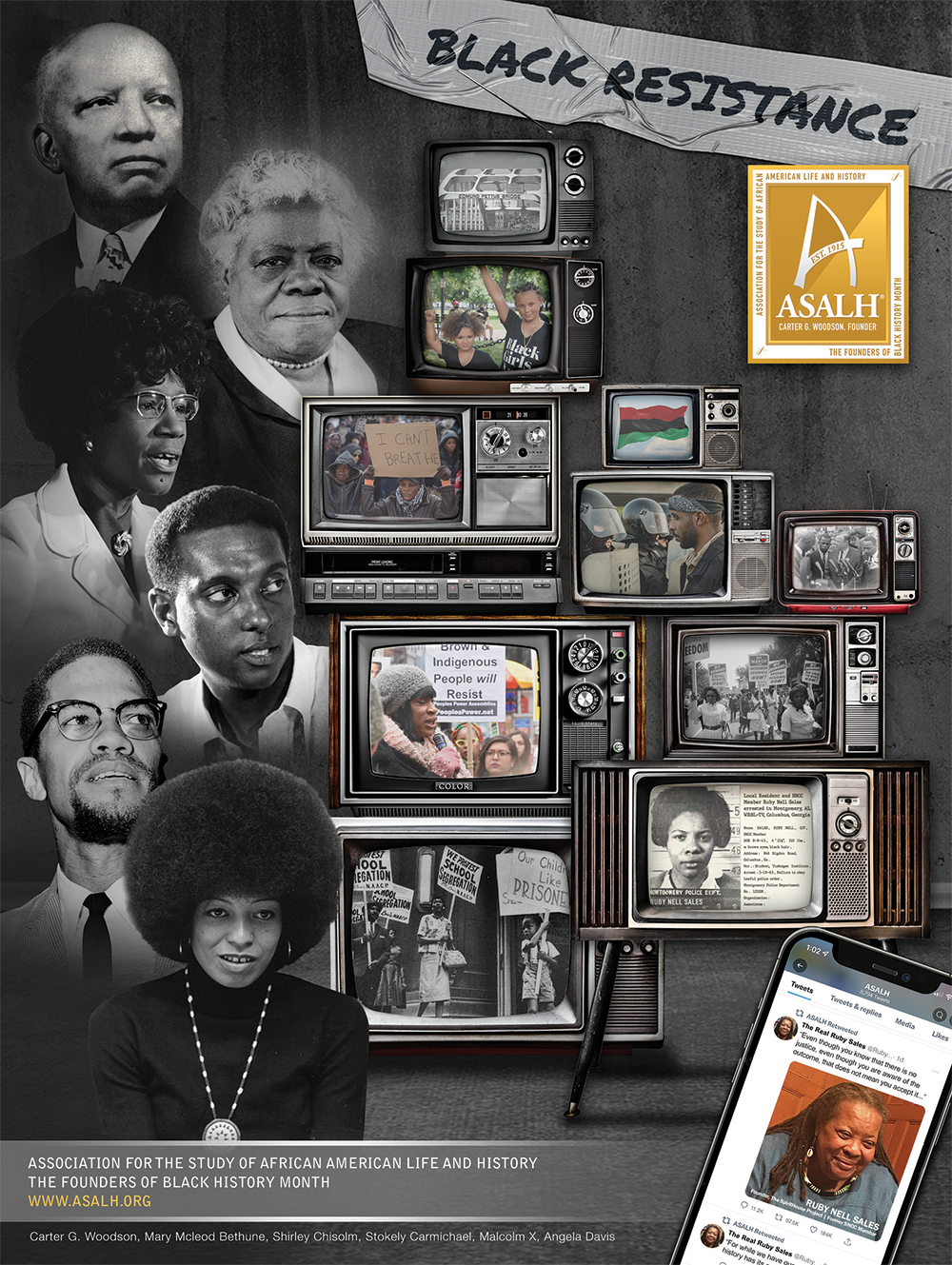
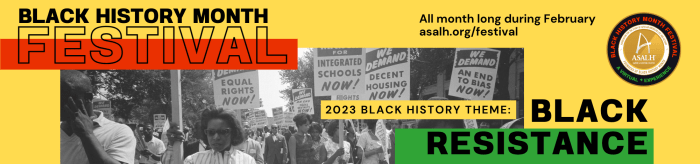
BLACK RESISTANCE :: 2023 BHM THEME :: ASALH since 1926

2023 BHM THEME

Black Resistance

African Americans have resisted historic and ongoing oppression, in all forms, especially the racial terrorism of lynching, racial pogroms, and police killings since our arrival upon these shores. These efforts have been to advocate for a dignified self-determined life in a just democratic society in the United States and beyond the United States political jurisdiction. The 1950s and 1970s in the United States was defined by actions such as sit-ins, boycotts, walk outs, strikes by Black people and white allies in the fight for justice against discrimination in all sectors of society from employment to education to housing. Black people have had to consistently push the United States to live up to its ideals of freedom, liberty, and justice for all. Systematic oppression has sought to negate much of the dreams of our griots, like Langston Hughes and Zora Neale Hurston, and our freedom fighters, like the Rev. Dr. Martin Luther King, Jr., Septima Clark, and Fannie Lou Hamer fought to realize. Black people have sought ways to nurture and protect Black lives, and for autonomy of their physical and intellectual bodies through armed resistance, voluntary emigration, nonviolence, education, literature, sports, media, and legislation/politics. Black led institutions and affiliations have lobbied, litigated, legislated, protested, and achieved success.

In an effort to live, and maintain and protect economic success Black people have organized/planned violent insurrections against those who enslaved them, such as in Haiti,, and armed themselves against murderous white mobs as seen in Memphis, TN (1892), Rosewood, FL (1923), and New Orleans, LA (1900). Additionally, some Black people thought that the best way to resist was to self-liberate as seen by the actions those who left the plantation system, of Henry Adams and Benjamin “Pap” Singleton, when they led a mass exodus westward in 1879 and Bishop Henry McNeal Turner of the African Methodist Episcopal Church, who organized emigration to Liberia.

Black faith institutions were spaces where Black communities met to organize resistance efforts, inspired folk to participate in the movements, and offered sanctuary during times of crisis. To promote awareness of the myriad of issues and activities media outlets were developed including radio shows, podcasts, newspapers (i.e. Chicago DefenderChicago Beethe AfroThe California Eagle, Omaha Star, the Crisis, etc.). Ida B. Wells used publications to contest the scourge of lynching. These outlets were pivotal in sharing the successes and challenges of resistance movements.

Cultural centers such as libraries including George Cleveland Hall Library (Chicago, IL), Dart Hall (Charleston, SC) and social, literary, and cultural clubs, such as Jack and Jill, Phillis Wheatley Literary Societies, fraternal and sororal orders, associations (i.e. Association for the Study of Negro Life and History, National Association of Colored Women, etc.) worked to support the intellectual development of communities to collect and preserve Black stories, sponsor Black history and literature events, and were active in the quest for civil, social, and human rights.

Black medical professionals worked with others to establish nursing schools, hospitals, and clinics in order to provide spaces for Black people to get quality health care, which they often did (and do not) receive at mainstream medical institutions. For economic and financial independence businesses, such as Binga Bank, Johnson Publishing Company, Parker House Sausage Company, Soft and Sheen, etc., were developed to keep funds within the community. In order to resist inequality and to advocate for themselves Black men and women formed labor unions based on trades and occupations, some examples, include the Colored National Labor Union, Colored Musicians Club, Coalition of Black Trade Unionists, and Negro American Labor Council.

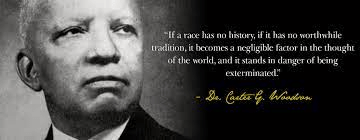
Education, whether in elementary, secondary, or higher education institutions have been seen as a way for Black people and communities to resist the narrative that Black people are intellectually inferior. When Carter G. Woodson founded Negro History Week (NHW) in 1926, he saw it as a way to provide a space and resources to critically educate students about their history. The grassroots network of Black teachers used this week not only to lionize individuals and narratives, but also to teach students about racial progress, and as well as shared and collective responsibility. They developed assignments and curriculum to provide students with the tools to succeed. Historically Black Colleges and Universities (HBCUs), were developed by Northern white philanthropists, but they emerged as a space for the formation of activists, artists, business owners, educators, etc. and their continued operation have stood as testament to Black investment and creative thinking in the face of the changing landscape of higher education. Furthermore, students at HBCUs were at the forefront of the Civil Rights Movement, Black Power Movements, and social justice movements from the nineteenth to twenty-first centuries.

African American spirituals, gospel, folk music, hip-hop, and rap have been used to express struggle, hope, and for solidarity in the face of racial oppression. Music has been used to illustrate societal issues including white and state sanctioned violence (i.e. Billie Holiday’s Strange Fruit), sexual politics (i.e. Salt-N-Pepa’s Let’s Talk About Sex), as motivation, for strength against harassment, and to experience freedom. The Black artists, writers, photographers, and musicians who participated in the Black Arts Movement, the Harlem Renaissance, and the Chicago Black Renaissance were the soundtrack and the visual representation of resistance movements. These individuals created art that supported the resistance movements, but also provided a space for Black people to express love and joy. Creatives used poetry, fiction, short stories, plays, films, and television to counter stereotypes and to imagine a present and future with Black people in it.

Sports are a world pastime, and it both brings people together and separates them. Black athletes have used sports as a way to advocate for social issues and for political agendas. Serena Williams, Flo Jo, Jesse Owens, Tommie Smith, John Carlos, Jackie Robinson, Colin Kaepernick, Simone Biles, and many others have used their public forum to bring awareness to issues that affect society as they resisted the idea that they cannot or should not speak about political, cultural, or social issues. Black athletic activists have often suffered personal and economic consequences due to their stances, speech, and actions, but to them it has been worth it to see changes.

Historically and today in the 21st century, Black people have worked the political angle to seek their rightful space in the country. Where race is concerned, legislative or judicial action to deal with controversial issues has often come late. The historic Executive Orders 8802 and 9346 were responses to A. Phillip Randolph and the all-Black March on Washington Movement’s threat to lead a 50,000-strong Black worker’s march into Washington, D.C. And all three of the Civil Rights Act, the Voting Rights Act and the Fair Housing Act were concessions to the Civil Rights and Black Power movements. Every advance, improvement in our quality of life and access to the levers of power to determine our destiny has been achieved through struggle. John Lewis advised, “Do not get lost in a sea of despair. Be hopeful, be optimistic. Our struggle is not the struggle of a day, a week, a month, or a year, it is the struggle of a lifetime. Never, ever be afraid to make some noise and get in good trouble, necessary trouble.”

Lewis’ advice is true not just for the 21st century, but also during the antebellum period, as seen in the narratives of the enslaved, such as Frederick Douglass and Harriet Jacobs, to testimonials about lynchings and ongoing police violence against African Americans. With the murders of Trayvon Martin, Michael Brown, Sandra Bland, Breonna Taylor, and thousands of other Black women, men, and trans people there are new movements (i.e. #Sayhername) and organizations (i.e. Black Lives Matter) that are pushing for the justice system to investigate police involved shootings and white supremacist vigilantes. Nearly 179 years ago, the Rev. Henry Highland Garnett proposed that the only path to freedom, justice, and equality; self-determination; and/or social transformation is resistance. In thunder tones, Garnett shouted, “Let your motto be resistance! resistance! RESISTANCE!

By resisting Black people have achieved triumphs, successes, and progress as seen in the end of chattel slavery, dismantling of Jim and Jane Crow segregation in the South, increased political representation at all levels of government, desegregation of educational institutions, the passage of Civil Rights Act of 1964, the opening of the Smithsonian National Museum of African American History in DC and increased and diverse representation of Black experiences in media. Black resistance strategies have served as a model for every other social movement in the country, thus, the legacy and importance of these actions cannot be understated.

As societal and political forces escalate to limit access to and exercise of the ballot, eliminate the teaching of Black history, and work to push us back into the 1890s, we can only rely on our capacity to resist. The enactment of HR 40, the John Lewis Voting Rights Act, the Breathe Act, and the closure of the racial wealth gap is not the end. They too will require us to mobilize our resources, human and material, and fight for “freedom, justice, and equality”; “self-determination”, and/or “social transformation.”

This is a call to everyone, inside and outside the academy, to study the history of Black Americans’ responses to establish safe spaces, where Black life can be sustained, fortified, and respected.

Click here to download a printable pdf

ASALH BLACK HISTORY MONTH VIRTUAL FESTIVAL


BLACK HISTORY MONTH VIRTUAL FESTIVAL

ASALH WILL HOLD INNOVATIVE VIRTUAL PROGRAMMING IN THE MONTH OF FEBRUARY CELEBRATING THE 2023 BLACK HISTORY THEME: BLACK RESISTANCE

This year’s festival will celebrate the theme of Black Resistance in the past present AND FUTURE STARTING FEBRUARY 1st 2023.

During these uncertain times in which the very nature of what the Association does—the teaching of areas of Black History which has been legally banned in seven U.S. states as “history that makes people uncomfortable” ASALH presents it’s annual month-long Black History Month Festival.

African Americans have resisted historic and ongoing oppression, in all forms, especially the racial terrorism of lynching, racial pogroms, and police killings since our arrival upon these shores. These efforts have been to advocate for a dignified self-determined life in a just democratic society in the United States and beyond the United States political jurisdiction.

READ MORE

Ron DeSantis Battles the African American A.P. Course—and History :: Dr. Jelani Cobb : The New Yorker

Ron DeSantis Battles the African American A.P. Course—and History

The state’s intent seems to be to provide white Floridians, from a young age, with a version of history that they can be comfortable with, regardless of whether it’s true.

Dr. Jelani Cobb

By Jelani Cobb January 29, 2023

The debacle surrounding the Florida Department of Education’s recent rejection of an Advanced Placement course in African American studies is a reminder that battles over the past are almost always tied to efforts to win some war being waged in the present. The late-nineteenth-century romanticization of the Confederacy was meant to justify the new regime of segregation then being implemented across the South. That campaign was so successful that, in 1935, when W. E. B. Du Bois published “Black Reconstruction,” his reconsideration of the period following the Civil War, he devoted an entire chapter to the ways in which the South had lost the war but won the historiography.

The road runs in both directions. The social movements of the nineteen-fifties and sixties spawned their own, generally corrective takes on the nation’s past. The discipline of Black studies, which originated in the late sixties and is now more often referred to as Africana or African American studies, is a direct product of that wave of scholarly revisionism. Today, during a period in which states, particularly with Republican-led legislatures, have taken to removing books from libraries, stoking fears about critical race theory, and eviscerating diversity-equity-and-inclusion programs in schools—forty-two have proposed restrictive measures—it’s scarcely surprising that a discipline built on an interest in exploring Black humanity would find itself in the crosshairs. That such a thing would happen in Florida is even less so.

Last year, Governor Ron DeSantis, a Republican who is frequently mentioned as a 2024 Presidential contender, signed into law the Stop woke Act, a piece of Trumpist culture warfare that regulates how subject matter relating to race can be taught in public schools, picking up from where the right-wing crusade against Nikole Hannah-Jones’s 1619 Project left off. (The State Board of Education had banned the teaching of critical race theory in public schools in 2021.) DeSantis also signed the “Don’t Say Gay” bill, which limits discussion of sexual orientation and gender identity in public schools and became the centerpiece in a conflict over gay rights with Disney, one of the state’s largest employers. (The Governor voiced concern, too, about the inclusion of “queer theory” in the A.P. course, saying last Monday, “When you try to use Black history to shoehorn in queer theory, you are clearly trying to use that for political purposes.”) Both laws have been challenged in court, but together they show the demagogic lengths to which DeSantis is willing to go to burnish his profile among conservatives nationally.

DeSantis shared some of his own ideas about the nation’s past during a gubernatorial-campaign debate last fall, stating that “it’s not true” that “the United States was built on stolen land.” That claim, of course, is starkly at odds not only with the history of westward expansion but with the history of Florida; thousands of Native Americans were forcibly relocated from the region, with the Indian Removal Act of 1830. In general, the Governor’s objective is seemingly to provide white Floridians, from a young age, with a version of the past that they can be comfortable with, regardless of whether it’s true.

VIDEO FROM THE NEW YORKERTwo-Spirit: A Trans Woman’s Struggle for Acceptance

The A.P. course is being piloted in sixty high schools across the country, including at least one in Florida, and is scheduled to be available to any schools that offer A.P. courses in the 2024-25 school year. There appear to have been few problems with teaching it, even in Florida, but on January 12th the state’s education department sent a letter to the College Board, which oversees the creation and implementation of A.P. courses, notifying it that the curriculum is “inexplicably contrary to Florida law and significantly lacks educational value.” On January 20th, Manny Diaz, Jr., the commissioner of education, tweeted, “We proudly require the teaching of African American history. We do not accept woke indoctrination masquerading as education.” He cited the course’s references to notable academics, including Robin D. G. Kelley, Kimberlé Crenshaw, and the late bell hooks, as supposed examples of such indoctrination.

A day earlier, the College Board had released a statement saying that the course was still in draft form, and that “frameworks often change significantly” during the revision process. But the official framework of the course is scheduled to be released to the public on February 1st, the first day of Black History Month. The course guide for instructors, which runs to two hundred and forty-six pages, states in its preface that A.P. “opposes indoctrination” and that courses are built around an “unflinching encounter with evidence” and empirical analysis. It’s an odd note to direct at teachers of high-school students who have displayed the intellectual and emotional maturity to engage with college-level coursework. However, it’s likely intended not for them but for any bureaucrats and politicians who believe that “wokeism”—a threadbare slang term for social awareness—is an actual ideology.

Of all the criticisms aimed at the course, the most questionable is the department’s contention that it “lacks educational value.” The course includes contributions from some of the most highly regarded academics in the field, including the literary scholar Henry Louis Gates, Jr., and the historians Nell Irvin Painter and Annette Gordon-Reed. Faculty from Harvard, Emory, Georgetown, the University of California, and the University of Connecticut are on an advisory board. With that contention, the department is, in effect, dismissing the import of Frederick Douglass’s autobiography “My Bondage and My Freedom,” excerpts of which are included in the curriculum; the Dred Scott decision, also excerpted; and the Thirteenth, Fourteenth, and Fifteenth Amendments, whose origins are explored in detail. In fact, the idea that the subject matter covered in the course does not warrant a place in the classroom is contradicted by Florida’s own educational standards. Among the topics examined are the transatlantic slave trade, the roots of the Civil War, Reconstruction, and the birth of the civil-rights movement, some of which students are taught as early as the fourth grade.

Last Wednesday, three Florida high-school students, represented by the civil-rights attorney Benjamin Crump, said that they were prepared to sue the DeSantis administration if the ban on the course is not lifted. But there is little likelihood that the course can be revised in such a way that it is palatable to DeSantis and the state’s education department without losing the essence of what it is attempting to convey about the miasma of race in American history. Their sense appears to be that the evils of the past are not nearly as dangerous now as the willingness to talk about them in the present. ♦Published in the print edition of the February 6, 2023, issue, with the headline “Historic Battles.”

New Yorker Favorites

Jelani Cobb, a staff writer at The New Yorker, is the co-editor of “The Essential Kerner Commission Report.” He is the dean of the Columbia Journalism School. He is an OUR COMMON GROUND Voice.

Black History Month 2023 :: Why BHM is Important

Origins of Black History Month

Daryl Michael Scott

Re-publication

The story of Black History Month begins in Chicago during the summer of 1915. An alumnus of the University of Chicago with many friends in the city, Carter G. Woodson traveled from Washington, D.C. to participate in a national celebration of the fiftieth anniversary of emancipation sponsored by the state of Illinois. Thousands of African Americans traveled from across the country to see exhibits highlighting the progress their people had made since the destruction of slavery. Awarded a doctorate in Harvard three years earlier, Woodson joined the other exhibitors with a black history display. Despite being held at the Coliseum, the site of the 1912 Republican convention, an overflow crowd of six to twelve thousand waited outside for their turn to view the exhibits. Inspired by the three-week celebration, Woodson decided to form an organization to promote the scientific study of black life and history before leaving town. On September 9th, Woodson met at the Wabash YMCA with A. L. Jackson and three others formed the Association for the Study of Negro Life and History (ASNLH).

He hoped that others would popularize the findings that he and other black intellectuals would publish in The Journal of Negro History, which he established in 1916. As early as 1920, Woodson urged black civic organizations to promote the achievements that researchers were uncovering. A graduate member of Omega Psi Phi, he urged his fraternity brothers to take up the work. In 1924, they responded with the creation of Negro History and Literature Week, which they renamed Negro Achievement Week. Their outreach was significant, but Woodson desired greater impact. As he told an audience of Hampton Institute students, “We are going back to that beautiful history and it is going to inspire us to greater achievements.” In 1925, he decided that the Association had to shoulder the responsibility. Going forward it would both create and popularize knowledge about the black past. He sent out a press release announcing Negro History Week in February, 1926.

Woodson chose February for reasons of tradition and reform. It is commonly said that Woodson selected February to encompass the birthdays of two great Americans who played a prominent role in shaping black history, namely Abraham Lincoln and Frederick Douglass, whose birthdays are the 12th and the 14th, respectively. More importantly, he chose them for reasons of tradition. Since Lincoln’s assassination in 1865, the black community, along with other Republicans, had been celebrating the fallen President’s birthday. And since the late 1890s, black communities across the country had been celebrating Douglass’. Well aware of the pre-existing celebrations, Woodson built Negro History Week around traditional days of commemorating the black past. He was asking the public to extend their study of black history, not to create a new tradition. In doing so, he increased his chances for success.

Yet Woodson was up to something more than building on tradition. Without saying so, he aimed to reform it from the study of two great men to a great race. Though he admired both men, Woodson had never been fond of the celebrations held in their honor. He railed against the “ignorant spellbinders” who addressed large, convivial gatherings and displayed their lack of knowledge about the men and their contributions to history. More importantly, Woodson believed that history was made by the people, not simply or primarily by great men. He envisioned the study and celebration of the Negro as a race, not simply as the producers of a great man. And Lincoln, however great, had not freed the slaves—the Union Army, including hundreds of thousands of black soldiers and sailors, had done that. Rather than focusing on two men, the black community, he believed, should focus on the countless black men and women who had contributed to the advance of human civilization.

From the beginning, Woodson was overwhelmed by the response to his call. Negro History Week appeared across the country in schools and before the public. The 1920s was the decade of the New Negro, a name given to the Post-War I generation because of its rising racial pride and consciousness. Urbanization and industrialization had brought over a million African Americans from the rural South into big cities of the nation. The expanding black middle class became participants in and consumers of black literature and culture. Black history clubs sprang up, teachers demanded materials to instruct their pupils, and progressive whites stepped and endorsed the efforts.

Woodson and the Association scrambled to meet the demand. They set a theme for the annual celebration and provided study materials—pictures, lessons for teachers, plays for historical performances, and posters of important dates and people. Provisioned with a steady flow of knowledge, high schools in progressive communities formed Negro History Clubs. To serve the desire of history buffs to participate in the re-education of black folks and the nation, ASNLH formed branches that stretched from coast to coast. In 1937, at the urging of Mary McLeod Bethune, Woodson established the Negro History Bulletin, which focused on the annual theme. As black populations grew, mayors issued Negro History Week proclamations, and in cities like Syracuse progressive whites joined Negro History Week with National Brotherhood Week.

Like most ideas that resonate with the spirit of the times, Negro History Week proved to be more dynamic than Woodson or the Association could control. By the 1930s, Woodson complained about the intellectual charlatans, black and white, popping up everywhere seeking to take advantage of the public interest in black history. He warned teachers not to invite speakers who had less knowledge than the students themselves. Increasingly publishing houses that had previously ignored black topics and authors rushed to put books on the market and in the schools. Instant experts appeared everywhere, and non-scholarly works appeared from “mushroom presses.” In America, nothing popular escapes either commercialization or eventual trivialization, and so Woodson, the constant reformer, had his hands full in promoting celebrations worthy of the people who had made the history.

Well before his death in 1950, Woodson believed that the weekly celebrations—not the study or celebration of black history–would eventually come to an end. In fact, Woodson never viewed black history as a one-week affair. He pressed for schools to use Negro History Week to demonstrate what students learned all year. In the same vein, he established a black studies extension program to reach adults throughout the year. It was in this sense that blacks would learn of their past on a daily basis that he looked forward to the time when an annual celebration would no longer be necessary. Generations before Morgan Freeman and other advocates of all-year commemorations, Woodson believed that black history was too important to America and the world to be crammed into a limited time frame. He spoke of a shift from Negro History Week to Negro History Year.

In the 1940s, efforts began slowly within the black community to expand the study of black history in the schools and black history celebrations before the public. In the South, black teachers often taught Negro History as a supplement to United States history. One early beneficiary of the movement reported that his teacher would hide Woodson’s textbook beneath his desk to avoid drawing the wrath of the principal. During the Civil Rights Movement in the South, the Freedom Schools incorporated black history into the curriculum to advance social change. The Negro History movement was an intellectual insurgency that was part of every larger effort to transform race relations.

The 1960s had a dramatic effect on the study and celebration of black history. Before the decade was over, Negro History Week would be well on its way to becoming Black History Month. The shift to a month-long celebration began even before Dr. Woodson death. As early as 1940s, blacks in West Virginia, a state where Woodson often spoke, began to celebrate February as Negro History Month. In Chicago, a now-forgotten cultural activist, Fredrick H. Hammurabi, started celebrating Negro History Month in the mid-1960s. Having taken an African name in the 1930s, Hammurabi used his cultural center, the House of Knowledge, to fuse African consciousness with the study of the black past. By the late 1960s, as young blacks on college campuses became increasingly conscious of links with Africa, Black History Month replaced Negro History Week at a quickening pace. Within the Association, younger intellectuals, part of the awakening, prodded Woodson’s organization to change with the times. They succeeded. In 1976, fifty years after the first celebration, the Association used its influence to institutionalize the shifts from a week to a month and from Negro history to black history. Since the mid-1970s, every American president, Democrat and Republican, has issued proclamations endorsing the Association’s annual theme.

What Carter G. Woodson would say about the continued celebrations is unknown, but he would smile on all honest efforts to make b[B]lack history a field of serious study and provide the public with thoughtful celebrations.

Daryl Michael Scott
dms@darylmichaelscott.com
Professor of History
Howard University
Vice President of Program, ASALH
© 2011, 2010, 2009 ASALH

How the Supreme Court Protects Police Officers :: The Atlantic

It’s almost impossible to hold them to account.

By Joanna Schwartz
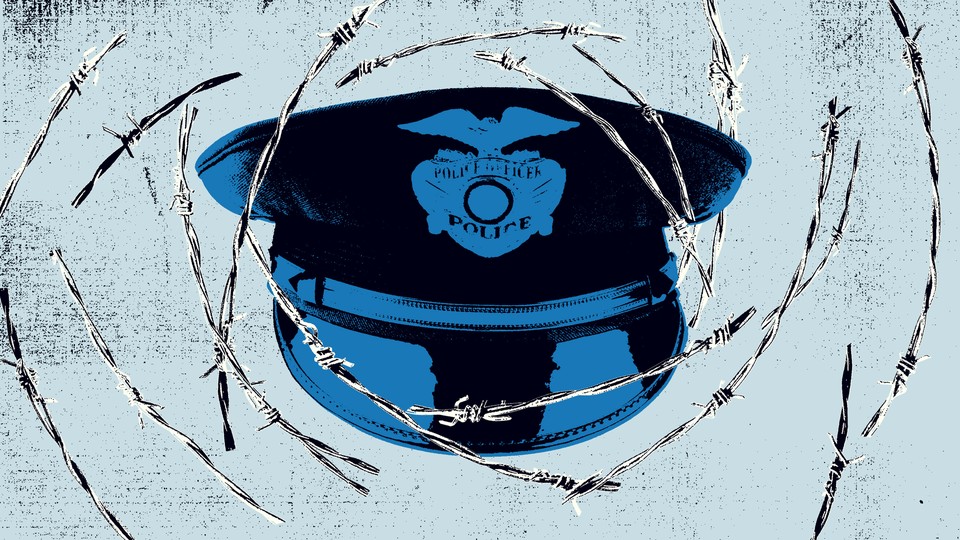
a police hat surrounded by barbed wire
Matt Chase / The Atlantic; Getty

How the Supreme Court Protects Police Officers

JANUARY 31, 2023, 7:12 AM ETSHARE

On the afternoon of February 8, 2018, more than two dozen law-enforcement officers crowded into a conference room in the Henry County Sheriff’s Office, on the outskirts of Atlanta. They were preparing to execute a no-knock warrant at 305 English Road, the home of a suspected drug dealer who had been under investigation for almost two years. The special agent leading the briefing told the team that 305 English Road was a small house with off-white siding and several broken-down cars out front, showed them an aerial photograph of the house, and gave them turn-by-turn directions to get there.

When the officers arrived at their destination, the house described in the warrant—305 English Road, run-down, off-white, with cars strewn across the yard—was right in front of them. But they walked past it to a different house, a tidy yellow one, 40 yards away. The house at 303 English Road looked nothing like the house described in the briefing and in the warrant. Yet, less than a minute after getting out of their cars, the officers set off flash grenades and used battering rams to smash open all three doors of the home.

Shielded: How the Police Became Untouchable JOANNA SCHWARTZ, PENGUINBUY BOOK

When you buy a book using a link on this page, we receive a commission. Thank you for supporting The Atlantic.

Inside, they found Onree Norris, a 78-year-old Black man who had lived there for more than 50 years, raising his three children while he worked at a nearby rock quarry. Norris was no drug dealer. He had never been in any trouble with the law; he’d never even received a traffic ticket.

Onree Norris was watching the evening news in an armchair in his bedroom when he heard a thunderous sound, as if a bomb had gone off in his house. He got up to see what the commotion was and found a crowd of men in military gear in his hallway. Norris was more than twice as old as the target of the search warrant, but the officers pointed assault rifles at him anyway and yelled at him to raise his hands and get on the ground. When Norris told the officers that his knees were in bad shape, an officer grabbed Norris, pushed him down, and twisted his arm behind his back. Norris’s chest hurt, and he had trouble breathing. He told the officers that he had a heart condition—he’d had bypass surgery and had a pacemaker put in—but they kept him on the ground for several minutes. Norris was eventually led outside in handcuffs. When the officers realized they had blasted their way into the wrong house, they turned their cameras off one by one.

Whatever one believes about the job of policing—whether it’s that well-intentioned officers often must make split-second decisions that are easy to criticize in hindsight, or that the profession is inherently corrupt—there is no doubt that police officers sometimes egregiously abuse their authority. The videos that have filled our screens in recent years—most recently the surveillance footage of officers in Memphis fatally beating Tyre Nichols—offer horrifying evidence of this reality.

People who have lost loved ones or have themselves been harmed by the police often say that they want the officers involved to be punished and an assurance that something similar won’t happen in the future. Yet justice for victims of police misconduct is extremely difficult to achieve.

What happened in Memphis last week—the swift firing and arrest of the five officers who beat Nichols, and the murder charges they face—is highly unusual, a result of immediate public attention to an inconceivably barbaric attack. Although officers can be criminally prosecuted and sent to prison, they seldom are: Police are charged in less than 2 percent of fatal shootings and convicted in less than a third of those cases. Police departments rarely discipline or fire their officers.

Typically, victims’ only recourse is a civil lawsuit seeking money or court-ordered reforms. In 1961, the Supreme Court ruled that people could sue officers who violated their constitutional rights under a federal statute enacted 90 years earlier, during the bloody years of Reconstruction. That statute, known then as the Ku Klux Klan Act and referred to as Section 1983 today, was meant to provide a remedy to Black people across the South who were being tortured and killed by white supremacists while local law enforcement either participated in the violence or stood idly by.

After that 1961 decision, the number of police-misconduct suits filed shot up. But so did concerns about the suits’ potentially ruinous effects. Settlements and judgments would bankrupt officers and cities; no one in their right mind would agree to become a police officer; the very fabric of our society would become unwound. These claims were exaggerated, if not simply false. But they have nevertheless been relied upon by courts, legislatures, and government officials over the past 60 years to justify the creation of multiple overlapping protections for officers and police departments that regularly deny justice to people whose rights have been violated.

The best-known of these protections is “qualified immunity.” When the Supreme Court created qualified immunity, in 1967, it was meant to shield officers from liability only if they were acting in “good faith” when they violated the Constitution. Yet the Court has repeatedly strengthened the doctrine. In 1982, the Court ruled that requiring officers to prove good faith was too much of a burden. Instead, they would be entitled to qualified immunity so long as they did not violate “clearly established law.” Over the years, what constitutes “clearly established law” has constricted. The Roberts Court, invoking the importance of qualified immunity to “society as a whole,” has emphasized that the law is “clearly established” only if a court has previously found nearly identical conduct to be unconstitutional. What began as a protection for officers acting in good faith has turned into a protection for officers with the good fortune to have violated the Constitution in a novel way.

It was qualified immunity that dashed Onree Norris’s hopes of getting justice. In 2018, Norris sued the officers who had raided his home, seeking money to compensate him for his physical and emotional injuries. But in 2020, a federal judge in the Northern District of Georgia granted the officers qualified immunity and dismissed the case; in 2021, a panel of three judges on the Eleventh Circuit Court of Appeals affirmed the ruling.

The three appeals judges recognized that officers who execute a search warrant on the wrong home violate the Fourth Amendment to the U.S. Constitution unless they have made “a reasonable effort to ascertain and identify the place intended to be searched.” In fact, the very same court of appeals that heard Norris’s case in 2021 had ruled five years earlier that it was unconstitutional for an officer who executed a warrant on the wrong house to detain its residents at gunpoint—almost exactly what had happened to Norris. But that earlier court decision was not enough to defeat qualified immunity in Norris’s case, because it was “unpublished”—meaning that it was available online but had not been selected to be printed in the books of decisions that are issued each year—and the Eleventh Circuit is of the view that such unpublished decisions cannot “clearly establish” the law.

Just as george floyd’s murder has come to represent all that is wrong with police violence and overreach, qualified immunity has come to represent all that is wrong with our system of police accountability. But, over the past 60 years, the Supreme Court has created multiple other barriers to holding police to account.

Take, for example, the standard that a plaintiff must meet to file a complaint. For decades, a complaint needed to include only a “short and plain” statement of the facts and why those facts entitled the plaintiff to relief. But in 2007, the Supreme Court did an about-face, requiring that plaintiffs include enough factual detail in their initial complaints to establish a “plausible” entitlement to relief.

This standard does not always pose a problem: Norris and his lawyer knew enough about what had happened during the raid of his home to write a detailed complaint. But sometimes a person whose rights have been violated doesn’t know the crucial details of their case.

Vicki Timpa searched for months for information about how her son, Tony, had died while handcuffed in Dallas police officers’ custody in August 2016. Department officials had body-camera videos that captured Tony’s last moments, but they refused to tell Timpa what had happened to her son or the names of the officers who were on the scene when he died. Timpa sued the city, but the case was dismissed because her complaint did not include enough factual detail about those last moments to establish a “plausible” claim.

When the Court set out the “plausibility” standard, it explained that, if filing a case were too easy, plaintiffs with “a largely groundless claim” could “take up the time” of defendants, and expensive discovery could “push cost-conscious defendants to settle even anemic cases.” But this rule puts people like Timpa in a bind: They are allowed discovery only if their complaints include evidence supporting their claims, but they can’t access that evidence without the tools of discovery.

(Timpa did eventually get the information she sought after she filed a public-records request and sued the city for not complying with it. Only with that information in hand could she defeat the motion to dismiss. But then her case was dismissed on qualified-immunity grounds because she could not point to a prior case with similar facts. That decision was overturned on appeal in December 2021, and Timpas’s case is set to go to trial in March, almost seven years after Tony was killed.)

The Supreme Court has also interpreted the Constitution in ways that deny relief to victims of police violence and overreach. The Fourth Amendment protects against “unreasonable searches and seizures.” But in a series of decisions beginning in the 1960s, the Court has interpreted the “reasonableness” standard in a manner so deferential to police that officers can stop, arrest, search, beat, shoot, or kill people who have done nothing wrong without violating their rights.

On a July night in 2016, David Collie was walking down the street in Fort Worth, Texas, headed to a friend’s house, when two officers jumped out of their patrol car and yelled for Collie to raise his hands. The officers were on the lookout for two Black men who had robbed someone at a gas station. Collie was at least 10 years older, six inches shorter, and 30 pounds lighter than the smaller of the two robbery suspects. But he, like the suspects, was Black and was not wearing a shirt on that warm summer evening. Collie raised his hands. Just seconds later, and while standing more than 30 feet away, one of the officers shot Collie in the back. The hollow-point bullet entered Collie’s lung and punctured his spine. He survived, but was left paralyzed from the waist down.

When Collie sued, his case was dismissed by a district-court judge in Texas, and the decision was affirmed on appeal. The Fifth Circuit Court of Appeals called the case “tragic,” and a prime example of “an individual’s being in the wrong place at the wrong time,” but concluded that the officer had not violated Collie’s Fourth Amendment rights, because he reasonably—though mistakenly—thought he had seen a gun in Collie’s raised hand.

The Supreme Court has undermined the power and potential of civil-rights lawsuits in other ways: It has limited, for example, plaintiffs’ ability to sue local governments for their officers’ conduct and to win court orders requiring that departments change their behavior. Any one of the barriers, in isolation, would limit the power of civil-rights suits. In combination, they have made the police all but untouchable.

Even when people are able to secure a settlement or verdict to compensate them for their losses, police officers and departments rarely suffer any consequences for their wrongdoing.

The Supreme Court has long assumed that officers personally pay settlements and judgments entered against them. That is one of the justifications for qualified immunity. But officers’ bank accounts are protected by a wholly separate set of state laws and local policies requiring or allowing most governments to indemnify their officers when they are sued (meaning that they must pay for the officers’ defense and any award against them). As a result, vanishingly few police officers pay a penny in these cases.

Police departments typically don’t feel the financial sting of settlements or judgments either. Instead, the money is taken from local-government funds. And when money is tight, it tends to get pulled from the crevices of budgets earmarked for the least powerful: the marginalized people whose objections will carry the least political weight—the same people disproportionately likely to be abused by police.

Officers and officials could still learn from lawsuits, even without paying for them. But most make little effort to do so when a lawsuit doesn’t inspire front-page news or meetings with an angry mayor. Instead, government attorneys defend the officers in court, any settlement or judgment is paid out of the government’s budget or by the government’s insurer, and the law-enforcement agency moves on. In many cases, it does not even track the names of the officers, the alleged claims, the evidence revealed, the eventual resolution, or the amount paid.

Fundamental questions remain about what we should empower the police to do, and how to restore trust between law enforcement and the communities it serves. But no matter how governments ultimately answer these questions, they will almost certainly continue to authorize people to protect public safety. And some of those people will almost certainly abuse that authority. We need to get our system of governmental accountability working better than it does, no matter what our system of public safety looks like.

The fact that so many barriers to justice exist means that there is something for officials at every level of government to do.

The Supreme Court should reconsider its standards for qualified immunity, pleading rules, the Fourth Amendment, and municipal liability. But this seems unlikely, because a majority of the justices have demonstrated a durable hostility to plaintiffs in civil-rights cases.

Congress could remove many of the obstacles the Supreme Court has devised. And at least some members of Congress have shown an appetite for doing so. A bill to end qualified immunity, among other reforms, was passed in the House soon after the murder of George Floyd. But following 15 months of negotiations in the Senate, the George Floyd Justice in Policing Act was abandoned. Republican Senator Tim Scott described the bill’s provision ending qualified immunity as a “poison pill” for Republican lawmakers.

In the face of intransigence at the federal level, states have stepped in. Since May 2020, lawmakers in more than half of the states have proposed bills that would effectively do away with qualified immunity; these bills would allow people to bypass Section 1983 claims altogether and, instead, bring state-law claims for constitutional violations where qualified immunity could not be raised as a defense. State legislatures have additionally proposed bills that would limit police officers’ power to use force—prohibiting choke holds and no-knock warrants.

A bill enacted by Colorado in June 2020 is, in many ways, the gold standard. It allows people to sue law-enforcement officers for violations of the state constitution and prohibits officers from raising qualified immunity as a defense. The law also requires local governments to indemnify their officers unless they have been convicted of a crime, but allows cities to make officers contribute up to $25,000 or 5 percent of a settlement or judgment if the city concludes that the officer acted in bad faith. And the law bans officers from using choke holds, creating a bright-line limit on police power. Similar bills have passed in New Mexico and New York City, and are on the legislative agenda in other states. But other police-reform bills have failed in California, Washington, Virginia, and elsewhere.

I’ve testified in legislative hearings for bills in several states, and each has been frustratingly familiar. The people speaking against the bills threaten that if police officers cannot raise qualified immunity as a defense, they will be bankrupted for reasonable mistakes, and frivolous lawsuits will flood the courts. These assertions are just not true. Nevertheless, they have led lawmakers to vote against legislation that would take tentative but important steps toward a better system. Their inaction has left us with a world in which Onree Norris could receive nothing more than a few repairs to his doors after officers busted into his home and forced him to the floor; a world in which the Dallas Police Department could hide information about Tony Timpa’s death and then argue that his mother’s complaint should be dismissed because she did not have that information; a world in which David Collie could be shot and paralyzed from the waist down by a police officer, and require medical care for those injuries for the remainder of his life, but receive nothing, because the officer mistakenly thought Collie had a gun.

We need to stop being scared of unfounded claims about the dangers of too much justice, and start worrying about the people who have their lives shattered by the police—and then again by the courts.


This essay was adapted from the forthcoming Shielded: How the Police Became Untouchable.

Shielded: How the Police Became UntouchableJOANNA SCHWARTZ, PENGUINBUY BOOK

How Oppressive Systems Work :: Jason Lefkowitz

from Jason Lefkowitz

You may be asking tonight how five Black cops could beat a Black man to death.

I can’t answer that. All I can do is tell you a story.

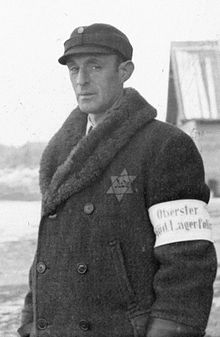
During the Holocaust, at every stage of the Nazi persecution of the Jews, there were some Jews who were willing to help them along. Nazi rule in the ghettos of Eastern Europe was enforced by Jewish police. Forced labor gangs in the concentration camps were worked to death by Jewish overseers.

These collaborators worked under a range of titles, but in the history books one, in particular, has come to stand for all of them: “kapo.” And that label has stuck. To this day, 80 years later, one of the worst insults you can hurl at a Jew is to call them a kapo.

Why did they do it? In a system rigged against them, collaboration was a way to suffer less. If you collaborated, you got better food, warmer clothes. You got beaten less. You got to live another day. And you got a little bit of power — power that you could wield however you wanted, as long as you only wielded it against your fellow Jews.

The kapos would have told you they had other reasons, of course. Some would tell you that they were trying to be a buffer between their people and the system that oppressed them. Some may even have thought they could change the system from the inside. But in the end, the justifications didn’t matter; when the kapos stopped being useful to their masters, they were just as disposable as their justifications.

If you are wondering how a system can get to a point where people are oppressing their own, all I can tell you is: that is how oppressive systems work.

More: https://en.wikipedia.org/wiki/Kapo

About Jason Lefkowitz

Amid global hellscape, full of modern recreational flavor. Founder, president and cruel intergalactic tyrant of Rogue Repairman Productions. Web developer for 25 years now (oh god). Writer that nobody reads; leader that nobody follows. #fedi22 #writing #movies #cycling #kayaking #programming #php #python #wordpress #history #military

Follow Jason Lefkowitz @jalefkowit@octodon.social

Join him on the web: YE ANCIENT WEBBESITTE

Why Black Women Will Never Be Safe in Blameless White America :: Allison Wiltz :: Medium

Allison Wiltz

Allison Wiltz

Jan 25

·

WOMANISM

Why Black Women Will Never Be Safe in Blameless White America

About the senseless murder of Devonna Walker

A confident Black lady near frame with flowers and plants| Photo by Dziana Hasanbekava via Pexels

America is not a safe haven for Black women, it’s a snake pit. We know that Black women are over three times as likely to die giving childbirth than White women, are the most educated group but earn the least, and are under constant pressure to change themselves to appease others. And the death of Breonna Taylor, a 26-year-old emergency medical technician, who police shot as she lay in bed, was a painful reminder that Black women in America can’t even expect safety in their own homes or communities. Misogynoir has fangs.

Devonna Walker was a 29-year-old Black woman living in Cedar Rapids, Iowa. However, Walker’s life was cut short after a White neighbor stabbed her following an argument at the Cambridge Townhomes on Monday, January 2nd. Devonna was a mother of three children. The local district attorney, Nick Maybanks, has not filed any charges in this case. So, how did this tragedy occur? And what does Devonna Walker’s death mean for Black women in America? Let’s unpack this.

Cell phone footage of Devonna Walker’s last moments shows her speaking to a White woman wearing a black sweatshirt, walking her dog, “arguing about a previous alleged attack.” Their conversation suggested Walker and her neighbors had unresolved problems and that she regularly faced hostility. As the argument escalated, the White man put himself in the middle of the fuss, telling Devonna, “shut the fuck up, you fucking nigger!” As the White woman walked back towards their home, Devonna pushed her, and she fell to the ground. Then, the video showed the White man stabbing Devonna. Afterward, she stumbled off and fell on the grass. Neighbors accuse her of faking her injuries.

Like many Black Americans, Walker lived near White people, who weren’t too happy about having a Black neighbor, which is why he called Devonna a “nigger,” while they were arguing. As 

Nada Chehade  wrote, “the man, could have just pushed her off his wife, but he chose to stab her quickly, sleazily; the knife was already waiting in his hand.” Now, of course, many White people are making the rounds to say Walker deserved to be stabbed for pushing her neighbor and that the White neighbor who stabbed Walker to death was acting in self-defense. While stabbing someone who hasn’t caused you bodily harm doesn’t seem like self-defense to me, that’s for a jury to decide. It’s disturbing to see so many people are willing to treat Devonna Walker’s death like an open-shut case.

Police questioned both of the neighbors but released them soon after. It’s as if a cloak of whiteness protected them from further scrutiny. And if Nick Maybanks, the local prosecutor, refuses to press charges, then Devonna Walker’s family won’t have a chance to see justice in her case. So, for those who claim this is a case of self-defense, why not advocate for charges to be filed? You shouldn’t be afraid of the outcome if you think neither of the White neighbors broke the law. Too often, when a Black woman becomes a homicide victim, there are excuses as to why no one should be charged and why we shouldn’t look any further down the rabbit hole. And those excuses are rooted in misogynoir. Black women will never be safe in a nation that routinely treats their homicides as blameless. A Black woman was stabbed to death. So, how can it logically follow that no one is to blame?

When Devonna Walker lost her life, she was an unarmed woman arguing with racist neighbors. And it could have easily been me, my sister, or my mother since each of us has weathered negative experiences with racist neighbors. Just yesterday, I caught a White neighbor fogging up the glass of my brother’s car as she snuck a peek inside. Because his car is not familiar to her, she thinks she has the right to snoop, to police our home, and to any Black visitors that she sees.

As we remember Devonna Walker, let us not forget that she was an unarmed Black woman and mother, who would still be alive if it weren’t for the violent act of her neighbor. As 

Nada Chehade  put it, Walker was “bullied, taunted, baited, then killed.” According to the Department of Justice, “hate crime is a crime motivated by bias against race, color, religion, national origin, sexual orientation, gender, gender identity or disability.” Calling someone a “nigger” prior to stabbing them to death sure seems racially motivated. So, why isn’t Devonna Walker’s story trending on social media and making the rounds on major news outlets? As I said, misogynoir has fangs, and it seems the venom reduces Black women to an afterthought in blameless White America.

Say Her Name. Devonna Walker

Allison Wiltz

Allison Wiltz

Womanist Scholar bylines @ Oprah Daily, Zora, GEN, Momentum, GEN, EIC Cultured, AfroSapiophile #WEOC Founder allisonthedailywriter.com ☕️ ko-fi.com/allyfromnola

Join Medium.

The Police Have Been Spying on Black Reporters and Activists for Years :: ProPublica

The police surveillance wasn’t conducted just with wiretaps and long lenses, but with snitches planted within local organizations, including spies planted by then-Mayor Henry Loeb, an anti-union segregationist, among sanitation workers who wanted to join a union.

I Know Because I’m One of Them.

Wendi C. Thomas is a black journalist who has covered police in Memphis. One officer admitted to spying on her. She’s on a long list of prominent black journalists and activists who have been subjected to police surveillance over decades.

by Wendi C. Thomas, MLK50: Justice Through Journalism June 9, 2020, 6 a.m. EDTWendi C. Thomas learned during a police surveillance trial that the Memphis Police Department spied on her and three other journalists. (Andrea Morales)

RACIAL JUSTICE

ProPublica is a nonprofit newsroom that investigates abuses of power. Sign up to receive our biggest stories as soon as they’re published.

This article was produced in partnership with the MLK50: Justice Through Journalism, a member of the ProPublica Local Reporting Network.

MEMPHIS, Tenn. — On Aug. 20, 2018, the first day of a federal police surveillance trial, I discovered that the Memphis Police Department was spying on me.

The ACLU of Tennessee had sued the MPD, alleging that the department was in violation of a 1978 consent decree barring surveillance of residents for political purposes.

I’m pretty sure I wore my pink gingham jacket — it’s my summer go-to when I want to look professional. I know I sat on the right side of the courtroom, not far from a former colleague at the city’s daily newspaper. I’d long suspected that I was on law enforcement’s radar, simply because my work tends to center on the most marginalized communities, not institutions with the most power.

One of the first witnesses called to the stand: Sgt. Timothy Reynolds, who is white. To get intel on activists and organizers, including those in the Black Lives Matter movement, he’d posed on Facebook as a “man of color,” befriending people and trying to infiltrate closed circles.

Projected onto a giant screen in the courtroom was a screenshot of people Reynolds followed on Facebook.

My head was bent as I wrote in my reporter’s notebook. “What does this entry indicate?” ACLU attorney Amanda Strickland Floyd asked.

“I was following Wendi Thomas,” Reynolds replied. “Wendi C. Thomas.”

I sat up.

“And who is Wendi Thomas?” Floyd asked.

She, he replied, used to write for The Commercial Appeal. In 2014, I left the paper after being a columnist for 11 years.

It’s been more than a year since a judge ruled against the city, and I’ve never gotten a clear answer on why the MPD was monitoring me. Law enforcement also was keeping tabs on three other journalists whose names came out during the trial. Reynolds testified he used the fake account to monitor protest activity and follow current events connected to Black Lives Matter.

My sin, as best I can figure, was having good sources who were local organizers and activists, including some of the original plaintiffs in the ACLU’s lawsuit against the city.

In the days since cellphone video captured white Minneapolis police officer Derek Chauvin squeezing the life out of George Floyd, a black man, residents in dozens of cities across the country have exercised their First Amendment rights to protest police brutality.

Here in Memphis, where two-thirds of the population is black and 1 in 4 lives below the poverty line, demonstrators have chanted, “No justice, no peace, no racist police!”

The most recent protests were sparked by the killings of Floyd and of Breonna Taylor, a black woman gunned down in her home by Louisville, Kentucky, police in March. But in Memphis, like elsewhere, the seeds of distrust between activists and police were planted decades ago. And law enforcement has nurtured these seeds ever since.

A Long History of Spying

In the mid-1960s, the MPD launched a domestic intelligence unit to spy not just on activists, but also on teachers’ meetings, a college black student union and labor organizers. That included Martin Luther King Jr., who came to Memphis in the spring of 1968 to stand in solidarity with underpaid and mistreated black city sanitation workers.

The police surveillance wasn’t conducted just with wiretaps and long lenses, but with snitches planted within local organizations, including spies planted by then-Mayor Henry Loeb, an anti-union segregationist, among sanitation workers who wanted to join a union.

In the iconic photo taken just moments after a gunman shot King on the Lorraine Motel balcony, several people are seen pointing in the direction from which the bullet came. Crouched over King’s body is a man holding a towel to the gaping wound on King’s face. The man, rarely identified in photos, is Marrell “Mac” McCollough, a Memphis cop who was assigned to infiltrate a militant activist group hated by Memphis police. There’s no evidence he was involved with King’s assassination.

Some, including members of King’s family, have long speculated that the assassination was not the work of a lone gunman but orchestrated by federal law enforcement agencies (the FBI famously monitored and harassed King). Both a U.S. House committee independent review in 1979 and a Department of Justice review in 2000 found no basis for this. Still, in 2002, the National Civil Rights Museum, which sits where the motel was, added to its permanent exhibits “Lingering Questions,” which contains hundreds of pieces of evidence, including the bullet plucked from King’s body. One of the questions (that the exhibit does not definitively answer): “Was the Memphis Police Department part of the conspiracy?”

Read More

On the Minds of Black Lives Matter Protesters: A Racist Health System

Black lives are being lost to COVID-19 at twice the rate of others. For protesters we talked to, that’s one more reason to be on the street. “If it’s not police beating us up, it’s us dying in a hospital from the pandemic,” one said.

In 1976, the ACLU of Tennessee sued the city, alleging it had violated residents’ First Amendment rights by maintaining records that “contained unverified information and gossip which related exclusively to the exercise of lawful and peaceful activities,” and, according to the complaint, “served no lawful or valid law enforcement purpose.”

A judge agreed and in 1978 signed the Kendrick consent decree, the first such decree in the country, which barred law enforcement from surveilling protesters for political purposes.

Many of today’s protesters know about that ruling, because in 2017 the ACLU of Tennessee sued the city, alleging that police were violating the consent decree by again illegally spying on residents who were exercising their First Amendment rights.

In 2016, protesters had a series of high-profile demonstrations including a May protest at the Memphis Zoo, a spontaneous protest against police brutality in July in which hundreds blocked traffic on the Interstate 40 bridge and a December “die-in” in the mayor’s front yard. After those, according to the lawsuit, the city started a blacklist of residents barred from City Hall without an escort.

It contained the names not just of those who had been arrested at demonstrations, but many who had not, including the mother of Darrius Stewart, a black teen police shot and killed in 2015 following a traffic stop, and a white grandmother who’d made it through a security blockade outside Graceland while black protesters were held back.

Reynolds’ sleuthing made up a good part of the joint intelligence briefings, which were shared with law enforcement agencies and some of the city’s largest corporations, such as FedEx and AutoZone, at the businesses’ request. (Facebook told the MPD it violated the social platform’s terms of service by creating fake accounts and impersonating others.)

In court, the city argued that the surveillance — videotaping demonstrations, using social media collators to sweep up posts about police and Black Lives Matters supporters — was necessary to protect public safety.

But while joint intelligence briefings and internal reports were ostensibly to keep track of potential threats, they were littered with unfounded rumors, misidentified photos of activists and surveillance reports of events that posed no clear threat, such as a black food truck festival.

And while it’s true that the pen is mightier than the sword, there’s nothing about me that screams threat, unless critical reporting on public policy and public officials, including Mayor Jim Strickland, counts.

In 2017, MLK50: Justice Through Journalism covered the anniversary of the bridge protest, but when I tried to get an interview with the mayor, I was rebuffed.

“Objectivity dictates if the mayor does one on one interviews,” wrote Ursula Madden, the city’s chief communications officer in an email. “You have demonstrated, particularly on social media, that you are not objective when it comes to Mayor Strickland.”

I replied that I was disappointed and asked her to point me to any errors of fact I’d made in my coverage. She did not respond.

Nagging Suspicions

I’ve worked as a journalist in Memphis for the last 17 years. I’ve never been a victim of police brutality, but few of my interactions with police have inspired confidence.

In 2014, while I was at The Commercial Appeal, a reader threatened by email to rape me after a column I wrote about Confederate Gen. Nathan B. Forrest. I reluctantly reported the threat to police, but the investigation felt lackluster and no suspect was ever identified.

It nagged at me, and years later, when I tried to learn more about what steps the detective assigned to my case had taken, department officials refused to share any information, even the details of their interview with me.

In July 2015, I covered the demonstrations that followed Stewart’s death by police. I interviewed the teen’s father and posted the video on Instagram.

A few days later, a cousin I hadn’t seen in years stopped by. He wanted to take a quick tour through downtown Memphis. It was dark and rainy. He’s black with long locks and a beard.

I wanted to be a good host, but before I left the house, I tweeted my hesitation: “My cousin is in town for work, leaving tomorrow. He wants to see Downtown. My 1st thought: Do I want to risk an encounter w/ police?”

My fear was not without cause: Less than two weeks earlier, Sandra Bland, a 28-year-old black woman, had been forced out of her car by an aggressive Texas cop who’d stopped her for failing to signal while changing lanes. A dashboard camera video caught her arrest and three days later, she was found dead in a jail cell. Authorities said she died by suicide.

I was thinking about what happened to Bland and what had happened to Stewart, who had been shot to death by police following a traffic stop the same month.

Just a few miles from home, flashing lights filled my rearview mirror. I pulled over, heart pounding.

I hit record on my cellphone and placed it on the dashboard. You can’t see the officer’s face in the video, which I still have, but you can hear our voices over the windshield wipers. The officer, who was black, asked for my license. I handed it to him and asked why I’d been stopped.

He said my driver’s side headlight was out, but when he leaned over to tap it, he said it was back on.

“I’m not trying to be Sandra Bland tonight,” I told the officer.

The Memphis officer said he was trying to be a nice guy. “You think I want to stand out here in the rain?” he can be heard saying on video.

“Ms. Thomas,” he said, reading my license. “Ms. Wendi Thomas.” I wondered if he recognized my byline. I offered to show him what I had just tweeted but he declined. “Your headlights are working now,” he said. “You be safe, OK?”

“Yeah, but what happens when somebody else pulls me over?” I asked.

“I don’t know what somebody else is gonna do,” he said, “but I know that if you do the right things, if you’re doing the right things, then nothing else can happen but good.”

I now wonder if the police had been following me. The police department did not answer questions for this story.

But at the time, I was paralyzed by fear and wanted to avoid being pulled over again.

I took side streets home.

Why Were You Following Me?

After Reynolds left the stand after naming me as someone he had followed, the judge took a short recess. I headed outside the courtroom and saw Reynolds headed to the elevator.

I followed him. When the doors closed, I stuck out my hand and introduced myself. I asked: Why were you following me on social media?

Although it was chilly in the courtroom, Reynolds was sweating. He said he couldn’t talk about it.

Two days after Reynolds’ testimony, I filed a public records request with the city of Memphis, asking for all joint intelligence briefings, emails or other documents that referenced me or any of the three other journalists that the MPD was following on social media.

Four hundred and thirty three days later, the city produced the records — and I still don’t understand what would make police see me as a threat worthy of surveillance in the name of public safety.

Contained in the documents: A screenshot of a Facebook post that I made on Jan. 28, 2016, while I was on a fellowship at Harvard University. I’d shared a notice about a grassroots coalition meeting to be held that day.

In a joint intelligence briefing was a screenshot of a tweet I’d been tagged in. The original tweet, which at the time police captured it had 11 likes and one retweet, was itself a screenshot of an offensive image a Memphis police officer had allegedly posted on Snapchat.

Read More

Police Brutality, COVID-19 and Overdoses in Chicago Follow the Same Deadly Pattern

Our country’s long history of structural racism stands at the center of why police brutality, COVID-19 and the opioid crisis are disproportionately killing black Americans, including in Chicago.

In another police email was a February 2017 tweet I sent about an upcoming protest, which had been announced on Facebook. It got two likes.

The city of Memphis is pushing back against the judge’s ruling. Its lawyers have asked the court to modify the consent decree, contending that the city can’t participate in a Trump administration public safety partnership if it isn’t allowed to share intelligence with federal agencies.

My battles with the city of Memphis didn’t end with the lawsuit, unfortunately.

In 2018, I was trying to figure out which corporations had answered the mayor’s call to financially subsidize police operations by funneling $6.1 million to the city through a secretive nonprofit, the Memphis Shelby Crime Commission.

Strickland wouldn’t divulge the companies’ identities, but he realized that public records I’d requested would. So the mayor’s staff, in conjunction with the Crime Commission and another secretive nonprofit, came up with a plan to release the companies’ names to local journalists before releasing the records to me, I learned through emails released in conjunction with a 2018 public records lawsuit against the Crime Commission.

And this year, I was forced to sue the city after it refused to include me on its media email advisory list despite repeated requests.

The city of Memphis did not respond to a request for comment for this story.

My experiences have shaped the way my newsroom has covered more recent protests, including those in Memphis since Floyd’s death.

guide on covering protests from the Racial Equity in Journalism Fund at Borealis Philanthropy notes, “Understand how police use news coverage to surveil black communities. Don’t allow police to use you, or your coverage, to do their jobs.”

We applied these principles to our recent coverage of a civil disobedience training that drew more than 350 people. While we know the names of the people we talked to, if participants weren’t comfortable using their whole name or showing their entire face, we protected their identity.

After all, I know how it feels to know that the police are watching you.

Support the Work and Subscribe to ProPublica