My Racist Encounter at the White House Correspondents’ Dinner


My Racist Encounter at the White House Correspondents’ Dinner

Posted: 05/07/2013

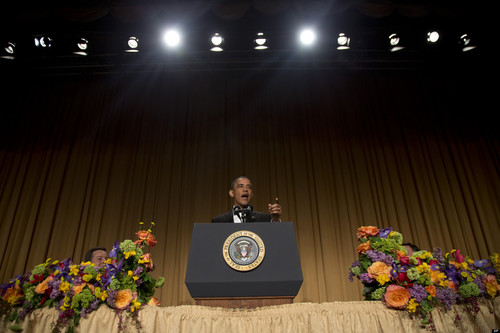
The faux red carpet had been laid out for the famous and the wannabe-famous. Politicians and journalists arrived at the White House Correspondents’ Dinner, bedazzled in the hopes of basking in a few fleeting moments of fame, even if only by osmosis from proximity to celebrities. New to the Washington scene, I was to experience the spectacle with my husband, a journalist, and enjoy an evening out. Or at least an hour out. You see, as a spouse I was not allowed into the actual dinner. Those of us who are not participating in the hideous schmooze-fest that is this evening are relegated to attending the cocktail hour only, if that. Our guest was the extraordinarily brilliant Oscar-nominated director of Beasts of the Southern Wild, Benh Zeitlin. Mr. Zeitlin’s unassuming demeanor was a refreshing taste of humility in a sea of pretentious politicians reeking of narcissism.

As I left the hotel and my husband went to the ballroom for the dinner, I realized he still had my keys. I approached the escalators that led down to the ballroom and asked the externally contracted security representatives if I could go down. They abruptly responded, “You can’t go down without a ticket.” I explained my situation and that I just wanted my keys from my husband in the foyer and that I wouldn’t need to enter in the ballroom. They refused to let me through. For the next half hour, they watched as I frantically called my husband but was unable to reach him.

Then something remarkable happened. I watched as they let countless other women through — all Caucasian — without even asking to see their tickets. I asked why they were allowing them to go freely when they had just told me that I needed a ticket. Their response? “Well, now we are checking tickets.” He rolled his eyes and let another woman through, this time actually checking her ticket. His smug tone, enveloped in condescension, taunted, “See? That’s what a ticket looks like.”

When I asked “Why did you lie to me, sir?” they threatened to have the Secret Service throw me out of the building — me, a 4’11” young woman who weighs 100 pounds soaking wet, who was all prettied up in elegant formal dress, who was simply trying to reach her husband. The only thing on me that could possibly inflict harm were my dainty silver stilettos, and they were too busy inflicting pain on my feet at the moment. My suspicion was confirmed when I saw the men ask a blonde woman for her ticket and she replied, “I lost it.” The snickering tough-guy responded, “I’d be happy to personally escort you down the escalators ma’am.”

Like a malignancy, it had crept in when I least expected it — this repugnant, infectious bigotry we have become so accustomed to. “White privilege” was on display, palpable to passersby who consoled me. I’ve come to expect this repulsive racism in many aspects of my life, but when I find it entrenched in these smaller encounters is when salt is sprinkled deep into the wounds. In these crystallizing moments it is clear that while I might see myself as just another all-American gal who has great affection for this country, others see me as something less than human, more now than ever before.

When I asked why the security representatives offered to personally escort white women without tickets downstairs while they watched me flounder, why they threatened to call the Secret Service on me, I was told, “We have to be extra careful with you all after the Boston bombings.”

I explained that I am a physician, that my husband is a noted journalist for a major American newspaper, and that our guest was an esteemed, Oscar-nominated director. They did not believe me. Never mind that the American flag flew proudly outside of our home for years, with my father taking it inside whenever it rained to protect it from damage. Never mind that I won “Most Patriotic” almost every July 4th growing up. Never mind that I have provided health care to some of America’s most underprivileged, even when they have refused to shake my hand because of my ethnicity.

I looked at him, struggling to bury my tears beneath whatever shred of dignity that remained. They finally saturated my lashes and flood onto my face. Shaking with rage, I said, “We are all human beings and I only ask that you give me the same respect you give others. All I am asking is to be treated with a dignity and humanity. What you did is wrong.” They stared straight ahead, arms crossed, and refused to even look at me. Up came the cruel, xenophobic, soundproof wall that I had seen in the eyes of so many after 9/11. Their eyes, flecked with disdain and hatred, looked through me.

The next affront came quickly thereafter. “You were here last year, weren’t you? You caused trouble here last year too. I know you,” they claimed, accusing me of being a party-crasher. Completely confused, I explained that this was my first time here and that I had no idea what he was referencing. Clearly, he had assumed all brown people look the same and had confused me for someone else.

I wonder what their reaction would have been to a well-dressed white woman trying to reach her husband. Would she have struggled for over an hour while they watched and offered to escort others in? Would they not have extended an offer to help, bended over backwards to offer assistance, just as they did with the woman who “lost her ticket”? Would the Boston bombings even be mentioned to a white woman?

Let’s stop this facade that we are a beacon of tolerance. I don’t need you to “tolerate” me. I don’t want you to merely put up with my presence. All I ask, all I have ever asked, is to be treated as a human being, that bigoted jingoism is not injected into every minute facet my life, that there remains at least the illusion of decency.

Despite being a native English speaker who was born in New Orleans and a physician who trained at a prestigious institution, all people see is the color of my skin. After this incident, I will no longer apologize, either for my faith or my complexion. It is not my job to convince you to distinguish me from the violent sociopaths that claim to be Muslims, whose terrorism I neither support, nor condone. It is your job. Just like when a disturbed young white man shoots up a movie theatre or a school, it is my job, as someone with a conscience, to distinguish them from others. It’s not my job to plead with you to shake my hand without cringing, nor am I going to applaud you when you treat me with common decency; it’s not an accomplishment. It’s simply the right thing to do. Honestly, it’s not that hard.

This year, Quvenzhané Wallis took the world by storm with her staggering performance inBeasts of the Southern Wild. At several award ceremonies, reporters refused to the learn the accurate pronunciation of her name, and one reporter allegedly told Wallis, “I’m gonna call you Annie,” because her name was too difficult to pronounce. If reporters can learn to pronounce Gerard Depardieu and Monique Lhuillier then surely they can take the time to learn how to pronounce Quvenzhané. It’s not hard; it’s just not deemed worthy of your energy because she is someone of color.

A school child recently threatened my 12-year-old niece claiming, “I’m going to kill you Miss Bin Laden.” Again, it is not my job to teach your children manners and social justice, to remove the disgusting threads of racism that you have woven into their hearts with your insecurities. Last week, a 39-year-old Muslim American cab driver who served in the Iraq war was attacked and had his jaw broken in a hate crime. The assailant, an executive from an aviation company, told the veteran “I will slice your fucking throat right now.” I suppose the “support the troops” rhetoric by the right only applies to white veterans.

It wasn’t enough that I have had to prove my “American-ness” at every step of my career, but now the next generation is suffering as well. It wasn’t enough that I was asked whether my father taught me how to make bombs, or that I was told that I was doomed to the seventh circle of hell during my medical school interviews. I was also asked whether I would wear a burqa or if my parents would arrange my marriage during interviews. It is outrageous that I have to actually prove to the world how horrified I am that an 8-year-old boy was brutally murdered by a terrorist bombing. Any normal human being feels this agonizing grief with the rest of the country. I do not have to prove to you that, I, too, find it morally reprehensible. Of course I do. I have a heart. I am human.

So, I no longer want a seat at your restaurant, where you serve me begrudgingly, where I am belittled for asking for food without pork, where I endure your dirty looks at my hijabi friend. I want my pride intact, I want this struggle of mine to be recognized, for you to look me in the eye and acknowledge that yes, this tumor called bigotry is indeed rivering through your veins, polluting your mind, and is so malignant that it compels you to squash my dignity.

It’s the little indignities that slowly devastate your soul. The ones where your guard is down, and you just expect to dress up, look pretty, and enjoy an evening as a newlywed, or at the Oscars, but instead end up humiliated and snubbed. The ubiquitous racist slap in the face is thinly veiled just beneath the carefully crafted façade. This filthy, highly infectious plague is transforming our nation into one of unwarranted suspicion and anguish inflicted on disenfranchised, voiceless people of color. And now, it is no longer my job to enlighten you. To quote what you so often tell ethnic communities, “It’s time for you to step up to the plate, take responsibility, and stop taking what I have earned,” my integrity, my dignity.


Seema Jilani

Physician reporting from Afghanistan
My Racist Encounter at the White House Correspondents’ Dinner

See on Scoop.itOUR COMMON GROUND Informed Truth and Resistance

I don’t need you to “tolerate” me. I don’t want you to merely put up with my presence.

OUR COMMON GROUND Omnibus‘s insight:

"It’s the little indignities that slowly devastate your soul. The ones where your guard is down, and you just expect to dress up, look pretty, and enjoy an evening as a newlywed, or at the Oscars, but instead end up humiliated and snubbed. The ubiquitous racist slap in the face is thinly veiled just beneath the carefully crafted façade. This filthy, highly infectious plague is transforming our nation into one of unwarranted suspicion and anguish inflicted on disenfranchised, voiceless people of color. And now, it is no longer my job to enlighten you. To quote what you so often tell ethnic communities, "It’s time for you to step up to the plate, take responsibility, and stop taking what I have earned," my integrity, my dignity."

Seema Jilani

Physician reporting from Afghanistan

See on www.huffingtonpost.com

Domestic Violence: When Love Becomes Hurtful

domestiv v

Domestic Violence: When Love Becomes Hurtful

By: Rev. Arlington Pryor, M.Div. 

The Statistics on Domestic Violence Are Shocking

Domestic violence occurs in an estimated 4 million intimate relationships each year in the United States. We are now recognizing and dealing with the urgency and severity of domestic violence in cities from coast to coast. The statistics reveal that domestic violence is one of the most important public health problems in our country and it is time that we all address this issue. Consider the following findings:

  • The Surgeon General of the United States reports that domestic violence causes more injury to adult women than cancers, heart attacks, or strokes.
  • FBI statistics point out that a woman is battered every 15-18 seconds in the United States.
  • More than three million children witness domestic violence, and more than four million women are battered to death by their husbands or boyfriends each year.
  • Approximately one third of female murder victims in the United States are killed by their husband or boyfriend.

What Is Domestic Violence?

Domestic violence, partner abuse, and battering refer to the physical, emotional, sexual, and psychological abuse, performed by one person against another. The abuser and the victim are involved in or have had an intimate or romantic relationship.

Who Are The Victims?

Domestic violence, including battering, happens in all socioeconomic levels, to urban or rural women, young or old, with child and childless, single, married, divorced – and within all religious, racial, ethnic groups, and geographic locations. Councils On Family Violence has designated domestic violence battering as an “Unreported Epidemic.” It is important to note, that women initiate and carry out physical assaults on their partners as often as men do, according to a 1993 study by Straus and Gelles. However, when it comes to serious physical abuse, women are still overwhelmingly on the receiving end.

The Impact Of Domestic Violence On Women:

More women are injured through domestic violence than by rape, muggings, and car accidents combined. Many pregnant women have been and may be victims of domestic violence abuse. Forced sex or marital rape is the leading type of sexual assault. Yet marital rape or forced sex maybe the most underreported and least legally punished crime of partner abuse because many victims are reluctant to report and file charges against the abuser, for various reasons. The Justice Department’s 1994 National Crime Victimization Survey (NCVS) found that only about half of the women who suffered domestic violence between 1987 and 1991 reported the abuse to law enforcement authorities.

Domestic Violence and African Americans

African Americans, including African American Women suffer deadly violence from family members at rates decidedly higher than for other racial groups in the United States. However, it is observed that research concerning family violence among African Americans is inadequate.

Factors such as the breakdown of families, unemployment and underemployment, poor schools, inadequate vocational skills and training, bad housing, the influence and use of drugs, and the density of liquor stores in the inner city contribute to the problem of domestic violence. All of these ingredients may compound and coalesce into a strong undercurrent of frustration that can lead to domestic violence.

A Painful Dilemma

Many Black women may find it harder to leave a battering relationship than White women. The reasons for this are unclear, but some possible explanations include the following: (1) African American women have fewer options in their search for a marital partner than do White women; (2) African American women on average, have a lower income level than that of most White women; (3) Black women are reluctant to call the police because they see the racial injustice in the criminal justice system; (4) community support systems including women’s shelters and other service programs may be less available to them and they may view the shelter system movement as something mainly to benefit White women. Unfortunately, many Black women resort to “homicide” as an answer to the violence and battering they encounter.

What You Can Do If You (Or A Friend) Suffers Domestic Violence

  • Domestic violence is a Federal crime. Call 911 immediately. This will activate the criminal justice system in regards to your domestic violence abuse and injurious claims. Experts say that women are beaten about five times before they ever dial 911.


  • Try to give police all available information and make certain that the police listen and write down your statements and their observations, and direct quotes of what your abuser said while attacking you.


  • Never refuse medical evaluations and medical services! Never clean up the house or location after a domestic violence attack, so that critical evidence of harm or injury is not removed. Keep a Polaroid or some type of camera and film on hand to photograph your injuries and any damage to property, etc. Remember, “a picture is worth a thousand words,” and is a good sign of evidence.


  • Call domestic violence resource agencies in your community or call the National Domestic Violence hot line at (800) 799-SAFE (7233). This hotline was initiated in 1996 with cooperation from the Justice Department. Through this hotline, a woman anywhere in the United States can be connected to resources to help her get away from her violent abuser.

Consider Obtaining A Protective Order Against Your Abuser

A protective order can be issued by civil and criminal courts against anyone who is a threat to your safety. The 1994 Federal Violence Act against women specifies that protective orders are recognized and enforced from state to state and includes Indian Tribal Reservations. Call the various domestic violence organizations and agencies for information and advice about a protective order.

How Can We As A Community More Effectively Address This Problem?

We must all work together to fight against domestic violence. Churches, corporations, hospitals, and individuals in general must be vigilant about increasing the awareness that domestic violence is a major problem facing our communities. Churches should present sermons, workshops and provide information about domestic violence and sexual violence including rape, child incest and child molestation, and conjugal battery.

Churches should also keep a file of references of therapists who work with victims of domestic and sexual violence and of medical, law enforcement, social services, and other resources that offer help and support. The Church needs to be open and forthright about the reality of domestic and sexual violence and not be silent on these subjects.

Additionally, hospitals and health care providers must be more vigilant in screening for domestic violence. The American Medical Association (AMA) advises doctors and nurses to routinely observe and screen patients in the emergency rooms for signs of domestic violence, and report their findings to proper authorities.

Empowerment Points

  • Domestic and sexual violence is a vicious malady that the African American community must confront, reduce, and eliminate from our lives.


  • The ancient Chinese proverb says that a journey of a thousand miles begins with the first step.


  • You are taking the first step by being informed and aware that domestic violence is a hard reality and no laughing matter for Black women.

References:

Hot Line

African American Domestic Violence Fact Sheet

Web Sites:


Books


  • Maria Hong, “Family Abuse, A National Epidemic”, Springfield, NJ: Enslow Publishers, Inc., 1997


  • Cynthia L. Mather, “How Long Does It Hurt?”  San Francisco, CA: Jossey-Bass Publishers, 1994


  • Susan Murphy-Milano, “Defending Our Lives”, New York: An Anchor Book, published by Doubleday, 1996


  • A.E. Sadler, book editor, “Family Violence”, San Diego, CA: Greenhaven Press, Inc., 1996


  • Jan Berliner-Statman, “The Battered Woman’s Survival Guide”, Dallas, TX: Taylor Publishing Company, 1995


  • Karin L. Swisher, book editor, “Domestic Violence”, San Diego, CA: Greenhaven Press, Inc., 1996


  • Karin L. Swisher and Carol Wekesser, book editors, “Violence Against Women”, San Diego, CA: Greenhaven Press, Inc., 1994

– See more at: http://www.blackwomenshealth.com/blog/domestic-violence-when-love-becomes-hurtful/#sthash.cOIlEzLB.dpuf

‘When Affirmative Action Was White’: Uncivil Rights

‘When Affirmative Action Was White’: Uncivil Rights

 
By NICK KOTZ
Published: August 28, 2005
After years of battling racial discrimination and braving state-sanctioned violence — with hundreds of Southern black churches set fire to and scores of citizens beaten or murdered for daring to challenge American apartheid — the civil rights movement achieved a climactic victory when President Lyndon Baines Johnson signed the Voting Rights Act on Aug. 6, 1965. It was the outcome of ”a shining moment in the conscience of man,” declared the Rev. Martin Luther King Jr. In less than two years, the nation did more to advance equal rights for minorities than at any time since Abraham Lincoln signed the Emancipation Proclamation.

Ray Bartkus
WHEN AFFIRMATIVE ACTION WAS WHITE
An Untold History of Racial Inequality in Twentieth-Century America.
By Ira Katznelson.
238 pp. W. W. Norton & Company. $25.95.

The 1964 Civil Rights Act struck down the South’s segregation laws, outlawed employment discrimination and forbade discrimination in federal programs. For black Americans living in the South, the voting rights law finally secured the right to the ballot. And President Johnson initiated a sweeping new government policy called affirmative action. Its purpose was to overcome at least some of the accumulated human damage caused by 350 years of slavery and Jim Crow, and to ensure further progress toward equality.

Benefiting from that ”shining moment” in the 1960’s, a black middle class has prospered and grown rapidly. Yet millions of African-Americans remain mired in poverty in a nation bitterly divided over whether special help to minorities should continue. Affirmative action programs have long been under siege, vigorously attacked in Congress and the federal courts and criticized for ”discriminating” against the white majority. With conservatives dominating the federal government, civil rights groups and other liberal organizations have waged a mostly defensive battle to protect the gains of the 1960’s. Fresh ideas and effective leadership to advance the American ideals of equality and social justice have been in short supply.

Ira Katznelson, the Ruggles professor of political science and history at Columbia University, enters this fray with a provocative new book, ”When Affirmative Action Was White,” which seeks to provide a broader historical justification for continuing affirmative action programs. Katznelson’s principal focus is on the monumental social programs of Franklin Roosevelt’s New Deal and Harry Truman’s Fair Deal in the 1930’s and 1940’s. He contends that those programs not only discriminated against blacks, but actually contributed to widening the gap between white and black Americans — judged in terms of educational achievement, quality of jobs and housing, and attainment of higher income. Arguing for the necessity of affirmative action today, Katznelson contends that policy makers and the judiciary previously failed to consider just how unfairly blacks had been treated by the federal government in the 30 years before the civil rights revolution of the 1960’s.

This history has been told before, but Katznelson offers a penetrating new analysis, supported by vivid examples and statistics. He examines closely how the federal government discriminated against black citizens as it created and administered the sweeping social programs that provided the vital framework for a vibrant and secure American middle class. Considered revolutionary at the time, the new legislation included the Social Security system, unemployment compensation, the minimum wage, protection of the right of workers to join labor unions and the G.I. Bill of Rights.

Even though blacks benefited to a degree from many of these programs, Katznelson shows how and why they received far less assistance than whites did. He documents the political process by which powerful Southern Congressional barons shaped the programs in discriminatory ways — as their price for supporting them. (A black newspaper editorial criticized Roosevelt for excluding from the minimum wage law the black women who worked long hours for $4.50 a week at the resort the president frequented in Warm Springs, Ga.)

At the time, most blacks in the labor force were employed in agriculture or as domestic household workers. Members of Congress from the Deep South demanded that those occupations be excluded from the minimum wage, Social Security, unemployment insurance and workmen’s compensation. When labor unions scored initial victories in organizing poor factory workers in the South after World War II, the Southern Congressional leaders spearheaded legislation to cripple those efforts. The Southerners’ principal objective, Katznelson contends, was to safeguard the racist economic and social order known as the Southern ”way of life.”

Katznelson reserves his harshest criticism for the unfair application of the Servicemen’s Readjustment Act, known as the G.I. Bill of Rights, a series of programs that poured $95 billion into expanding opportunity for soldiers returning from World War II. Over all, the G.I. Bill was a dramatic success, helping 16 million veterans attend college, receive job training, start businesses and purchase their first homes. Half a century later, President Clinton praised the G.I. Bill as ”the best deal ever made by Uncle Sam,” and said it ”helped to unleash a prosperity never before known.”

But Katznelson demonstrates that African-American veterans received significantly less help from the G.I. Bill than their white counterparts. ”Written under Southern auspices,” he reports, ”the law was deliberately designed to accommodate Jim Crow.” He cites one 1940’s study that concluded it was ”as though the G.I. Bill had been earmarked ‘For White Veterans Only.’ ” Southern Congressional leaders made certain that the programs were directed not by Washington but by local white officials, businessmen, bankers and college administrators who would honor past practices. As a result, thousands of black veterans in the South — and the North as well — were denied housing and business loans, as well as admission to whites-only colleges and universities. They were also excluded from job-training programs for careers in promising new fields like radio and electrical work, commercial photography and mechanics. Instead, most African-Americans were channeled toward traditional, low-paying ”black jobs” and small black colleges, which were pitifully underfinanced and ill equipped to meet the needs of a surging enrollment of returning soldiers.

The statistics on disparate treatment are staggering. By October 1946, 6,500 former soldiers had been placed in nonfarm jobs by the employment service in Mississippi; 86 percent of the skilled and semiskilled jobs were filled by whites, 92 percent of the unskilled ones by blacks. In New York and northern New Jersey, ”fewer than 100 of the 67,000 mortgages insured by the G.I. Bill supported home purchases by nonwhites.” Discrimination continued as well in elite Northern colleges. The University of Pennsylvania, along with Columbia the least discriminatory of the Ivy League colleges, enrolled only 46 black students in its student body of 9,000 in 1946. The traditional black colleges did not have places for an estimated 70,000 black veterans in 1947. At the same time, white universities were doubling their enrollments and prospering with the infusion of public and private funds, and of students with their G.I. benefits.

Katznelson argues that the case for affirmative action today is made more effectively by citing concrete history rather than through general exhortations. Studying the New Deal, the Fair Deal, the Great Society and the civil rights movements of the 1960’s could not be more relevant at a time when the administration seems determined to weaken many of the federal programs that for decades have not just sustained the nation’s minorities but built its solid middle class. Whether or not Katznelson’s study directly influences the affirmative action debate, it serves an important purpose. With key parts of the Voting Rights Act set to expire in 2007 and other civil rights protections subject to change, we must understand a continuing reality: the insidious and recurrent racial bias in the history of American public life.

Nick Kotz, a journalist and historian, is the author of ”Judgment Days: Lyndon Baines Johnson, Martin Luther King, Jr., and the Laws That Changed America.”

How to address the Insanity that is the Congress

ocgmainlogo6

THIS IS HOW YOU  Start to Block the ability of CONGRESS to take the American people hostage

A Congressional Reform Act of 2013 bill which includes, but are not limited to the following provisions.

1. No Tenure / No Pension/ Term limitations to no more than 3.

A Congressman/woman collects a salary while in office and receives no pay when they’re out of office.

2. Congress (past, present & future) participates in Social Security.

All funds in the Congressional retirement fund move to the Social Security system immediately. All future funds flow into the Social Security system and Congress participates with the American people. It may not be used for any other purpose.

3. Congress can purchase their own retirement plan, just as all Americans do or through the same system as other federal employees.

4. Congress will no longer vote themselves a pay raise. Congressional pay will rise by the lower of CPI or 3%.

5. Congress loses their current health care system and participates in the same health care system as the American people.

6. Congress must equally abide by all laws they impose on the American people.

7. All contracts with past and present Congressmen/women are void effective 12/31/13. The American people did not make this contract with Congressmen/women.

8. Public funded election campaigns with limits. No other provision, no private or individual funding.

Congressmen/women made all these contracts for themselves. Serving in Congress is an honor not a career. The Founding Fathers envisioned citizen legislators, so ours should serve their term(s), then go home and back to work.

If each person contacts a minimum of twenty people then it will only take three days for most people (in the U.S. ) to receive the message. Don’t you think it’s time?

Thanks to Derek Oronhde for passing on some of this from Warren Buffet. I can’t authenticate that he in fact is distributing this, but the ideas are good.

The Irony Behind Tim Wise and White Privilege

SOUL LATTE

A strong dose of soulful thought.


The Irony Behind Tim Wise and White Privilege

Tim_WiseLast week, renowned anti-racist advocate, Tim Wise, came to UMass for a screening of his new documentary, “White Like Me,” followed by a question and answer period with the audience. I won’t go into details about the actual documentary, y’all can check that on your own time, but during the post-screening  period, Wise was confronted about some online beef that occurred after a post on his blog in remembrance of the 50th anniversary of the Birmingham 16th Street Church bombing that killed 4 African-American girls on September 16th, 1963. His post not only acknowledges the tragedy, but also pays tribute to a man named Charles Morgan, Jr, a white southerner who lived in Birmingham at the time, but who opposed the bombings and was ultimately chased out of the South because of his willingness to speak out against racism.

Following the post, a stream of opposition came. In general, they criticized Wise’s emphasis on the need for white allies. After all, they said, if it wasn’t for white people making the lives so hard for Black-Americans to begin with, they wouldn’t need white partnership in the first place. Wise retaliated to the responses through his Facebook page, the status update wasn’t so friendly.

Wise admitted to the audience at UMass that he was wrong for how he reacted, saying that he is “only human,” and he can’t be perfect all the time. Once the applause ended after the apology, a man of color rose and told his own story of dealing with anger. He was a professor at Hampshire College, from the Bronx, and he explained how living in western Massachusetts is never easy for men of color. He told Wise of the discrimination he deals with on a regular basis. Despite being a college professor, it was the color of his skin that was seen first, and it would always put him in a disadvantage. Any man of color knows, he said, that we don’t get the luxury of “being only human,” because being of color, any outburst could be your last–you don’t need to read a James Baldwin novel to come to that realization.

Tim Wise, a renowned expert on white privilege, could recognize he was a product of white privilege, but he could never fully understand how it manifested itself in his own life. If I he could, then he would never have been so openly accepting of the fact that he can have angry outbursts over issues as sensitive as the Birmingham bombing, and so easily get applause over it.

It was a year ago on my college campus when I had first met Tim Wise. I had no idea how famous Tim was, I had never heard of him before. As I sat down to hear him speak to a packed auditorium, I was impressed and unimpressed all in one. I remember being amused by his delivery, you cannot deny he wouldn’t fair too badly as a stand up comedian. He has a way of fusing irony and raw facts through stating just the obvious reality. That is always refreshing to hear from someone who isn’t of color. But then that becomes the real issue: Tim Wise isn’t a person of color. What he was saying wasn’t anything new or profound, but it was the fact that he was white which was why people gave him so much praise. So to put it ironically: In the same way Tim Wise goes around raising awareness on white privilege, he also benefits from it–he is white privilege.

At the end of the lecture, a friend who helped organized the event asked if I would go with him to take Tim to the airport. I couldn’t turn down an opportunity to get some one one one with Tim Wise after hearing everything he just said. We covered a lot of ground in that 40-minute car ride. He told me about where he grew up, what he studied in college, why he does the work he does, he even told me how he met his wife. We talked about my own studies, intellectual curiosities, and some of the research I was currently working on. It was an inspirational car ride, one that influenced the direction of a lot of the research I did that semester, along with many of the things I write on this blog.

And then he did admit what I had been thinking all along: that his whiteness was the reason for his success. He knew why he was getting called to speak all over the country. He knew why he was able to get through to white people. He was aware of his whiteness, and how that created so many privileges that automatically put him ahead of blacks who were saying much of the very same things he was, and who were also working in the field of anti-racism. And for me, my criticism of Wise doesn’t come from the fact that he is a white guy discussing racism. It’s how he utilizes his whiteness. He continually makes mention of how he is a “white ally” for Black America, and then goes on to expect us to give him a gold star. As stated in the blogGroupThink:

It’s great that that guy stood up for what was right, but to try to piggy back on a very significant and painful part of AA history to sing the praises of a white guy who did the right things is… missing the point. It’s great he did that. It’s awesome, but he doesn’t get a cookie. Why is it so hard for people to understand that you don’t get applause for being a decent person?

I don’t have issues with Tim Wise wanting to stand up against racism, it’s quite commendable when anyone–white or black–stands up for racial justice. My issues are with the fact of how righteously he goes about parading his whiteness when speaking about these issues, and then expects us to view him as some kind of “white knight.”

I don’t care if he goes around speaking to large audiences, it’s the fact that he has become more than just a spokesperson on white privilege and that he feels he can also become a spokesperson for Black America, as well. I don’t have any inner-conflicts being upset when people ask Tim Wise to speak on national television over issues of race when there is a sea of well qualified black scholars who can say the same things Tim says, if not better.

My words to Tim Wise: Black-America could use a few white allies, but we don’t need white leaders attempting to claim some sort of moral medal for doing what every human being should be expected to do: the right thing.

Follow Soul Latte

The Irony Behind Tim Wise and White Priviledge

Mtali Banda's avatarSoul Latte

Tim_WiseLast week, renowned anti-racist advocate, Tim Wise, came to UMass for a screening of his new documentary, “White Like Me,” followed by a question and answer period with the audience. I won’t go into details about the actual documentary, y’all can check that on your own time, but during the post-screening  period, Wise was confronted about some online beef that occurred after a post on his blog in remembrance of the 50th anniversary of the Birmingham 16th Street Church bombing that killed 4 African-American girls on September 16th, 1963. His post not only acknowledges the tragedy, but also pays tribute to a man named Charles Morgan, Jr, a white southerner who lived in Birmingham at the time, but who opposed the bombings and was ultimately chased out of the South because of his willingness to speak out against racism.

Following the post, a stream of opposition came. In general, they…

View original post 981 more words

Building A Poor People’s Survival Movement In A Time of Economic Crisis
Saturday, September 21, 2013

Building A Poor People’s Survival Movement In A Time of Economic Crisis

Download Podcast
With the US Congress slashing food assistance programs by tens of billions of dollars, food security is a serious issue for everyone in the United States but especially poor and working class communities. The urban Black community could be especially hit hard and while a few non-governmental programs exist in a few communities, the need for a larger Poor People’s Survival Movement can not be stressed enough.
www.StatCounter.com/myspace/ - Free myspace Profile Counter

Why Race Matters in the Government Shutdown

COLORLINES NEWS FOR ACTION

Why Race Matters in the Government Shutdown


Speaker of the House John Boehner (R-OH) arrives for a Republican Conference meeting at the U.S. Capitol September 30, 2013. Photo: Chip Somodevilla/Getty Images

by Imara Jones

Tuesday, October 1 2013

The shutdown of the federal government which began at midnight today is a body blow to our economy that could prove difficult to bear. Coming on the heels of the automatic budget cuts of sequestration, which are already forecast to cost 750,000 jobs this year, and three years of an anemic economic recovery, the furlough of almost a million federal workers is just not what the economy needs right now. The shutdown was touched off by a Senate vote yesterday to turn down a measure that would have kept the government operating for 10 weeks in exchange for a one year delay in Obamacare.

Given that the federal government contributes one out of seven dollars to annual economic output by making critical investments in key areas such as health, education, food security and housing, it will be hard to find an American who won’t be touched by this freeze in government activities, especially if it lasts for more than a few short days.

As the parts of the government affected by the shutdown disproportionately impact economic opportunity programs for the working poor, historically marginalized communities are likely to the feel the effects of a shutdown acutely as time goes on.

What’s particularly distressing about the shuttering of the government is that it comes at a time when unemployment remains in the double digits for blacks and Latinos. As the Center for American Progress points out, federal, state and local governments since 2008 have eliminated 750,000 public sector jobs. Given unionization and strong anti-discriminatory hiring practices, people of color are more likely to have jobs in the public sector. This is particularly true for African-Americans, and it’s why joblessness remains so stubborn in communities of color.

The truth is that people of color represent a larger proportion of the federal workforce than the workforce overall. According to the Washington Post, 35 percent of federal workers are non-White versus 30 percent of all workers.  This means that a shutdown will only add to the economic woes and employment worries in communities of color.

To be clear, not all of the more than four million federal workers will be told to stay home. Men and women in the armed forces make up close to half of all those on the federal payroll. Given special legislation to exempt them from the shutdown passed by Congress yesterday, they will be on the job and receive pay.

But over 800,000 of the remaining two million civilian workers will be barred from work. Those deemed “essential” to maintain the “safety of human life or protection of property” in critical positions will work but not receive pay. Either way, the bottom line is that two million Americans and the families that rely on them will not receive a paycheck during the period of the shutdown.

The key question though is “how much of this will really hurt?” The answer depends on how long it goes on.

If the federal government is up and running by the end of next week, the impact will be minimal. But should it last for more than 10 days or so, it will begin to bite.  Economic forecasts underscore the point.

As Bloomberg reports, Mark Zandi, former economic advisor to John McCain and chief economist at Moody’s, calculates that a shutdown of a few days would be negligible, but one of two weeks would cut economic growth for the last three months of this year by 10 percent. Any longer than that and the economy would be on its way back to recession.

Adding to the potential pain and uncertainty of it all is the sheer scale of government activities that will be curtailed, each touching on vital areas of economic life necessary for the country to function. With guidance from agency submissions to the White House, here’s a sampling of the way things could look if the shutdown persists into next week.

Health needs delayed: The 110 million Americans already in Medicare—the government health program for the elderly—and Medicaid—the federal and state partnership to provide health insurance to the working poor and their children—will continue to receive the services and treatment that they need. However new applications to these programs will be delayed until the government reopens.

Impaired ability to fight disease: The Centers for Disease Control will scale back the monitoring of the spread of infectious diseases and the National Institutes of Health will do the same for critical research into life-saving treatments until the lights come back on.

More people hungry:  The Supplemental Nutrition Assistance Program (SNAP), commonly referred to as food stamps, will continue to provide its $33 of weekly assistance to the 48 million Americans who currently receive it. However, the Women Infants and Children Program (WIC)—which covers seven million children and infants, and their mothers—will temporarily end. The program will restart once the government reopens.

Poor kids set back: Funds for the one million children in Head Start will technically expire today, but only a smattering of locations will be forced to immediately close their doors. However, more programs will run out of money and come under pressure the longer this goes on. The same is true for Title I education grants, which provide badly needed assistance to 20 million children in the nation’s poorest school districts. Also, review of new student loan and federal grant applications will be delayed.

Housing at risk:  The Federal Housing Administration, which underwrites four out of every 10 mortgages in the United States and is crucial for working families entering the housing market, will not process new home loans during an extended shutdown. Housing vouchers for the working poor and the homeless will also be at risk the longer this goes on.

More immigration delays:  Border patrols and enforcement will continue during the shutdown, but new visa and citizenship applications will be stalled until the government is back to work.

The essential point is that the partial closing of the government is potentially a huge setback for both the broader economy and economic justice at a crucial moment.

Though Congressional Republicans and their allied tea party organizations don’t see it that way.

Former Republican vice chairman and head of the American Conservative Union, Al Cardenas, told the Center for American Progress’ Thinkprogress blog this past weekend that he was “convinced” that there “would not be” any negative economic fallout from the shutdown. If the government is closed for a just a few days, he might very well be right.

But as I argued last week, the GOP and tea party outlook on a government shutdown is not about economic evidence, it’s about advancing an overall ideology. Until that changes, millions of Americans might very well have reason to worry.

http://colorlines.com/archives/2013/10/how_the_government_shutdown.html

Black women murdered by men at a rate 2.5 times greater than White women according to VPC report

Black women murdered by men at a rate 2.5 times greater than White women according to VPC report


September 25, 2013 By  No Comments

rihanna

Even famous Black women are not immune, Rihanna’s face following altercation with Chris Brown (Source: TMZ)

WASHINGTON – — Black women face a disproportionate share of fatal domestic violence in America, according to the new Violence Policy Center (VPC) report When Men Murder Women: An Analysis of 2011 Homicide DataIn 2011, 492 black females were murdered by males at a rate of 2.61 per 100,000, compared to a rate of 0.99 per 100,000 for white females.

The annual report is released to coincide with Domestic Violence Awareness Month in October. The study covers homicides involving one female murder victim and one male offender, and uses data from the Federal Bureau of Investigation’s unpublished Supplementary Homicide Report. This year’s report applies to 2011, the most recent year for which data is available.
Here are some of the report’s findings related to black females murdered by males:
  • Where the relationship could be determined, 94 percent of black females killed by males knew their killers. Nearly 15 times as many black females were murdered by a male they knew than were killed by male strangers.
  • Of the black victims who knew their offenders, 52 percent were wives, common-law wives, ex-wives, or girlfriends of the offenders. Ninety-three percent of the homicides were intra-racial.
  • Firearms, especially handguns, were the most common weapons used by males to murder black females. When the murder weapon could be identified, 51 percent of black female victims were shot and killed with guns. Within that group, 82 percent were killed with a handgun.
  • In homicides where the age of victims was reported, 12 percent of black female victims were less than 18 years old (55 victims), and five percent were 65 years of age or older (22 victims).
  • The vast majority of homicides of black females murdered by males were not related to any other felony crime. Most often, black females were killed by males in the course of an argument. In cases where the circumstances could be identified, 87 percent were not related to the commission of any other felony.
“The sad reality is that women are nearly always murdered by someone they know,” said VPC Legislative Director Kristen Rand. “Already, many elected officials and community leaders are working tirelessly to reduce the toll of domestic violence. Yet despite these efforts, the numbers remain unacceptably high. We need new policies in place from local communities to the federal government to protect women from harm.”
“Nine women each week are shot to death by their husband or intimate partner,” said Shannon Watts, founder of Moms Demand Action for Gun Sense in America. “That’s nearly 500 domestic gun violence deaths each year — more than twice the number of servicewomen killed in military conflicts since the Korean War. We urgently need better policies that protect women and their families from this senseless violence. No American, adult or child, should live in a perpetual state of fear. It’s inhumane.”
Nationwide, a total of 1,707 females were murdered by males in single victim/single offender incidents in 2011, at a rate of 1.17 per 100,000.
The study also ranks each state based on the homicide rate for females murdered by males. In 2011, South Carolina led the nation with a rate of 2.54 per 100,000.
Below is the complete list of the 10 states with the highest rates of females murdered by males in single victim/single offender incidents in 2011:
Rank   State                         Homicide Rate, Females Murdered by Males
                               
1          South Carolina        2.54 per 100,000
2          Alaska                        2.01 per 100,000
3          Oklahoma                 1.99 per 100,000
4          Delaware                   1.92 per 100,000
5          Arizona                      1.84 per 100,000
6          Tennessee                1.80 per 100,000
7          Idaho                          1.77 per 100,000
8          West Virginia            1.70 per 100,000
9          Louisiana                  1.67 per 100,000
10        New Mexico              1.62 per 100,000
Please view the full report to find additional details on the study, including data on the murder of black females. To view the full report, please visit http://www.vpc.org/studies/wmmw2013.pdf.