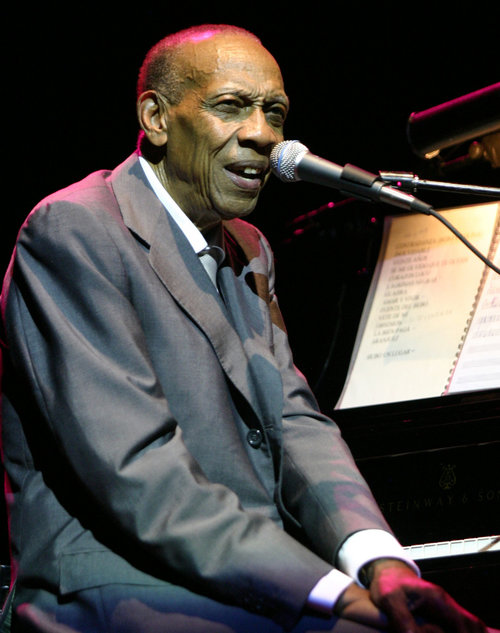
Bebo Valdés, a Force in Cuban Music, Dies at 94

See on Scoop.itOUR COMMON GROUND News Board •● ☥●• The Third Eye Parenthesis

Mr. Valdés, a pianist, arranger and composer, was at the center of Havana’s musical life in the pre-Castro era.

OUR COMMON GROUND Omnibus‘s insight:

But at the root of Mr. Valdés’s success was his pianism, which was influenced by Baroque fugues, Art Tatum and the left-hand rhythms in Ernesto Lecuona’s Euro-Antillean danzas and built on rhythmic principles he learned while playing for dancers alongside some of the great Cuban singers of his era, including Beny Moré, Pio Leyva and Orlando Cascarita Guerra.

See on www.nytimes.com

The Truth Comes Out! Will Smith Reveals The Real Reason Why He Rejected ‘Django’

See on Scoop.itOUR COMMON GROUND Informed Truth and Resistance

First, as I said when I reviewed the script for Django Unchained in the spring of 2011, after it was first announced that Will Smith was Quentin Tarantino’s first choice to play Django…:

OUR COMMON GROUND Omnibus‘s insight:

In fact, I’d say that Django doesn’t really, fully, come alive until about the last 25 minutes of this almost 3-hour script/movie. And there are circumstances that accommodate that transition – circumstances that felt all-too-convenient. Suffice it to say that just as it takes the assist of a white man to set Django free and on course towards saving his damsel in distress, it also takes the assist (however unintentional) of a white man to finally allow Django his moment to really shine, and get out of the white man’s shadow. And even those last 20 minutes, aren’t very satisfying.

See on blogs.indiewire.com

The Credit-History Pariah Class

See on Scoop.itOUR COMMON GROUND News Board •● ☥●• The Third Eye Parenthesis

People whose credit history was damaged in the recession should not be shut out of the job market.

OUR COMMON GROUND Omnibus‘s insight:

Advocates of screening say that it provides insight into an applicant’s character. But those who seek bankruptcy often do so because of unmanageable medical debt. A new studyof nearly 1,000 low- and middle-income families by Demos, a research and policy group, suggests that most of those who suffered degraded credit ratings during the recession either lost their job, lacked medical insurance or incurred debt when they were injured or got sick. “Poor credit,” the study says, “tells a story of medical misfortune far more convincingly than one of poor work habits.” The study also underscored the fact that African-American families have been disproportionately affected. They had fewer assets to start with, and were easy targets for predatory subprime lenders who led them deeper into debt.

See on www.nytimes.com

Key U.S. Outcomes at the UN Human Rights Council 22nd Session

See on Scoop.itOUR COMMON GROUND News Board •● ☥●• The Third Eye Parenthesis

Key U.S. Outcomes at the UN Human Rights Council 22nd Session

OUR COMMON GROUND Omnibus‘s insight:

he 22nd Session of the Human Rights Council (HRC) underscored the importance of robust engagement at the Council, where the United States continues to work with a diverse range of countries from all regions of the world to address urgent human rights concerns. This was the first session of the United States’ second term on the Council, after our re-election by the General Assembly in New York last November. U.S. leadership helped to keep the Council at the forefront of international efforts to promote and protect human rights. We continue to engage strategically with the goal of making the HRC a more effective and credible multilateral forum for promoting and protecting human rights. At the same time, the Council’s biased and disproportionate focus on Israel remains a major challenge, as exemplified by the annual Item 7 resolutions. As a member of the Council, our mission remains to emphasize key human rights issues while vigorously opposing efforts to shield human rights violators.

See on www.state.gov

Day of Remembrance of Slavery Victims and the Transatlantic Slave Trade

The UN International Day of Remembrance of Slavery Victims and the Transatlantic Slave Trade

By  Michael Evans – 25 Mar 2013
The UN International Day of Remembrance of Slavery Victims and the Transatlantic Slave Trade

 Monument to Slaves; Credit: © Shutterstock

On 25th March each year the United Nations International Day of Remembrance of Slavery Victims and the Transatlantic Slave Trade honours the lives of those who died as a result of slavery, or who experienced the horrors of the transatlantic slave trade.

The day also presents an excellent opportunity to raise awareness of the dangers of racism and prejudice.

During the period of around 400 years from the sixteenth and nineteenth centuries between 15 million and 17 million African men, women and children were transported against their will across the Atlantic to North, Central and South America. Millions more died during the course of the journey.

The captives were brought from the coasts of Africa in cramped and unhygienic slave ships and 96 % of them were landed at ports in South America and the Caribbean Islands.

Between 1501 and 1830, four Africans crossed the Atlantic for every one European. The legacy of this is plainly evident today, with many millions of people throughout the Americas who are all of African descent.

This inhumane trade is now universally regarded as being one of the worst ever violations of human rights, with some experts believing that the effects of this trade are still being felt in the economies of some African countries.

The first anti-slavery statement was signed in Germantown, Pennsylvania by a group of Dutch and German Quarters in 1688 and this was followed by similar disapproval by English Quakers who began to promote reforms. From the 1750s a number of Quakers in Britain’s America colonies began to express their opposition and called on Quaker slave owners to improve the conditions of their slaves, to educate them in reading and writing and Christianity and to gradually emancipate them.

The British abolitionist movement came into being in 1783 after an informal group of six Quakers presented a petition to Parliament, signed by over 300 Quakers. Individuals and organisations began to correspond and books, pamphlets and newspaper articles were part of the effort to raise awareness of the cause. This was the beginning of perhaps the first and certainly the largest humanitarian movement that had ever been seen.

It was becoming clear to the international community that this sort of trade was no longer to be tolerated. Although the trade had previously been accepted without question, the Anglo-American abolitionist movement began to gain more support. In 1791 the British campaigner William Wilberforce introduced his first Parliamentary Bill to abolish slavery. This was easily defeated, but he tried again the following year, and the next, and the next, until in 1807 the British Parliament finally voted to abolish the slave trade throughout its maritime power.

Abolition itself followed slowly as agreements had to be established with the various semi-autonomous colonial governments. Further British Parliamentary legislation followed and in Britain the Slavery Abolition Act was passed in 1833, ending slavery in Canada, the British West Indies and the Cape of Good Hope.

By now the abolitionist movement was gaining momentum. Within ten years slavery had also been abolished in India and in 1848 it was abolished in French territories.

1st January 1863 was the day of the Emancipation Proclamation in the United States. This stated that: “all persons held as slaves within any state, or designated part of the state, the people whereof shall be in rebellion against the United States, shall be then, thenceforward and forever free”

Slavery was officially abolished in the United States on 1st February 1865 as a result of the passing of the Thirteenth Amendment to the United States Constitution. President Lincoln was anxious that the Emancipation Proclamation should not be seen as a temporary measure made during the Civil War. Yet in spite of all the good intentions, racial segregation continued throughout most of the following century and racism continues to remain an important issue.

The United Nations International Day of Remembrance of Slavery Victims and the Transatlantic Slave Trade is an occasion to consider the causes, consequences and lessons to be gained from the transatlantic slave trade. The theme for 2013 is Forever Free: Celebrating Emancipation when tribute will be paid to all those who worked tirelessly to overturn the acceptance of the slave trade as an institution that was legitimate and moral.

Earthtimes 


International Day of Remembrance of the Victims
of Slavery and the Transatlantic Slave Trade
25 March

Theme for 2013: “Forever Free: Celebrating Emancipation”

Poster created for the 2012 observanceClick on the poster to download it [PDF 9.1MB]

For over 400 years, more than 15 million men, women and children were the victims of the tragic transatlantic slave trade, one of the darkest chapters in human history.

The annual observance of 25 March as the International Day of Remembrance for the Victims of Slavery and the Transatlantic Slave Trade serves as an opportunity to honour and remember those who suffered and died at the hands of the brutal slavery system, and to raise awareness about the dangers of racism and prejudice today.

This year’s theme, “Forever Free: Celebrating Emancipation,” pays tribute to the emancipation of slaves in nations across the world. This year is particularly important with many key anniversaries, including 220 years since France’s General Emancipation decree liberated all slaves in present-day Haiti; 180 years since the Slavery Abolition Act of 1833 ended slavery in Canada, the British West Indies and the Cape of Good Hope; and 170 years ago, the Indian Slavery Act of 1843 was signed. Slavery was also abolished 165 years ago in France; 160 years ago in Argentina; 150 years ago in the Dutch colonies; and 125 years ago in Brazil.

2013 is also the 150th anniversary of the Emancipation Proclamation in the United States, which declared that, on 1 January 1863, all persons held as slaves within any States, or designated part of the State, the people whereof shall be in rebellion against the United States, shall be then, thenceforward, and forever free.


OCG Witness

Thought Merchant's avatarTHOUGHT MERCHANT

In the youtube video above I’m having a conversation with Yvette Carnell of Your Black World about my piece “The Historical Failure of Black Leadership.”

“Ethiopia will soon stretch forth her hands onto God, that Africa’s redemption shall soon be accomplished…”—a common quote of 19th Century Black Nationalists found in The Golden Age of Black Nationalism, by Wilson Jeremiah Moses.

A major aspect of Black political history stems from a concept that has maintained a profound and lasting position in the discourse of Black leadership, as well as racial diversity discourse relative to Black politicians. The concept is called “The Politics of Redemption.” The politics of redemption is a direct consequence of the perverse relationship Blacks had to White slave owners in the United States upon their arrival after the trans-Atlantic slave trade. Because the African was denied any vestiges of his identity and culture, he was given a…

View original post 884 more words

Dr. Ben Carson, Great Surgeon but a Bad Icon for the Political Collective l Dr. Wilmer Leon

Dr. Wilmer Leon: Dr. Ben Carson, Great Surgeon but a Bad Icon for the Political Collective

 wilmer112

by OUR COMMON GROUND VOICE, Dr. Wilmer J. Leon III

Black Politics on the Web

 “Nobody is starving on the streets (of America).  We have always taken care of them.  We have churches which actually are much better mechanisms for taking care of the poor because they are right there with them.  This is one of the reasons we give tax breaks to churches…” Dr. Ben Carson – CPAC Speech 2013

In modern culture, an icon is a symbol – i.e. a name, face, picture, or even a person readily recognized as having some well-known significance or embodying certain qualities.  That face or person begins to represent something else of greater significance through literal or figurative meaning. With his speech at the 2013 National Prayer Breakfast and his recent CPAC speech, Carson has become the new Black conservative darling.  He’s a great pediatric surgeon but a terrible icon for the political collective.

Dr. Ben Carson has an incredibly compelling and motivational story.  Born into poverty in Detroit in 1951 and raised by a single mother with a third-grade education, Carson became the first surgeon to separate conjoined twins and the youngest to head a surgical department.  His focus, work ethic, and commitment to excellence should be emulated by as many as possible.

One problem with Dr. Carson and others like him – i.e. Justice Thomas, Michael Steele, Wardell Connerly and Condoleezza Rice is how they have lent their voices and their personal narratives to conservatives in ways that allow them to undermine the social safety net in America.  The argument is that these individuals have overachieved in spite of the odds; therefore, the inability of the poor in America to rise into the middle class or beyond is due to personal failure, lack of drive, initiative, and dependence upon the system. Carson, Rice, and Thomas made it; why can’t you?

Another problem with their “realities” is their failure to recognize and/or admit how they benefitted from “the system” at some point in their struggle.  For example, Wardell Connerly grew his business in part with assistance from the 8(a) Program.  Justice Thomas was a beneficiary of Affirmative Action.  I don’t know if Carson’s mother ever received any public assistance during his childhood but if she did not I am certain some of his neighbors did. Is he ready to cast them all as lazy and totally dependent upon the government?

We love to hear stories about people overcoming great odds to achieve success. What is ignored when reciting the stories of the Carson’s, Thomas’, and Rice’s of the world is depth of the chasm that lied between Africans in America and later the African American community and white America. There have always been personal successes in the midst of the collective or group struggle. During the 18th century while hundreds of thousands and later millions of Africans in America where bound by the shackles of slavery, individuals such as Olaudah Equiano aka “Equiano, the African” and James Forten found success on American shores.  Did the success of Equiano, Forten and others negate the suffering and systemic oppression of those enslaved?  Obviously not.

Today, in spite of all of the disturbing data documenting the disparity between the African American community and Whites, such as eighteen percent unemployment, African Americans being fifty-three percent of those incarcerated and only thirteen percent of the population, the wealth disparity, high school drop-out rates, college graduation rates, home foreclosure rates, etc. the likes of a Wardell Connerly, Shelby Steele, or Clarence Thomas stand before conservatives and argue that we no longer need Affirmative Action, Head Start, and other social programs.

Individual success should never become the standard of measure of success for the collective. It is only through group success that the African American community will truly become politically and economically empowered.

Dr. Ben Carson made some very inaccurate and dangerous statements during his CPAC speech that cannot go unchallenged.  He stated as referenced above, “Nobody is starving on the streets (of America)”.  According to Bread for the World, “14.5 percent of U.S. households struggle to put enough food on the table. More than 48 million Americans—including 16.2 million children—live in these households…Among African-Americans and Latinos, nearly one in three children is at risk of hunger.”  Has he forgotten that in 1951 he may have been one of those hungry children?

He also stated, “Many people don’t know this but socialism started as a reaction to America because people in Europe, they looked at us and said, “”wait a minute look at those Americans…people like Henry Ford, Kellogg, Vanderbilt…they’ve got so much money…”” it needs to be redistributed.”  Actually, the term socialism is attributed to Pierre Leroux and Robert Owen around 1827.  Henry Ford was not born until 1863.  Socialist models and ideas espousing common or public ownership have existed since antiquity. Karl Marx, considered by many to be the founder of modern socialism first published Das Kapital in 1847.  Henry Ford was 4 years old.  Socialism was actually a reaction to the Industrial Revolution which started in Britain around 1760.

Carson said, “People don’t want to talk about God…let’s let everybody believe what they want to believe.”  Actually, the basis of the free exercise clause of the First Amendment is the freedom to believe.  It is one of the few absolute protections that the Constitution provides.  There is a big difference between belief and practice. If Carson understood the Constitution he would know that.

Dr. Ben Carson has a very motivational story but his political analysis and message lack real understanding of the issues necessary to be taken seriously.  It is dangerous to use the success of an individual(s) as the basis of a sociological or economic indictment of an entire class of individuals.  A reporter once asked Dr. Carson why he never talked about race to which he responded, “…because I’m a neurosurgeon”.  Well, Dr. Carson, I’ll make a deal with you, I’ll stay out of the operating room if you leave the political analysis and dialogue to trained professionals.

Dr. Wilmer Leon is the Producer/ Host of the nationally broadcast call-in talk radio program “Inside the Issues with Leon,” and a Lecturer  in the Department of Political Science at HowardUniversity in Washington, D.C.  Go to http://www.wilmerleon.com or email: wjl3us@yahoo.comwww.twitter.com/drwleon and Dr. Leon’s Prescription at Facebook.com

© 2013 InfoWave Communications, LLC

Black Politics on the Web

“Inside the Issues With Wilmer Leon” Political Scientist Wilmer J. Leon, lll, Ph.D. is a Political Commentator, Nationally Syndicated Columnist with the National Newspapers Publishers Association (NNPA) and the Host of the nationally broadcast three-hour call-in talk radio program Inside The Issues with Wilmer Leon” airing live nationally every Saturday at 11am est. on Sirius/XM Satellite Radio channel 128 “The Power.” The show rebroadcasts on Sundays at noon. A Teaching Associate in the Department of Political Science at Howard University in Washington, Dr. Leon writes and delivers commentary for a variety of national media outlets including Root.com, TheGrio.com, TruthOut.org, CNN, NPR.org, MSNBC, The Maynard Institute.com,Politicsincolor.com and many others. Dr. Leon’s primary areas of expertise are Black Politics and Public Policy. He has a BS degree in Political Science from Hampton Institute, a Masters in Public Administration (MPA) from Howard University, and a Ph.D. in Political Science from Howard University.

wilmer promo

Prison Profiteers Are Neo-Slaveholders and Solitary Is Their Weapon of Choice – Chris Hedges

Prison Profiteers Are Neo-Slaveholders and Solitary Is Their Weapon of Choice

Monday, 18 March 2013 10:56  By Chris HedgesTruthdig | Op-Ed

Prison fence(Image: Prison fence via Shutterstock)


If, as Fyodor Dostoevsky wrote, “the degree of civilization in a society can be judged by entering its prisons” then we are a nation of barbarians. Our vast network of federal and state prisons, with some 2.3 million inmates, rivals the gulags of totalitarian states. Once you disappear behind prison walls you become prey. Rape. Torture. Beatings. Prolonged isolation. Sensory deprivation. Racial profiling. Chain gangs. Forced labor. Rancid food. Children imprisoned as adults. Prisoners forced to take medications to induce lethargy. Inadequate heating and ventilation. Poor health care. Draconian sentences for nonviolent crimes. Endemic violence.

Bonnie Kerness and Ojore Lutalo, both of whom I met in Newark, N.J., a few days ago at the office of American Friends Service Committee Prison Watch, have fought longer and harder than perhaps any others in the country against the expanding abuse of prisoners, especially the use of solitary confinement. Lutalo, once a member of the Black Liberation Army, an offshoot of the Black Panthers, first wrote Kerness in 1986 while he was a prisoner at Trenton State Prison, now called New Jersey State Prison. He described to her the bleak and degrading world of solitary confinement, the world of the prisoners like him held in the so-called management control unit, which he called “a prison within a prison.” Before being released in 2009, Lutalo was in the management control unit for 22 of the 28 years he served for the second of two convictions—the first for a bank robbery and the second for a gun battle with a drug dealer. He kept his sanity, he told me, by following a strict regime of exercising in his tiny cell, writing, meditating and tearing up newspapers to make collages that portrayed his prison conditions.

“The guards in riot gear would suddenly wake you up at 1 a.m., force you to strip and make you grab all your things and move you to another cell just to harass you,” he said when we spoke in Newark. “They had attack dogs with them that were trained to go for your genitals. You spent 24 hours alone one day in your cell and 22 the next. If you do not have a strong sense of purpose you don’t survive psychologically. Isolation is designed to defeat prisoners mentally, and I saw a lot of prisoners defeated.”

Lutalo’s letter was Kerness’ first indication that the U.S. prison system was creating something new—special detention facilities that under international law are a form of torture. He wrote to her: “How does one go about articulating desperation to another who is not desperate? How does one go about articulating the psychological stress of knowing that people are waiting for me to self-destruct?”

The techniques of sensory deprivation and prolonged isolation were pioneered by the Central Intelligence Agency to break prisoners during the Cold War. Alfred McCoy, the author of “A Question of Torture: CIA Interrogation, From the Cold War to the War on Terror,” wrote in his book that “interrogators had found that mere physical pain, no matter how extreme, often produced heightened resistance.” So the intelligence agency turned to the more effective mechanisms of “sensory disorientation” and “self-inflicted pain,” McCoy noted. [One example of causing self-inflicted pain is to force a prisoner to stand without moving or to hold some other stressful bodily position for a long period.] The combination, government psychologists argued, would cause victims to feel responsible for their own suffering and accelerate psychological disintegration. Sensory disorientation combines extreme sensory overload with extreme sensory deprivation. Prolonged isolation is followed by intense interrogation. Extreme heat is followed by extreme cold. Glaring light is followed by total darkness. Loud and sustained noise is followed by silence. “The fusion of these two techniques, sensory disorientation and self-inflicted pain, creates a synergy of physical and psychological trauma whose sum is a hammer-blow to the existential platforms of personal identity,” McCoy wrote.

After hearing from Lutalo, Kerness became a fierce advocate for him and other prisoners held in isolation units. She published through her office a survivor’s manualfor those held in isolation as well as a booklettitled “Torture in United States Prisons.” And she began to collect the stories of prisoners held in isolation.

“My food trays have been sprayed with mace or cleaning agents, … human feces and urine put into them by guards who deliver trays to my breakfast, lunch, and dinner… ,” a prisoner in isolation in the Wabash Valley Correctional Facility at Carlisle, Ind., was quoted as saying in “Torture in United States Prisons.” “I have witnessed sane men of character become self-mutilators, suffer paranoia, panic attacks, hostile fantasies about revenge. One prisoner would swallow packs of AA batteries, and stick a pencil in his penis. They would cut on themselves to gain contact with staff nurses or just to draw attention to themselves. These men made slinging human feces ‘body waste’ daily like it was a recognized sport. Some would eat it or rub it all over themselves as if it was body lotion. … Prisoncrats use a form of restraint, a bed crafted to strap men in four point Velcro straps. Both hands to the wrist and both feet to the ankles and secured. Prisoners have been kept like this for 3-6 hours at a time. Most times they would remove all their clothes. The Special Confinement Unit used [water hoses] on these men also. … When prisons become overcrowded, prisoncrats will do forced double bunking. Over-crowding issues present an assortment of problems many of which results in violence. … Prisoncrats will purposely house a ‘sex offender’ in a cell with prisoners with sole intentions of having him beaten up or even killed.”

In 1913 Eastern State Penitentiary, in Philadelphia, discontinued its isolation cages. Prisoners within the U.S. prison system would not be held in isolation again in large numbers until the turmoil of the 1960s and the rise of the anti-war and civil rights movements along with the emergence of radical groups such as the Black Panthers. Trenton State Prison established a management control unit, or isolation unit, in 1975 for political prisoners, mostly black radicals such as Lutalo whom the state wanted to segregate from the wider prison population. Those held in the isolation unit were rarely there because they had violated prison rules; they were there because of their revolutionary beliefs—beliefs the prison authorities feared might resonate with other prisoners. In 1983 the federal prison in Marion, Ill., instituted a permanent lockdown, creating, in essence, a prisonwide “control unit.” By 1994 the Federal Bureau of Prisons, using the Marion model, built its maximum-security prison in Florence, Colo. The use of prolonged isolation and sensory deprivation exploded. “Special housing units” were formed for the mentally ill. “Security threat group management units” were formed for those accused of gang activity. “Communications management units” were formed to isolate Muslims labeled as terrorists. Voluntary and involuntary protective custody units were formed. Administrative segregation punishment units were formed to isolate prisoners said to be psychologically troubled. All were established in open violation of the United Nations Convention Against Torture, the U.N.’s International Covenant on Civil and Political Rights, and the International Convention on the Elimination of All Forms of Racial Discrimination. Kerness calls it “the war at home.” And she says it is only the latest variation of the long assault on the poor, especially people of color.

“There are no former Jim Crow systems,” Kerness said. “The transition from slavery to Black Codes to convict leasing to the Jim Crow laws to the wars on poverty, veterans, youth and political activism in the 1960s has been a seamless evolution of political and social incapacitation of poor people of color. The sophisticated fascism of the practices of stop and frisk, charging people in inner cities with ‘wandering,’ driving and walking while black, ZIP code racism—these and many other de facto practices all serve to keep our prisons full. In a system where 60 percent of those who are imprisoned are people of color, where students of color face harsher punishments in school than their white peers, where 58 percent of African [American] youth … are sent to adult prisons, where women of color are 69 percent more likely to be imprisoned and where offenders of color receive longer sentences, the concept of colorblindness doesn’t exist. The racism around me is palpable.”

“The 1960s, when the last of the Jim Crow laws were reversed, this whole new set of practices accepted by law enforcement was designed to continue to feed the money-generating prison system, which has neo-slavery at its core,” she said. “Until we deeply recognize that the system’s bottom line is social control and creating a business from bodies of color and the poor, nothing can change.” She noted that more than half of those in the prison system have never physically harmed another person but that “just about all of these people have been harmed themselves.” And not only does the criminal justice sweep up the poor and people of color, but slavery within the prison system is permitted by the 13th Amendment of the U.S. Constitution, which reads: “Neither slavery nor involuntary servitude, except as punishment for crime whereof the party shall have been duly convicted, shall exist within the United States. …”

This, Kerness said, “is at the core how the labor of slaves was transformed into what people in prison call neo-slavery.” Neo-slavery is an integral part of the prison industrial complex, in which hundreds of thousands of the nation’s prisoners, primarily people of color, are forced to work at involuntary labor for a dollar or less an hour. “If you call the New Jersey Bureau of Tourism you are most likely talking to a prisoner at the Edna Mahan Correctional Institution for Women who is earning 23 cents an hour who has no ability to negotiate working hours or working conditions,” she said.

The bodies of poor, unemployed youths are worth little on the streets but become valuable commodities once they are behind bars.

“People have said to me that the criminal justice system doesn’t work,” Kerness said. “I’ve come to believe exactly the opposite—that it works perfectly, just as slavery did, as a matter of economic and political policy. How is it that a 15-year-old in Newark who the country labels worthless to the economy, who has no hope of getting a job or affording college, can suddenly generate 20,000 to 30,000 dollars a year once trapped in the criminal justice system? The expansion of prisons, parole, probation, the court and police systems has resulted in an enormous bureaucracy which has been a boon to everyone from architects to food vendors—all with one thing in common, a paycheck earned by keeping human beings in cages. The criminalization of poverty is a lucrative business, and we have replaced the social safety net with a dragnet.”

Prisons are at once hugely expensive—the country has spent some $300 billion on them since 1980—and, as Kerness pointed out, hugely profitable. Prisons function in the same way the military-industrial complex functions. The money is public and the profits are private. “Privatization in the prison industrial complex includes companies, which run prisons for profit while at the same time gleaning profits from forced labor,” she said. “In the state of New Jersey, food and medical services are provided by corporations, which have a profit motive. One recent explosion of private industry is the partnering of Corrections Corporation of America with the federal government to detain close to 1 million undocumented people. Using public monies to enrich private citizens is the history of capitalism at its most exploitive.”

Those released from prison are woefully unprepared for re-entry. They carry with them the years of trauma they endured. They often suffer from the endemic health problems that come with long incarceration, including hepatitis C, tuberculosis and HIV. They often do not have access to medications upon release to treat their physical and mental illnesses. Finding work is difficult. They feel alienated and are often estranged from friends and family. More than 60 percent end up back in prison.

“How do you teach someone to rid themselves of degradation?” Kerness asked. “How long does it take to teach people to feel safe, a sense of empowerment in a world where they often come home emotionally and physically damaged and unemployable? There are many reasons that ex-prisoners do not make it—paramount among them is that they are not supposed to succeed.”

Kerness has long been a crusader. In 1961 at the age of 19 she left New York to work for a decade in Tennessee in the civil rights struggle, including a year at Tennessee’sHighlander Research and Education Center, where Rosa Parks and Martin Luther King Jr. trained. By the 1970s she was involved in housing campaigns for the poor in New Jersey. She kept running into families that included incarcerated members. This led her to found Prison Watch.

The letters that pour into her office are disturbing. Female prisoners routinely complain of being sexually abused by guards. One prisoner wrote to her office: “That was not part of my sentence to perform oral sex with officers.” Other prisoners write on behalf of the mentally ill who have been left to deteriorate in the prison system. One California prisoner told of a mentally ill man spreading feces over himself and the guards then dumping him into a scalding bath that took skin off 30 percent of his body.

Kerness said the letters she receives from prisoners collectively present a litany of “inhumane conditions including cold, filth, callous medical care, extended isolation often lasting years, use of devices of torture, harassment, brutality and racism.” Prisoners send her drawings of “four- and five-point restraints, restraint hoods, restraint belts, restraint beds, stun grenades, stun guns, stun belts, spit hoods, tethers, and waist and leg chains.” But the worst torment, prisoners tell her, is the psychological pain caused by “no touch torture” that included “humiliation, sleep deprivation, sensory disorientation, extreme light or dark, extreme cold or heat” and “extended solitary confinement.” These techniques, she said, are consciously designed to carry out “a systematic attack on all human stimuli.”

The use of sensory deprivation was applied by the government to imprisoned radicals in the 1960s including members of the Black Panthers, the Black Liberation Army, the Puerto Rican independence movement and the American Indian Movement, along with environmentalists, anti-imperialists and civil rights activists. It is now used extensively against Islamic militants, jailhouse lawyers and political prisoners. Many of those political prisoners were part of radical black underground movements in the 1960s that advocated violence. A few, such as Leonard Peltier and Mumia Abu Jamal, are well known, but most have little public visibility—among them Sundiata Acoli,Mutulu ShakurImam Jamil Al-Amin (known as H. Rap Brown when in the 1960s he was the chairman of the Student Nonviolent Coordinating Committee), Jalil Bottom,Sekou OdingaAbdul MajidTom Manning and Bill Dunne.

Those within the system who attempt to resist the abuse and mistreatment are dealt with severely. Prisoners in the overcrowded Southern Ohio Correctional Facility, a maximum-security prison in Lucasville, Ohio, staged a revolt in 1993 after years of routine beatings, degrading rituals of public humiliation and the alleged murders of prisoners by guards. The some 450 prisoners, who were able to unite antagonistic prison factions including the Aryan Brotherhood and the black Gangster Disciples, held out for 11 days. It was one of the longest prison rebellions in U.S. history. Nine prisoners and a guard were killed by the prisoners during the revolt. The state responded with characteristic fury. It singled out some 40 prisoners and eventually shipped them to Ohio State Penitentiary (OSP), a supermax facility outside Youngstown that was constructed in 1998. There prisoners are held in solitary confinement 23 hours a day in 7-by-11-foot cells. Prisoners at OSP almost never see the sun or have human contact. Those charged with participating in the uprising have, in some cases, been held in these punitive conditions at OSP or other facilities since the 1993 revolt. Five prisoners—Bomani Shakur, Siddique Abdullah Hasan, Jason Robb, George Skatzes and Namir Abdul Mateen—involved in the uprising were charged with murder. They are being held in isolation on death row.

Kerness says the for-profit prison companies have created an entrepreneurial class like that of the Southern slaveholders, one “dependent on the poor, and on bodies of color as a source for income,” and she describes federal and state departments of corrections as “a state of mind.” This state of mind, she said in the interview, “led to Abu Ghraib, Bagram and Guantanamo and what is going on in U.S. prisons right this moment.”

As long as profit remains an incentive to incarcerate human beings and our corporate state abounds in surplus, redundant labor, there is little chance that the prison system will be reformed. It is making our corporate overlords wealthy. Our prisons serve the engine of corporate capitalism, transferring state money to private corporations. These corporations will continue to stymie rational prison reform because the system, however inhumane and unjust, feeds corporate bank accounts. At its bottom the problem is not race—although race plays a huge part in incarceration rates—nor is it finally poverty; it is the predatory nature of corporate capitalism itself. And until we slay the beast of corporate capitalism, until we wrest power back from corporations, until we build social institutions and a system of governance designed not to profit the few but foster the common good, our prison industry and the horror it perpetuates will only expand.

This piece was reprinted by Truthout with permission or license. It may not be reproduced in any form without permission or license from the source.

CHRIS HEDGES

Chris Hedges spent nearly two decades as a foreign correspondent in Central America, the Middle East, Africa and the Balkans. He has reported from more than 50 countries and has worked for The Christian Science Monitor, National Public Radio, The Dallas Morning News and The New York Times, for which he was a foreign correspondent for 15 years.

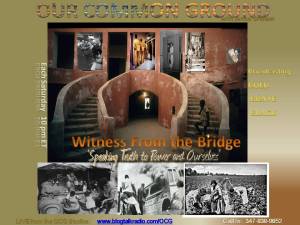
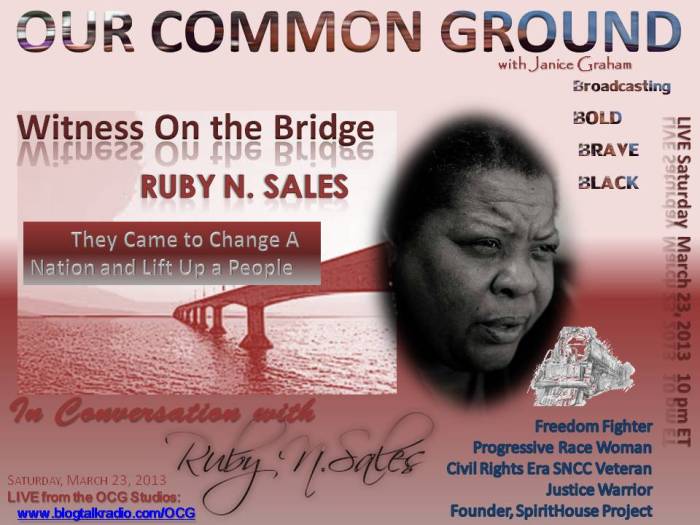
Witness On the Bridge l In Conversation with Ruby N. Sales l March 23, 2013 l OUR COMMON GROUND

OUR COMMON GROUND with Janice Graham

WITNESSES FROM THE BRIDGE Series


03-09 RubySales2

In Conversation with Ruby N. Sales


Civil Rights and Liberation Activist – Community Activist and OrganizerCommunity Education and Development Leader

 Human Rights Activist

March 23, 2013       10pm ET

LIVE and CALL-In

“WITNESSES FROM THE BRIDGE”
“They came to Change a Nation and Lift Up A People”
The Women of the Black Power Movement

about RUBY N. SALES

FREEDOM and JUSTICE WARRIOR

sales
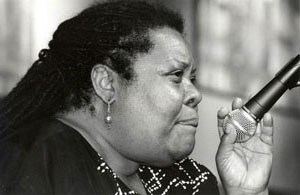
Ruby Nell Sales is a highly-trained, experienced, and deeply-committed social activist, scholar, administrator, manager, public theologian, and educator in the areas of Civil, Gender, and other Human Rights. She is an excellent public speaker, with a proven track record in conflict resolution and consensus building. Ms. Sales has preached around the country on race, class, gender, and reconciliation, and she has done ground-breaking work on community and nonviolence formation. Ms. Sales also serves as a national convener of the Every Church A Peace Church Movement.

Along with other SNCC workers, Sales joined young people from Fort Deposit, Alabama who organized a demonstration to protest the actions of the local White grocery-store owners who cheated their parents. The group was arrested and held in jail and then suddenly released. Jonathan Daniels, a White seminarian and freedom worker from Episcopal Divinity School in Cambridge, Massachusetts was assassinated as he pulled Sales out of the line of fire when they attempted to enter Cash Grocery Store to buy sodas for other freedom workers who were released from jail. Tom Coleman also shot and deeply wounded Father Richard Morrisroe, a priest from Chicago. Despite threats of violence, Sales was determined to attend the trial of Daniels’ murderer, Tom Coleman, and to testify on behalf of her slain colleague.

As a social activist, Sales has served on many committees to further the work of reconciliation, education, and awareness. She has served on the Steering Committee for International Women’s Day, Washington, D.C.; the James Porter Colloquium Committee, Howard University, Washington, D.C.; the Coordinating Committee, People’s Coalition, Washington, D.C.; the President’s Committee On Race, University of Maryland; and the Coalition on Violence Against Women, Amnesty International, Washington, D.C. She was a founding member of Sage Magazine: A Scholarly Journal on Black Women. Sales received a Certificate of Gratitude for her work on Eyes on the Prize. Additionally, she was featured in Broken Ground: A Film on Race Relations in the South, by Broken Ground Productions. From 1991-1994, Sales founded and directed the national nonprofit organization Women of All Colors, dedicated to improving the overall quality of life for women, their families, and the communities in which they live. Women of All Colors organized a week-long SisterSpeak that brought more than 80 Black women together to set a national agenda.

In 2000, Dan Rather spotlighted Sales on his “American Dream” Segment. In 1999, Selma, Alabama gave Sales the key to the city to honor her contributions there. In 2007, Sales moved to Columbus, Georgia, where she organized: a southern summit on racism; a national write-in campaign to save Albany State from being merged into a White college; a grassroots and media campaign to shed light on the death of seventeen year old, Billye Jo Johnson, who allegedly killed himself on a dark road in Lucedale, Mississippi when a deputy stopped him for speeding; Long Train Running Towards Justice, which celebrated the work of Black teachers during segregation and explored the ways that the Black school culture has been destroyed by White officials under the guise of desegregation; and a meeting with students at Savannah State to assist them in organizing and mobilizing a move by officials to merge Savannah State with a White college.

03-09 RubySalesIn 2009, the History Makers named her a History Maker for her contributions to civic affairs. The Veterans of Hope Project selected her to be a part of its video series. Her video “Standing Against the Wind” has been shown at colleges around the nation.

Sales serves as the founder and director of the SpiritHouse Project. SpiritHouse Project is a national organization that uses the arts, research, education, action, and spirituality to bring diverse peoples together to work for racial, economic, and social justice, as well as for spiritual maturity.

about SPIRITHOUSE Project

SpiritHouse Project houses The Jonathan Daniels and Samuel Young Institute for Racial Justice, which (1) supports and prepares a new generation of peace and justice workers who want to discern a call to social justice and nonviolence; (2) strengthens their courage, hope, resolve, and reason to do this work; (3) prepares them to play leading roles in public policy debates about issues such as poverty, prison industrial complex, militarism, the shrinking budget for human needs, voting rights, privacy and judicial issues, and neo-conservatism; and (4) helps grassroots communities meet their urgent need for trained and committed volunteers or staff. Throughout her career, Sales has mentored young people and provided support and venues for an intergenerational community of developing and seasoned social justice performing and creative artists. Sales has a deep commitment to providing the education, practical experiences, and frame of references to contest racism and add their voices to a public conversation on the many streams of oppression that emerge from it.

SpiritHouse also houses SisterAll Programs that bring Black women together in assemblies, classrooms, and performance spaces to renew our historical roles as a community of activists, spiritual guides, and leaders who stand and work on the front lines for racial, economic, and human rights using the tools of nonviolence and participatory democracy. SisterAll One was a community-building project that called together black female scholars, activists, artists, students, workers, practitioners, and lay and ordained spiritual leaders between the ages of 18 and 35, alongside older Black women who have been long distance runners for justice.

Ruby Sales’ Spirit House Project interns will share what they have learned in their work tracking the different points of connection within the Prison Industrial Complex and Criminal Justice Reform.

Spirit House is located at 1884 Ponce De Leon Avenue NE #1, Atlanta, GA 30307

Join us in the conversation with one of our most powerful, prolific and important figures in contemporary Black History.

LIVE: OCG Meetinghouse: http://www.blogtalkradio.com/OCG

For More Information: http://www.ourcommongroundtalk.wordpress.com/

OUR COMMON GROUND with Janice Graham

“Speaking Truth to Power and Ourselves

“BROADCASTING BRAVE BOLD BLACK

Community Forum: http://www.ourcommonground-talk.ning.com/

Twitter: @JaniceOCG #TalkthatMatters                   Web: http://www.wordpress.ourcommongroundtalk.com/

Chinua Achebe, African Literary Titan, Dies at 82 : The iroko has fallen.

Chinua Achebe, African Literary Titan, Dies at 82

 The iroko has fallen.

Craig Ruttle/Associated Press

Chinua Achebe, a Nigerian-born novelist and poet, at home on the campus of Bard College in Annandale-on-Hudson, New York, in 2008.

By JONATHAN KANDELL

From the NYT

Published: March 22, 2013

Chinua Achebe, the Nigerian writer who was one of Africa’s most widely read novelists and one of the continent’s towering men of letters, has died after a brief illness, his publisher and agent said in London on Friday. He was 82.

Few details were immediately available.

Besides novels, Mr. Achebe’s works included powerful essays and poignant short stories and poems rooted in the countryside and cities of his native Nigeria, before and after independence from British colonial rule. His most memorable fictional characters were buffeted and bewildered by the conflicting pulls of traditional African culture and invasive Western values.

For inspiration, Mr. Achebe drew on his own family history as part of the Ibo nation of southeastern Nigeria, a people victimized by the racism of British colonial administrators and then by the brutality of military dictators from other Nigerian ethnic groups.

Mr. Achebe burst onto the world literary scene with the publication in 1958 of his first novel, “Things Fall Apart,” which sold millions of copies and was translated into 45 different languages.

Set in the Ibo countryside in the late 19th century, the novel tells the story of Okonkwo, who rises from poverty to become an affluent farmer and village leader. But with the advent of British colonial rule and cultural values, Okonkwo’s life is thrown into turmoil. In the end, unable to adapt to the new status quo, he explodes in frustration, killing an African in the employ of the British and then committing suicide.

The novel, which is also compelling for its descriptions of traditional Ibo society and rituals, went on to become a classic of world literature and was often listed as required reading in university courses in Europe and the United States.

But when it was first published, “Things Fall Apart” did not receive unanimous acclaim. Some British critics thought it idealized pre-colonial African culture at the expense of the former empire.

“An offended and highly critical English reviewer in a London Sunday paper titled her piece cleverly, I must admit Hurray to Mere Anarchy!” wrote Mr. Achebe in “Home and Exile,” a collection of autobiographical essays that appeared in 2000. A few other novels by Mr. Achebe early in his career were occasionally criticized by reviewers as being stronger on ideology than on narrative interest.

But over the years, Mr. Achebe’s stature grew until he was considered a literary and political beacon.

“In all Achebe’s writing there is an intense moral energy,” observed Kwame Anthony Appiah, professor of Afro-American studies and philosophy at Princeton, in a commentary written in 2000. “He speaks about the task of the writer in language that captures the sense of threat and loss that must have faced many Africans as empire invaded and disrupted their lives.”

In a 1998 New York Times book review, the novelist Nadine Gordimer hailed Mr. Achebe as “a novelist who makes you laugh and then catch your breath in horror — a writer who has no illusions but is not disillusioned.”

Mr. Achebe’s political thinking evolved from blaming colonial rule for Africa’s woes to frank criticism of African rulers and of citizens who tolerated their corruption and violence.

Forced abroad by Nigeria’s bloody civil war in the 1960s and then by military dictatorship in the 1980s and 1990s, Mr. Achebe had lived for many years in the United States, where he was a university professor. But he continued to believe that writers and storytellers ultimately held more power than army strongmen.

“Only the story can continue beyond the war and the warrior,” an old soothsayer observes in Mr. Achebe’s 1988 novel, “Anthills of the Savannah.” “It is the story that saves our progeny from blundering like blind beggars into the spikes of the cactus fence. The story is our escort; without it, we are blind.”

Above from the NYT

MORE INFORMATION ABOUT THIS GREAT AUTHOR AND SCHOLAR

A KING HAS TRANSITIONED…LAST NIGHT IN BOSTON, MASS.

The iroko has fallen.

A Great One has passed over today.

“Things Fall Apart” tells two intertwining stories, both centering on Okonkwo, a “strong man” of an Ibo village in Nigeria. The first, a powerful fable of the immemorial conflict between the individual and society, traces Okonkwo’s fall from grace with the tribal world. The second, as modern as the first is ancient, concerns the clash of cultures and the destruction of Okonkwo’s world with the arrival of aggressive European missionaries. These perfectly harmonized twin dramas are informed by an awareness capable of encompassing at once the life of nature, human history, and the mysterious compulsions of the soul.”

Chinua Achebe (Nov 16, 1930-Mar 22, 2013).

HAVE YOU READ FROM HIS BOOKS! ONE IS “WHEN THINGS FALL APART” Comfort&Courage.

Chinua Achebe Biography

Today in History: We mourn the death of literary great and activist Prof Chinua Achebe, 82. He died in the United States where he was said to have suffered from an undisclosed ailment. He died last night in a hospital in Boston, Massachusetts, United States.
A source close to the family said the professor had been ill for a while and was hospitalized in a hospital in Boston.

Until his death, the renowned author of Things Fall Apart was the David and Marianna Fisher University Professor and Professor of Africana Studies at Brown. The University described him as “known the world over for having played a seminal role in the founding and development of African literature.”

“Achebe’s global significance lies not only in his talent and recognition as a writer, but also as a critical thinker and essayist who has written extensively on questions of the role of culture in Africa and the social and political significance of aesthetics and analysis of the postcolonial state in Africa,” Brown University writes of the literary icon.

Mr. Achebe was the author of Things Fall Apart, published in 1958, and considered the most widely read book in modern African Literature. The book sold over 12 million copies and has been translated to over 50 languages worldwide. Many of his other novels, including Arrow of God, No Longer at Ease, Anthills of the Savannah, and A man of the People, were equally influential as well.

Prof Achebe was born in Ogidi, Anambra State, on November 16, 1930 and attended St Philips’ Central School at the age of six. He moved away from his family to Nekede, four kilometres from Owerri, the capital of Imo State, at the age of 12 and registered at the Central School there. He attended Government College Umuahia for his secondary school education. He was a pioneer student of the University College, now University of Ibadan in 1948. He was first admitted to study medicine but changed to English, history and theology after his first year.
While studying at Ibadan, Mr. Achebe began to become critical of European literature about Africa. He eventually wrote his final papers in the University in 1953 and emerged with a second-class degree.

Prof Achebe taught for a while after graduation before joining the Nigeria Broadcasting Service in 1954 in Lagos. While in Lagos with the Broadcasting Service, Mr. Achebe met Christie Okoli, who later became his wife; they got married in 1961. The couple had four children. He also played a major role during the Nigeria Civil War where he joined the Biafran Government as an ambassador.

Mr. Achebe was a consistent critic of various military dictators that ruled Nigeria and was a loud voice in denouncing the failure of governance in the country. Twice, he rejected offers by the Nigerian government to grant him a national honor, citing the deplorable political situations in the country, particularly in his home state of Anambra, as reason…

This is a great loss to not only the literary world, but to humanity! His legacy will live on in his work. May he ‘ascend’ in peace! 

Here’s he is on CNN’s African Voices

African voices tv program on CNN interviewed Nigerian writer Chinua Achebe