The Radicalization of Ray Richardson: Suspicion Still Surrounds Death of Black Activist TV Producer
by Jeffrey B. Perry and Charles V. Richardson
In January, 1971, the young producer of Boston public television’s groundbreaking program Say Brother, was found dead in a Mexican resort, along with his fiancé. Ray Richardson was the grandson of Harlem radical Hubert Harrison. The cause was listed as drowning but, as in this year’s death of Malcolm Shabazz, grandson of Malcolm X, in Mexico, questions still linger.
The Radicalization of Ray Richardson: Suspicion Still Surrounds Death of Black Activist TV Producer
by Jeffrey B. Perry and Charles V. Richardson
“Members of Ray Richardson’s family believed that he was monitored and targeted and that the U.S. government was involved in his death.”
The grandson of one of the outstanding Black activists of the twentieth century was found dead under suspicious circumstances in Mexico. Sound familiar? For many current readers this may immediately bring to mind Malcolm Shabazz, the grandson of Malcolm X. For some it also brings to mind Ray Richardson, an exceptionally talented media activist and Black Power TV pioneer, and the grandson of Hubert Harrison — the “Father of Harlem Radicalism.”
Ray Richardson, producer from 1968-70 of Say Brother, Boston Public Television station WGBH’s prime time public-affairs show, though a strong swimmer, was declared dead from “asphyxiation by drowning” at age twenty-four in Acapulco, Mexico in late January 1971. The Richardson family and others familiar with the nature of his work and the powerful forces it threatened, with the U.S. government’s monitoring and repression of Black radical activities, and with the events surrounding his “drowning,” have, for over forty years, expressed suspicions concerning his death and that of his fiancé, Vashti Lowns.
Historian Komozi Woodard has described Ray’s grandfather, Hubert Harrison, as “the lost ancestor of Black radicalism” and emphasized that his story can serve to “awaken and reorient a new generation.” Ray Richardson’s life and work is also a story from which we can learn much today. It is a story that offers important insights about the effectiveness of the collective work done by young Black activists in Boston some forty-plus years ago. That story should not be “lost” and it is to that story that we now turn.
Family Background
Ray Richardson was born March 31, 1946, to Aida Harrison Richardson (the Harlem born-daughter of Hubert Henry Harrison and Irene Louise Horton Harrison) and Virgil Richardson. Aida’s family had roots in West Africa, St. Croix, Barbados, Demerara (now part of Guyana), Antigua, and Puerto Rico. She had been a regular columnist for the Amsterdam News while still in High School and became a New York City public school teacher and assistant principal. For many decades she oversaw, along with her brother William Harrison (an attorney), son Charles Richardson, and niece Ilva Harrison, the preservation of the Hubert H. Harrison Papers (a major collection now at Columbia University’s Rare Book and Manuscript Library). They were the papers of her father and she carried his legacy forward as would her sons Charles and Ray.
Hubert Harrison (1883-1927) was a brilliant, early twentieth-century writer, editor, orator, and political activist. Historian J. A. Rogers described him as “the foremost Afro-American intellect of his time.” The labor and civil rights activist A. Philip Randolph, referring to a time when Harlem was considered the “center of radical Black thought” and the “international Negro Mecca,” referred to him as “the father of Harlem Radicalism.” Extremely popular in his day, Hubert Harrison was also, as the Afro-Puerto Rican bibliophile Arthur Schomburg eulogized, “ahead of his time.”
The contributions of this mass-oriented, race- and class-conscious, “radical internationalist” were extraordinary. Harrison was the leading Black activist in the Socialist Party during its 1912 heyday; thefounder of the militant New Negro Movement (a World War I-era precursor to the Black Power Movement of the 1960s) in 1916-17; the co-convener with Boston’s William Monroe Trotter of the 1918 Liberty Congress, the major national Black protest effort during WWI; the principal editor of Marcus Garvey’s Negro World in 1920; and the major radical influence on both the class-conscious Randolph and the race-conscious Garvey. He is a key link in the ideological unity of the two great trends of 20th-century African American struggle — the labor and civil rights trend associated with Randolph and Martin Luther King, Jr. and the race and nationalist trend associated with Garvey and Malcolm X. He was also, as his family well knew, one of the first Black activists monitored by the Bureau of Investigation and British Military Intelligence (forerunners of the FBI and similar surveillance operations), who described him as having “influence . . . more far reaching than that of any other individual radical.”
Virgil Richardson, Ray’s father, was born to Birdie Lee Clardy and Ross Richardson in Center Point, Arkansas and raised in Texarkana, Texas. He was a co-founder of the American Negro Theater in Harlem and a Tuskegee Airman. His family had roots in Africa, India, Virginia, North Carolina, Texas, and Arkansas and included Native-American and “perhaps” some European ancestors. After a series of white-supremacist incidents upon his return from WW II and in a strained marital relationship, Virgil moved to Mexico, leaving his wife and two sons behind. His life is detailed in the biography Flight: The Story of Virgil Richardson, A Tuskegee Airman in Mexico by historian Ben Vinson III.
Ray and his older brother by two-years, Charles, were reared by their mother in Harlem and the New York City area and educated, with scholarships, at the Horace Mann School. At Horace Mann Ray was Vice-President of the International Council, a varsity soccer player, and, according to the yearbook, the Mannikin,“perhaps first among his classmates in never-ending affability and good-heartedness.” He utilized the school’s Summer Film Project and new film lab under George Bouwman (a friend of Jack Kerouac, Allen Ginsberg, and other “Beats”), where he shot, edited, and scored his own student film. He then received a B.S. in Film from the School of Public Communications at Boston University in 1968. While a student, he taught filmmaking and cinematic techniques in Harlem’s Haryou-Act program and in a summer Upward Bound program at Dillard University in New Orleans.
While in Boston University’s cooperative work-study program, Ray was employed as a production assistant for WBZ-TV in Boston and then joined WGBH Ch 2 as a cameraman (under executive producer Jim Boyd) before quickly becoming producer/director for the Say Brother show in 1968. Under his leadership Say Brother greatly impacted the Boston-area Black community. (The consulting firm The Circle, Inc. found that 1/3 of Black viewers watched it regularly with a stronger viewer response than for any other show.) It also reached beyond the Black community and half of its audience was reported to be “white.” It became a powerful voice of Black Power television, offering both a critique of exiting conditions and an alternative vision.
Say Brother Background and Staff
As the Civil Rights and Black Power movements grew in strength and militancy in the 1960s, and as U.S. cities faced urban “riots”/rebellions, increased attention was paid by many, including leadership at WGBH, to the fact that television stations had almost no Black staff members. After the assassination of Dr. Martin Luther King Jr., on April 4, 1968, conditions were extremely tense in Boston. A James Brown concertscheduled for April 5 was expected to draw 15,000 people downtown to the Boston Garden. City officials negotiated with WGBH to broadcast the concert show live and people were encouraged to watch it from home for free. Many did stay home and the resultant live turnout at the concert was low.
Devorah Heitner, author of a new and important book, Black Power TV (featured in a December 5, 2013Schomburg Center event), describes how the “recognition that WGBH received” for the television show “was a critical factor in the decision to create an ongoing, weekly Black public-affairs television program.” That show was Say Brother, and it was scheduled for prime time, Thursday evenings from 8:30 to 9:30 with repeats on Saturdays at 6:30 p.m. [later changed to Sundays at 5 p.m.]. Heitner describes it “as WGBH-Boston’s answer to America’s racial crisis.”
She also describes how the “title and the content of Say Brother constituted a call to action” — “its theme song was named for a salutation used by some African-Americans [to pause and consider something, like the onset of a conversation] in this era, encouraging African Americans to ‘Say ‘brother’!” The original theme song, “Say Brother,” performed by The Crowd on the Street and written by Stark Reality, was played with accompanying montage and “offered a vision of Black power in which men and women have mutually-supportive roles, with a call and response between male and female singers.”
Key members of the extremely talented staff in that first year included the producer/director Richardson and the director Stan Lathan, a 1967 graduate of Pennsylvania State University in theater, who, like Richardson, was from Boston University’s cooperative work-study program. Lathan would go on to have a prolific and influential career as an award-winning television executive producer and director. Other key staffers were stage manager Bob Wilson, film cameraman editor Tony Lark, assistant cameraman Richie Lee, and production assistants Hazel Bright, Jewelle Gomez, Ellen Cabot, and Dierdre Francis. On-camera regulars included host Jim Spruill, Stewart Thomas (who focused on youth), interviewer Roy Thompson, and Sarah Ann Shaw, Boston’s first African American television reporter. In addition, Henry Hampton, of Blackside Productions, which later created the documentary television series Eyes on the Prize, was a regular and insightful commentator.
Tony Lark, one of the more militant members of the group, pointed out that the staff was not comprised primarily of Black people from Boston, they were “sort of rootless,” and needed “to develop contacts” in the Back community. An “even greater problem,” however, was that “they were largely ‘middle class.” Then, as the young staff increasingly “noticed real class differences among blacks,” they sought “to identify with the poorer people . . . the masses.” In this way Say Brother had a very important “effect on the people who put it together.” It “‘radicalized’ them.” They turned to “real issues,” attacking “the Establishment” and “challenging” the status quo.
Richardson described what the challenging meant. Since the “black community doesn’t exist in a vacuum,” you are “doing a disservice if you’re just talking about the community and not about the people outside who are affecting it.” So Say Brother sought “to educate blacks to the way in which they are operated upon.” It sought “to present an alternative” to “all that white aimed television.” Richardson emphasized, “Anyone who wants an opposing view can dial-flip through . . . 800 other hours of weekly television in Boston.” Say Brotherwas “fulfilling a role for black people that television has failed to fill.” It was “meeting a responsibility that is being met in no other way” and doing “what Channel Two should be doing in its programming in general.” In producing the show, added Richardson, “we never deal with whether whites are going to watch. The minute you consider that, the show starts changing. We’re talking with black people, not just projecting the black community to other people.”
In an April 15, 1969, Boston Globe interview with Dexter D. Eure, Richardson described how the staff included six full time members (five of whom were African American) and two part-time production assistants, a part-time cameraman-editor, and six others who worked ads, talent, etc., “all of whom are black.” Staff members were part of the Black community, in “close touch with a good number of organizations and individuals” and “constantly involved with people and events.” From these sources they “get lots of ideas and comments, and sometimes criticism.” The show filmed in Roxbury, Dorchester, the Black communities of Cambridge, Malden, Springfield, and dozens of other places in Massachusetts and New England and it differed from “white” programming on the Black community in that “we, being blacks, draw on common interest, common background, and a common cause, whereas white shows about black people are merely the outside looking in.” The “staff was developed as a unit” and was “beginning to create more shows along thematic lines” such as “black theater,” “black communities,” and “black athletes” and it was looking to “continue to exchange shows” with other cities such as they had arranged with ABC in New York.
Henry Hampton, one of the most experienced members of the staff, elaborated on the collective effort and its relationship to the community. “I’ve seen a lot of black shows and we are more experimental and do more exploration than any other. We have a real base in the community and reach a broad cross section of the community. I like participating in the unity that is SAY BROTHER, where we think out, reflect and are in context.”
Jewelle Gomez, a nineteen-year-old of mixed Native American and African American heritage recruited from Northeastern University, manifested some of the enthusiasm of the era: “When we began we wondered if we should aim for super militancy, the poor or the middle class. We said No. We want to relate to the black community generally. I want SAY BROTHER to be an institution in the community . . . I want them to say ‘that’s us.’ We are one with the show. They are SAY BROTHER. I want all black people in New England watching SAY BROTHER. I’d like to relate to the entire black community across the country. That’s 22 million of us. The Third World, even.”
Sarah Ann Shaw, who would later serve as a chief consultant on the Say Brother collection, explained in the December 26, 1968, Bay State Banner, Boston’s leading Black newspaper, that “On SAY BROTHER I have found a freedom in presenting different points of view about issues . . .. There is great satisfaction in working with the SAY BROTHER staff. It’s a good, tight-knit group with imagination, interested in developing concrete ideas.” She described producer Ray Richardson as “a brilliant young man” who “never wavered in his commitment to portraying all facets and accomplishments of black life.”
Carol Munday Lawrence, an assistant producer of Say Brother, informs us in Jacqueline Bobo’s Black Women Film and Video Artists that the show had its own minivan and a “full-time technical staff” including “a film crew and two film editors.” Her job, “like everyone else’s,” was being a “jack of all trades” and she points out, “No one could ask for a better, more thorough learning experience.” Regarding Ray Richardson, she notes that he “had carte blanche when it came to content and layout of the shows” and she emphasizes that the staff worked well together because “Ray’s style” was “informal and egalitarian.”
Stan Lathan, cameraman-director for Say Brother, worked closely with producer Richardson. “There’s no question about it,” said Lathan in the October 18, 1973, Bay State Banner, “what I know production-wise I learned early on in the year with Say Brother.’” The most important thing learned in that period was “an attitude toward the work” — “With Ray and Hazel [Bright] and the people we worked with there was a striving for excellence. We tried to do the best that could be done.” “I have been developing techniques since the beginning. But the most important thing is, I got my foundation in Boston, a certain professionalism,” said Lathan.
As Devorah Heitner in Black Power TV explains, Say Brother was “ unique among Black public affairs television programs because it was Black-produced from the outset.” In addition to the executive producer (Boyd, then Richardson) and the director (Lathan) there was also at least one Black sound technician, which was extremely rare at that time. In its first season, “all the on-air staff members, the writers, and the off-air staff” were “in their teens or twenties, which was atypical of the world of public television.” Further, the staff’s “articulation of their vision for Black empowerment differed from what WGBH executives had anticipated.” In the case of Say Brother, “a television program created to contain Black anger was re-envisioned by staff members to express the Black critique and alternative visions for Black life and Black empowerment.” The show’s “youthful and politically active creators embodied a generational shift to Black Power and a lively interest in new Black cultural and political formulations.”
Early Programs
Say Brother first aired on July 18, 1968, and according to Sarah-Ann Shaw in an article on “The History ofSay Brother,” it “helped set a standard of excellence for black television shows, with the issues it brought to the public, the artists it featured, and the education it provided for the white community.” It was “the era of Black Power, Black Pride, and the thrust for political power — an era when hairstyles and modes of dress proclaimed ‘Black is Beautiful’ and even the show’s title sent a message.” – “Say Brother’ was a commonplace greeting in those days. It was a signal, a sign of recognition that blacks were connected to one another emotionally and by common experience.”
When the show started, WGBH-TV had an idea of doing a Black community show, but “didn’t know how.” That’s how Ray Richardson put it to staff writer Deckle Maclean in the Boston Globe of December 14, 1969. Soon, however, emblazoned on the program was the slogan — “of, by and for” the Black community. In the early stages it was a variety show, “a combination of everything . . . newscaster, . . .black history, . . . community problems political talk, . . . theoretical ‘agency’ talk, . . . entertainment, . . . poetry, . . . drama.” There was then a movement toward “deeper treatment of politically touchy issues.” By the 10th show (September 18), production was turned over to students and parents to discuss Boston’s public schools after a Black student was expelled from English High School for wearing a dashiki. That particular show was originally 1½ hour long. It aired the anger felt with “grown men crying, young bloods swearing, desperation and resolve,” but the station cut it to an hour.
The pattern was set; people in the street would speak. “You find somebody who has been on the butt end of abuse and let him tell anecdotes.” You “run into a perfectly innocent looking woman in the parking lot. You ask her about the Vietnam War . . . the next thing you know she’s saying black men shouldn’t be fighting Asians in Asia but instead white people in white communities. And she’s not being non-violent. Almost everyone you talk to comes down hard on the war.” Then a former Marine tells “how he became a Panther in part because of his experience in Nam.” So “you put them into the show along with some history of blacks in the armed forces and wait for trouble.” Then comes a disclaimer – “this program represents the views of the producer, not of the station management.” Then, when you try to put it on again, the station says no, “You hassle it out and get it on anyway. And all the time figuring ‘If we really do our job right, the man is going to have to cut us off.” The voices of the Black community “are just too much for any white-run media.” It was a struggle, in the words of Charles Richardson, of “forces . . . destined to collide . . . the media vs. the masses.”
In a December 26, 1968, article by Kay Bourne in the Bay State Banner, Ray Richardson explained, “Black people don’t have choices in their TV viewing” so “in our one show at WGBH we are trying to provide something interesting for blacks to do and watch. We are not a weekly newsy, what’s happening show because with our small staff we can’t compete with a major station’s reportage. We are not trying to speak for the community, although we do have representatives on the show. We are trying for good, black programming. We are aspiring to black. Occasionally we reach flashes of really hitting that nerve, so the cat watching knows it’s [about] him–what he wants and what he is.”
“SAY BROTHER has developed a great deal since its first program last June,” he added. “We are coming closer to our aim of black recognition. Recent shows I’m particularly proud of are the school show done after the first week of school this fall and during the English High School tension [an August 29, 1968, presentation on “Black Youth and Education” that included a panel discussion led by Sarah-Ann Shaw]; last week’s show with David Ruffin, Bill Cosby, Leroi Jones and Jesse Jackson; and the Election Show.” On the Election Show, “we had discussion of the relevancy of candidates to black people” and “what the election results might mean for black people.” There was analysis, an original play and people in the street interviews. “We closed and opened the show with Aretha Franklin singing ‘Think.’ It’s the continuity, each week making its own statement that I like.” [See Bill Cosby, on the 1968 election.]
The January 16, 1969, program devoted an hour to “Black Power on University Campuses.” It examined the student takeover of Ford Hall at Brandeis University by 65 Black students and included a panel discussion of Black Power on university campuses moderated by Henry Hampton. It was the only TV news operation that was able to do this and its exclusive 17-minute filmed news report included interviews with students inside the occupied building with discussion and analysis of the conditions that lead up to the demonstration.
A spring special in the last week of March 1969 showcased the musical talents of some of the African American musicians who had appeared on the show during its first year including Gladys Knight and the Pips, Patti LaBelle and the Blue Bells, The Chambers Brothers, The Delfonics, The Impressions, Gwen Michaels, Ronnie Gill, Carla Thomas, David Ruffin, The Stark Reality, plus Sly and the Family Stone. An early June 1969 feature hosted by Jim Spruill included seventeen Boston-area-based artists discussing the meaning of Black art.
On June 19, 1969, a show on Black male athletes featured a segment on “Muhammad Ali and the Vietnam War” and also included interviews with Frank Robinson (baseball), Arthur Ashe (tennis), Tom Sanders (basketball), Ken Hudson (referee), Jim Brown (football), Bill Russell (coach), and Tommie Smith (track). Other shows featured Eldridge Cleaver, the African playwright and poet Wole Soyinka, and dancer Gus Solomons Jr.
First Anniversary
The Say Brother first anniversary program of July 10, 1969, featured actresses Ruby Dee and Alice Childress interviewed by James Spruill. Dee said “We artists have been betrayers of the job of art: to affect change . . .. I want to see the same originality, spirit and fervor black people brought to music now brought to films and television.” Henry Hampton offered commentary noting that “For the first time, television stations not only paid lip service to the participation of blacks and Puerto Ricans, but actually offered significant blocks of air time to black producers and writers” and emphasized that Say Brother went “far past” its “original boundaries.” It was a show “by, for, and about blacks” – “a foreign concept to management at commercial and educational television stations.”
Ray Richardson explained: “We attempted to create an outlet for many of the viewpoints that exist in our community and to deal with political, educational, and cultural activities relevant to black people. We have had successes, occasional failures, and many memorable incidents.” Sarah-Ann Shaw asked people on the street their responses to previous programs. The Parliaments performed “Do Your Own Thing” and “I Want to Testify” and the final minutes included Joanne Robinson dancing.
WGBH-TV’s handling of the Say Brother anniversary special is revealing. Channel Two pre-empted the weekend re-broadcast in favor of a tennis match and the Say Brother staff decided to repeat its special in both time slots the following week. Richardson introduced the special and was “particularly critical of WGBH-TV” and “an industry that pays little more than lip-service to the needs of its black viewers.” He pointed out that Channel 2 broadcasted 70 hours a week and devoted only 2 hours directly to the Black community; had only 11 Black people on its staff of over 200, and had no Black people in its public or cultural affairs departments. Later in the program Henry Hampton extended similar criticism to other Boston stations and throughout the country.
The Second Year
Hazel Bright in an interview with historian Devorah Heitner remembered Richardson doing a show in which Stan Lathan moved in for a “real close up of Ray criticizing harshly the management of WGBH . . . and I was so scared for him.” Ray “was very, very harsh, it was true; [but] he didn’t say anything that wasn’t true.” He said, “that they [WGBH] don’t support the show; they don’t support Black issues; they don’t have a [Black] show but this one, and they have no interest in developing anything. He was just sort of telling them about themselves.”
The radicalization continued. Kay Bourne, in the Bay State Banner of October 30, 1969, quoted Richardson explaining the aims of the program — “We want to direct ourselves to the masses of people, the people who are fighting off landlords in Roxbury and the South End, and the people who are supplying troops for the war in Viet Nam. We want programming which makes black people aware of ourselves not only to ourselves, but in relation to other people, in relation to other poor people black brown and white.” He described how the “program on Viet Nam examined the role of the black soldier, historically” and tried “to show the kinds of things that have motivated or pressured people to go into the service, [and] the economic consideration.” The show aimed “to establish the fact that black people have always been an important part of every military action of this country” and “to examine racism within a military context,” because “it is a duplicate of the racism happening outside, in the country.” To do this, it focused “on the Panthers . . . the only group presently in the [Boston area] community looking at the involvement of black people in the military” who have “taken a position . . . against the war and against the drafting of black men.” Richardson also explained thatSay Brother was “interested in black film, film that has social and economic realities,” and “jobs for black people in television.”
In November, the Waterbury Sunday Republican, contained an article by Dorothy Leach, “‘Say Brother’Attains Top Black Show Status,” which described the show as “Boston’s top television program ‘for, by and about the black community.” She pointed out that Richardson was very knowledgeable regarding the Black community – “well-informed of its activities and remains constantly in touch with people and events” and that the “show is not aimed at the super-militant, . . . but to the entire community.”
In addition to discussing a number of previous shows and segments, and highlighting the contributions of Richardson and of Lathan (who moved to Black Journal and Sesame Street in New York), the article also took a close look at Richardson. Leach commented: “In spite of his youth, Richardson, a tall, calm, articulate young man who speaks with maturity far beyond his years, is most capable when it comes to the technical and creative ‘knowhow’ of television. His self-confidence in his abilities paid off and ‘Say Brother’ became and remains one of Boston’s most interesting television shows. He feels, however, that he and his staff of six can improve and develop to an even fuller degree.” Leach also discussed how “Richardson, a personification of young Black America,” and “aware of the social problems facing our country,” is “proud of his heritage.” She noted that he preferred the name “black” (rather than “Negro” of “Afro-American”) because it was used “to describe not just the . . . people but the nature of our historical, economical, cultural and psychological experience,” and “is a valid term.” In response to this, Leach ended her article — “Say Brother!”
Deckle McLean in the Boston Globe of Dec 14, 1969, pointed out that “Say Brother was the first prime time show aimed at a black community. It ran, and still runs, without prescreening, without anything that could be employed in the service of censorship.” He ominously noted, however, the station wanted to inject rules about “fairness.” “Essentially, the station wants Say Brother to be ‘fair’ in its presentation of white people.” The show says, “it is being as fair as it can be.” The station “wants the show to include opposing points of view, especially when charges are made.” The Say Brother people say, “that it is not always possible.” The questions “involve both matters of journalistic style and of equal time policy” and it is “the story of Say Brother and also the story of blacks in the media.”
At that time, McLean explained, “on the networks there is about one hour of black programming to every 1140 hours of white, on the local stations, nationally, about one hour black to every 10,000 hours white.” Tony Lark of the Say Brother production crew described the situation as racist. “Media doesn’t care about black people,” he said, “It’s building racist images.” He was, said McLean, postulating, “that the tube is an image builder, a validifier, and that to the extent it overemphasizes white images, it sullies black ones.”
Ray Richardson probed more deeply — “White people have got to realize” that it “is not a black face that makes it black.” This understanding leads “to the real stuff. We’re down where white people can’t quite understand what’s going on. We’re down in blackness. And from blackness we know what a racist image is . . .. It occurs every time a white media man pays allegiance to the myth system that has fueled the white racial ego trip. Every time he indicates he is not ready to start over again.”
Devorah Heitner sums up that “the staff felt that they did not need to yield their hour to oppositional points of view, as the entire program consisted of an oppositional point of view to the rest of what aired on WGBH and other stations.”
In early 1970, while serving as the producer of Say Brother, 24-year-old Ray Richardson was elected Vice Chairman, and 37-year-old Tony Brown of Detroit was elected Chairman, of the newly formed National Association of Black Media Producers Inc. at a conference at the Johnson Foundation in Racine, Wisconsin. The conference was co-sponsored by the Johnson Foundation and the Kettering Foundation. According to Charles Richardson, “When Ray participated in the meeting in which he was chosen” as Vice-Chair, he got “the impression . . . that the group was being created so as to keep an eye on all the Black folks. Tony Brown, ‘elected’ as the organization’s President, was understood to be a government tool whose roommates at the event were white agents. It was held on an estate donated by some rich white person and it was assumed that all rooms were tapped.” Charles Richardson adds that he understood from Ray that many participants considered Brown’s credentials suspect and questioned whether he actually had any relevant previous experience. Nevertheless, Brown went on to become the arbiter of Black thought, news, and information deemed to be important for the Black community through his Tony Brown’s Journal,” a show that “aired on most PBS stations in the country for the next 30 years” To “add insult to injury,” Charles notes that Brown “was appointed/became founding Dean of Howard University’s School of Communication.”
By the 1990s Tony Brown would be recognized as a Black conservative and he openly identified with the Republican Party. To Charles, “the plan was really cleverly thought out” as Brown’s long running program was “supported by Pepsi, another vital government tool.” Charles notes that, though Ray “was aware of the dastardly deeds,” he was, in early 1970, “naive to the ways of corporate America and the corporate/government nexus, and this seemed to have contributed to his [1970] fall from grace at WGBH.”
Interestingly, conservative Republican programming also came to dominate America’s Black Forum, “the first nationally syndicated Black news interview program on commercial television.” The show began in 1977 with a decidedly progressive perspective – it sought “to establish an independent, nationally syndicated television vehicle that would allow Black reporters to hold politicians and activists of all persuasions accountable to Black people” and it succeeded in those early years beyond its founders’ expectations. Years later, however, creators Peter Gamble and Glen Ford described how, after they left the show, it became “infested” by the “Hard Right” in the form of “professional Black propagandists in service of the most vicious elements of the Republican Party.”
New Bedford Rebellion and Aftermath
Ray Richardson’s “fall from grace at WGBH” for his efforts at developing a program “of, by and for” the Black community led to increased difficulties with WGBH management. Serious political issues came to a head forSay Brother in July 1970 with a ninety-minute special on the “race riot”/rebellion that erupted in New Bedford, Massachusetts. New Bedford was an economically depressed city, dependent on manufacturing and fishing, with significant African American and Cape Verdean populations and, according to Richardson, an overall unemployment rate of 8% and a Black unemployment rate of 35%. The eruption began on July 8-9 after the arrest of an African-American man for “disorderly conduct.” Conditions continued to heighten after a bottle throwing incident with police, the shooting and killing of Lester Lima, an African American youth by “white” vigilantes, the shooting of two other teenagers, and a police raid on a youth center. Richardson and otherSay Brother staff spent six days interviewing the community, including visiting the west and south end neighborhoods of New Bedford from Friday July 10 through Sunday the 12th discussing discrimination, jobs, unemployment, welfare difficulties, housing issues, police harassment, and community sentiment and direction.
“Everywhere the TV crew went,” writes Heitner, “people gathered around the cameras to share their perspective” and the show “was packed with forceful critiques of racial conditions in New Bedford, as residents described wasted federal aid money, overt discrimination, stunted employment opportunities, broken promises, and third-world living conditions.” Such “analysis offered by ‘rioters’” was “unlike the way other news shows represented riots and rioters—typically as chaotic scenes of inarticulate rage.” She emphasizes that this coverage was “exactly what the Kerner Commission Report had called for in the wake of the mid-sixties uprising: African American points of view during civil unrest.”
Some New Bedford residents, notes Heitner, spoke without using profanity, while many others didn’t. WGBH management warned Richardson about the content of the show and told him to remove sections. (At that time, FCC rules prohibited profanity.) Richardson and other staff members disagreed with management’s position. “They questioned how the show ‘could be by, for, and about black people if final decisions did not rest with them.’”
According to Heitner, “Richardson felt strongly that the people’s voices had to be heard unexpurgated. He refused to edit out the rampant profanity from the comments, choosing instead to air the program despite instruction from WGBH not to do so. Richardson felt that the language of those interviewed in New Bedford might be the appropriate language to express the situation and point of view; conditions were profane, so their profane language seemed justified in his perspective. Furthermore, the objectionable terms were so prevalent that it would have been quite difficult to edit them out of the broadcast.”
On July 23, 1970, Ray Richardson hosted the ninety-minute New Bedford show. It focused on the African American community, provided a history of the New Bedford events that compared the media’s coverage with the statements and opinions of community residents, and criticized the media for focusing on “incidents” rather than “the real issues.” It was a strong and effective critique and he quickly learned how far the powerful forces he was up against were willing to go.
The Firing of Ray Richardson and Cancelling of Say Brother
And the Community Response
Ray Richardson was fired at four o’clock Monday, August 10, 1970, and given a day to get all his personal belongings out of the television station office. Say Brother was to be cancelled effective August 27. His dismissal came in a memo from director of programming Michael Rice with approval from station president Stanford Calderwood (two men later associated with the Aspen Institute and its programs). Richardson’s refusal to entirely cut out the use of profanity and his refusal, in three instances, to allow rebuttals in the show’s limited, sixty-minute time slot were issues that had been disputed with management. Among the statements cited by Rice was one from the July 23, 1970, show that “the United States killed both Dr. Martin Luther King and Malcolm X.” Rice called such statements unsubstantiated and one-sided, according to Heitner. Say Brother staffers, however, expressed the opinion that management knew of the profanity and allowed the show to be aired in order to have an excuse to cancel the show. [Another issue, according to Richardson’s father Virgil, was that the show had accused Boston Mayor Kevin White of corruption. During his tenure there was considerable talk of corruption in his administration and mayoral aides and administration officials, though not White, were indicted and convicted. The State Ethics Commission would later, after a ten-month investigation, find “reasonable cause” that White had violated conflict-of-interest laws.]
Significantly, Kay Bourne, in the August 13 Bay State Banner, reported Rice as saying that “Say Brother‘ has focused … on the particular problems of the young, untrained,” it “has done so with the predominant voice of the militant or radical,” and “almost every member of the Say Brother‘ team personally believes that way and expresses that belief as the voice of the program on the air.” Rice went on, “So you can see the dilemma. At a time when more and more groups are asking for air time, this particular program has not found it possible to display the variety of opinion throughout the black community or the relationships of the black community to white groups or influence.” It was, added Rice ominously, “a tough question as to whether that program can be supported any longer.”
For production assistant James Spruill, who worked closely on the New Bedford show with Richardson, the reason for Ray’s firing by WGHB management was clear — “He was responsible to black people… so they had to get rid of him.”
The program staff and the Black community vigorously supported Say Brother and Ray Richardson. Protests, picketing, mass letter writing, call-in campaigns, and boycott efforts followed. On August 12, Say Brotherstaff members issued a protest letter that was published in the Bay State Banner. The staffers contended that the real reason the show was cancelled was its political content, not the profanity.
Mel King, Director of the New Urban League of Boston, led a demonstration of 50-60 people to WGBH demanding that Rice, the director of programming, be fired because of his decision to drop Say Brother and fire the producer Ray Richardson.
At a mass meeting at the Elma Lewis School of Art, Russell Tillman read the statement that the nine members of the Say Brother staff had drawn up and presented to management. A Say Brother Community Committee was established to press community demands, protest the closing of the show and the firing of Richardson, demand Rice’s firing, and implement a community boycott. Members of the Committee included Brother Karim, Black United Front; Elaine Munn, Roxbury Community School; William A. Davis, Circle Association; George Daniels, NAACP; Simon Wiltz, Workers Defense League; Jewelle Gomez; Charles Howard; Elma Lewis; Chuck Turner; Joe Nkunta, St. Stephen’s Church, and attorney Clarence Dilday. The list of boycott supporters provided by the committee indicated seven organizations and 31 individuals, including State Reps. Franklin Holgate and George Johnson, Model Neighborhood Board chairman John Bulliner, Elma Lewis, Mel King, and NAACP director Leon Nelson.
The crowd at the meeting shouted for Calderwood and Rice, who had come to present their position, to leave. Ray Richardson, who was in the crowd, did not speak. After much heated discussion, particularly with Leo Fletcher, of the United Community Construction Workers, and with King, WGBH’s Calderwood and Rice drove away.
Station management clearly got the message, however. Nine days after its initial action WGBH reinstatedSay Brother’ for the fall viewing schedule, called their decision to cancel “a mistake,” and agreed to work with the citizens group. Adamantly, however, the station refused to rehire Richardson and that refusal spawned a boycott. Most former staffers, according to Heitner, “chose not to return.”
Percy Shain in the Boston Globe of October 9, described how The Boston Black United Front (BBUF) on October 8 “announced a community-wide boycott against station WGBH-TV Ch 2 as a first step” in the continuing controversy with the channel over the fate of Say Brother and the firing of its director, Ray Richardson.” The boycott was a partial one involving two phases:
1—Members of the community are asked not [to] appear before the Ch. 2 cameras.
2—They should take no part in the station’[s] fundraising efforts.
“No economic boycott is contemplated at this moment,” said co-chairman Charles (Chuck) Turner of the BBUF as he announced the boycott at the organization’s offices at 70 Warren St. in Roxbury. Black people would not be prevented from working at the station; they would be encouraged to do so.
“The issue has gone beyond the merit or demerit of Richardson,” declared City Councilor Tom Atkins, who sat with the committee co-heads, Turner and Leroy Boston, at the head table. “It is, basically, what is the role of a public station in purporting to serve all elements of the public it reaches? “In the case of this community program, it should have come to the community first instead of notifying us after-the-fact,” Atkins said.
Less than two weeks later, on October 21, 1970, Stanford Calderwood resigned as president and general manager of Station WGBH, Boston. He had been on the job only three months.
Ray Richardson, however, was still not rehired and he would never get his job back. The Say Brotherexperience, show cancellation, and firing radicalized him. According to his brother Charles, Ray was an activist who felt he “could change things by acting in a manner different than and not necessarily in alignment with the status quo.” As the show progressed Ray saw that what they were trying to do at Say Brother was, in his words, “just too much for any white-run media” and the powerful forces behind them. Then, adds Charles, “he got slammed for the stand he took on New Bedford” and he was “radicalized” as “he saw to what ends the forces he was up against were willing to go.
“Fairness” and Other Issues
David Deitch, a Boston Globe reporter, who in less than two years (on August 10, 1972) would be fired like Ray Richardson, wrote important analyses of the Say Brother/Black Community struggle with WGBH beginning in the October 12, 1970, issue. In “The black community’s fight with WGBH Boston’s educational TV station, over Say Brother,’” he wrote WGBH was “resisting . . . any challenge to the conventional and exclusionist pattern of mass communications in this country.” Although it had been forced to reinstate the show, management adamantly refused to take back director Ray Richardson. The Black United Front, wanted Richardson back and they wanted the conditions prior to the show’s cancellation re-established.
The rehiring of Richardson, explained Deitch, would be “a recognition by WGBH of the inalienable right of the black community to free access to the mass media,” which would supersede “bureaucratic control by the station’s management and the interests it represents.” The Black community was “talking about control of a single TV show, not a whole station,” but the “educational TV stations, not beholden directly to corporate profit-making” were nevertheless indicating “they are in the business of selling ideas for profit” and these ideas “revolve around the implicit assertion that they,” as the “electronic media,” are “able to define the ‘public interest’ in terms of a white, middle class, corporate America.” Deitch added, most public television stations “are governed by Boards of Directors representing the more ‘substantial’ elements in the community” and it was important that “The Black United Front should stick to its guns because it is arguing something for all of us.”
The Boston Globe in an October 17, editorial, acknowledged that “Say Brother . . . was a pioneering venture . . . and was widely praised. It deserved to be. It gave the black community a voice.” The Globe went further, adding, “Mr. Richardson’s argument is persuasive that since Say Brother is the only black program (one hour locally for every 10,000 hours of white programming), criticisms of it can be answered on other programs.” The Globe, however, supported WGBH’s position “that a person unfairly attacked should get a chance to reply on the programme’s time.”
Globe reporter Deitch, in the October 23 issue explained, the more Say Brother became a Black community voice, “the more Channel 2 was pressured by established elements to re-assert control over the show’s content.” The “intellectual justification” was “the allegation that the show did not meet the requirements of the Fairness Doctrine, which says that those holding opposing points of view have the right of reply.” Channel 2 insisted, “the Fairness Doctrine be implemented on the program’s time,” but as Deitch pointed out, “there is no question that it could also be implemented anywhere else in the hours and hours of Channel 2’s scheduling.”
Since “those who control the electronic media have a lot more in common with those who control the print media,” explained Deitch, they were now “following the lead of the newspapers in advancing the notion of ‘balanced reporting’ and objectivity as the means by which editorial control can be established over political material.” Those in society “advocating a consistent point of view detrimental to the existing power structure would be immobilized by the requirement to present on the same program a point-by-point rebuttal to their position.” He stressed, “Balanced reporting – the presenting of pros and cons on every issue no matter how disingenuous – is the handmaiden of liberal paternalism” and with such “balanced reporting” any “sharp picture challenging the status quo would be made impossible.” For that reason, and because it was “legally acceptable,” Deitch argued that “it is important that the content of the ‘Say Bother’ show not be rebutted on the same program, but elsewhere on Channel 2.”
The attack on Say Brother and Ray Richardson had additional consequences. Within months of Richardson’s firing, Donald B. Fouser, a producer who in 1968 had helped get Say Brother started and who was now the executive producer of “The Nader Report,” the station’s major project, was summarily fired on February 2, 1971. As in the case with “Say Brother,” there were, according to reporter Percy Shain in theBoston Globe, “constant reports of high-echelon interference and differences over material and policy during the making of the program.” Fouser protested and within weeks of his firing a union was established at WGBH.
In the Boston Globe of March 9, 1971, Thom Shepard, explained that “Part of the frustration that the black community feels with WGBH in its removal of the Say Brother’ show is based on the actual belief in the station’s credo of being ‘public’ and ‘educational.’” He pointed out that, until recently, Black people were consistently “victimized by all facets of the media” and “were rarely seen outside of crime reports.” The “rise in consciousness of Afro-Americans and the subsequent pressure brought to bear” led to a “less imperfect portrayal in the media,” but “there was no analysis.” “Much disgust was expressed in the black community about its sudden popularity (photographers running all over the place) and the same lack of concern with the real issues.”
It was at this point, Shepard said, that Ray Richardson and Say Brother entered. The Say Brother staff concluded “that news was being reported but not analyzed from a black perspective” and they “decided that the educational station was the best point to start from, i.e., no hassles with sponsors.” As Say Brother“sought to define black programming for black people,” it “ran up against the same, if more sophisticated, wall blacks have been trying to destroy for years – the attitude in whites that stresses singing and dancing, but . . . don’t get serious, you’re not capable of it.”
The last “Say Brother” program was “one of the best of a number of good television shows” and it “revealed the problems of New Bedford.” Channel 2 “opposed the use of commonly-used ghetto invective in the program.” “At no time,” however, “did it oppose the attitude that allowed four black youngsters to be shot.” Instead, noted Shepard, it “opposed the emotion that the people of New Bedford justifiably showed.”
Death in Mexico
While the controversy over his firing continued, Ray Richardson co-directed the Harlem Film Cooperative with Roy Campanella, Jr. and Danny Williams and completed plans for funding the training of African and African-American students in filmmaking and cinematic techniques. Them, in December 1970, he traveled with his fiancé Vashti Lowns to Mexico City to visit his father Virgil who was grieving the loss of his father (Ray’s paternal grandfather), Ross Richardson. Prior to that visit Virgil says that Ray indicated to him that he had become a member of the Black Panther Party because he was infuriated at how Black people and Puerto Ricans were treated and wanted to do something about it. Virgil, suspecting that the FBI had infiltrated that organization, thought “it was time” to get Ray across the border to Mexico “for his own protection and safety.”
Vashti Anita Lowns (1942-1971), Ray’s fiancé, had attended Eastern H.S. (Washington, DC), Howard University, American University, and Corcoran School of Art before moving to New York in the mid-1960s andassociating with Leroi Jones/Amiri Baraka and others in the Black Arts Movement. In New York she obtained employment at The Studio Museum in Harlem and then became an Emmy-award winning producer of WABC New York’s pioneering Black TV show “Like it Is.” In late 1970 she also worked with Ray at the Harlem Film Cooperative before they departed for Mexico.
After spending most of two months in Mexico City with Virgil, Ray and Vashti were preparing to return to the U.S. On Virgil’s suggestion they went on a trip to Acapulco for a few days. They did not go alone, however. They went to Acapulco with a young couple, Basil Giff Jr. and Willie Sharon Giff from Buffalo, New York. The four had met a week before the trip in a park in Mexico City. The Giffs, according to Virgil, claimed they were “affiliated with the University of Buffalo” and that “they had been sent by a government agency to be investigators in Mexico.” To Virgil it “sounded like a whole lot of crap,” but Ray and Vashti “seemed intrigued.”
Charles Richardson explains that his father, Virgil, considered Ray and Vashti’s meeting of the Giffs “strangely coincidental, and therefore suspicious; and that after meeting him/them . . . he wasn’t comfortable with the apparent quick friendship – it seemed too ‘pat’/ convenient, so he was suspicious.” As to how Ray and Vashti viewed the Giffs — Virgil later commented to Charles, “they were happy to find other young, Black Americans of their same age to hang out with, and that as a result their guard was down.” Vashti, it was added, “was very leery of white people and would have gravitated easily to a seemingly harmless young black couple.”
In late January 1971, Ray, along with Vashti and the Giffs, reportedly went to the beach for a last swim before leaving Acapulco. What then happened and exactly when it happened is not clear.
Virgil says in his biography that on Sunday [January 24] he received a note under his door from the American Embassy. When he called the number he was told “Your son and two women drowned in Acapulco yesterday” [January 23]. He took the next bus to Acapulco where he met the husband of the couple [he knew him as “Givens”] who was “clearly distraught.” According to Virgil, “Givens” told him “the four of them had checked out of the hotel and were on their way back when they decided to have one last swim. Then Vashti started screaming. Givens called out for Ray, but Ray was missing. Soon he looked around and his wife was missing. Vashti was missing. None of them had realized that the place where they were swimming had a strong undertow.” The “undertow” [probably the rip current — JP] was, noted Virgil, maliciously called El Revocadero (“the place that revokes”). After Virgil spent several days in Acapulco, Ray’s body was found. Virgil saw it “had been decomposing in the salt water and baking in the sun” and had one leg “savagely” shark bitten. He “couldn’t bear to look for long.” Virgil added that “Vashti’s body was found” sometime after Ray’s was found, “but they never did recover the last corpse,” that of Willie Sharon Giff.
In contrast to Virgil’s account, the January 27, 1971, Sarasota Times-Herald identified Vashti as Ray’s wife and cited the Associated Press that Vashti, Ray, and Willie Sharon Giff drowned Monday, January 25 and that all three bodies were found on Tuesday, January 26 by members of the Mexican Navy.
In contrast to the two previous accounts, Vashti’s official Mexican death certificate dated January 30 said “Miss Lowns was a member of a group of four persons who, while swimming at a beach in Acapulco, were caught in a strong undertow. Three of the persons drowned; two bodies have been recovered and identified, leaving the body of Miss Lowns as not recovered.” Vashti was reported as “missing while swimming, presumed to be dead” on January 25, 1971. The Mexican government reported Ray’s death date as January 30, 1971, and said he was buried at Panteón Municipal de las Cruces in Acapulco. Also buried in that cemetery, according to the Mexican authorities, was nineteen-year-old Willie Sharon Giff, who was born in Birmingham, Alabama, and was reported to have died on January 25. Mexican authorities told Vashti’s family that there was no need for them to come to Mexico.
Regarding Basil Giff, not much is known. He was in the class of 1968 at Grover Cleveland High School in Buffalo and he was arrested and charged with third-degree assault in 1968 after demonstrating against George Wallace in Buffalo. Charles Richardson was later informed that Giff was institutionalized at Walter Reed Hospital in Washington, DC at some point after the deaths.
Soon after Ray’s death, his brother Charles became aware that his own home phone was tapped. He said he “heard comments by those recording” his incoming, “and likely his outgoing, calls.” He adds that his mother, Aida Harrison Richardson, “had noticed this on her home phone number much sooner.” She had also frequently received “random phone calls with no one on the other end” – and this happened to her both before and after Ray’s death and to Ray before he died.
Ray Richardson’s death came in the period that included the December 4, 1969, murder of Black Panther activists Fred Hampton and Mark Clark by Chicago police; the 1970 CIA-involvement in the kidnapping (and subsequent death) of a Chilean general, Rene Schneider; the March 11, 1971, death in Nigeria of National Urban League Executive Director Whitney Young (by drowning according to a U.S. coroner, by brain hemorrhage according to a Lagos coroner) after he came out against the Vietnam War; the August 21, 1971,murder by prison guards of Black Panther George Jackson; and the September 11, 1973, death of Salvatore Allende during the CIA-driven coup in which armed forces and police overthrew the socialist government in Chile. It was also a period in which COINTELPRO, the FBI’s counterintelligence program, targeted Black radicals and activists and the Black Panther Party; the National Security Agency and its Minaret Programmonitored and targeted Black and anti-war activists (particularly while abroad); and the Nixon administration sought to control Public Television and support its aims through its funding policies and removal of personnel it perceived as hostile.
It is therefore noteworthy that on the same day (January 28, 1971) that Ray Richardson’s obituary appeared in the Boston Globe under the title “Say Brother,’ Ex-Producer, By Drowning,” a second obituary, right below it, noted another suspicious drowning death in Mexico attributed to “asphyxiation by immersion in water.” Titled “Ex-Guatemalan President Drowns in Mexico City,” that article was about Jacobo Arbenz (1913-1971), the exiled, left leaning, democratically elected, former President of Guatemala who, it was claimed, drowned in his own bathtub on January 27. Arbenz had been ousted in a US-driven, CIA coup, code-named PBSUCCESS in 1954 and he had been the subject of CIA Operations under such names as PBFORTUNE, PBHISTORY, and WASHTUB.
In this hostile political climate, it is also noteworthy that the couple that appeared in a park in Mexico City, and then were reportedly at the beach with Ray and Vashti when they drowned, said that they were “sent by a government agency to be investigators in Mexico.” Members of Ray Richardson’s family believed that — because of Ray’s activities, because of the powerful forces who felt threatened by those activities, and because of the general political climate — he was monitored and targeted and that the U.S. government was involved in his death.
A great deal was also at stake regarding Black programming in the WGBH vs. Say Brother struggle. Charles Richardson points out that “WGBH was the flagship of the PBS network” and that, as he “understood it from Ray, it’s activities were “run out of the paranoid Nixon White House.” In addition, “the FBI under Hoover was monitoring all things Black.” In this way “Black public affairs shows, ostensibly introduced to feed the community’s appetite for information and news about local community goings on, were also the government’s way of monitoring thought, and, by the placement of their own operatives in positions of power and control (as directors/producers) they had the means to control thought by controlling the programming.” Neither Nixon, nor Hoover, nor WGBH management and its most powerful supporters wanted a show that truly gave voice to the Black community, particularly a show that included Black radical criticism of societal conditions.
Regarding government surveillance and possible involvement in the death of Ray Richardson, brother Charles, after forty-three years, speaks out. He writes: “Our family’s suspicions about the government’s involvement in tracking Ray’s activities and ultimately his death wasn’t something we generally discussed with others – why would we and for what purpose? We knew what we knew; knew what we were experiencing; and understood this had been stuff that had been happening to my mother’s father, and my father (and probably my mother as a result), so of course it would be happening to Ray. His show was popular throughout the progressive Black activist community locally, regionally, and nationally; his guests (and therefore many of his sources and resources) were directly involved in anti-establishmentarian agendas (e.g., the Panthers, the Nation of Islam, etc.); and his show blended the appearances of all of these thought leaders with appearances by the most popular Black performing artists of the day.” If one “was in a position to monitor the goings-on of the national Black community still dealing with post assassination riots & recovery as well as Viet Nam, “ as was WGBH “through its position . . .as the CPB’s [the Corporation for Public Broadcasting’s] flagship station,” it is not surprising that they would view Say Brother as “dangerous to the status quo.”
Charles Richardson adds, “When Ray died, the Nation of Islam through the Editor of their weekly newspaper [Muhammad Speaks] offered to have their Fruit of Islam (their paramilitary style security force) provide security for a funeral . . .Those was serious times and only the people who were living it like we were understood . . . what he was dealing with.”
Tributes
In one of the glowing tributes to Ray Richardson shortly after his death forty-nine-year-old Elma Lewis, director of the National Center of Afro-American Artists, remembered him with the wisdom of an older generation. In a February 2, 1971, Boston Globe, tribute she wrote:
I remember a young man much too serious for his years, much too sensitive to bear the inequities of being black in this society, much too honest to be comfortable with the necessity for adjusting to the games that people play. But these are fine qualities in a fine young man! The phrase “much too” should be inappropriate. However, this society doesn’t reward fine qualities in its young men, they must walk cautiously, and young black men must tip-toe.
Ray was a very intelligent, imaginative young man, who showed the gentle bearing of one whose special nature had been carefully nurtured. It was clear that here was not just a charlatan, looking for sudden fame and success; but here was a strong young man with a fine intellect for its chosen profession. A television producer at 23, he showed more balance than men who have arrived at that point ten years later.
I am proud to have been the friend of the gentleman, for he was a gentle man in the finest sense of the word. He was that rare young, modern man, who was courteous and respectful to his elders without feeling his manhood threatened. I shall treasure his memory and hope that other young men will see in him a fine role model. It’s significant that in talking to his staff they remember him as a very fair guy, a boss who wasn’t a boss, a boss who could open up to his staff giving consideration to their valid opinions, a boss who didn’t need “ego trips.”
Two days later, Bay State Banner reporter Kay Bourne offered a second insightful portrait:
Ray Richardson was controversial because he believed that public broadcast television must permit the production crew, performers, and the community to present an unedited statement. He raised the question in this country, perhaps for the first time, whether the role of the community in public television should be greater than in commercial TV.
Ray Richardson . . . tried in “Say Brother‘s” last months to make as much impact as he could as long as the show would last. He tried to make Say Brother reflect political and social issues affecting the black community.
Ray Richardson was totally unselfish about his role as producer and developed his staff along the lines of a family. He treasured his relationships with people far more than with things. He had a gift for developing top people and balancing their talents to produce a show of first quality.
Ray Richardson encouraged graphic arts. He combined the script with the camera to make Say Brothermean something each and every week. He always welcomed young people enthusiastic about film into his office. He knew film was the coming language and his most recent plans were to make films within the community.
Ray Richardson was a note-taker . . . wherever he went he wanted to know the philosophy behind whatever someone had to say and he wanted to know if television was serving the needs of the black community.
Over thirty years later, when Northeastern University unveiled the Say Brother Archives Kay Bourne in the January 3, 2002, Bay State Banner quoted the insightful comment of a former staff person. James Spruill, a former production assistant and host, stated simply that Say Brother under Ray Richardson was a model “we can continue to use. It says a lot about community and about individuals bonding together on specific issues and in concrete ways.”
“For the Future in the Distance”
The picture of Ray that emerges is a picture of a young man, mature beyond his years. A Black activist of the late 1960’s-early 1970s with a deep concern for improving the lives and conditions of Black people through education, co-operative work with his co-workers, use of the media, and struggle. A young Black activist opposed to white supremacy and imperialist war, skilled in effective mass outreach and interaction with the public, and appreciative of the importance of the arts. We see how Ray Richardson’s comments – particularly on such issues as the assassination of Malcolm and Martin, the Vietnam War, the plight of the poor, the conditions faced by Black people, “white” and powerful control of media, and the importance of the voice of Black people being heard – threatened powerful forces and prompted strong reaction. We also see how Ray Richardson and the staff of Say Brother, in their efforts to develop a show that was truly “of, by and for” the Black community expressed what Devorah Heitner describes as “the Black critique and alternative visions for Black life and Black empowerment” that “embodied a generational shift to Black Power” and a new interest in “Black cultural and political formulations.”
Ray Richardson was in many ways a young Black activist struggling with dedication and great integrity in the tradition of his grandfather Hubert Harrison. His collectivist approach and ability to work with others to raise the political consciousness of a movement rooted in the masses saw “the future in the distance.” It speaks to people today. It is important for the work ahead that Ray Richardson should not be a “lost ancestor” – it is important that we learn from and link his life and work to current times and current efforts.
Ray Richardson was only twenty-four years old when he died under suspicious circumstances in Mexico in late January 1971. It is hoped that this article will stimulate others, particularly upcoming generations, to probe more deeply into the life, work, and death of Ray Richardson, into the life and work of Hubert Harrison, into the history of “Say Brother,” and into the struggles waged and issues addressed by Richardson and Harrison and their co-workers and contemporaries.
In closing, the following words from the 1917 masthead of The Voice: A Newspaper for the New Negro, the first newspaper of the militant “New Negro Movement,” which was edited by Hubert Harrison, “the father of Harlem radicalism” and the grandfather of Ray Richardson, are offered:
For the Cause that lacks assistance;
For the Wrongs that need resistance;
For the Future in the distance
And the Good that we can do.
The Contributors
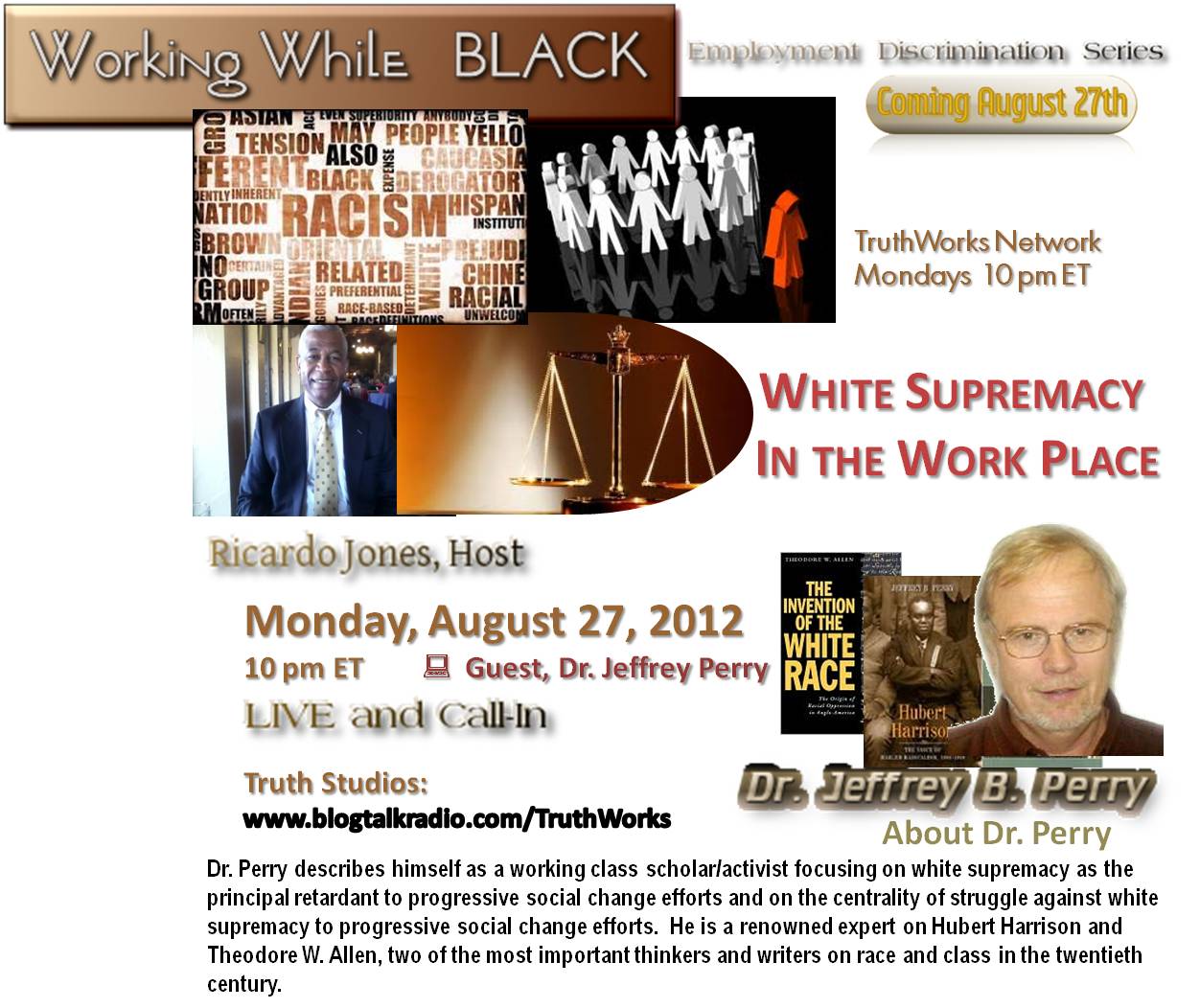
Jeffrey B. Perry is an independent working class scholar whose work focuses on the role of white supremacy as a retardant to progressive social change and on centrality of struggle against white supremacy to progressive social change efforts. He is the editor of A Hubert Harrison Reader (Wesleyan University Press, 2001) and author of Hubert Harrison: The Voice of Harlem Radicalism, 1883-1918 (Columbia University Press, 2008). Most recently he wrote the introduction and back matter for the new expanded edition of Theodore W. Allen’s “classic” The Invention of the White Race (2 vols. 1994, 1997; Verso Books, 2012).
Charles V. Richardson is the brother or Ray Richardson and grandson and heir of Hubert Harrison. For many years he helped to oversee, and then to place, the Hubert H. Harrison Papers at Columbia University’s Rare Book and Manuscript Library. He works in the media field.



 the Research Network on Racial and Ethnic Inequality at Duke University. He earned the Ph.D. in economics from the Massachusetts Institute of Technology in 1978. He chairs the prestigious National Association of Economist.