Toward a Global History of White Supremacy | Boston Review

Toward a Global History of White Supremacy

The simultaneous success of Trump and Brexit was no coincidence: white supremacist politics are international in scope and often share entwined histories.

DANIEL GEARYCAMILLA SCHOFIELDJENNIFER SUTTON

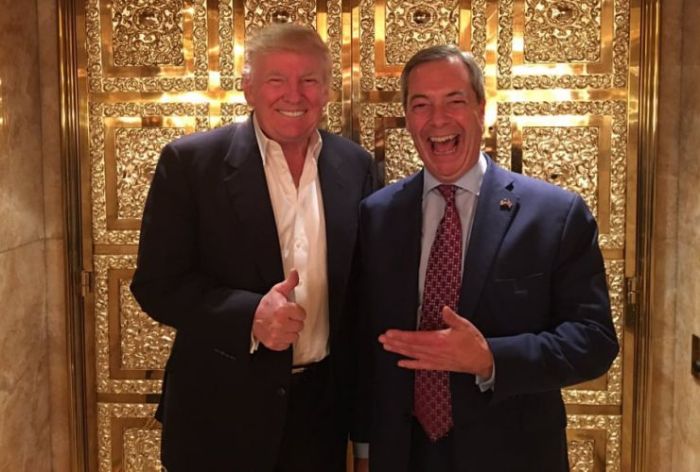
Image: Twitter/Nigel Farage

Editor’s Note: Adapted from Global White Nationalism: From Apartheid to Trump edited by Daniel Geary, Camilla Schofield, and Jennifer Sutton.


From promulgating the racist birther conspiracy theory to exhorting vigilante Proud Boys to “stand by,” Donald Trump has amplified white nationalist ideas in the United States. But neither Trump’s emergence nor his impact can be understood fully by looking at the United States in isolation. Rather, Trump must be understood for his place in a long line of Anglophone leaders who claimed to speak for besieged whites, with precedents including Ian Smith, the leader of the white minoritarian regime of Rhodesia, and Enoch Powell, the British MP who infamously warned of “rivers of blood” if Britain did not halt non-white immigration. Moreover, white nationalism is global not only in its history but in its present manifestations: white nationalists worldwide have hailed Trump’s actions and would be emboldened by his reelection.

White nationalists worldwide have hailed Trump’s actions and would be emboldened by his reelection.

While his authoritarian response to a season of Black Lives Matter protests has brought renewed attention to Trump’s racist politics, his investment in global white supremacy is long-standing and was instrumental to his election. Indeed, Nigel Farage, a leader of the UK’s far right, was an important international ally while Trump was campaigning. The morning after the June 2016 Brexit referendum vote, Donald Trump landed at his Scottish golf resort and tweeted that Britons “took their country back, just like we will take America back.” During his campaign that summer, Trump forged a close alliance with Farage, leader of the UK Independence Party and the most prominent advocate of British withdrawal from the European Union. Farage already knew Trump’s campaign manager, Steve Bannon, who hailed the rise of right-wing European nationalism as executive chairman of the alt-right website Breitbart News. In November, Farage was the first foreign leader to meet the president-elect; pleased with their successes on both sides of the Atlantic, they posed for a celebratory photograph before a glimmering set of golden elevator doors in Trump Tower. Trump and Farage’s image marked a victory in a struggle by linked resurgent white nationalists on both sides of the Atlantic to “take back” their countries from non-white immigrants and internationalist liberal elites.

Although many have observed the similarities between Brexit and Trumpism, few have noted that those similarities arise from the entwined histories of U.S. and British revanchist politics. Likewise, many have been baffled by the international spread of white supremacist violence, with authorities and the mass media wrongly depicting such attacks as the work of isolated loners rather than emanating from a dispersed political movement. Such bonds link not only Trump’s and Farage’s successes, but also the 2016 assassination of pro-Remain Labour MP Jo Cox in Yorkshire by a neo-Nazi proclaiming “Britain First”; the 2018 killings at a Pittsburgh synagogue by a white supremacist who believed that Jews were orchestrating white genocide by abetting immigration from Latin America; and the 2019 murder of Muslims in Christchuch, New Zealand, by an Australian white supremacist. Both the rise of ethnonationalism in electoral politics and of white supremacist violence in the English-speaking world need to be understood as related developments in a longer history of exchange among white nationalists globally.

Because white nationalists are primarily concerned with the racial integrity of states, they have wrongly been assumed to be parochial in their politics, focused solely on domestic issues. In fact, transnational ties and transnational flows of culture and capital have long undergirded the pursuit of white racial nationalism. The success of Brexit, for example, emboldened Trump’s nativist supporters to see themselves as part of a global movement that could achieve power in the United States. Trump’s victory in turn inspired the Christchurch killer, who praised the U.S. president as a “symbol of renewed white identity and common purpose.” We need to understand the history of these connections if we are to grasp what has sustained white nationalism despite global trends toward liberation and equality.

White nationalism is an ideology that asserts national identity and belonging in terms of European descent. Accordingly, white nationalists see their countries as threatened by immigration and social advancement by non-whites. They contend that national identity and belonging must be built around racial whiteness—rather than culture, language, or place—and that it is the whiteness of the nation’s past, present, and future that ensures its continued historical development and survival. The fundamental ideas of white nationalists are hardly new, yet they have taken on new formulations since the mid-twentieth century as a politics of reaction to the promise of racial equality and decolonization. Though the numbers of self-identified white nationalists remain small, their ideas resonate broadly, impacting contemporary debates about global demographic change, national identity, and mass migration.

The shift of white nationalist politics from center to ostensible periphery is a relatively recent phenomenon. At the British Empire’s zenith, its apologists claimed that the rule of law, free trade, and parliamentary sovereignty were natural virtues of the “English race.” At the turn of the twentieth century, U.S. elites shared with British imperialists a discourse of English racial heritage termed Anglo-Saxonism that was used to justify the subjugation of Native Americans, the subordination of African Americans, and the possession of the United States’ own overseas empire. According to Anglo-Saxonism, white, Protestant, English-speaking men naturally made modern nations. This racialized modernity is based on the presumption that only whites can govern and that the empowerment of non-whites is therefore an existential threat to white self-government.

Although many have observed the similarities between Brexit and Trumpism, few have noted that those similarities arise from the entwined histories of U.S. and British revanchist politics.

Anglo-Saxonism’s cherished ideal of a white man’s country reserving self-government and economic opportunity to whites may no longer be as dominant as it was a century ago, but neither has it disappeared. Popular historian Niall Ferguson still maintains that British colonial settler culture brought “modernity” to the world. Today some Brexiteers look to trade within an “Anglosphere” to reanimate this historical political tradition and harness racialized notions of kith and kin in the English-speaking world. Indeed, nostalgia for a past period of national glory in which white rule was unchallenged is a signature feature of today’s right-wing populists who seek to make their nations great again.

Any account of white nationalism’s influence today must take account of this longer history and also recognize that profound and persistent structures of white supremacy remain deeply rooted in the English-speaking world. To understand the politics of racism in the present requires locating and examining the histories of modern white nationalism in global terms: as a response to decolonization, struggles for equal rights, mass migration, and postwar international institutions. As Western political and social elites professed a commitment to color-blind ideals, assumptions of white supremacy were challenged and reformulated.

In particular, the declining legitimacy of overtly racist political expression produced new international alliances and new populist claims among white supremacists. As they saw themselves losing power locally, they looked abroad for allies. Countering liberal internationalist organizations such as the United Nations and the World Council of Churches, white nationalists increasingly adopted a rhetoric of ethnic populism, casting themselves as representatives of forgotten whites betrayed by globalist liberal elites. Even as they shifted their focus from opposing civil rights and preserving white rule in settler colonies to Islamophobia and opposing non-white immigration, they articulated a consistent mindset stressing the need to preserve the ethno-racial character of their nations.

section separator

In 1900 the ideal of the white man’s country was broadly shared among whites of all classes.

At the turn of the twentieth century, English-speaking whites throughout the world drew a global color line that marked out their own nations as white men’s countries. Their policies restricted immigration to “desirable” Europeans and limited non-whites’ right to vote to ensure whites’ ability to govern themselves. Though their aims were ethnonationalist, they developed ideas and policies in coordination with international networks. As historians Marilyn Lake and Henry Reynolds write: “The project of whiteness was thus a paradoxical politics, at once transnational in its inspiration and identification but nationalist in its methods and goals. The imagined community of white men was transnational in its reach, but nationalist in its outcomes, bolstering regimes of border protection and national sovereignty.”

In 1900 the ideal of the white man’s country was broadly shared among whites of all classes, even as it provoked tension between aggressive white settlers and cautious metropolitan elites. Nonetheless, the global color line was slowly erased over the twentieth century. The industrialized slaughter of World War I undermined notions of European civilization’s superiority. After the war, the colonized increasingly demanded self-determination and a new generation of intellectuals discredited the precepts of scientific racism. World War II, which pitted the Allies against a fascist enemy, also did much to discredit notions of racial hierarchy and subordination. The most important developments accelerated after World War II: the rise of national liberation movements and of movements for racial equality in existing nations. It was, as British prime minister Harold Macmillan put it to Australian prime minister Robert Menzies, “the revolt of the yellows and blacks from the automatic leadership of the whites.”

Many liberal elites, over the course of the twentieth century, evolved from a white nationalist perspective toward color-blind or multicultural conceptions of their nations. For instance, in the 1920s, the Carnegie Corporation funded studies to justify white minority rule in South Africa. But by 1944, it was publishing Swedish social scientist Gunnar Myrdal’s An American Dilemma, an influential text calling for the gradual extension of equal rights to African Americans. Rejection of explicit white supremacy became one of the components of a new liberal internationalism, embodied in the United Nations. While the violence of apartheid and Jim Crow continued unabated, in 1950 the United Nations Educational, Scientific, and Cultural Organization (UNESCO) released the first of its influential statements on race, drafted by an international team of prominent scholars and rejecting any notions of racial superiority. Many metropolitan elites also came to embrace decolonization, and thereby contain it, envisioning it as a historical step forward into modernity. Those who adhered to explicit white supremacy, however, experienced this new racial liberalism as a betrayal. Postwar white nationalism thus shifted toward a populist perspective, arrayed against white elites—the racial enemy within—as well as racial minorities.

The decades after the end of World War II saw the breakup of the British Empire as nations across the Global South won independence. As European empires dismantled, the United States extended its influence among newly independent nations. Despite losing its own major colony of the Philippines in 1946, the United States emerged from World War II as the preeminent world power, in many ways continuing the European imperial project of making the world safe for global capitalism. The need to maintain good relations with new nations and win their support in the Cold War put considerable pressure on the United States, UK, and British dominions to dismantle domestic racial discrimination. As Black sociologist E. Franklin Frazier, one of the principal author of the first UNESCO Statement on Race, acerbically remarked in 1954, “The white man is scared down to his bowels, so it’s be-kind-to-Negroes decade at last.”

E. Franklin Frazier, one of the authors of the first UNESCO Statement on Race, acerbically remarked in 1954, “The white man is scared down to his bowels, so it’s be-kind-to-Negroes decade at last.”

Black activists and intellectuals in both the civil rights and anticolonial nationalist movements saw themselves as fighting in a shared international struggle to dismantle white supremacy. By the 1960s, though civil rights movements were unable to achieve their goal of full racial equality, they forced recognition of the formal legal equality of all citizens regardless of race. Landmark legislation prohibited racial discrimination. In 1963 the United Nations General Assembly adopted a Declaration on the Elimination on All Forms of Racial Discrimination; two years later, Ghanaian ambassador George Lamptey led the campaign to introduce a UN convention against racial discrimination. Steeped in the language of human rights, this convention condemned colonialism and apartheid, affirmed equality before the law, and required its signatories to criminalize hate speech and institute national procedures to combat racial discrimination. The UN helped propel the extension of antidiscrimination laws globally. The United States passed the Civil Rights Act of 1964, the death knell to the southern system of Jim Crow, and followed that with the Voting Rights Act of 1965. The UK passed the Race Relations Act in 1965, Canada its Canadian Multiculturalism Policy in 1971, and Australia its Racial Discrimination Act in 1975.

White supremacy was on the defensive. Yet ideas about whiteness and natural ability for self-government continued to shape understandings of global demography, anticolonial violence, and uneven economic development. Racial anxieties ran through analyses of population growth in the Global South, for instance, echoing early twentieth-century panics about white “race suicide.” Anticolonial violence was routinely depoliticized and depicted as an expression of savagery, a rejection of civilization. Whites continued to assert themselves as natural agents of modernity via, for instance, international development; their authority now increasingly drawn from an emphasis on technical expertise rather than any explicit white man’s burden. Tenets of the white man’s country were transmuted by technocracy to appear universal or color-blind.

Though white nationalism developed transnationally and in response to common international changes, it evolved asynchronously and asymmetrically according to different local logics. The United States has a history of domestic slavery, mass immigration, and subjugation of Native Americans that contrasts with Britain’s long history as an imperial metropole or the history of white minoritarian regimes in Rhodesia and South Africa. These differences are perhaps clearest in immigration policy changes and their demographic effects. The civil rights movement made the existence of racial quotas in U.S. immigration policy untenable, leading to the passage of the Hart-Cellar Act of 1965 which soon (unintentionally) led to a mass wave of emigration from Latin America, Asia, and Africa. Similarly, Australia dismantled its restrictionist White Australia policy in 1973, leading to a sharp increase in non-white immigration, especially from Asia.

In Britain, however, the story was different. Migrants from colonies and former colonies, who held citizenship in the British Empire and Commonwealth, began to arrive in increasing numbers after World War II in search of economic opportunity. This moment is often marked by the 1948 London arrival of the ship Empire Windrush which carried migrants from the Caribbean. The non-white population in Britain increased tenfold by 1961. Then, as a result of domestic political opposition, the British government began to introduce migration controls. To signal that these controls were part of a wider government effort to benefit race relations, the government also passed new equality legislation modeled on that of the United States but accompanied by the imposition of immigration restrictions rather than their relaxation.

In different countries, white nationalists adapted in similar ways to outlast the challenges against them: they persisted not simply by becoming far-right fringe minorities but also by developing coded electoral appeals within major political parties, such as the Democratic Party’s southern strategy in the United States. Everywhere, though, the array of forces against them led white nationalists to take up a defensive posture. In this new mode, white nationalists mobilized emotions of besiegement, resentment, loss, and nostalgia. The populist language of aggrievement white nationalists developed in retreat enabled them to capture broad appeal when new forms of political activism—on both left and right—challenged the legitimacy of the postwar order and the political establishment.

White nationalists persisted not simply by becoming far-right fringe minorities but also by developing coded electoral appeals within major political parties.

In response to the efforts to challenge white racial privilege in the 1960s and ’70s, a reactionary discourse emerged that rejected any guilt complex over the long history of white supremacy and instead offered a counternarrative of white victimization. Histories of lost causes were marshalled to this goal. As Paul Gilroy has examined, in Britain the loss of empire produced a “postcolonial melancholia” attached to the lost glories of the past—one detached from any sense of the real history of the empire. In Britain, as in Australia and the U.S. South, white nationalists turned away from acknowledging the atrocities of white supremacy. Instead, theirs is a history of heroism in defeat: the Lost Cause of the U.S. Confederacy, Australia’s Battle of Gallipoli in World War I, and Britain’s myth of self-reliance at the retreat of Dunkirk in World War II all serve as sites for what Gilroy calls “dreamworlds” where white male heroism can be retrieved.

This sense of resentment framed around perceived loss gave additional resonance to a wider set of social and political tensions in the period of decolonization and equal rights. The sexual revolution, student protests, and progressive legal reforms on marriage and abortion came to be viewed by many white nationalists as further examples of the destruction of national culture. Women’s liberation and the moral revolution of the late twentieth century played into fears of a declining white population. White nationalisms throughout the Anglosphere are replete with anxious visions of lost white male and patriarchal authority. Opposition to gender equality has been and remains crucial to the making of modern white nationalism—as the defense of white women and white domesticity has long functioned as a focal point for white supremacy, colonial violence, and the dehumanization of people of color. Drawing from this long tradition, white nationalists present the white woman as the perennial potential victim, under constant threat from migrant rapists, Black male sexuality, and sharia law.

section separator

From the civil rights era to the present, white nationalists found a home in right-wing political parties, where leaders appealed to race despite formally renouncing racism. White nationalism fit within the broader constellation of ideas advocated by the transnational right, whose critique of liberal internationalism also included asserting the place of social hierarchy, patriarchal families, and fundamentalist Christian values while attacking the legitimacy of the postwar social welfare state.

White nationalism needs to be understood as a specific political movement of the right, though one hardly limited to just a handful of extremists.

Though white nationalism is nurtured most intensely by a small group of activists and intellectuals, the electoral right throughout the English-speaking world has consistently appealed to racial fears among whites about loss of status. The electoral right receives much of its dynamism from the far right. Yet the existence of such far-right groups makes the electoral right more respectable by contrast, able to appeal to white nationalist sentiment while disavowing violent and explicit racism, and thereby enabling it to assemble a broader political coalition. This dialectic of extremism and respectability operates not simply within national boundaries but in a transnational framework.

One of the key issues involved in understanding global white nationalism is whether it should be perceived as a marginal political movement or as part of the mainstream of contemporary political culture. We think white nationalism should be understood as both constitutive of our societies and as a specific political movement of the right whose fortunes are now resurgent. Given the deep ways in which notions of white man’s countries structured Britain, the United States, and British settler colonies just a century ago, it is hardly surprising that a foundation of white supremacy remains under the edifice of societies that have formally renounced racism. This is particularly true given the partial defeat of movements for racial equality, as reflected in the continuation of vast institutional inequalities. The unacknowledged persistence of white supremacy in our societies has provided a strong platform on which white nationalists can stand, and it must be dismantled.

We also believe that white nationalism needs to be understood as a specific political movement of the right, though one hardly limited to just a handful of extremists. The successes of anti-racist movements in the twentieth century were only partial, but they were enough to spark a powerful reaction from those who wished to openly assert that that their nations were still white men’s countries. White nationalists’ sense of betrayal and loss is very real. While their claims of victimhood often serve as cover for the assertion of racial dominance, they are rooted in very real changes to the racial order. Without question, combatting white nationalism requires truly grappling with the long history of white supremacy and the untold damage wrought by our contemporary racial order. But it does not mean accepting that our civic cultures must remain racist or that a majority of whites will be inevitably drawn to racist politics. Rather, it requires understanding contemporary Anglophone white nationalism as a specific historical formation which cannot be extricated from the history of slavery, settler colonialism, and white supremacy.

To many observers, Brexit and Trump made it seem as if an atavistic ideology was suddenly resurrected. But white nationalism has always been a presence in trans-Atlantic political culture. While rooted in the older ideal of the white man’s country associated with British settler colonialism, it has adapted to the challenges posed by decolonization, civil rights, and liberal internationalism.

Those seeking to explain white nationalism’s renewed political strength in our own time should then ask why it has begun to have greater appeal. To the minority who explicitly identify with white nationalist ideas, their sense of victimization and desire to return to an imagined past era of national glory has everything to do with the decline of white dominance. To many others, white nationalists’ rhetoric of betrayal, nostalgia, and denouncement of non-white immigrants and internationalist elites has increased appeal in a period of depressed wages and precarious employment.

Critically, the lack of a significant left-wing challenge to neoliberalism has made ethnonationalism the main political form in which antiestablishment sentiment can be articulated. The adaptations that white nationalists made since 1945 has enabled it to broaden its appeal in our time. White nationalism is a worldly ideology. Regardless of whether Trump wins or loses, its resilience should never again be underestimated.


Source: Toward a Global History of White Supremacy | Boston Review

How to Abolish the Police, According to Josie Duffy Rice | Vanity Fair

Long before the internet caught wind of him, Henry Earl was already a local legend. By the time the Charleston Gazette dubbed him a “cult-status hero” and Newsweek called him the “town drunk,” Earl was already known around Lexington, Kentucky, as James Brown. He liked to dance, and he’d do a few moves in exchange for a couple bucks, money which he’d usually promptly spend on alcohol.

Earl was born in the Jim Crow South and adopted at age seven. Drinking was a habit he picked up as a teenager after his mother died, one he never could quite shake. By age 19 he was homeless, and by 20 he’d been arrested for the first time. That was back in 1970. Over the next several decades, Earl was arrested more than 1,500 times, almost always for alcohol intoxication. This is how he became known as the World’s Most Arrested Man. Over the years, he spent a total of more than 16 years in jail, usually in couple-day spurts. He was never once charged with violence or theft. “I like to drink,” he said once. “Alcoholic, that’s what I am. Every police knows me on the force. They see me drunk; they pick me up; I get five days.”

For almost 50 years, this was Earl’s life. No home, no family, just alcohol and jail. He was a regular at the local bar scene, known for sometimes overstaying his welcome. The locals would see him at house parties sometimes; he’d go for the free beer. He tried court-mandated rehab a few times, but it didn’t stick. “It’s a weekly, if not every-two-or-three-days thing,” said a police spokesperson in 2013. “He’s never doing bad or illegal things purposely…. He’s just so highly intoxicated that he’s posing a danger to himself.”

Interest in Earl peaked a few years back, with websites dedicated to his mug shots that amusedly tracked his arrests. Late-night TV cracked jokes at his expense. National outlets ran stories on him. Around town, people called him harmless and happy, a “lovable loser.” But there were times Earl saw it differently. “It’s a sad life, it ain’t worth a dog,” he said in 2003, tearing up. “I got more sense than some people think I do. I’ve seen what it’s doing. It is ruining my life.”

Last year Attorney General William Barr addressed the Fraternal Order of Police’s biennial conference. “[W]hat stands between chaos and carnage on the one hand, and the civilized and tranquil society we all yearn for,” Barr told his audience “is the thin blue line of law enforcement.” Barr is a right-wing Republican who has for years advocated for a harsher and more robust police state. But his proclamation reflected a deeply held idea in American politics—that police are essential to an ordered and just country. Barr’s worldview is time-honored and bipartisan. Democratic presidential nominee Joe Biden might not be the same politician he was when he championed the 1994 crime bill, but his belief in the necessity of American policing—Biden proposes to pump $300 million in federal dollars to the police—has not changed. And it’s not just politicians who proselytize the necessity of policing. Boilerplate TV procedurals, true-crime podcasts, and the evening news sell us a world where the police, beleaguered and badgered, are ultimately all that stands between those of us who wish to live in society and the others who would choose savagery.

This is a myth. Despite much reporting of a spike in murder this year, the long-term trend still shows the murder rate hovering roughly in the same place it was in the 1960s, half of what it was in 1980. And while procedurals may paint a picture of cops chasing serial killers weekly, the actual face of police is more mundane. In June, the New York Times culled available data and estimated that police spend roughly 4 percent of their time addressing “violent crime.” Most of their time is spent dealing with noncriminal matters. And yet no matter the call—the loud party next door, the permit for a parade, the expired car tags, the escort for a funeral procession, the elderly welfare check, the frolickers barbecuing in the park, the schoolyard fight, the opioid overdose, the homeless person outside in the cold, the stray dog—the state’s answer is to respond with armed agents blessed with the near unimpeachable right to kill. The impact is not theoretical. After James Smith noticed the door of his neighbor’s home was open and the lights were on, Smith called the police, hoping an officer would conduct “a wellness check” on his neighbor. Instead, Officer Aaron Dean shot and killed Atatiana Jefferson in her own home as she played video games with her young nephew. Smith was left to draw a grim conclusion. “We don’t have a relationship with the police because we don’t trust the police,” Smith recently told the BBC.

Even the impact of policing on violent crime is debatable. “We are fighting an unrelenting, never-ending fight against criminal predators in our society,” Barr claimed at the FOP conference in New Orleans. But the “never-ending fight” in the very city in which Barr was speaking is not going well. New Orleans has the fourth highest murder rate in the nation but clears only 35 percent of homicide cases. In 2018, the city’s police cleared only 2 percent of all rapes. The country at large isn’t much better. Last year, the Washington Post launched an investigation into murder clearance rates in 50 cities over the course of 10 years. The results were bracing. “Despite a nationwide drop in violence to historic lows,” the Post reported, “34 of the 50 cities have a lower homicide arrest rate than a decade ago.” In St. Louis, during the period the Post studied, it calculated that 54 percent of all homicides resulted in no arrest. In Baltimore, during the period it studied, the Post calculated that only 35 percent of all homicides resulted in an arrest. In Chicago the rate was 26 percent. The “line” isn’t just thin and blue—it’s porous and arbitrary.

One argument for policing holds that while police may not solve much violent crime, their very presence helps ensure safety. In a survey of research, the National Institute of Justice concludes that “hot spot policing” was “associated with reductions in violent crime relative to control areas.” What is “hot spot policing”? According to the survey, it includes “order maintenance and drug enforcement crackdowns, increased gun searches and seizures and zero tolerance policing.” This isn’t just a list of policing tactics; it’s a list of prerequisites for the present moment. For “order maintenance,” Eric Garner was suffocated on a New York sidewalk. For “drug enforcement crackdowns,” Breonna Taylor was killed in her own home. For “gun search and seizure,” the Black neighborhoods of New York endured Stop and Frisk. For “zero tolerance policing,” George Floyd was choked on a Minneapolis street.

It would be at least honest if we said that enduring arbitrary harassing, beating, tasing, and strangulation by the state was the price of being “associated with reduction in violent crime relative to control areas.” That we don’t say this, and that we only imply it for certain classes of people, exposes the assumptions built into American policing. It’s those assumptions that, on the one hand, allow Henry Earl to be arrested more than a thousand times, and on the other offer a sporting chance for anyone who’d like to try their hand at murder or rape. Policing accomplishes this dubious feat by imposing costs on innocent people who happen to live in proximity to crime, and others who simply happen to resemble in skin color those we think of as criminal. This is a system begging for reform, and the best way to reform an institution as compromised as American policing is by abolishing it.

It is impossible to imagine American policing without the institution foundational to America itself—enslavement. Indeed, from colonial times up through the Civil War, the largest police force in the country wasn’t primarily found in the early towns or the bustling metropolises, but in the slave societies of the South, where to be a white man was to be deputized. Enslavement, where the enslaver is both the maker and enforcer of law, was the first experience of policing for Black people. But through the invention of slave patrols, militias charged with enforcing the law against the enslaved, the policing powers were expanded. “All white persons were permitted and in some regards required to exercise a police power over slaves,” the white supremacist historian U.B. Phillips noted. In many states, white people were not only allowed but required to whip, capture, and jail enslaved people they encountered. They had a mandate to “prevent all caballings amongst negros [sic], by dispersing of them when drumming or playing,” meaning they could punish any enslaved people for simply interacting with each other. The patrollers operated, as one of their number put it, “without warrant and at my own discretion.” The shadows of American policing are here—in the prisons, we find the absolute mastery once enjoyed by the planter class; in the wide discrepancy granted the slave patrol, one sees the echoes of broken windows policing; and the bodies of Trayvon Martin and Ahmaud Arbery reflect the extension of police powers far beyond official police.

Slave patrols were born of the propertied interests of white people seeking to maximally exploit Black labor, an endeavor that did not fade with emancipation. In many ways, it was reinforced. Planters may no longer have owned their labor force, but that didn’t stop them from seeking out means of preventing the formerly enslaved from freely selling their labor. Policing was key to this effort, which saw control lost through slavery regained through a panoply of laws that threatened arrest for everything from not having an annual work contract to “malicious mischief” and criminalized “persons who led idle or disorderly lives.” Depending on the state, the arresting officers could consist of urban police, militias drawn from former Confederate soldiers, or merely any white man. While there was a brief reprieve during Reconstruction, after federal troops departed the South in 1877, white Southerners employed policing to ensure a permanent and pliable source of labor. When Blacks tried to go north for jobs during the Great Migration, “the South resorted to coercion and interception worthy of the Soviet Union,” writes Isabel Wilkerson in The Warmth of Other Suns. “In Brookhaven, Mississippi, authorities stopped a train with 50 colored migrants on it and sidetracked it for three days. In Albany, Georgia, the police tore up tickets of colored passengers as they stood, waiting to board, dashing their hopes of escape. A minister in South Carolina, having seen his parishioners off, was arrested at the station on the charge of helping colored people get out.”

It is tempting to think the Northern police departments unsullied by white supremacy. The assumption would be wrong. Throughout the entirety of Jim Crow, Northern police often parroted their Southern counterparts. “From the moment the emigrants set foot in the North and West,” writes Wilkerson, “they were blamed for the troubles of the cities they fled to.” Indeed, police departments took the cue and regarded Blacks much as the broader society had—as outcasts and threats. In 1917, in East St. Louis, Illinois, white workers angered by Blacks brought in to replace them during a strike rioted and “fired shots into colored homes,” writes Wilkerson. “The police, charged with quelling the riot, in some cases joined in, as did some in the state militia.” In 1943, during the Detroit race riot, “Police openly sympathized with the white rioters,” writes historian Thomas J. Sugrue; “17 blacks were shot to death by the police, no whites were.” Ten years later, as Black families tried to integrate Chicago’s Trumbull Park Homes, they were granted minimal protection from the police who sympathized with the whites who terrorized the families. Still, the greatest indicator of the role law enforcement in the North played in suppressing their Black populations lay in the prison population. Even in an era of relatively low incarceration, the rate in the Northern cities stood at seven to one—exactly the same as today.

That the police were not concerned with neutrality nor “law enforcement” was always clear to Black people. In 1967, after a series of riots, President Lyndon Johnson convened the Kerner Commission to report on the riot’s origins and recommend a series of reforms. Read today, the report is bracing for a haunting quality—its timelessness. Just like the countless commissions that have followed it, the Kerner Commission found a police department with too many responsibilities, filling in for the defunding and decline of societal institutions. Just as today, the Kerner Commission found Black communities complaining of “stop and frisk” tactics. And then, as now, voices of authority blamed police violence on the inherent pathologies of the Black population instead of the learned brutality of the police. Among the commission’s recommendations: an intolerance for police brutality, “a clear and enforced policy…of law enforcement in ghetto areas as is the same as in other communities,” and eliminating a focus on smaller crimes such as “gambling or loitering” in favor of crimes that threaten “life and property.” After the report was published, it became a best seller, but Johnson quickly scuttled it, and the era of “law and order” commenced.

It is common to note, as the Kerner report does, that Black communities frequently complain of crime right alongside police brutality. This is not surprising. Black communities are on every level less safe than white communities. And yet it is curious the ease with which police, who never fail to note this safety gap, abandon these vulnerable neighborhoods. Calls for accountability are often met with indignance and threats to desert those most affected by crime. The practice of officers, at the slightest sign of public critique, calling in sick en masse and refusing to do their jobs has long been called “blue flu.”

At times, retaliation is even uglier. After becoming the New York City’s first Black mayor in 1990, David Dinkins angered the union by calling for police reform. The response was open defiance of the law. Police officers derided Dinkins as a “janitor” and a crack addict, drank openly, blocked traffic, and assaulted journalists. A photographer seeking the protection of a lieutenant after being assaulted by an officer was essentially told to flee. “I can’t protect you up here,” the lieutenant said. In 2011, after the NYPD was investigated for corruption, officers again rallied at the courthouse, blocking the cameras of journalists, mocking poor people by chanting “EBT” at people attempting to collect their benefits. In 2014, in the midst of a conflict with Mayor Bill de Blasio, the NYPD largely stopped policing, at the behest of the union.

This is all very strange behavior for a group which takes an oath “to serve and protect.” But policing is often revealed to be about something muddier. In June, the Times asked Chicago mayor Lori Lightfoot her opinion on the effort to “defund the police.” Lightfoot, a former prosecutor, didn’t even bother to defend her department—probably because a department with a history of torture, black sites, framing innocent people, and child killing is not easily defensible. Instead Lightfoot seemingly deflected to the lack of opportunity for Black and brown people in Chicago. Defunding “means you are eliminating one of the few tools that the city has to create middle class incomes for Black and brown folks.” That America’s second largest police department can only be defended as a kind of violent jobs program is a clear indictment of policing as an act of public safety. Furthermore, the fact that policing is one of the few tools available to bolster a racially diverse middle class is yet another indicator that police have far too much responsibility.

But America has never truly had a system of “public safety,” if only because Black “safety” has historically been imagined as being secured by more policing, whereas white “safety” is ensured by altogether different means. America does not flood the dorms of Harvard with cops because they are areas of “known drug activity.” It does not station armed officers in the cubicles of Wells Fargo. The white parents of Westchester do not generally have to subject their teenagers to The Talk. White safety, itself built on a foundation of enslavement and segregation, is ensured through familial wealth, home ownership, well-funded public schools, stable employment, and health care. Black safety is ensured by “zero tolerance policing” and “stop and frisk.” White safety is cancer prevention. Black safety is all-day chemotherapy.

Abolition seeks to eradicate this Jim Crow system of public safety—not merely a two-tiered system, but a system where one tier benefits by extracting from the other. To “reform” policing, to subject it to bias training of dubious import, to push for the return to an illusory past where Officer Friendly provided sanctuary, is to attempt to patch up the more nefarious features of a system that should be obsolete. Without the history of policies and practices that make up white supremacy, without enslavement and slave patrols, without black codes and miscegenation laws, without poll taxes and courthouse lynchings, without redlining and housing segregation, without mass incarceration, policing as we know it would not exist.

The outlines of the possible are already upon us. Defunding the police—divesting money from the back-end solution of policing and investing it on the front end—is a first step along the path. To meet the very real concerns about neighborhood violence, we could look to preventative programs like Cure Violence and Save Our Streets in cities like New York. These organizations view gun violence as a public health question rather than evidence of community moral rot. Both have been able to successfully reduce and prevent gun violence without inflicting more violence on communities they claim to protect.

Nowhere is the extra layer of unnecessary violence more reflected than in our insistence on sending men with guns to resolve mental health crises. In Eugene, Oregon, CAHOOTS, a crisis intervention program, was able to respond to 20 percent of the area’s 911 calls last year. Through the program, teams of medics and experienced mental health professionals are dispatched to handle certain emergencies instead of the police. For people suffering from mental health crises, addiction, and homelessness, introducing law enforcement in moments of desperation is an invitation for disaster. CAHOOTS reduces the risk of unnecessary violence and criminalization.

And removing police from our long and futile war against drug abuse is essential to abolition. This requires us to consider the role of harm reduction, rather than abstinence, as a possible avenue toward reducing the associated drug use. This solution is not theoretical. In countries such as Norway, Germany, and Canada, drug users can go to a safe injection site and use in regulated, medically supervised, and sanitary conditions. These facilities avoid relying on the stigma and shame that trails many of those suffering from addiction. And it works. When people have access to a safe environment for drug use, they are more likely to seek treatment on their own.

Abolition looks like justice for domestic violence and sexual assault survivors. According to RAINN, for every 1,000 sexual assaults, only about 230 are reported to law enforcement. Of those, less than five result in incarceration. In other words, 75 percent of sexual assaults go unreported and 99 percent go unpunished. Policing does not protect women from sexual assault, it facilitates it. Prison sexual violence, not only at the hands of other incarcerated people but also from correctional officers, is a persistent problem across the gender spectrum, including the thousands of juveniles housed in adult prisons. In place of our current system, abolition envisions providing domestic abuse survivors with crisis counselors and violence intervention teams trained to specifically navigate intimate relationships, available at a moment’s notice. What would a future look like for rape survivors if there were professionals or organizations that could provide not just physical safety but mental, emotional, and financial resources as well?

But more than an array of solutions to discrete, isolated issues, abolition envisions something more fundamental—entirely different values. A world where the resources put into not just policing but our robust system of prisons and jails is invested in the people to eventually render the present justice system obsolete. This is a world focused on the reduction of violence and harm. Certainly you would still need professionals responsible with holding accountable those who violate the social contract in the extreme—rape or murder—and an improved investigative system to catch the perpetrators. But even in that case, ensuring society’s protection should look very different. Even in the most extreme circumstances, it would demand an end to the conflation of public safety with public vengeance. Removing someone from society to stop them from enacting violence does not require subjecting someone to the current prison system, where solitary confinement, assault, sickness, torture, and rape are par for the course.

This is the world I imagine when I picture what I want for my children—a world where social consequences are weighted along with criminal consequences, where incapacitation is not conflated with torture, and murder and rape are taken so seriously that we do all we can to prevent either from happening in the first place. But ultimately abolition is not about a suite of options imposed by someone else—even me. The promise of abolition is the promise of democracy itself—one long denied Black people: the promise inherent in constructing an order of public safety originating in the needs and desires of a community, and not those who have, for so long, exploited them.

MORE STORIES FROM V.F.

— Ta-Nehisi Coates Guest-Edits THE GREAT FIRE, a Special Issue
— Breonna Taylor’s Beautiful Life, in the Words of Her Mother
— An Oral History of the Protest Movement’s First Days
— Celebrating 22 Activists and Visionaries on the Forefront of Change
— Novelist Jesmyn Ward on Witnessing Death Through a Pandemic and Protests
— Angela Davis and Ava DuVernay on Black Lives Matter
— How America’s Brotherhood of Police Officers Stifles Reform

Source: How to Abolish the Police, According to Josie Duffy Rice | Vanity Fair

Triaging Public Health Services Based on Race: What Are The Legal Challenges? :: Race and the Law

Race and the Law Prof Blog

Triaging Public Health Services Based on Race: What Are The Legal Challenges?

By Christopher Ogolla.

According to the CDC, race and ethnicity are risk markers for other underlying conditions that affect health including socioeconomic status, access to health care, and exposure to the Covid-19 virus.[1] For example, American Indian or Alaska Natives are 4 times more likely to be hospitalized for Covid-19 and 2.6 more times to die, compared to White non Hispanic persons. Black or African American non Hispanics are 3.7 times more likely to be hospitalized and 2.8 times more likely to die from Covid-19 compared to White non-Hispanic persons.[2] The disparate impact of the Coronavirus has drawn national attention to how public health resources are used in times of emergency. In light of these circumstances, if states were to prioritize racial minorities in public health emergencies, such as distribution of vaccines during a pandemic, for example, would that focus survive equal protection challenge? Put succinctly, can we triage public health services based on race?

As an example, California’s Covid-19 vaccination plan includes this statement: “One of the primary efforts of the Community Vaccine Advisory Committee will be to help ensure vaccine planning supports all Californians, but particularly for individuals in communities that are disproportionally impacted, including Latinos, African, Americans, Native Hawaiians, Pacific Islanders, and other Asians including Filipinos.”[3] Will this plan pass constitutional muster?

The Supreme Court has countenanced the use of race in public programs when it is narrowly tailored to achieve a compelling governmental interest. The downside of this standard of review is that public health agencies, particularly those offering services to the underprivileged or victims of poverty, may be barred from giving preferential treatment in services to groups based on ethnicity, even if those groups may be in dire need of those services.”[4]

Professors Schmidt, Gostin and Williams, writing on whether it is lawful and ethical to prioritize racial minorities for Covid-19 vaccines, note that “there is no direct precedent in which courts have considered race in allocating scarce health care resources.[5] They write that “[s]trict judicial scrutiny would not permit vaccine priority strategies. First, a healthcare worker could not give priority to vaccinating persons from minority groups, for instance, by skipping White people waiting in line at a health care facility. Second, public health agencies could not provide vaccines exclusively, or in large shares, to geographic areas identified by race alone.”[6] Nevertheless, they suggest that a vaccine distribution formula could lawfully prioritize populations based on factors like geography, socioeconomic status and housing density status that would favor minorities de facto, but not explicitly include race.”[7]

The geographic/ proportional distribution suggested by Schmidt et al., would be consistent with other race neutral suggestions or solutions for other affirmative action-based programs, such as school admissions.  In Fisher v. University of Texas at Austin, 136 S.Ct. 2198 (2016) (Fisher II), the Court affirmed diversity in higher education as a compelling state interest, and held the race-conscious admissions program in use at the time of petitioner’s application lawful under the Equal Protection Clause. We could analogize the geographical distribution to University of Texas, Austin’s use of top 10% plan, where the university used a race neutral method of equalizing the structural inequities by guaranteeing acceptance of students who graduate in the top 10% of their graduating class.  This plan cures the obstacles that minorities often face in getting admitted to elite universities: parental educational background, attending under-resourced schools because they are located in economically depressed neighborhoods, kids having to work to support the family, language barriers, low socio-economic status, etc.[8]

However, this legal analogy flounders in times of a pandemic. Unlike the school admission cases (where the lack of diversity that elite schools are trying to improve is a self-inflicted wound), Covid-19 is an emergency, a disaster of epic proportions. As of this writing, there are over 21 million confirmed cases and over 356,000 deaths in the United States.[9] During a pandemic, there is more urgency and a race neutral alternative might not be as equally effective. For example, vulnerable populations might slip through the cracks while waiting for their priority groups. One can conclude that race-based policies have the greatest chance of passing strict scrutiny during pandemics.[10] But will they? This will depend on how the Justices view racial inequalities during a pandemic. For example, after acknowledging the serious nature of the pandemic, Justice Kavanaugh, in his concurring opinion in Roman Catholic Diocese of Brooklyn, New York v. Cuomo  writes, “[B]ut judicial deference in an emergency or a crisis does not mean wholesale judicial abdication, especially when important questions of religious discrimination, racial discrimination, free speech, or the like are raised.”[11]

All in all, focusing on vulnerable populations in vaccine distribution is likely to succeed only if it doesn’t explicitly use racial categories. Even though using a race neutral distribution plan presents little or no constitutional challenges, if success (and here success is defined as getting the vaccine to the most neediest people to reduce the pandemic) means focusing on vulnerable groups, whether delineated by race or socioeconomic status, shouldn’t such a distribution plan be countenanced? Put differently, if admission to colleges and universities based on race can be narrowly tailored to achieve a compelling governmental interest, then surely a plan that benefits a race can be upheld on the basis of urgency due to COVID-19.   Then again, maybe not. In July 2020, Oregon state lawmakers passed the Oregon Cares Fund. This state fund was meant to steer coronavirus relief money directly to black Oregonians and black-owned businesses.[12] The state earmarked $62 million of its $1.4 billion in federal Covid-19 relief money to provide grants to black residents, business owners and community organizations enduring pandemic-related hardships. However, a Mexican-American and two white business owners sued the state, arguing that the fund discriminated against them.[13] Although the lawsuit has not been decided yet, the outcome will have far reaching implications on any state planning to distribute vaccines or any public health services based on racial categories.


[1] CDC COVID-19 Hospitalization and Death by Race/Ethnicity, available at https://www.cdc.gov/coronavirus/2019-ncov/covid-data/investigations-discovery/hospitalization-death-by-race-ethnicity.html

 (Updated Nov 30, 2020).

[2] Id.

[3] See Covid-19 Vaccination Plan, State of California. Interim Draft, 14-15 (Cal. Dept. Pub Health, 10-16-2020).

[4] Christopher Ogolla, Will The Use of Racial Statistics Survive Equal Protection Challenges? A Prolegomenon for The Future, 31 N.C. Cent. L. Rev, 1, 19 (2008).

[5] Harald Schmidt, Lawrence Gostin & Michelle Williams, Is it Lawful and Ethical to Prioritize Racial Minorities for Covid 19-Vaccines? 324 JAMA 2023 (Nov. 2020).

[6] Id., at 2024.

[7] Id.

[8] Professor Eang Ngov, Barry University Dwayne O. Andreas School of Law. (Pers. Comm., Dec 6, 2020).

[9]See John Hopkins University, Corona Virus Resource Center available at https://coronavirus.jhu.edu/ (last visited on Jan 5, 2021).

[10] Ngov, supra note 8.

[11] Roman Catholic Diocese of Brooklyn, New York v. Cuomo, 2020 WL 6948354 * 8 (Nov. 25, 2020) (Kavanaugh, J., concurring).

[12] Dirk VanderHart, Fund to help Black Oregonians cope with Covid-19 put on hold. OPB Dec. 18, 2020. https://www.opb.org/article/2020/12/18/oregon-cares-fund-black-community-business-covid-19/

[13] John Eligon, A Covid-19 relief fund was only for black residents. Then came the lawsuits. N.Y. Times Jan. 3, 2021. https://www.nytimes.com/2021/01/03/us/oregon-cares-fund-lawsuit.html

Permalink

Source: Race and the Law Prof Blog

Building a More Inclusive Federal Judiciary – Center for American Progress

The federal judiciary does not reflect the population that it serves, which has severe consequences for both the institution’s legitimacy and the parties who come before it.

Source: Building a More Inclusive Federal Judiciary – Center for American Progress

Opinion | The Dangerous Fantasy of Hope Rooted in Self-Delusion

The Dangerous Fantasy of Hope Rooted in Self-Delusion

The real lesson we should learn from the rise of a demagogue such as Trump and a pandemic that our for-profit health care industry proved unable to contain is that we are losing control as a nation and as a species.

More of the same means more disaster. If we want to reclaim our open society and save the ecosystem, we must abolish the corporate stranglehold on global economic and political power. (Photo by Justin Sullivan/Getty Images)

More of the same means more disaster. If we want to reclaim our open society and save the ecosystem, we must abolish the corporate stranglehold on global economic and political power. (Photo by Justin Sullivan/Getty Images)

Joe Biden and the systems managers of the deep state and empire are returning to power. Trump and his coterie of buffoons, racists, con artists and Christian fascists are sullenly preparing to leave office. U.S. pharmaceutical corporations are starting to disseminate vaccines to mitigate the globe’s worst outbreak of COVID-19 that has resulted in more than 2,600 deaths per day. America, as Biden says, is back, ready to take its place at the head of the table. In the battle for the soul of America, he assures us, democracy has prevailed. Progress, prosperity, civility and a reassertion of American prestige and power are, we are promised, weeks away.

But the real lesson we should learn from the rise of a demagogue such as Trump, who received 74 million votes, and a pandemic that our for-profit health care industry proved unable to contain, is that we are losing control as a nation and as a species. Far more dangerous demagogues will arise from the imperial and neoliberal policies the Biden administration will embrace. Far worse pandemics will sweep the globe with higher rates of infections and mortality, an inevitable result of our continued consumption of animals and animal products, and the wanton destruction of the ecosystem on which we and other species depend for life.

Biden’s appointments are drawn almost exclusively from the circles of the Democratic Party and corporate elite, those responsible for the massive social inequality, trade deals, de-industrialization, militarized police, world’s largest prison system, austerity programs that abolished social programs such as welfare, the revived Cold War with Russia..

“One of the most pathetic aspects of human history,” Reinhold Niebuhr wrote, “is that every civilization expresses itself most pretentiously, compounds its partial and universal values most convincingly, and claims immortality for its finite existence at the very moment when the decay which leads to death has already begun.”

Biden’s appointments are drawn almost exclusively from the circles of the Democratic Party and corporate elite, those responsible for the massive social inequality, trade deals, de-industrialization, militarized police, world’s largest prison system, austerity programs that abolished social programs such as welfare, the revived Cold War with Russia, wholesale government surveillance, endless wars in the Middle East and the disenfranchisement and impoverishment of the working class. The Washington Post writes that “about 80 percent of the White House and agency officials he’s announced have the word ‘Obama’ on their résumé from previous White House or Obama campaign jobs.” Bernie Sanders, apparently rebuffed in his efforts to become secretary of labor in the Biden administration, has expressed frustration with the Biden nominations. Rep. Alexandria Ocasio-Cortez was denied a seat by House Democrats on the House Energy and Commerce Committee because of her support for the Green New Deal. The message of the Biden administration to progressives and left-wing populists is very clear – “Drop dead.”

The list of new administration officials includes retired General Lloyd J. Austin III who is being nominated to be secretary of defense. Austin is on the board of Raytheon Technologies and a partner at Pine Island Capital, a firm that invests in defense industries and also includes Antony Blinken, Biden’s nominee to be secretary of state.  Blinken, who was deputy national security adviser and deputy secretary of state, is a strong supporter of the apartheid state of Israel.  He was one of the architects of the invasion of Afghanistan and Iraq and a proponent of the overthrow of Muammar Gaddafi in Libya, resulting in yet another failed state in the Middle East.

Janet Yellen, former Federal Reserve chair under Barack Obama, is slated to be Treasury Secretary. Yellen as the chair of Bill Clinton’s Council of Economic Advisors (CEA) and later as a member of the board of the Federal Reserve, backed the repeal of Glass-Steagall, which led to the banking crisis of 2008.  She supported the North American Free Trade Agreement (NAFTA). She also lobbied for a new statistical metric intended to lower payments to senior citizens on Social Security.  Yellen backed “quantitative easing” that provided trillions in virtually no-interest loans to Wall Street, loans used to bail out banks and corporations and engage in massive stock buy-backs while the victims of financial fraud were abandoned.

Former Secretary of State John Kerry is to become a special envoy for climate. Kerry championed the massive expansion of domestic oil and gas production, largely through fracking, and, according to Obama’s memoir, worked doggedly to convince those concerned about the climate crisis to “offer up concessions on subsidies for the nuclear power industry and the opening of additional U.S. coastlines to offshore oil drilling.”

Avril Haines, a former Obama deputy CIA chief, is to become Biden’s director of national intelligence. Haines oversaw Obama’s expanded and murderous drone program overseas and backed Gina Haspel’s nomination to be the head of the CIA, despite Haspels’ direct involvement in the CIA torture program carried out in black sites around the globe. Haines called Haspel “intelligent, compassionate, and fair.” Brian Deese, the executive who was in charge of the “climate portfolio” at BlackRock, which invests heavily in fossil fuels, including coal, and who served as a former Obama economic adviser who advocated austerity measures, has been chosen to run the White House’s economic policy.

Neera Tanden, a former aide to Hillary Clinton, has been picked to be director of the Office of Management and Budget. Tanden, as the head of the Democratic Party’s thinktank, the Center for American Progress, raised millions in dark money from Silicon Valley and Wall Street.  Her donors include Bain Capital, Blackstone, Evercore, Walmart and the defense contractor Northrup Grumman. The United Arab Emirates, a close ally of Saudi Arabia in the war in Yemen, also gave the thinktank between $1.5 million and $3 million. She relentlessly ridicules Sanders and his supporters on cable news and social media. She also proposed a plank in the Democratic platform calling for the bombing Iran.

The perpetuation of the deeply unpopular wars and onerous neoliberal policies by the Biden administration will be accompanied by a fevered demonization of Russia, most recently blamed for cyber-attacks.  A new Cold War with Russia will be used by the corporate Democrats to discredit domestic and foreign critics and deflect attention from the political stagnation and the corporate pillaging of the country. It will allow MSNBC and The New York Times, which spent two years slogging empty Russiagate conspiracies, to disseminate a daily stream of emotionally charged rumors and shady accusations about Russia.  Cable celebrities such as Rachel Maddow will hyperventilate night after night about Russia while ignoring the corruption of the Biden administration.  The only reason Russia is not blamed for rigging the election in 2020, as opposed to 2016, by the Democratic Party is because Trump was defeated.

Biden, after his defeat in the Democratic Party Caucus in Nevada by Bernie Sanders, where Sanders got more than twice his vote, immediately played the Russian card, telling CBS News that the “Russians don’t want me to be the nominee, they like Bernie.”  Hillary Clinton started this dirty game when she attacked 2016 Green Party presidential candidate Jill Stein as a “Russian asset” and in 2020 leveled the same charge against Rep. Tulsi Gabbard.  The Democrats need an enemy, real or fictious, and Silicon Valley and major manufacturers will not allow them to target China.

More of the same means more disaster. If we want to reclaim our open society and save the ecosystem, we must abolish the corporate stranglehold on global economic and political power. If we want to avert zoonotic diseases such as COVID-19, swine flu, avian flu, bovine spongiform encephalopathy (Mad Cow disease), Ebola, and SARS we must stop consuming animals and their bodily secretions. We must abolish factory farming and adopt a vegan diet.  And we must keep fossil fuels in the ground.

The belief that we can maintain current levels of consumption, especially of animal products, capitalist expansion, imperial wars, a reliance on fossil fuels and abject subservience to unfettered corporate power, which has solidified the worst income inequality in human history, is not a form of hope but suicidal self-delusion.

Razing the rainforest for cattle grazing and vast tracts of farmland devoted to growing monocrops to feed animals destined for human consumption are responsible for up to 91 percent of Amazon rainforest destruction since 1970. The loss of forests is one of the single biggest contributors to climate change. Animal agriculture is the leading cause of ocean dead zones. Oceans could be devoid of fish by 2048. Each minute, 7 million pounds of feces are produced by the animals raised for human food in the US alone. The continued destruction of natural habitat, coupled with the vast factory farms which use 80 percent of the antibiotics in the U.S. and incubate drug-resistant pathogens that spread to human populations, presage new forms of the Black Death.

The belief that we can maintain current levels of consumption, especially of animal products, capitalist expansion, imperial wars, a reliance on fossil fuels and abject subservience to unfettered corporate power, which has solidified the worst income inequality in human history, is not a form of hope but suicidal self-delusion. We are not headed under the policies of the Biden administration and the global ruling elite for the broad sunlit uplands of a new and glorious future, but economic misery, vast climate migrations, waves of new and more virulent pandemics, of which COVID-19 is a mild precursor, along with irreversible ecological systems collapse and frightening forms of societal breakdown, authoritarianism and neofascism.

Global warming is inevitable. It cannot be stopped.  At best, it can be slowed. Over the next 50 years the earth will most likely heat up to levels that will make whole parts of the planet uninhabitable. Tens, perhaps hundreds, of millions of people will be displaced. Millions of species will go extinct. Cities on or near a coast, including New York and London, will be submerged.

Oceans absorb much of the excess CO2 and heat from the atmosphere. This absorption is rapidly warming and acidifying ocean waters, resulting in the deoxygenation of the oceans. Each of the earth’s five known mass extinctions was preceded by at least one part of what climate scientists call the “deadly trio” – warming, acidification and deoxygenation of the oceans. The next mass extinction of sea life is already under way, the first in some 55 million years.

This is not defeatism. It is realism. We appear to have bought four years with Biden’s election, but if we do not use it wisely – and there is nothing in the Biden nominations that offer any encouragement – we are merely reconstructing a shabby Potemkin village that will soon be flattened by the gale-force political and environmental hurricanes that are gathering around us.

One of the lessons I learned from covering wars and revolutions as a foreign correspondent is that the political, economic and cultural systems that are erected by any society are very fragile. The façade of power remains in place, as I saw in Eastern Europe during the 1989 revolutions and later in Yugoslavia, long after terminal rot has consumed the foundations. This façade fools a society into thinking the structures of authority remain solid, impervious to collapse. So, when collapse comes, which should have been long predicted, it appears sudden and incomprehensible. The ensuing chaos is disorienting and frightening. The cognitive dissonance between the perception of power and its rapid dissolution feeds self-delusion.  It creates, as I witnessed in the former Yugoslavia, what anthropologists call crisis cults, as well as bizarre conspiracy theories, fascism and the embrace of inchoate violence to purge society of the demons blamed for the national debacle. Hatred becomes the highest form of patriotism. The vulnerable are scapegoated. Intellectuals, journalists and scientists rooted in a fact-based world are despised. Ruling elites and ruling structures lose all credibility. This collapse is often a portal to a world of nihilism and blood-drenched fantasy.

After four years of lies, the stoking of racist violence, stunning ineptitude, rampant corruption and an abject failure to cope with a national health crisis, Trump expanded his base by 11 million votes. This should be a huge, flashing red light. Worse, 70 percent of Trump voters, 51 million Americans, believe that “radical Left Democrats” and the deep state rigged the elections through “voter fraud,” including the importation of Venezuelan voting software, illegitimate mail-in ballots and the wholesale destruction of Trump ballots by election officials. One hundred and twenty-six Republican House members joined a lawsuit filed by 18 Republican state attorneys general asking the Supreme Court to overturn Biden’s victory. The vast majority of Republican senators refused to acknowledge the election results following the November vote. Electors from the Electoral College were forced in several states to deliver their votes to state legislatures under armed guard. Some two dozen armed protesters carrying American flags and chanting “Stop the Steal” descended on the home of Democratic Michigan Secretary of State Jocelyn Benson. Seven hundred members of the white nationalist group the Proud Boys took over streets in Washington last weekend to protest the alleged theft of the election, leading to more than three dozen arrests, four stabbings, the vandalizing of four Black churches, and Black Lives Matter banners and signs ripped down and burned.

Trump may be gone soon, but he leaves behind a party that is openly authoritarian, dismissive of democratic norms, an enemy to science and fact-based discourse and which attempted a coup d’état. The next time around they won’t be so disorganized and inept.  This hostility to democracy by one of the two ruling parties, supported by millions of Americans, many of whom were betrayed by Biden and the leaders of the Democratic Party, will not dissipate but grow, especially as the hammer of economic dislocation, including the looming evictions of millions of Americans, pummels the country.

The decades-long corporate assault on culture, journalism, education, the arts, universities and critical thinking has left those who speak this truth marginalized and ignored. These Cassandras, locked out of the national debate, are dismissed as unhinged and depressingly apocalyptic. The country is consumed by a mania for hope, which our corporate masters lavishly provide, at the expense of truth. It is this delusional hope that will doom us.

The Austrian writer Stefan Zweig, who with a handful of other writers and artists desperately tried to warn of the suicidal folly of World War I, wrote of what he called “the mental superiority of the defeated.” His anti-war play Jeremiah, based on the Biblical prophet Jeremiah who issued warnings in vain, illustrated that those who face reality, however bitter, are able to endure and rise above it.

“Awaken, doomed city, that thou mayest save thyself,” the prophet cries out in Zweig’s play. “Awaken from your heavy slumbers, heedless ones, lest you be slain in sleep; awaken, for the walls are crumbling, and will crush you; awaken.”

But the warnings from Jeremiah, called “the weeping prophet,” were ignored and ridiculed. He was attacked for demoralizing the people. There were plots against his life.  When the Babylonian army captured Jerusalem, Jeremiah, like Julian Assange, was in prison.

“I was always attracted to showing how any form of power can harden a human being’s heart, how victory can bring mental rigidity to whole nations, and to contrasting that with the emotional force of defeat painfully and terribly ploughing through the soul,” Zweig wrote in his memoir, “The World of Yesterday”. “In the middle of war, while others, celebrating triumph too soon, were proving to one another that victory was inevitable, I was plumbing the depths of the catastrophe and looking for a way to emerge from them.”

We cannot use the word hope if we refuse to face the truth. All hope rooted in self-delusion is fantasy. We must lift the filter from our eyes to see the danger before us. We must heed the warnings of our own prophets. We must destroy the centers of power that lure us and our children, like the Pied Piper of Hamelin, to certain doom. The walls, daily, are closing in around us. The radical evil we face is as real under Trump as it will be under Biden. And if this radical evil is not smashed, then the world ahead will be one of torment and mass death.

Chris Hedges

Chris Hedges is a Pulitzer Prize–winning journalist who was a foreign correspondent for fifteen years for The New York Times, where he served as the Middle East Bureau Chief and Balkan Bureau Chief for the paper.  He is the host of the Emmy Award-nominated RT America show On Contact. His most recent book is “America: The Farewell Tour” (2019).

Source: Opinion | The Dangerous Fantasy of Hope Rooted in Self-Delusion

Why You Really Can’t Fight City Hall, At Least Over the Police – POLITICO

In the early morning hours of January 28, 2000, a Black police officer named Cornel Young Jr. —“Jai” to those who knew him—was off duty, dressed in plain clothes, and waiting on a steak sandwich from an all-night diner in a rough section of Providence, Rhode Island. A fight broke out at the front of the restaurant and quickly spilled outside. Someone brandished a gun. Young jumped into action, shouting “Police!” as he rushed through the diner and drew his weapon. Within seconds, he would be bleeding in the snow outside the restaurant, shot multiple times by two white, uniformed officers from his own department. Within hours, he would be dead.

Those are the basic facts, and the sadness of them transcends politics. If Black lives matter and blue lives matter, as they all most assuredly do, the killing of patrolman Cornel “Jai” Young was doubly tragic.

But the tragedy does not end there. As an attorney who has litigated civil rights cases, I can tell you that the tragedy of Jai Young’s story actually ends in a courtroom, some six years after his death, when the city of Providence slipped through a gaping chasm in federal civil rights law—one that has largely escaped scrutiny in the current national push for racial justice reform. It’s called the Monell Rule, and it’s why cities and police departments are rarely held accountable for the actions of police officers.

To learn more about her case, I recently reached out to Leisa Young, Jai’s mother, who fought the city of Providence in court for the better part of five years. She is an impressive woman: a bright, successful, former single mother who lifted herself out of poverty while raising an exceptional son. The pain of his death has hardened with time, the way scar tissue fills a wound that once might have been fatal. When she speaks of Jai now, Leisa’s voice does not crack, though she tends to change the subject.

The story she tells is awash in irony. Jai had entered the police force to change it, and he died, Leisa believes, because of the very problems he wanted to fix. Growing up, Jai had not been immune to the racial profiling so often experienced by young Black males. But his father—from whom Leisa had long since been divorced—was a police officer, and through him Jai developed an interest in community-based police reforms. By joining the force, Jai hoped to change what he saw as a militaristic approach to policing, especially in low-income neighborhoods like the one where he eventually died.

Leisa tells me that one of the cops who shot her son had been his classmate at the police academy and might have recognized him if he had only paused an instant before shooting: “Out of uniform, in that neighborhood, Jai was just another target.”

When asked about the city’s handling of her son’s case, Leisa responds with exasperation—the type of chronic emotional fatigue known only to those unfortunate souls who have spent years fighting a more powerful and highly motivated enemy. You can’t fight city hall, they say. Most people know the phrase; Leisa Young has lived it.

From the very beginning, the city circled the wagons. Just two days after Jai’s death, the mayor of Providence declared in the local press that race had not been a factor in the shooting. In a televised interview, a high-ranking officer predicted the two shooters would be exonerated by the department’s internal investigation, which was just barely underway. Meanwhile, Leisa says, city officials worked privately to convince her that Jai was somehow at fault in his own death because he had been pointing his firearm sideways, “like a thug.” Recalling the accusation now, Leisa dismisses it with a laugh that is somehow charming and bitter at the same time: “Where would he have learned that? In thug school?”

The 2003 verdict has never been overturned, and in the eyes of the law, the violation of Jai Young’s civil rights is an unassailable fact. That verdict almost certainly would have ended the case if Leisa had been suing a trucking company over a traffic accident, or a chemical company over a cancer-causing pesticide. But hers was a civil rights lawsuit against a city government, and though she still does not understand what it means or why, she would spend the next two years trying to overcome something called the Monell Rule.

I first learned about the Monell Rule in 2013, shortly after I accepted my first civil rights case. I had been practicing business law in Texas for 15 years when a friend asked for my help in a case involving threats and extortion by a small-time city government. It was not my area of the law, so I immersed myself in legal research, and it wasn’t long before I encountered this little-known legal rule that, despite its obscurity, plays a massive role in virtually every federal civil rights lawsuit against a city or county government. One case led to another, and I have been fighting the Monell Rule ever since.

To understand it, one must go back briefly to the end of the Civil War, when Congress passed the Civil Rights Act of 1871. The 13th, 14th and 15th Amendments had just been ratified, promising civil rights to emancipated slaves and other citizens. The 1871 law—also known as the Third Enforcement Act—was designed to provide a mechanism for enforcing these constitutional guarantees and it authorizes individual citizens to bring private lawsuits for civil rights violations committed by police and other persons cloaked in the authority of state or local governments. Today, among lawyers, this law is known simply as “Section 1983,” and it remains one of the most important civil rights statutes in the country.

In 1961, in a case called Monroe v. Pape, the U.S. Supreme Court ruled that city governments were exempt under Section 1983. The Monroe case involved horrific allegations of racial abuse at the hands of 13 Chicago police officers who had allegedly broken into a Black couple’s apartment and forced them to stand naked in front of their children as they beat the father with a flashlight, degraded him with racial slurs and ransacked the apartment. The Supreme Court ruled that the officers could be sued under Section 1983, but the city of Chicago could not.

Unsurprisingly, the Monroe decision was met with heavy criticism, and the Supreme Court eventually reversed itself—sort of. In Monell v. Department of Social Services of the City of New York, the high court ruled that cities are accountable under Section 1983, but only if the civil rights violation was caused by “official policy” of the city government. The court’s reasoning was based on a strained reading of the 1871 law, and has been often criticized ever since, but the rule established in Monell has nonetheless survived and evolved.

Today, “official policy” can be proven in multiple ways, but the gist is always the same: the civil rights violation must have been caused by a deliberate policy choice made at the highest levels of a city government, or by a pattern of institutional neglect so pervasive and consistent that it constitutes “deliberate indifference” by city policymakers. It is a very high bar, and clearing it often depends on facts and concepts that are inherently elusive.

The Monell Rule is unique to civil rights litigation and exists nowhere else in the legal world. If, for example, an Amazon delivery driver were to negligently cause a traffic accident while on the job, Amazon would ordinarily be liable for the victim’s injuries; there would be no need for the victim to prove that Jeff Bezos or Amazon’s board of directors had caused the accident through their corporate policies or their “deliberate indifference” to the rights of potential accident victims. In the civil rights context, however, that is essentially what the Monell Rule requires. In simplest terms, the Monell Rule is a barrier to government accountability. It puts legal distance between city governments and their employees, allowing cities to avoid responsibility for the on-the- job conduct of their own police officers.

As a practical matter, the Monell Rule blocks the only pathway by which civil rights victims can hold police departments accountable. Victims of police violence have three basic avenues to justice: criminal prosecution of the individual officers involved; a civil lawsuit against the same officers; or a civil lawsuit against the municipality that employs them. The first two avenues have their own unique challenges, such as the high burden of proof in criminal cases, or the qualified immunity standard that protects individual police officers from liability in civil suits. But the first two avenues—even where successful—punish only the individual officers. It is only the third avenue that has the potential to impact municipal police departments as a whole, and the Monell Rule blocks that avenue like a barricade.

Source: Why You Really Can’t Fight City Hall, At Least Over the Police – POLITICO

Births of a Nation, Redux | Boston Review

Births of a Nation, Redux

Births of a Nation, Redux

Surveying Trumpland with Cedric Robinson

ROBIN D. G. KELLEY

Image: A poster for Birth of a Nation (1915)

November 5, 2020

I wrote the following essay, “Births of a Nation: Surveying Trumpland with Cedric Robinson,” in the wake of Trump’s 2016 victory, but it could have been written today—two days into a still unsettled presidential election; two days of witnessing frenzied, nail-biting, soul-searching Democrats wondering what happened to the blue wave and why 68 million people actually voted for Trump; two days of threats from the White House that they will fight in the courts and in the streets before giving up power. And today Cedric Robinson, pioneering scholar of what he called the “Black Radical Tradition,” would have celebrated his eightieth birthday.

Today Cedric Robinson would have celebrated his eightieth birthday. What Robinson identified as “the rewhitening of America” a century ago is what we’re seeing play out today.

The lessons I took from Cedric in the aftermath of Trump’s election still stand: our problem is not polling, or the failure of Democrats to mobilize the Black and Latinx vote (they came out, often at great risk to their health and safety), or a botched effort to reach working-class whites with a strong, colorblind class-based agenda. What Robinson identified as “the rewhitening of America” a century ago is what we’re seeing play out today.

But before reviving the tired race-versus-class debate, pay attention: Robinson was making an argument about racial regimes as expressions of class power and how racism undergirds class oppression. As I quoted Robinson before: “White patrimony deceived some of the majority of Americans, patriotism and nationalism others, but the more fugitive reality was the theft they themselves endured and the voracious expropriation of others they facilitated. The scrap which was their reward was the installation of Black inferiority into their shared national culture. It was a paltry dividend, but it still serves.” (The emphasis is mine.)

What we’ve seen is the consolidation of a racial regime based—as are all racial regimes—on “fictions” “masquerading as memory and the immutable.” Trump is saving white suburban women from Black rapists and drug dealers who want to take their Section 8 vouchers out to gated communities. He’s protecting our borders from “illegals” who have no claims whatsoever to this white man’s country. He’s shielding the nation from wicked critical race theorists and Howard Zinn with “patriotic education.” He responds to the assault on white supremacist mythologies by defending Confederate monuments. He dispatches federal military forces to crush antiracist protests and declares Kyle Rittenhouse a patriot for killing two unarmed Black Lives Matter protesters. And he dusts off the tried and true strategy of labeling all challengers to the regime “communists and socialists.” (When Biden brags “I beat the socialists!” and “I am the Democratic Party,” he plays right into the regime’s fictions—he is the neoliberal moderate taking back the country from rioters, fascists, and socialists.)

We keep telling ourselves that Trump was elected as a backlash to a Black president, but really he was elected as a backlash to a Black movement. President Obama presided during the killing of Mike Brown, Tamir Rice, Tanisha Anderson, Philando Castile, Alton Sterling, Freddie Gray, Sandra Bland—ad infinitum. It was the mass rebellion against the lawlessness of the state—in Ferguson, in Baltimore, in Chicago, in Dallas, in Baton Rouge, in New York, in Los Angeles, and elsewhere—that prompted Trumpian backlash.

We keep telling ourselves that Trump was elected as a backlash to a Black president, but really he was elected as a backlash to a Black movement. Fear and racism feed off of insecurity.

The massive vote for Trump and his fascist law-and-order rhetoric should also be seen as a backlash to a movement. Some of us believed Black Spring rebellion in the wake of the murders of George Floyd, Breonna Taylor, and Ahmad Arbery signaled a national reckoning around racial justice. But rather than reverse the rewhitening of America, our struggles catalyzed and concretized the racial regime’s explicit embrace of white power. Once again, an unstable ruling class drapes itself in white sheets, puts on its badge and brings out its guns. Fear and racism feed off of insecurity. And in the face of a global pandemic, joblessness, precarity, and an economy on the verge of collapse, this paltry dividend still serves.

If we’d paid attention, we wouldn’t have expected a Biden landslide or a blue wave ripping the Senate from Kentucky’s Mitch McConnell grip. It is not a coincidence that Louisville is on fire over the murder of Breonna Taylor and countless others who died at the hands of police in McConnell’s state. Kentucky has always been a battleground. California is too, and we’re not necessarily winning. Voters just defeated affirmative action, rent control, and the labor rights of gig workers. And despite some important victories, California delivered a lot of votes to Trump. We need to face the fact that our entire country, and the world, is a battleground. Trump and McConnell have succeeded in packing the Supreme Court with reactionaries. Trump’s backers still run the Senate. Gun-toting men and women in red hats stand outside vote-tabulating centers, threatening to do whatever is needed to secure a Trump victory. They yell “stop the count.”

Even with a Biden victory, the failure of the blue wave will be attributed in part to a certain kind of identity politics—Black and Latinx voter turnout less than what was expected—or to the militancy of antiracist protests, or to left-leaning candidates who scared off white moderates by pushing for single-payer healthcare and a Green New Deal. We should not see these as problems for legitimate Democrats. We’ve been witnessing authentic small-d democracy in action. In the streets we’ve seen a movement embrace Black, Brown, and Indigenous people, queer feminism, and a horizontal leadership model that emphasizes deliberative, participatory democracy.

We have an electoral college, battleground states, and voter suppression because the U.S. political order was built on anti-democracy.

This is the democracy Cedric Robinson insisted we embrace. He reminded us that the U.S. political order was built on anti-democracy, a theory of so-called enlightened governance that excludes the popular classes. This is why we have an electoral college, why we have battleground states, and why voter suppression was built into our country’s DNA. As I wrote three years ago, “today’s organized protests in the streets and other places of public assembly portend the rise of a police state in the United States. For the past five years, the insurgencies of the Movement for Black Lives and its dozens of allied organizations have warned the country that unless we end racist state-sanctioned violence and the mass caging of black and brown people, we are headed for a fascist state.”

We’re already here. And there is no guarantee that a Biden-Harris White House will succeed in completely reversing this trend. Nor should we expect presidents and their cabinets to do this work. That would put us back where we started—with tacit acceptance of the principles of anti-democracy.

Cedric’s words from exactly twenty years ago still haunt: “For the moment . . . an unelected government has seized illegal powers. That must be opposed with every democratic weapon in our arsenal.”

Happy Birthday, Dr. Robinson.


March 6, 2017


Cedric Robinson was fond of quoting his friend and colleague Otis Madison: “The purpose of racism is to control the behavior of white people, not Black people. For Blacks, guns and tanks are sufficient.” Robinson used the quote as an epigraph for a chapter in Forgeries of Memory and Meaning (2007), titled, “In the Year 1915: D. W. Griffith and the Rewhitening of America.” When people ask what I think Robinson would have said about the election of Donald Trump, I point to these texts as evidence that he had already given us a framework to make sense of this moment and its antecedents.

Robinson’s work—especially his lesser-known essays on democracy, identity, fascism, film, and racial regimes—has a great deal to teach us about Trumpism’s foundations, about democracy’s endemic crises, about the racial formation of the white working class, and about the significance of resistance in determining the future.

Source: Births of a Nation, Redux | Boston Review

Jon Henry’s ‘Stranger Fruit’ shows Black mothers’ constant fear of loss and trauma

For America’s Black mothers, the fear of loss and trauma is constantWhen photographer Jon Henry poses families as if in mourning, he’s calling out police violence that too often kills young Black men and terrifies their mothers.

Source: Jon Henry’s ‘Stranger Fruit’ shows Black mothers’ constant fear of loss and trauma

Tearing Down Black America | Boston Review

Tearing Down Black America

Policing is not the only kind of state violence. In the mid-twentieth century, city governments, backed by federal money, demolished hundreds of Black neighborhoods in the name of urban renewal.

BRENT CEBUL

Lincoln Center under construction, after the demoltion of the historically black neighborhood of San Juan Hill. Image: NYPL

When James Baldwin visited San Francisco in 1963 to film a documentary about U.S. racism, he encountered neighborhoods in turmoil: the city was seizing properties through eminent domain, razing them, and turning them over to private developers. Part of a massive, federal urban renewal program, nearly 5,000 families—no fewer than 20,000 residents, the majority of them people of color—were being displaced from rental homes, private property, and businesses in the Western Addition neighborhoods. Baldwin spoke to a Black teenager who had just lost his home and watched as his neighborhood was destroyed. He told Baldwin: “I’ve got no country. I’ve got no flag.” Soon after, Baldwin would say: “I couldn’t say you do. I don’t have any evidence to prove that he does.”

At the very moment when the civil rights movement secured voting rights and the desegregation of public and private spaces, the federal government unleashed a program that enabled local officials to simply clear out entire Black neighborhoods.

That young man was one of millions of Americans, disproportionately of color, who lost homes and communities through the federal urban renewal program. In discussing its human costs—colossal in scope and yet profoundly intimate—Baldwin helped popularize a phrase common in Black neighborhoods: urban renewal meant “Negro removal.” To steal people’s homes, Baldwin understood, was to shred the meaning of their citizenship by destroying their communities. And “the federal government,” he said, “is an accomplice to this fact.”

The 1921 Tulsa massacre and redlining have pierced the popular consciousness in recent years as ways that, through murder and markets, Black communities were destroyed. Curiously, urban renewal has so far remained on the margins of these discussions. Yet that program, in operation between 1949 and 1974, constituted one of the most sweeping and systematic instances of the modern destruction of Black property, neighborhoods, culture, community, businesses, and homes. At its peak in the mid-1960s, urban renewal displaced a minimum of 50,000 families annually—a 1964 House of Representatives report estimated the figure at more like 66,000.

At the very moment when the civil rights movement secured voting rights and the desegregation of public and private spaces, the federal government unleashed a program that enabled local officials to simply clear out entire Black neighborhoods. Federal subsidies went to more than 400 cities, suburbs, and towns, supported more than 1,200 projects, and displaced a minimum of 300,000 families—perhaps some 1.2 million Americans. While Black Americans were just 13 percent of the total population in 1960, they comprised at least 55 percent of those displaced. And, while we tend to remember urban renewal as a big-city program, pursued by titans such as Robert Moses in New York, the vast majority of projects were carried out in cities of 50,000 residents or fewer. These were small cities such as Greenville, North Carolina, where 207 families of color and 11 white families were displaced; Tupelo, Mississippi, where 217 families of color and 31 white families were displaced; and Demopolis, Alabama, where 55 families of color and 7 white families were displaced. Urban Renewal was spread as widely as today’s marches for social justice.

Today, as racially disparate rates of eviction, police violence, and capital flight raise urgent questions about the right to live in safe, thriving communities, a more complete reckoning with urban renewal’s record of destruction is necessary. Fortunately, because urban renewal was federally funded, Washington collected data about how projects unfolded; these records also allow us to reconstruct the many costs of urban renewal. Thanks to a recent comprehensive digital mapping project which I helped spearhead at the University of Richmond’s Digital Scholarship Lab, it’s now possible for the first time to visualize how hundreds of urban renewal projects displaced tens of thousands of Americans. While private–public practices such as redlining help explain the staggering racial wealth gap, the history of urban renewal, though no less materially devastating, involved kinds of theft that are more difficult to quantify—thefts that amount to the destruction of entire lifeworlds. And, the political and economic forces that made urban renewal seem like a good idea at the time continue to shape the precarity of neighborhoods of color today. Like redlining, profit— in this case, returns derived from boosting property taxes— continues to define the state’s interest in destabilizing Black neighborhoods.

section separator

The political and economic forces that made urban renewal seem like a good idea at the time continue to shape the precarity of neighborhoods of color today.

As the United States emerged from World War II, many cities faced a housing crunch. Whites policed the racial boundaries of their neighborhoods, often violently. And so as greater numbers of African Americans migrated north in search of manufacturing jobs and to escape the South’s more formal system of Jim Crow, Black neighborhoods quickly became overcrowded. Residents were often subjected to exorbitant rents in derelict housing owned by slumlords. Families and friends boarded together. Others sublet rooms to meet extortionate rents. Segregated neighborhoods in northern cities became so crowded that many schools operated in two shifts—half of the students went in the morning, the other half in the afternoon. “Blight” was the term policymakers used to describe the worsening conditions structured by these national practices of urban segregation.

Meanwhile, city budgets teetered on the edge of fiscal cliffs, from which they had only just clawed their way back up. The economic exuberance of the 1920s had produced an urban and suburban “land boom,” as the Wall Street Journal put it—the overheated, last gasp of a period “of great and extended prosperity.” Cities fueled this speculation by taking on staggering levels of debt to support the infrastructure that made private property profitable. Net annual additions to municipal debt between 1923 and 1931 averaged over $845 million (or more than $13.5 billion in 2020 dollars), or enough, as one contemporary analyst accurately predicted, “to keep municipal finance in a turmoil for two decades or more.”

When the bottom fell out of the stock market, the consequences quickly ricocheted through urban land markets and city budgets. Property values plummeted, and tax delinquency skyrocketed. In the Great Depression, some 1,200 local or county governments defaulted or went bankrupt.

The New Deal helped stabilize the situation. Later, defense conversion and contracting in World War II injected desperately needed capital into cities. But cities still held considerable debt, and the New Deal’s public works agenda was not without its own considerable costs—while federally subsidized labor constructed many bridges, libraries, schools, and sewage plants, these public assets had also become new line items on municipal budgets. Moreover, as the Depression shuttered factories and the Great Migration brought new residents, officials worried that property tax revenues would never rise to meet these new burdens.

As early as the late 1930s, New Dealers were increasingly concerned that city budgets were fiscal time bombs that threatened to explode the entire progressive project. And they saw that local governments were already using New Deal works programs to remedy the situation. As Mabel Walker, an urban analyst, noted in 1938, in New York City, federally subsidized works projects had begun “siphoning off [the] slum population,” constructing affordable housing “in cheaper areas,” and might even facilitate the delivery of cleared land to “higher income groups” and “business and industry.” The result, she wrote, was “in effect a gigantic subsidy or bonus handed out to property holders in these slum areas” who could never have assembled enough private capital to reset urban land markets themselves. By 1938 Mayor Fiorello LaGuardia estimated the city had torn down or gutted nearly 9,000 buildings. In Philadelphia federal support for clearance subsidized the demolition of 8,328 structures, releasing land with an estimated value of $11.5 million.

Federal leaders struck on the idea of using urban renewal to harness this haphazard redevelopment of cities and turn it into a more coherent, national program of planning, redevelopment, and housing. They also recognized that the federal government’s budget overwhelmingly depended on capital generated in cities in the form of confiscatory, progressive corporate and personal income tax rates. As one of urban renewal’s federal designers put it, short of “a nation-wide overhauling of our traditional arrangements for taxation and public expenditures,” “it seems only fair that the federal government should aid the local governments to the extent necessary to cover their urgently needed outlays.” Federally subsidized slum clearance and redevelopment could put cities back on the path to fiscal independence—and the federal government wouldn’t have to share much of its precious income tax revenue.

Local government officials and their private sector partners were much less interested in creating public housing than they were in commercial redevelopment.

World War II delayed the initiative, but the Housing Act of 1949 set aside significant financing to enable cities to build public housing and to demolish neglected, overcrowded neighborhoods, and antiquated or abandoned industrial properties. As in a number of New Deal programs, the subsidies would be offered in the form of bonded debt, which, after cities delivered a matching share, the federal government would retire. The goal with such a convoluted system of finance was to get capital moving through private financial institutions and to plausibly deemphasize the role of the national government. These were local programs.

This growing mishmash of priorities was a hallmark of midcentury liberalism, which forged cross-cutting relationships with many different interest groups. Some policymakers, for instance, worked closely with real estate interests and business groups and their allies in city halls. Together they hungered for the potential bonanza of private redevelopment and city property tax yields. Others were aligned with progressive public housing advocates or worked closely to cultivate the support of African American community leaders. When he signed the 1949 bill, a signature piece of his Fair Deal agenda, President Harry S. Truman heralded a new front in the war for civil rights: securing a decent home for all Americans. Early on, Black clergy and civil rights activists were among the initiatives’ most hopeful supporters.

Congress soon confronted the reality that few local governments were pursuing the program. Local government officials and their private sector partners were much less interested in creating public housing than they were in commercial redevelopment. But the act’s regulations mandated that housing projects were to be prioritized.

Rather than amend the legislation to offer greater incentives for housing, a revised version of the legislation, the Housing Act of 1954, created the federal Urban Renewal Administration, ceding to the interests of commercial lobbyists and mayors. The act loosened housing mandates and so unleashed a goldmine of federally financed business-oriented clearance and development.

Many of the developments that resulted are among their city’s most iconic. New York City’s Lincoln Square, anchored by Lincoln Center, displaced at least 4,000 families, many of whom were recent arrivals from Puerto Rico. (One imagines some of those residents had been displaced from Puerto Rico, too, where the federal government funded renewal projects in some 30 municipalities, displacing at least 10,000 families.) Pedro Quinones protested displacement by joining a movement called Save Our Homes. As he correctly understood, the program “has come to New York to ‘clean up’ minority groups.” But “we are living there very happily, Puerto Ricans, Negroes, Japanese-Americans and other minorities. . . . We don’t want these communities broken up, but the city wants to have what are called ‘better class people’ there.”

Other projects underwrote the emergence of the “meds and eds” economy that fuel so many cities today. The University of Chicago displaced more than 4,000 families in a series of projects. Clearance and construction of Oklahoma City’s University Medical Center displaced at least 700, disproportionately African American families. And Detroit’s massive Medical Center displaced around 2,000 families, again disproportionately of color. That campus now anchors the city’s fashionable Midtown neighborhood. The University of Pennsylvania spurred projects that displaced more than 700 African American families and a thriving Black business district. That community, called Black Bottom, had been owned or occupied by African Americans since at least the Civil War. Many of its men were Union Army veterans.

“We are living there very happily, Puerto Ricans, Negroes, Japanese-Americans and other minorities. We don’t want these communities broken up, but the city wants ‘better class people’ there.”

Just counting families displaced, however, misses important dimensions of what made this so devastating. While they may not have been thriving in the terms that counted on municipal balance sheets, and while many residents were in dire economic straits, the informal, unplanned mix of public and private, business and culture often amounted to thriving communities. In New York, for instance, more than 600 businesses sat within the Lincoln Square project footprint, businesses that defined the commercial and cultural life of the neighborhood: diners and luncheonettes, candy stores and beauty parlors, a “Chinese goods” store, photography studios, a detective agency, and a funeral parlor.

For displaced businesses, federal law authorized a $2,500 reimbursement for “moving and fixtures” (the ceiling was ultimately abolished, but payments were still at local officials’ discretion). But business owners protested that the figure was a pittance compared to the costs associated with moving, reopening, and lost revenue in the meantime. Small businesses operated on vanishingly slim margins. One pharmacist estimated the cost of relocating and reopening was more like $20,000. Many displaced businesses simply closed down. These dynamics played out in small cities such as Rome, Georgia, too. Callie Martin had owned and operated Let’s Eat Café in the city’s cleared Black neighborhood. After packing up, moving, and reopening, she was barely scraping by. “I was able to give work to two people,” she told the local paper in 1971. “But now I’m just working by myself and not really making ends meet.” Renewal “really caused me to lose a decent living.” Hubert Holland, who lost his barber shop was clearer: “The way I see it, they destroyed the Negro businesses, what little they had.” Two years after clearance, just four of Rome’s 16 displaced Black businesses had reopened. As of 1963, some 39,399 businesses were reported to have been displaced through urban renewal alone (the federal highway program displaced thousands more). Urban renewal would run for another 11 years.

The vast majority of families displaced were renters: a 1968 study found that two thirds of all “relocatees” and three quarters of non-white families displaced were renters. While their landlords—slumlords in many cases—would be compensated for the loss of their property (and some quite handsomely), very often the families that actually lived in these buildings were not. Instead, federal statutes entitled these citizens to “relocation assistance”—vague guidelines that local authorities assist displaced families with finding temporary housing. The legislation “authorized” local governments to offer up to $300 in relocation grants to displaced families. That figure was raised to $500 in 1964, the first year that relocation funds and rental assistance were included elderly individuals. But in many cities, “relocation assistance” simply amounted to flyers with lists of local real estate brokers.

Because of baked-in local discretion, thousands and thousands of those who were displaced never received any financial assistance. Cities made little attempt to keep track of those who were displaced because if they didn’t know where people went, they couldn’t compensate them; as a result, displacement records constitute one of the archival silences of urban renewal. In one Cleveland neighborhood, 717 families’ homes were razed to clear land for industrial redevelopment. Of them, 224 moved to “unknown” locations (they were likely living with friends and family); 57 moved into other forms of “substandard” housing; and 301 still lived, as the city’s Black paper reported, “in the midst of abandoned housing.” Across a number of Cleveland’s renewal programs, officials admitted not knowing what had become of another 1,194 families.

section separator

Thousands of those who were displaced never received financial assistance. Cities made little attempt to keep track of those who were displaced because if they didn’t know where people went, they couldn’t compensate them.

The transfer of wealth, capital, and land from these communities to large business interests and developers only scratches the surface of the damage done by urban renewal. Ties of kinship and community were shattered. The loss of a sense of “rootedness” was devastating. Grady Abrams, who was displaced from the Five Points neighborhood in Augusta, Georgia, recalled the traumatic experience of his lost community. “It is one thing to leave your home, your neighborhood on your own, to be forced out is a different manner.” He testified to the lasting trauma: “It was, to me, the closest thing to death I can think of. In fact, my neighbors and I lost relationships forever. There is nothing of the past now in Five Points that I can show my grandchildren and great grandchildren that was part of my past. Nothing at all.”

All of these issues were known to federal administrators. As one 1965 report found, thanks to urban renewal, “Nonwhites have been forced into already crowded housing facilities, thereby spreading blight, aggravating ghettoes, and generally defeating the social purpose of urban renewal.” Displaced citizens, another report found, “are faced with having to reconstruct their lives. . . . They must terminate relationships and break routines that—especially for the elderly—have been equated with life itself.” These were connections to tradition, community, and history that the built environment makes manifest—the millions of memories and attachments we make to each other through spaces like street corners and schools, bars and barber shops.

As we try to reconstruct these histories, so far we only have comprehensive family displacement data for the years 1950–66. These figures dramatically undercount families of color because in many places Latin and Caribbean communities were counted as white, as in the Lincoln Center project and a number of clearance projects in California. Moreover, the government only counted families for displacement purposes, because they were the primary displacees entitled to the paltry and frequently underdelivered relocation assistance grants. Non-elderly single people and nonconforming households—by which officials meant gay and lesbian families and those in which unmarried women and men cohabitated—were not entitled to relocation assistance. They literally didn’t count.

Rather than solve urban decay, urban renewal often exacerbated the problems. Many projects took years to complete. In the state of New York, it took an average of 8 years to develop a project; in New York City the average was 13 years. Those who stuck around their old neighborhoods often lived among boarded-up and vacated buildings or vacant lots. Not surprisingly, crime, which often hadn’t been much of a problem before, frequently took hold. Once optimistic Black residents—who had hoped to take their relocation checks out to the suburbs or use them to secure new homes in their old neighborhoods—couldn’t wait to get out. As one Black property-owner in Cleveland put it, “I’d move tonight if the city will buy my property. I’m ready to get out.” But in Cleveland, as in other cities, the local urban renewal office often intentionally delayed purchasing properties. In the mid-1960s, the federal Civil Rights Commission found that city officials allowed targeted properties to fall into further disrepair in order to secure a lower purchasing price ahead of demolition.

As historian Arnold Hirsch found in his landmark study of midcentury Chicago, clearing out African Americans was often the entire point: as the Chancellor of the University of Chicago put it, the program would act as “an effective screening tool” and as a way of “cutting down the number of Negroes” in the neighborhood surrounding the elite institution. That said, communities of color, immigrants, and the elderly were not alone in shouldering the costs of urban renewal. Many working-class white communities were devastated as well. While white families had more options for neighborhoods where they could move, and greater access to traditional mortgages, the loss of community and history reverberated across the color line.

“It is one thing to leave your neighborhood on your own, to be forced out is a different manner. It was, to me, the closest thing to death I can think of. There is nothing of the past now that I can show my grandchildren.”

In Boston, the majority of families displaced to build the city’s new West End and brutalist Government Center complex—nearly 70 percent—were white. Though even that figure suggests that nonwhite Bostonians were disproportionately displaced: as of 1960, they were still less than 10 percent of the city’s population. Still, the sheer number of white families displaced in Boston, more than 7,000, is staggering. And, as in Black neighborhoods, class played an important role in leading officials to choose certain communities—those with fewer resources and less political clout suffered greater losses. In Brooklyn, for instance, white, middle-class gentrifiers successfully blocked or modified key aspects of Robert Moses’s redevelopment plans for Brooklyn Heights and neighborhoods farther south. In the process, they also taught city planners about the potential value to be gained through preservation and gentrification. From these clashes emerged new, subtler and more recognizably modern forms of urban renewal: code enforcement, historical zoning, targeted policing.

In total, at least 550 square miles of U.S. cities were razed through urban renewal. The scale of displacement in big cities was staggering. Washington, D.C.’s Southwest projects displaced more than 4,000 families. The Lubbock, Texas, Coronado project forced out nearly 1,300 families and, federal data shows, managed not to touch a single white family. The country’s single largest project in terms of dislocation was Cincinnati’s Kenyon-Barr, which displaced at least 4,953 families—4,824 of which were African American. However, the intimacy of clearance in small city renewal projects was no less devastating. Communities that had lived and worked beside each other were ripped apart. Tiny Danville, Kentucky—population 9,010 in 1960—cleared out its lone Black residential and commercial district, displacing businesses and at least 48 families of color. When violence erupted in smaller cities in Georgia—Augusta in 1970 and Rome in 1971—a younger generation of African Americans in these communities signaled that discriminatory policing and displacement continued to define their second-class citizenship.

Throughout, local and federal officials kept their eyes on the bottom line: property values and property tax revenues. As the commissioner of the federal Urban Renewal Administration testified before Congress, the leading rationale for the program had “always been to sustain and increase the capacity of cities to meet rising needs for essential public facilities and services”; “private enterprise could not do it alone”; and “the impact of urban renewal upon taxable values is particularly important.” Local officials enthusiastically ratified these commitments. In Chicago, Mayor Richard Daley expected the city’s tax harvest on renewed land to rise from $2.3 million to $4.8 million. The massive Southwest, Washington, D.C., renewal project—estimated to displace some 2,500 black families—was expected to produce nearly $5 million in tax revenue annually against less than $600,000 prior to clearance. Even Tiny Calexico, California, population 7,900 in 1960, situated on the California–Mexico border, predicted a nearly fourfold uptick in property tax yields on its renewed land, from $4,400 to $16,400.

Many projects failed, leaving cities under pressure to boost property values through aggressive policing tactics. In the wake of Michael Brown’s killing, the DOJ found that Ferguson’s harsh policing of Black residents was the result of a systemic effort to raise revenue.

Yet, for many cities, these forecasts were dead wrong. Many projects failed to materialize, often removing otherwise “productive” properties from the tax rolls. The result has been even greater pressure on municipal governments to boost property values and tax yields, goals they have often pursued through greater borrowing and aggressive policing tactics. In the wake of Michael Brown’s killing by Ferguson, Missouri, police, the U.S. Department of Justice found that the city’s harsh policing of its Black residents was the result of a systemic effort to raise revenue. The recent allegations that Breonna Taylor’s murder by Louisville police was tied to a special police squad—“Place Based Investigations”—makes the linkage between policing, municipal revenue creation, and redevelopment even clearer. According to attorneys for Taylor’s family, the warrants associated with narcotics investigations were meant to address one of the “primary roadblocks” to a multimillion-dollar redevelopment initiative. As the attorneys put it, “When the layers are peeled back, the origin of Breonna’s home being raided by police starts with a political need to clear out a street for a large real estate development project and finishes with a newly formed, rogue police unit violating all levels of policy, protocol and policing standards.”

The young man James Baldwin spoke with in San Francisco understood that the fullest expressions of identity and citizenship rest on the most intimate foundations—the spaces of home and community through which our lives take on meaning, a neighborhood to which we might return, memories created and that come rushing back. Returning to such spaces enables us to rediscover our roots, collapsing, for a moment, the distance between past and present. Urban renewal robbed generations of these formative spaces—and much more besides.

As today’s movements for social justice grapple with state-sanctioned violence on communities of color, we must also be alert to the fact that policing is but one branch of the local state. While the audacity and scale of urban renewal was exceptional, the structural conditions and fiscal-political logics that created it are still with us. Indeed, today’s austerity and municipal debt only increases urban budgetary pressures, which helps explain why cities led by Black mayors and councils are as likely as any other to pursue aggressive displacement and redevelopment schemes. These powerful dynamics also help explain why city officials resist calls for defunding the police: they guard present property values and are one among a number of tools for producing the property values of the future. Focusing on policing alone, then, misses this broader picture—of urban real estate, the fiscal bases of city governance, and capitalism. Producing flourishing Black communities today means addressing all of these forces at once.


Source: Tearing Down Black America | Boston Review

How to Close Heirs’ Property Loopholes — ProPublica


How to Close Heirs’ Property Loopholes

What to consider to avoid losing land that has been passed down through generations without a will and is shared among heirs.

ProPublica is a nonprofit newsroom that investigates abuses of power. Sign up to receive our biggest stories as soon as they’re published.

The Reels brothers grew up on waterfront land that their great-grandfather bought one generation after slavery. Their family has lived there for more than a century. But because it was passed down without a will, it became heirs’ property, a form of ownership in which descendants inherit an interest, like holding stock in a company. Without a clear title, these landowners are vulnerable to laws that allow speculators and developers to acquire their property. One attorney called heirs’ property “the worst problem you never heard of.” The U.S. Department of Agriculture has recognized it as “the leading cause of Black involuntary land loss.”

Read about the Reels brothers and the risks of heirs’ property.


What can heirs’ property owners do to protect their land?

  • Plan for the future. Write a will or prepare a transfer on death deed to help pass a clear title to the next generation.

  • Pay your property taxes. Visit your tax assessor’s office and make sure that your taxes are paid and that the address of the person responsible for coordinating bills is up to date.

  • Write a family tree. Find out the names on the deed for your land and lay out each generation of heirs that has followed. You can use legal documents from the county, like birth certificates and marriage licenses, as well as family letters, obituaries, information from genealogy websites and records from family reunions.

  • Create a paper trail to prove your ownership. If you inherited your property without a will or formal estate proceedings, many states allow for an affidavit of heirship to be filed in the property records to establish your ownership. The rules of when and how an affidavit can be filed vary by state.

  • Consolidate the ownership. Consider asking other heirs if they would be willing to transfer their interest in the property to those with the closest ties to the land. In many states, this can be done through a gift deed.

  • Manage the co-ownership. Talk to a lawyer you trust about your options, like creating a family LLC or land trust.

  • Track your expenses. If you pay for expenses on the property, like improvements to the homes or taxes, keep track of them. If a partition sale is started, you may be able to receive a larger share of the proceeds.

The Reels brothers grew up on waterfront land that was passed down without a will. (Wayne Lawrence, special to ProPublica)

What laws affect heirs’ property owners?

Fourteen states have passed the Uniform Partition of Heirs Property Act, which expands heirs’ rights in partition actions and can help heirs’ property owners gain access to Department of Agriculture programs. States where this has not passed include North Carolina, Mississippi, Florida, Louisiana and Tennessee.

The 2018 Farm Bill created a lending program that, if funded by Congress, would support local organizations providing legal assistance to heirs’ property owners.

About half of the states have Transfer on Death Deed statutes, which allow families to file a simple deed that automatically transfers title to real property upon the owner’s death, without having to go through probate court. The Uniform Real Property Transfer on Death Act has been presented as a model for how such statutes can be written.

What do advocates see as the next steps in helping heirs’ property owners?

Advocates have supported a number of possible legislative initiatives, including:

  • Funding to support an increase in the number of legal aid lawyers who help families clear title and make estate plans, and to support local legal education on maintaining clear title.

  • Legislation that creates an easier route for heirs’ property owners to access FEMA and home repair programs by allowing for heirship affidavits, a simpler, less costly process than clearing a title through the courts.

  • Legislation that creates alternatives to the formal administration of estates when a homeowner dies without a will.

  • Legislation that allows heirs’ property owners to access exemptions from property taxes that are available to other homeowners.

Source: How to Close Heirs’ Property Loopholes — ProPublica