This Week on OUR COMMON GROUND with Janice Graham >> March 15, 2014

See on Scoop.itOUR COMMON GROUND Informed Truth and Resistance

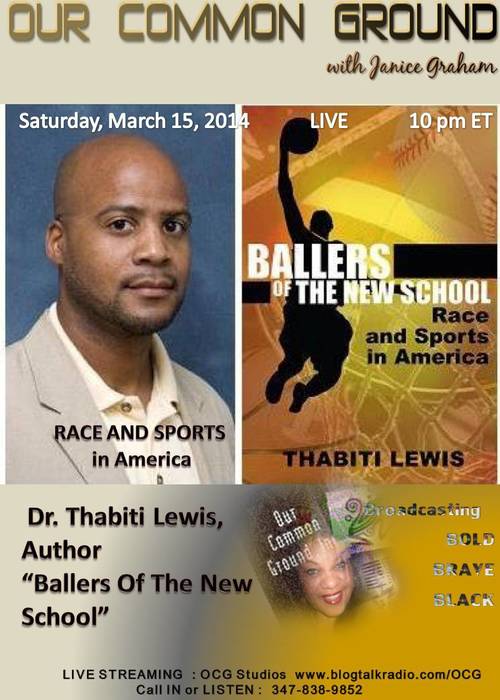
OUR COMMON GROUND with Janice Graham  THIS WEEK     Listen Live Call-in Number: (347) 838-9852 March 15, 2014 “Ballers of the New School: Race and Sports in America” Author and Professor, Dr. Thabi…

OUR COMMON GROUND Omnibus‘s insight:

March 15, 2014“Ballers of the New School: Race and Sports in America”
Author and Professor, Dr. Thabiti Lewis

See on ourcommongroundtalk.wordpress.com

Fair Trade? Why Armstrong Williams Doesn’t Represent Broadcast Diversity

See on Scoop.itOUR COMMON GROUND Informed Truth and Resistance

A recent Wall Street Journal Op-Ed claims that a proposed FCC rule is designed to target and derail the ownership plans of African-American Armstrong Williams. This is, in a word, false.

OUR COMMON GROUND Omnibus‘s insight:

More scamhood from Armstrong Williams offering himself up as the Black strawman.


"The joint sales agreements (JSAs) and SSAs between Sinclair and Armstrong Williams’ company, Howard Stirk Holdings, are illustrative of many similar agreements across the country.

Under these arrangements, Sinclair provides Howard Stirk with all technical, promotional, marketing, back-office, payroll, sales and related services. Sinclair also has the right to provide Howard Stirk stations with up to 25 hours of programming."

See on www.freepress.net

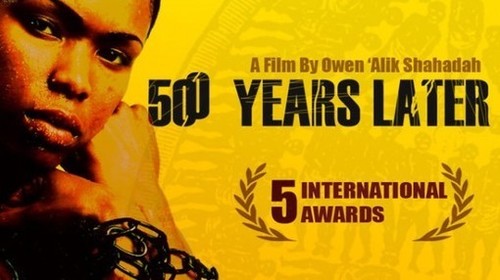
8 Black Documentary Films Everyone Should Watch – Atlanta Black Star

See on Scoop.itOUR COMMON GROUND Informed Truth and Resistance

“Have You Heard From Johannesburg?” “Have You Heard From Johannesburg?” is a seven-part documentary series that shines light on the global citizens movements that took on South Africa’s apartheid regime. It focuses on one of South Africa’s most important and powerful allies, the United States, which becomes a key battleground in the anti-apartheid movement as […]

OUR COMMON GROUND Omnibus‘s insight:

8 Black Documentary Films Everyone Should Watch

See on atlantablackstar.com

Who is Black? Striking Images of the World’s Dark-Skinned People Inaccurately Considered Non-Black – Atlanta Black Star

See on Scoop.itOUR COMMON GROUND Informed Truth and Resistance

Black Arabia “Black Arab” may be a confusing concept to many people in the West, where Arabs are classified as Caucasian people. However, all uses of the word “Arab” prior to the rise of Islam in the 7th century refer specifically to people belonging to the Bedouin ethnic group.  After that and leading up to […]

OUR COMMON GROUND Omnibus‘s insight:

Who is Black? "Today’s Arabs are a mixture of these groups, with those of darker-skin facing the typical discrimination and oppression seen by the darker peoples of the world. . . ."

See on atlantablackstar.com

Diversity in the Workplace Help or Hinder Teamwork?


Excellence in Government
Diversity in the Workplace Help or Hinder Teamwork?

By Evan Apfelbaum

Andrey_Popov/Shutterstock.com

Companies promote diversity in the workplace as a moral imperative with “bottom line benefits.” But research on the value of diversity is mixed. Some studies have found diverse teams—meaning workgroups comprised of employees of different races, genders, and backgrounds—promote creativity, nurture critical thinking, and tend to make better, more thoughtful decisions because they consider a wider range of perspectives. Other studies indicate diverse teams fuel interpersonal conflicts, reduce cohesion, and slow the pace of learning.

The trouble with past research is it assumes only diverse settings are capable of changing how people behave, form impressions, and make decisions. The research has created a convention in which homogeneous groups are considered a “control condition.” Think, for instance, about how we talk about topics related to diversity—we ask whether diversity influences perception, decision-making, and performance. When we digest results, we focus on whether diversity helped or hurt, strengthened or weakened, increased or decreased a given outcome. On the other hand, we view the homogeneous condition as a baseline: a reference point from which we can understand how diversity has changed behavior or what type of response is “normal.”

Homogeneity, however, is not a baseline. My colleagues, Katherine Phillips at Columbia Business School and Jennifer Richeson at Northwestern University, and I recently sampled 240 research articles on group diversity. We found that while the vast majority of research pays no heed to the effects of homogeneity, it may play a profound—and at times negative—role in shaping group behavior. Studies show, for instance, that homogeneous groups tend to make oversimplified judgments that can result in over-confident, even objectively inaccurate, decisions.

Take, for instance, one study that involved giving case information—potential clues to solve a murder mystery—to individuals assigned to either a homogeneous or diverse group. In diverse groups, people’s confidence about their group’s performance corresponded with how well their group actually performed. That is, diverse groups that identified the correct murder suspect reported higher levels of confidence than diverse groups who did not. People in homogeneous groups, on the other hand, tended to report high levels of confidence irrespective of how their group performed. In other words: homogeneous groups were further, not closer, than diverse groups to an objective index of accuracy.

In a different study, participants were randomly assigned to all-white or racially diverse juries and asked to deliberate over the same trial. Results revealed that the all-white juries made more factually inaccurate statements and considered a narrower range of information when discussing a trial than did racially diverse juries.

Why may homogeneous groups be more prone to make less accurate decisions, but feel more confident about them?

One reason may be that homogeneity leads people to assume that other peoples’ behavior is more predictable than it actually is. People in homogeneous groups assume that because others look like them, they are like them in terms of having similar perspectives, knowledge, and values. This assumption of like-mindedness feels comfortable. We feel good when we think we’re around people like us. It happens in the school cafeteria, at cocktail parties, and also in hiring situations.

But that sense of comfort comes at a cost. It creates blind spots in our judgments and decision-making. People in homogeneous groups seem to underestimate the potential for seemingly similar others to have substantively different perspectives, which can lead them to make oversimplified, perhaps even objectively inaccurate, decisions. It’s as though homogeneous groups operate on cruise control. Without people who look different, there’s no “social prompt” to snap team members out of their comfort zone and remind people there may be a different way of looking at an issue. Everyone goes on blithely presuming that all others are all thinking the same thing.

It’s worth noting that the effects associated with homogeneity—lack of accuracy in processing information and an absence of objectivity in making decisions— hark back to one of the most widely-popularized phenomenon in the psychology of groups: groupthink. Groupthink scenarios traditionally are characterized as ones in which a group’s consensus-seeking tendencies detract from the quality or morality of their decisions. There is a distinct possibility that homogeneity plays an underappreciated role in producing some effects typically ascribed to groupthink.

My point isn’t that diversity has no effects on behavior. Of course it does. But homogeneity does, too. Much more work remains to be done, but it may be that the strongest business case to be made for diversity in the workplace has less to do with what diversity adds, and more to do with what homogeneity takes away.

Reprinted with permission from Quartz. The original story can be found here

Government Executive

The Comparative Suffering of “Black Girls’ Zero-Sum Struggle” and “My Brother’s Keeper”

See on Scoop.itOUR COMMON GROUND Informed Truth and Resistance

An Uppity Negro Response to Brittney Cooper and why comparative gender suffering is a zero-sum gain for all.

OUR COMMON GROUND Omnibus‘s insight:

"For me, to do work and support initiatives and to lobby for policy changes that is specifically geared to black and brown males does not make one a supporter of heteronormative patriarchy. "

See on uppitynegronetwork.com

The Comparative Suffering of “Black Girls’ Zero-Sum Struggle” and “My Brother’s Keeper”

Counter revolutionary strategies must be examined and dissolved through that examination. We empower all or all will fail.

the uppity negro's avatarJoshua Lawrence Lazard

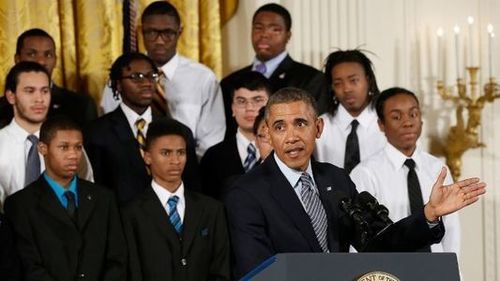
obama brothers keeper

I didn’t have the pleasure of watching President Obama make the big reveal about the My Brother’s Keeper initiative that he’s launching from the White House.  I say that because I’ll never forget the impact of watching a live press conference on my lunch break last year and seeing Obama go off script about Trayvon Martin and hearing the words “Trayvon Martin could have been my son; he could have been me” coming from a president who was staring down not even looking into the cameras no doubt trying to maintain presidential composure.  The day he announced My Brother’s Keeper he had boys and young men of color standing behind him and watching the young man with cornrows speak at the White House was monumental.  Never in our country have we had someone speak about this issue who had the social and racial capital behind him.

However, like most political…

View original post 1,734 more words

5 Reasons Why The Black Community Is Still Enslaved To White People >>Urban Intellectuals

5 Reasons Why The Black Community Is Still Enslaved To White People

by  | Jan 17, 2014 | Opinions |

5 Reasons Why The Black Community Is Still Enslaved To White People


You might not want to hear this, but it is time for the black community to have a dose of cold reality. We are in a position today where we don’t control our own destiny and are effectively still slaves to white people. Hopefully, this article we can open the dialog and minds to get out of this situation before it is too late.

This opinion isn’t about bashing white people or telling you to hate them. It is about pointing out our behaviors and things we are allowing to continue to happen to us 150 years after the Emancipation Proclamation. We have lawyers, politicians, doctors, PhDs, business owners and so called intelligent people in the black community. We have many material things in our lives and “freedoms”, but in many ways are in a worse position than we were 100 years ago. Isn’t it time to recognize and admit it is time to do something different as a community?

slavery photo

With that said, let’s dive into the reasons we still haven’t gotten from under the thumb of our captors and still have a long uphill battle to fight. Despite some of us having the markings of success, we still have a long way to go as a people.

The White Educational System And View Of The World Dominates The Black Community

Because the black community doesn’t control their educational system, our children will forever see the world through the perspective of white eyes. This is what is meant when people say one has black skin, but white eyes. The individual looks like a member of the black community, but thinks like a member of the white community. Meaning, they see everything as sacred that comes from the white community and negates thoughts, sciences, businesses and everything else that comes from their own people.

During the indoctrination years, I mean formal education, the black community is being conditioned to love, honor and respect white history, people and where they come from on the planet. Blacks know everything about white people, but only take one month, February, to learn anything about the black community. And if you are awakened, then you know these are controlled lessons that only emphasis what you are learning the other 11 months of the year.

Black People Are Infatuated By White Culture & Europe

This is a by product of the reason above, the educational system. Why wouldn’t you love, honor and respect white or Western culture when you have been formally indoctrinated into the system? It only makes sense. It becomes what you are familiar with and identify with at the same time.

On the other hand, if you are all in on Western culture, then you must be ignoring your own culture, history and people. Sure, you don’t mean for this to be the outcome, but it is nevertheless unless you are blessed enough to have someone in your life to help the scales fall from your eyes.

However, most in the black community are not so fortunate. We end up living a life dreaming of visiting Europe to see and experience the history we endear growing up first hand. The black community is infatuate with white culture, people and Europe.

Nothing Is Validated In The Black Community Until It Is Approved By Whites

Building on the education and the infatuation the black community has with white people, you know nothing is given the stamp of approval until someone white gives it the thumbs up. It hurts my heart to say this in public, but it is true and you know it.

breaking the chainsValidation comes to businesses, athletes, students, children, our intelligence, medicine, inventions, political policies, and everything else the black community can dream up when someone from the white community says it is good. This is a hangover from slavery as discussed by Dr. Na’im Akbar in his epic book “Breaking the Chains of Psychological Slavery”. We need white validation.

Blacks Embrace White Jesus And Their Religion

I know I’m going to lose a few of you from the this point forward. However, I don’t care. This is very important. Dr. John Henrik Clarke talks about if you take a man’s identity out of his God, then he will always see himself as inferior because he will identify the other with the deity, blessed people and not himself. This is exactly what happen to the black community and we bought it hook line and sinker.

For hundreds of thousands of years, we have controlled our visions of God, the Universe and our spirituality. Post slavery, we do not control this image and continue to struggle from turning over this basic human right.

Blacks Spend All Their Money With Whites Continuing To Make Them Rich At The Expense Of Themselves

It makes me sick that we are economically foolish enough to spend our $1 trillion dollars in annual spending power almost exclusively with white businesses. We have no concept of how important it is to spread our money around our community a few times before allowing it to leave. In fact, we are the only community in the country that does this and because of our Mis-Education, Carter G. Woodson’s book reference. What is worst is we don’t even understand the error in this practice, nor care to learn.  At this rate, we will definitely forever be slaves to white people.

Obviously, the black community is no longer in physical chains, but to the awakened mind it is clear the psychological chains still exist. We turn over all power and assets back to the white community without resistance and need to make a serious change in our behavior and beliefs.

What Are Your Thoughts and What Reasons Are Missing From the List Above?
[IN MEMORIUM] Who Was Chokwe Lumumba?

See on Scoop.itOUR COMMON GROUND Informed Truth and Resistance

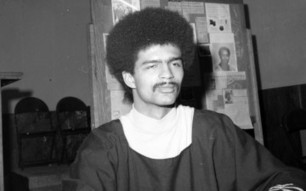
The Honorable Mayor of Jackson, Mississippi, Chokwe Lumumba, an unapologetic revolutionary “New Afrikan” (Black) nationalist, fighting for the human rights and dignity of Black folks in a place…

OUR COMMON GROUND Omnibus‘s insight:

Since ‘America’s Black Revolutionary Mayor’ died suddenly on Feb 25, the Internet has been buzzing with his name, but still too few know who he really was

Read more at EBONY http://www.ebony.com/news-views/who-was-chokwe-lumumba-987#ixzz2vJCmtugO 
Follow us: @EbonyMag on Twitter | EbonyMag on Facebook

See on www.ebony.com