The Black American Amputation Epidemic


 Black patients were losing limbs at triple the rate of others.
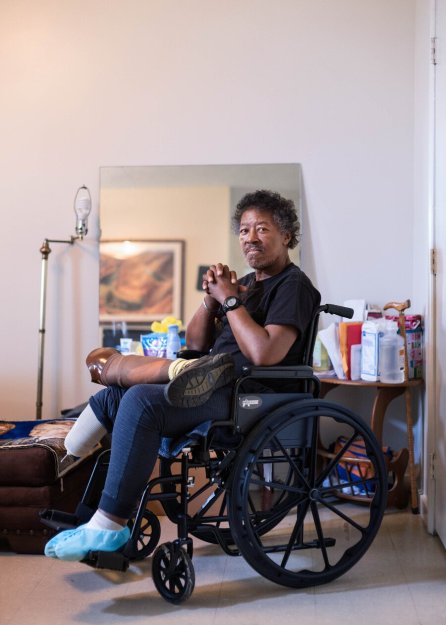
l1070122_final-publish-version-9001260-25422e

The doctor put up billboards in the Mississippi Delta.

Amputation Prevention Institute, they read.

He could save their limbs, if it wasn’t too late.

The Black American Amputation Epidemic

ProPublica is a nonprofit newsroom that investigates abuses of power. Sign up to receive our biggest stories as soon as they’re published.

IT WAS A FRIDAY EVENING in the hospital after a particularly grueling week when Dr. Foluso Fakorede, the only cardiologist in Bolivar County, Mississippi, walked into Room 336. Henry Dotstry lay on a cot, his gray curls puffed on a pillow. Fakorede smelled the circumstances — a rancid whiff, like dead mice. He asked a nurse to undress the wound on Dotstry’s left foot, then slipped on nitrile gloves to examine the damage. Dotstry’s calf had swelled to nearly the size of his thigh. The tops of his toes were dark; his sole was yellow, oozing. Fakorede’s gut clenched. Fuck, he thought. It’s rotten.

Fakorede, who’d been asked to consult on the case, peeled off his gloves and read over Dotstry’s chart: He was 67, never smoked. His ultrasound results showed that the circulation in his legs was poor. Uncontrolled diabetes, it seemed, had constricted the blood flow to his foot, and without it, the infection would not heal. A surgeon had typed up his recommendation. It began: “Mr. Dotstry has limited options.”

Fakorede scanned the room. He has quick, piercing eyes, a shaved head and, at 38, the frame of an amateur bodybuilder. Dotstry was still. His mouth arched downward, and faint eyebrows sat high above his lids, giving him a look of disbelief. Next to his cot stood a flesh-colored prosthetic, balancing in a black sneaker.

Fakorede explained that he wasn’t the kind of doctor who cuts. He was there because he could test circulation, get blood flowing, try to prevent any amputation that wasn’t necessary. He hated that doctors hadn’t screened Dotstry earlier — when he’d had the stroke or lost his leg. “Your legs are twins,” he said. “What happens in one happens in the other.”

Dotstry needed an immediate angiogram, an imaging test that would show blockages in his arteries. He also needed a revascularization procedure to clean them out, with a thin catheter that shaves plaque and tiny balloons to widen blood vessels. His foot was decaying, fast. Though Fakorede ran an outpatient practice nearby, when doctors consulted him on inpatients at Bolivar Medical Center, the local hospital, he expected to use its facilities.

He asked his nurse to schedule the procedures. But by the time he had driven home to his ranch house on the northern edge of town, he hadn’t received an answer. Nor had he when he woke up on Saturday at 3:30 a.m., as he did every morning. By sunrise, he was restless at his kitchen counter, texting the hospital’s radiology director, explaining the need for an intervention on Monday, Martin Luther King Jr. Day. Within a few hours, he got a response: “I don’t have the staff or the supplies. I’m sorry.”

Now Fakorede was mad, walking briskly into his office, dialing friends on speaker phone, pacing around his conference room. He’d been raised in Nigeria, moved to New Jersey as a teenager and had come to practice in Mississippi five years earlier. He’d grown obsessed with legs, infuriated by the toll of amputations on African Americans. His billboards on Highway 61, running up the Delta, announced his ambitions: “Amputation Prevention Institute.”

Nobody knew it in January, but within months, the new coronavirus would sweep the United States, killing tens of thousands of people, a disproportionately high number of them black and diabetic. They were at a disadvantage, put at risk by an array of factors, from unequal health care access to racist biases to cuts in public health funding. These elements have long driven disparities, particularly across the South. One of the clearest ways to see them is by tracking who suffers diabetic amputations, which are, by one measure, the most preventable surgery in the country.

Look closely enough, and those seemingly intractable barriers are made up of crucial decisions, which layer onto one another: A panel of experts decides not to endorse screening for vascular disease in the legs; so the law allows insurance providers not to cover the tests. The federal government forgives the student loans of some doctors in underserved areas, but not certain specialists; so the physicians most critical to treating diabetic complications are in short supply. Policies written by hospitals, insurers and the government don’t require surgeons to consider limb-saving options before applying a blade; amputations increase, particularly among the poor.

Despite the great scientific strides in diabetes care, the rate of amputations across the country grew by 50% between 2009 and 2015. Diabetics undergo 130,000 amputations each year, often in low-income and underinsured neighborhoods. Black patients lose limbs at a rate triple that of others. It is the cardinal sin of the American health system in a single surgery: save on preventive care, pay big on the backend, and let the chronically sick and underprivileged feel the extreme consequences.

Henry Dotstry, Dr. Foluso Fakorede’s patient. (Ruddy Roye for ProPublica)

Fakorede grabbed his car keys and headed to the hospital. He walked straight to the lab. As he suspected, it had all the supplies that he needed. Why won’t they give me staff? he wondered. They wouldn’t do that to a surgeon.

He has little tolerance for this kind of transgression. He is militaristic, to an extreme. To him, nonhealing wounds are like heart attacks. “Time is muscle,” he repeats. He calls huddles when nurses forget to check a patient’s ankles: “If you haven’t assessed both legs, I don’t want to walk into that room.” He considers each of his procedures an act of war. When people stand in his way, he sends a barrage of text messages, punctuated by exclamation marks. And he uses his cellphone to collect evidence that the system is working against his patients, and his efforts.

He pulled out his iPhone and photographed the hospital’s wires and catheters, IVs and port protectors. He shot the images over to the hospital’s radiology director. Fakorede’s private practice was closed for the holiday weekend. He calculated that he had only a few days to carry out some plan before Dotstry’s remaining leg was amputated.


TWO MAPS EXPLAIN why Fakorede has stayed in the Mississippi Delta. One shows America’s amputations from vascular disease. The second shows the enslaved population before the Civil War; he saw it at a plantation museum and was stunned by how closely they tracked. On his phone, he pulls up the images, showing doctors, or history buffs, or anyone who will listen. “Look familiar?” he asks, toggling between the maps. He watches the realization set in that amputations are a form of racial oppression, dating back to slavery.

AVERAGE ANNUAL AMPUTATIONS, 2007–9

0–5
5–8
8–10
10–13
13+

The average number of amputations for peripheral artery disease per 10,000 patients per year. Source: Dartmouth Atlas of Healthcare

ENSLAVED POPULATION IN 1860

0%
0–10%
10–30%
30–50%
50%+

The percentage of the population enslaved in 1860. Source: IPUMS NHGIS, University of Minnesota

Fakorede was initially tempted to move to the Delta while practicing in Tennessee. He befriended a medical device sales rep named Maurice Hampton who had grown up in the Mississippi region. Hampton talked about how black families were leery of local hospitals and how few black doctors in the Delta specialized in vascular work. “It’s the norm to go to Walmart and see an amputation or a permacath in the neck,” he’d told Fakorede. “If you don’t see one, then you didn’t stay but two minutes.”

Then, a little over a year into his Tennessee job, Fakorede found himself at loose ends. He’d raised concerns that he was being billed for expenses that weren’t his and asked for an audit; though the audit later found that the clinic where he worked had claimed over $314,000 in improper expenses, he was quickly terminated. Fakorede sued the clinic for retaliation under the False Claims Act and lost. (The clinic’s lawyer said his client had no comment, but there were “numerous” reasons for Fakorede’s departure.) In the spring of 2015, he had a mortgage, a quarter of a million dollars in student debt and four months of severance pay. He also had an impulse to understand the Delta.

A highway in the Mississippi Delta. (Andrea Morales for ProPublica)

Fakorede spent four days driving through its long, flat stretches of farmland dotted with small towns and shotgun houses. The wood-slat homes and bumpy roads reminded him of his grandparents’ village in the Nigerian state of Ondo, where he’d spent summers as a kid. He drove scores of miles on the Mississippi highways without seeing a single grocery store; fast-food chains lit the busiest intersections. He was startled by the markers of disease — the missing limbs and rolling wheelchairs, the hand-built plywood ramps with metal rails. He thought of amputees like “an hourglass,” he said, “that was turned the day they had their amputation.” Mortality rates rise after the surgeries, in part, because many stop walking. Exercise improves circulation and controls blood sugar and weight. The less activity a person does, the higher the risk of heart attacks and strokes. Within five years, these patients were likely to be dead.

Fakorede weighed taking a lucrative job up north, near his parents, who had both been diagnosed with diabetes. He had professional connections there; he’d gone to Rutgers Robert Wood Johnson Medical School and done a residency at NewYork-Presbyterian Weill Cornell Medical Center. But the South, he felt, needed him. About 30 million people in America had diabetes, and Mississippi had some of the highest rates. The vast majority had Type 2; their bodies resisted insulin or their pancreas didn’t produce enough, making their blood sugar levels rise. Genetics played a role in the condition, but so did obesity and nutrition access: high-fat meals, sugary foods and not enough fiber, along with little exercise. Poverty can double the odds of developing diabetes, and it also dictates the chances of an amputation. One major study mapped diabetic amputations across California, and it found that the lowest-income neighborhoods had amputation rates 10 times higher than the richest.

The Delta was Mississippi’s poorest region, with the worst health outcomes. Fakorede had spent years studying health disparities: African Americans develop chronic diseases a decade earlier than their white counterparts; they are twice as likely to die from diabetes; they live, on average, three years fewer. In the Delta, Fakorede could treat patients who looked like him; he could find only one other black interventional cardiologist in the entire state. A growing body of evidence had shown how racial biases throughout the medical system meant worse results for African Americans. And he knew the research — black patients were more responsive to, and more trustful of, black doctors. He decided after his trip that he’d start a temporary practice in Mississippi, and he rented an apartment deep in the Delta.

He fantasized about building a cardiovascular institute and recruiting a multidisciplinary team, from electrophysiologists to podiatrists. But as he researched what it would take, he found a major barrier. Medical specialists with student debt, who graduate owing a median of $200,000, generally could not benefit from federal loan forgiveness programs unless they got jobs at nonprofit or public facilities. Only a few types of private practice providers — primary care, dentists, psychiatrists — qualified for national loan forgiveness. The Delta needed many other physicians. Though Bolivar County was at the center of a diabetes epidemic, there wasn’t a single diabetes specialist, an endocrinologist, within 100 miles.

Fakorede in his clinic with a patient. (Ruddy Roye for ProPublica)

Fakorede leased a windowless space in the Cleveland Medical Mall, a former shopping center that had been converted to doctors’ offices. People came to him with heart complaints, but he also asked them to remove their socks. Their legs alarmed him. Their toes were black and their pulses weak. Their calves were cold and hairless. Some had wounds but didn’t know it; diabetes had numbed their feet. Many had been misdiagnosed with arthritis or gout, but when Fakorede tested them, he found peripheral artery disease, in which clogged arteries in the legs limit the flow of blood.

This is what uncontrolled diabetes does to your body: Without enough insulin, or when your cells can’t use it properly, sugar courses through your bloodstream. Plaque builds up faster in your vessels’ walls, slowing the blood moving to your eyes and ankles and toes. Blindness can follow, or dead tissue. Many can’t feel the pain of blood-starved limbs; the condition destroys nerves. If arteries close in the neck, it can cause a stroke. If they close in the heart, a heart attack. And if they close in the legs, gangrene.

Within a month, Bolivar Medical Center had credentialed Fakorede, allowing him to consult on cases and do procedures in the hospital. His most complicated patients came in through the emergency room. Some arrived without any inkling that they had gangrene. One had maggots burrowing in sores. Another showed up after noticing his dog eating the dead flesh off the tips of his toes. Fakorede took a photo to add to his collection. “It was a public health crisis,” he told me. “And no one was talking about amputations and the fact that what was happening was criminal.”

On weekends, Fakorede had been driving back to his five-bedroom home in Tennessee, but in August of 2015, he decided to go all-in on Bolivar County. He sold his house and black Mercedes G-Wagon, and applied for funding to build a practice in the Delta: Cardiovascular Solutions of Central Mississippi. He pitched himself as a heart guy and a plumber, removing buildup in the arteries. Four banks denied him loans, so he borrowed money from friends. He gave himself a two-year window to reduce amputations and publish his outcomes.


The Delta was once a cotton empire. (Andrea Morales for ProPublica)

THE DELTA FLOOD PLAIN runs 7,000 square miles along the northwestern edge of the state, with sweet-smelling, clay-like soil cordoned between bluffs and the banks of the Mississippi River. By the 19th century, the primeval forests had been transformed into a cotton empire; at the start of the Civil War, more than 80% of people in many Delta counties were enslaved. Sharecropping emerged after emancipation, and black farmers cultivated small plots in return for a portion of their crop. They lived on credit — for food and feed and clothing — until the harvest, but even then, their earnings rarely covered their expenses.

For decades, African Americans in the South struggled to find and afford health care. The American Medical Association excluded black doctors, as did its constituent societies. Some hospitals admitted black patients through back doors and housed them in hot, crowded basements. Many required them to bring their own sheets and spoons, or even nurses. Before federal law mandated emergency services for all, hospitals regularly turned away African Americans, some in their final moments of life.

Fakorede was drawn to Bolivar County, in part, because of its history. He’d run out of gas there when he was first scouting the region, and later that evening, he’d Googled its background. For a brief moment, Bolivar was the center of a movement for public health care, driven by the conviction that racial equality was not possible without justice in health. In 1964, when a group of physician activists traveled to the Delta, Robert Smith, a black doctor from Jackson, saw rocketing rates of intestinal parasites and maternal death. “I understood for the first time what it truly meant to be black in Mississippi,” he told a magazine. Under President Lyndon B. Johnson’s War on Poverty, a Boston doctor secured funding to open a community health center in Bolivar, which he grew with the help of Smith. Clinicians worked with residents to take on housing, sanitation, exercise and nutrition. Its success spawned a national project of more than a thousand Federally Qualified Health Centers for the underserved. But funding shrank under President Richard Nixon, and the centers’ initiatives were scaled back to basic primary care.

By the time Fakorede moved to the Delta, in 2015, the state had the nation’s lowest number of physicians per capita. It had not expanded Medicaid to include the working poor. Across the country, 15% of African Americans were still uninsured, compared with 9% of white Americans. That year, Jennifer Smith, a professor at Florida A&M University College of Law, wrote in the National Lawyers Guild Review what Fakorede saw firsthand: “While the roots of unequal and inequitable health care for African Americans date back to the days of slavery, the modern mechanisms of discrimination in health care has shifted from legally sanctioned segregation to inferior or non-existent medical facilities due to market forces.”

Fakorede understood that to reach patients, he needed referrals, so he met primary care providers at hospitals and clinics. He asked them to screen for vascular disease, measuring blood pressure at the ankle and the arm. Many didn’t have the time; given the shortage of local physicians, some were seeing up to 70 patients a day. Others didn’t know much about peripheral artery disease or why it was important to diagnose. Some were offended by Fakorede’s requests. Michael Montesi, a family doctor, was grateful for the help, but he found it brash for the new doctor in town to start telling the veterans what to do. He recalled thinking, “Where were you the first 12 years of my practice, when I needed a cardiologist, when I needed an OB-GYN, when I needed a surgeon, when I had to do an amputation in the ER, or deliver a baby that was 23 weeks and watch the baby die because there was nobody there that could take care of him?”

The brushoffs disturbed Fakorede, but when he dug deeper, he realized that the doctors weren’t only overwhelmed; they had no guaranteed payment for this vascular screening. The Affordable Care Act mandates that insurers cover all primary care screenings that are recommended by the U.S. Preventive Services Task Force, an independent panel of preventive care experts. The group, though, had not recommended testing anybody without symptoms, even the people most likely to develop vascular disease — older adults with diabetes, for example, or smokers. (Up to 50% of people who have the disease are believed to be asymptomatic.) As specialists, cardiologists are reimbursed if they screen patients with risk factors. But by the time patients got to Fakorede, the disease was sometimes too far along to treat. Many already had a nonhealing wound, what’s known as “end stage” peripheral artery disease, the last step before an amputation.

When Luvenia Stokes came to Fakorede, she had already lost her right leg at the age of 48. Like many Delta residents, she grew up in a food desert, and without money for fresh produce, she’d developed diabetes at a young age. She said that a pedicurist nicked her toe, and the small cut developed an infection. Without good blood flow, it began bubbling with pus. Stokes told Fakorede that no doctor had performed an angiogram to get a good look at the circulation or a revascularization to clean out the arteries. A surgeon removed her second toe. Without cleared vessels, though, the infection spread. Within weeks, a new surgeon removed her leg.

Luvenia Stokes. (Ruddy Roye for ProPublica)

Stokes lived in a single-wide trailer with her mother. Her wheelchair could not fit in the doorways, so she inched through sideways with a walker. Because she could hardly exercise, she gained 48 pounds in two years. The amputation hadn’t treated her vascular disease, and a stabbing pain soon engulfed her remaining leg, “like something is clawing down on you,” she said. When she finally made it to Fakorede, she told him that one doctor had prescribed neuropathy medication and another had diagnosed her with arthritis. “I’m not letting them get that other leg,” Fakorede told her. Stokes’ grandmother, Annie, who lives in a nearby trailer, had lost both her legs, above the knee, to diabetes. Her cousin Elmore had lost his right leg, too.

General surgeons have a financial incentive to amputate; they don’t get paid to operate if they recommend saving a limb. And many hospitals don’t direct doctors to order angiograms, the most reliable imaging to show if and precisely where blood flow is blocked, giving the clearest picture of whether an amputation is necessary and how much needs to be cut. Insurers don’t require the imaging, either. (A spokesperson for America’s Health Insurance Plans, a leading industry trade association, said, “This is not an area where there is likely to be unnecessary surgery.”) To Fakorede, this was like removing a woman’s breast after she felt a lump, without first ordering a mammogram.

Nationwide, more than half of patients do not get an angiogram before amputation; in the Delta, Fakorede found that the vast majority of the amputees he treated had never had one. Now, he was determined to make sure that no one else lost a limb before getting the test. This wasn’t a controversial view: The professional guidelines for vascular specialists — both surgeons and cardiologists — recommend imaging of the arteries before cutting, though many surgeons argue that in emergencies, noninvasive tests like ultrasounds are enough. Marie Gerhard-Herman, an associate professor of medicine at Harvard Medical School and a cardiologist at Brigham and Women’s Hospital, chaired the committee on guidelines for the American College of Cardiology and the American Heart Association. She told me that angiography before amputation “was a view that some of us thought was so obvious that it didn’t need to be stated.” She added: “But then I saw that there were pockets of the country where no one was getting angiograms, and it seemed to be along racial and socioeconomic lines. It made me sick to my stomach.”

Stokes wasn’t at immediate risk of losing her left leg when she met Fakorede, but pain prevented her from walking. She had a severe form of the disease, and Fakorede booked her for an angiogram and revascularization. He inserted a wire into her arteries and cleaned out the clogged vessels, letting oxygen-rich blood rush to her remaining foot. While she was recovering in Fakorede’s lab, she thought about her neighbors who had the same problems. “I really don’t like what’s happening to us,” she said to me. “They’re not doing the tests on us to see if they can save us. They’re just cutting us off.”

A wooden ramp and concrete steps outside Stokes’ trailer. (Ruddy Roye for ProPublica)

Patients didn’t know about vascular disease, or why their legs throbbed or their feet blackened, so Fakorede went to church. The sales rep, Hampton, introduced him to pastors, and several times each month, he stood before a pulpit. He told the crowds that what was happening was an injustice, that they didn’t need to accept it. He told them to get screened, and if any surgeon wanted to cut off their limbs, to get a second opinion. In the lofty Pilgrim Rest Baptist Church, in Greenville, he asked the congregation, “How many of you know someone or know of someone who’s had an amputation?” Almost everyone raised their hands.

At first, Fakorede took a confrontational approach with colleagues. Some seemed skeptical that he could “prevent” amputations; it’s a tall claim for a complex condition. Once, when a doctor had disregarded his advice, he’d logged it in the electronic health record, so the oversight would be on display for anyone who looked up his patient’s chart. Fakorede could fume when people questioned his authority; self-confidence carried him, but it sometimes blinded him to his missteps. Over time, though, Fakorede tried to rein in the arrogance. “You peel off a layer that may be comprised of: I’m from up North, I know it all, you should be thankful we’re here to provide services that you probably wouldn’t get before.” He picked up some Southern manners. Fakorede began texting doctors with photos of their patients’ feet along with X-rays of their arteries, before his intervention and afterward. Referrals picked up, and within a year, he’d seen more than 500 patients.

But Bolivar Medical Center, he learned, was turning away people who couldn’t pay a portion of their revascularization bill upfront. Several former employees told me the same. “It’s a for-profit hospital, it’s no secret, it’s the name of the game,” Fakorede said. “But a for-profit hospital is the only game in town in one of the most underserved areas. So what happens when a patient comes in and can’t afford a procedure that’s limb salvage? They eventually lose their limbs. They’ll present back to the emergency room with a rotten foot.” And a surgeon would have no choice but to amputate. (A hospital spokeswoman said that last year, it gave $25 million in charity care, uncompensated care and uninsured discounts. Asked if it turned away patients who couldn’t pay for revascularization, she did not respond directly: “We are dedicated to providing care to all people regardless of their ability to pay.”)

The practice was discriminatory, he reasoned, and also financially backward. At $237 billion in medical costs each year, diabetes is the most expensive chronic disease in the country; one of every four health care dollars is spent on a person with the condition. Left untreated, the costs pile on. Medicare spends more than $54,000 a year for an amputee, including follow-ups, wound care and hospitalizations; the government program is the country’s largest payer. Then come the uncounted tolls: lost jobs, a dependence on disability checks, relatives who sacrifice wages to help with cooking and bathing and driving.

By the time Carolyn Williams came to see Fakorede, in 2016, she’d been uninsured with diabetes for 20 years; she’d worked at a housing nonprofit and for a food assistance program, but neither had offered coverage. At the age of 36, she’d needed a triple bypass surgery, and at 44, she had three toes amputated. Untreated leg pain left her needing a wheelchair; she pulled out of Delta State University, where she was pursuing a degree in social work. Fakorede reconstituted blood flow in her legs and got her walking. But the diabetes was already destroying her kidneys. She joined the government’s disability rolls. She also went on dialysis, at a yearly cost to Medicare of $90,000.

On the days when Fakorede wanted to give up and leave, he drove to an Emmett Till memorial in Money, Mississippi. After 14-year-old Till was mutilated and murdered, in 1955, his mother had insisted on opening his casket. “Let the people see what I’ve seen,” she said, and his image brought national outrage to racist violence in the South. Fakorede thought often about how that decision sparked the Civil Rights movement. He thought about it as he exhibited his photos of rotten feet and limbless bodies, his own proof of what he considered a modern atrocity. He didn’t want to live by Bolivar Medical’s policies. He decided that in order to treat as many people as possible, irrespective of income or insurance, he needed to build a lab of his own.


THIS JANUARY, THAT LAB was now Dotstry’s best shot. The hospital’s consulting surgeon expected to amputate his leg below the knee. He had written that because Dotstry’s kidneys were impaired, the contrast dye in an angiogram would be dangerous. But Fakorede could replace the dye with a colorless gas, which wouldn’t jeopardize Dotstry’s health.

It would have made the most sense to perform the procedure at the hospital; Dotstry had been admitted and was occupying a bed. But after Fakorede opened his outpatient lab and hired away two techs and a nurse, a spokeswoman said the hospital stopped doing certain interventions. She told me it shouldn’t have surprised Fakorede that they couldn’t schedule Dotstry’s case, and that if he had been unable to treat a patient in his lab, the hospital could have worked with him to find another. Fakorede told me he’d never received such a message. When a doctor asks him to treat an inpatient with an acute condition, his responsibility, as he sees it, is to do it in the hospital. “If I don’t have a hospital that wants to coordinate,” he asked, “what do I do?”

Fakorede prepares for a procedure. (Ruddy Roye for ProPublica)

The answer, at least this time, was to get his patient out of there. He called Dotstry’s doctor and convinced her to discharge him for the intervention. Then, at noon on Saturday, Fakorede walked back into Room 336. Dotstry’s sister, Judy, was standing by his bed. She wore tall leather boots over acid-washed jeans, with a thick, black wig in a braid down her back.

Fakorede handed over his card. “I called the hospital to see if we can do this case on Monday,” he said, “and they said no.”

Judy inhaled. “What now?”

Fakorede laid out the plan for a Monday morning angiogram in his own procedure room. He would open up as many vessels as he could. If he could get circulation to Dotstry’s foot, he might be able to save it. He wasn’t sure about the toes.

When Dotstry had suffered his stroke several years back, Judy had become his caregiver. She’d stopped taking jobs in home care and supported her brother without pay — shuttling him to doctors’ appointments, controlling his sugars, managing his medications. After his amputation, she’d helped him learn to walk again. In place of a salary, she’d drawn disability for an old work injury; she’d been electrocuted while operating a machine, and the nerves in her arm were damaged, making her hands tremble. But she couldn’t stay unemployed forever. This past fall, she had gone back to work, cleaning the local post office.

After Fakorede left, Judy looked over at her brother, who sat slumped over the side of the cot, a blue gown slipping off his bony shoulders. Their father had been a sharecropper, and Dotstry had dropped out of elementary school to help on the farm, harvesting soybeans, rice and cotton. Of 10 kids, he was the oldest boy, and he took care of the others, bringing in cash and cooking them dinner. They almost never saw a doctor. Instead, they’d relied on cod liver oil, or tea from hog hoofs, parched over a fire.

Dotstry had spent his career driving tractors, hauling crops and plowing fields, but he wasn’t insured and still rarely saw doctors. At 60, when he was diagnosed with Type 2 and prescribed insulin, he didn’t know how to manage the medicine properly; he had never learned to read. Insulin pumps were too expensive — more than $6,000. His blood sugar levels often dropped, and he sometimes passed out or fell on the job. Little by little, his employer cut back his duties. In 2015, he had a stroke; diabetes had raised his risk. A year later, his right foot blackened and was amputated at the ankle. The infection kept spreading, and soon, his lower leg went. He could no longer work.

Two of his sisters had died after complications of diabetes. Judy had stood over their beds like she was now standing over Dotstry’s. He’s still here, she reminded herself.

Dotstry with his niece Shequita, his girlfriend and his sister Judy. (Ruddy Roye for ProPublica)

She pulled out her phone and called another brother. “They gonna amputate his foot, cause it’s bad,” she said. “Toe’s rotted.”

Dotstry looked up from the bed. “No!” he shouted. “They can’t take that off. Why?”

“Why you think your foot look like that? Why you think it smells? It stinks!” she said. Dotstry reached down to unwind the gauze. Judy wondered why he hadn’t told her that his foot was infected sooner. She lowered her voice. “You were doing pretty good. If you wasn’t, I could have tried to get back in there and do something.”

Her daughter, Shequita, ran into the room, huffing. She was loud and pissed off. “Whose foot is that?” she shrieked. She kneeled by the cot and helped Dotstry scoot up onto his pillow, stretching out his legs. He was usually a prankster, a hard-headed contrarian, the uncle who’d picked her up and spun her around like an airplane. She was thrown off by how quiet he’d become.

“Your daughter wants to know if you want to come stay with her, if you want to come to Texas,” Shequita told him.

Dotstry knew the offer was on the table, but he hadn’t yet accepted. A few days earlier, a tornado had torn the roof from his trailer, and he was, for the moment, without a home.

“She said it’s a lot better doctors up there,” Shequita continued, “and if she gotta stop working to take care of you, she can do that.” She gripped her hands around the frame of the bed and leaned over it, locking her eyes with his. “I need you to be thinking hard about this, sir. This ain’t you. I need you to get back to you.”

“He ain’t gotta go to Texas,” Judy interrupted.

Shequita shot back: “You gonna take care of him?”

Judy was silent. She knew that she couldn’t, not like before. She needed her paycheck for home repairs; a flood had warped her wooden floors. But Dotstry’s daughter was younger, and Judy thought that if she quit her job at Walmart, she’d get restless. Besides, Dotstry knew no one in Texas. She pictured him in a wheelchair, staring off, confused about where he was. Judy figured if he went, he’d go on and die.

She crossed her arms. “He’ll be all right if they don’t have to amputate that leg,” she said.

Shequita looked at her mother. She walked over to where she stood, by a shaded window, and threw her arms around her neck. Then, she left the room. Judy hoisted herself up onto the foot of her brother’s cot. She swung her legs up so that she faced him, and she laid herself down.


ABOUT EVERY FIVE YEARS, the doctors and researchers who make up the U.S. Preventive Services Task Force reassess their screening guidelines. In 2018, the members returned to peripheral artery disease and the blood flow tests that Fakorede had asked local primary care doctors to conduct. Once again, the panel declined to endorse them, saying there was not enough evidence that the tests benefited the average asymptomatic American.

In their statement, they acknowledged that public commenters had raised concerns that the disease “is disproportionately higher among racial/ethnic minorities and low-socioeconomic populations” and that this recommendation “could perpetuate disparities in treatment and outcomes.” In response, the panel said it needed better evidence. But as the National Institutes of Health has found, minorities in America make up less than 10% of patients in clinical trials.

Dr. Joshua Beckman, the director of vascular medicine at Vanderbilt University Medical Center, was an expert reviewer of the evidence base for the task force, and its final report struck him as irresponsible. It hardly noted the advantages of treatment after screening; the benefits were right there in the data that he saw. The panel discounted the strongest study, a randomized control trial, which demonstrated that vascular screening, for men ages 65 to 74, reduced mortality and hospital days. (The study bundled peripheral artery disease screening with two other tests, but in Beckman’s eyes, the outcomes remained significant.) He was confused about why the task force had published its evaluation of screening the general public, when it was clear that the condition affects specific populations. Several American and European professional society guidelines recommended screening people with a higher risk. “You wouldn’t test a 25-year-old for breast cancer,” he told me. “Screening is targeted for the group of women who are likely to get it.”

Dr. Alex Krist, the chair of the task force, repeated the group’s position in an email that the data was not strong enough to endorse screening, even for at-risk patients. “The Task Force does not do its own research, so we can’t fix these research gaps, but we can — and did — ring the alarm bell to raise awareness of this vital issue among researchers and funders.”

Fakorede performs a revascularization procedure with an assistant. (Ruddy Roye for ProPublica)

Vascular surgeons who have spent their careers studying limb salvage have come to see preventive care as perhaps more important than their own last-ditch efforts to open blood vessels. Dr. Philip Goodney, a vascular surgeon and researcher at Dartmouth and White River Junction VA Medical Center, made a name for himself with research that showed how the regions of the country with the lowest levels of revascularization, like the Delta, also had the highest rates of amputation. But revascularizations aren’t silver bullets; patients still must manage their health to keep vessels open. Now, Goodney believes his energy is better spent studying preventive measures earlier in the disease’s progression, like blood sugar testing, foot checks and vascular screening. Many patients have mild or moderate disease, and they can be treated with medicine, counseled to quit nicotine, exercise and watch their diet. “We need to build a health system that supports people when they are at risk, when they are doing better and when they can keep the risk from coming back,” he told me. “And where there’s a hot spot, that’s where we need to focus.”

Fakorede scrolled through the task force’s statement. “You want more data? Really? Who has the highest amputation rates in America?” he asked. “That’s your data.” He had taken to the national stage, speaking at conferences about what he’d witnessed in Bolivar. On behalf of the Association of Black Cardiologists, he testified before Congress, convincing U.S. Rep. Donald M. Payne Jr., a Democrat from New Jersey, along with U.S. Rep. Gus Bilirakis, a Republican from Florida, to start a Congressional Peripheral Artery Disease Caucus. The group is pushing for the task force to reevaluate the evidence on screening at-risk patients, for federal insurers to start an amputation prevention program and for Medicare to ensure that no amputation is allowed before evaluating arteries. Other groups are advocating for legislation that would require hospitals to publicly report their amputation rates.

In Bolivar, Fakorede had seen more than 10,000 cardiovascular patients from around the Delta. Dr. DeGail Hadley, a primary care provider in town, told me that before Fakorede arrived, he wasn’t sure what was best to do for patients with rotting feet. “It was always a process of transferring the patients to Jackson or Memphis, which can be difficult.” Both cities were two hours away. Now, Fakorede was performing about 500 angiograms annually in town. Last year, he published a paper in Cath Lab Digest describing an 88% decrease in major amputations at Bolivar Medical Center, from 56 to seven. (Fakorede did not provide me with all of his sources.) The hospital has different internal figures, which also reflect a significant decrease. Between 2014 and 2017, the hospital recorded that major amputations had fallen 75% — from 24 to six.

Fakorede couldn’t catch everyone in time, and he was haunted by the patients who got to him too late. A week before he’d met Dotstry, Sandra Wade had come in with an open sore on her right big toe. She came from a family of diabetics. Her mother had died after a diabetic coma. Her cousin had just lost a leg. Her oldest sister, who’d raised her, had given up on walking when a tired, burning, itching sensation consumed her legs. Now, Wade felt it, too.

Sandra Wade. (Ruddy Roye for ProPublica)

“I don’t want to give up like that,” Wade had said, reclining in a cot in Fakorede’s pre-procedure room. “I want my toes. I don’t want to lose not one limb. I choose life.” She elongated her O’s. She was 55 and had a high, gentle voice, a wide smile and big, curled lashes under loose, curled hair. She had spent most of her career in food service and retail, recently managing a Family Dollar, but after diabetes took her eyesight, she’d had to quit. She wondered if the sodas and chips that had fueled her at the store had accelerated her disease. Or if she’d focused so much on her son, who was developmentally disabled, that she’d neglected herself. She didn’t like to offload blame onto her genes. “Somebody’s gotta try to change the cycle,” she’d said. “I really want to be the one.”

Fakorede inserted an IV into the top of her leg. He opened up each of her blocked arteries, one at a time, until he got to the most important one, which ran along her inner calf. It was supposed to supply blood to her open wound, and she needed it to heal. Without it, she’d likely lose her toe. If she didn’t control her sugars, she could lose her lower leg next. Fakorede was hopeful as he slid a wire through the vessel in her knee, and into that crucial artery in her calf. But then, about a third of the way down, it stopped. It was as if the vessel itself had evaporated.


UNDER A CRISP, WIDE SKY, on Martin Luther King Jr. Day, churches around town were opening their doors for services. Fakorede’s office was scheduled to be closed, but he’d called in his nurses and radiology technicians, even those out hunting deer, to staff Dotstry’s case.

“What’s up, young man?” Fakorede greeted Dotstry, who was slowly fading into his Ambien, and he handed Judy a diagram of a leg. “The prayer is that we can find this many vessels to open up,” he said, pointing to the paper. “As soon as I’m done, I’ll let you know what I find.”

In the procedure room, he put on his camouflage-patterned lead apron, and with an assistant, he inserted an IV near Dotstry’s waist. He wound a wire across Dotstry’s iliac artery, into the top of his left leg. The femoral artery was open, even though it had hardened around the edges, a common complication of diabetes. They shot a gas down the arteries in Dotstry’s lower leg so the X-ray could capture its flow. Fakorede looped his thumbs into the top of his vest, waiting for the image. Other than a small obstruction, circulation to the toes was good. “They don’t need to whack off the knee,” he said, staring at the screen. Dotstry would lose one toe.

After they’d cleaned out the plaque, Fakorede called Judy into the lab and pulled up the X-rays. Dotstry snored in the background. The doctor showed Judy a playback of the blood moving through the vessels. She could tell that his foot had enough flow. She folded over, running her palms along her thighs. “Y’all have done a miracle, Jesus.”

Dotstry would need aggressive wound care, help controlling his sugars and a month in rehab following his toe amputation. In the meantime, Judy and her daughter would have to learn to manage his antibiotics and find him an apartment. He’d still be able to tinker with his cars, as he did most afternoons. And as far as Judy was concerned, he wasn’t moving to Texas.

Fakorede scrubbed out. He sat at his desk to update Dotstry’s doctors. He called an infectious disease specialist, 35 miles south, to check on whether he could see Dotstry the following morning. Then, he dialed the hospital and asked for one of the nurses. He explained what he’d found: that Dotstry didn’t need a leg amputation.

“Oh, great,” the nurse replied. “The surgeon was calling and asking about that. He called and tried to schedule one.”

Fakorede had been typing up notes at the same time, but now he stopped. “He was trying to schedule it when?” he asked.

“He was trying to schedule it today.”


ABOUT THE REPORTING

For this story, Lizzie Presser spent over a month in Mississippi, in December and January, speaking with dozens of patients and shadowing doctors, in clinic and in procedures. She interviewed over a dozen medical professionals whose work has intersected with Fakorede’s, including nurses, limb-salvage specialists, primary care providers and the hospital’s consulting surgeon, Dr. Roger Blake, who corroborated all facts related to his treatment plan for Henry Dotstry. She asked Bolivar Medical Center if it believed it provided Dotstry with adequate care. Even with Dotstry’s permission, the hospital declined to comment on his case, citing patient privacy.

The scenes in the story are informed by her own observations and interviews with the subjects to fill in details, including their thoughts at the time.

To put her observed reporting into national context, she reviewed the salient medical research and interviewed more than a dozen experts in all corners of the health care system, from those who treat diabetic patients to those who inform and set policies around care.

Lizzie Presser covers health, inequality and how policy is experienced for ProPublica.

Benjamin Hardy contributed research to this story. Maps by Lena Groeger. Design and production by Jillian KumagaiAgnes Chang, and David Sleight.

Source: The Black American Amputation Epidemic

How Oath Keepers Are Quietly Infiltrating Local Government – POLITICO

GRANBURY, Texas — In late August, the constable in a small county outside Fort Worth logged on to his Facebook account and called for the execution of a mayor nearly 2,000 miles away.

“Ted Wheeler needs to be tried, convicted and executed posthaste,” John D. Shirley wrote on Aug. 31. “He has blood on his hands, and it’s time for justice.”

What precipitated Shirley’s outburst against the mayor of Portland, Ore., was the shooting death on Aug. 29 of a member of a right-wing group called Patriot Prayer by an antifa activist. The killing was a violent escalation of clashes that had roiled Portland in the weeks since George Floyd was suffocated to death by police. Shirley said “patriots” in “socialist-controlled cities” needed to protect themselves. As the presidential election approached, he warned of “open conflict.” Twitter suspended his account shortly after, but he continued to post about violent disputes on Facebook with crescendoing alarmism.

“If you doubt these lefties won’t put you and your family against a wall and pull the trigger, then you aren’t paying attention,” Shirley said on Oct. 10. “Their hatred for you is palpable. We dare never let them regain power again.”

Since 2018, Shirley has been the constable of Hood County, a conservative, mostly white community outside of Fort Worth popular among retirees. As constable, Shirley is empowered to serve warrants and subpoenas and make arrests. It might seem odd that an elected member of law enforcement would incite violence against another democratically elected official in one of the nation’s largest cities. But Shirley was also a sworn member of Oath Keepers, which in recent months has been warning of a civil war.

Depending on whom you ask, Oath Keepers is either “the last line of defense against tyranny” or an extremist militia. They describe themselves as a nonpartisan association of tens of thousands of current and former military, police and first responders who pledge to defend the Constitution and refuse to obey orders they consider unconstitutional. The Southern Poverty Law Center on the other hand lists Oath Keepers as “one of the largest radical antigovernment groups in the U.S. today” and has kept tabs on incidents involving members that may betray the idea that the group is just about defending the Constitution. In 2010, for example, a man in Tennessee driving a truck with an Oath Keepers logo was accused in a plot to arrest two dozen local officials.

By the time he was posting about Wheeler, Shirley had been an Oath Keeper for more than a decade, serving on the organization’s board of directors, as its national peace officer liaison, and as the Texas chapter president. But he isn’t the only elected official in Hood County affiliated with the group. One member, a newly elected justice of the peace, said in February that Oath Keepers was having a “surgence” there. Shirley has described an incoming county commissioner as an Oath Keeper.

I first learned about Oath Keepers in Hood County in March, when I received a message about the group’s growing presence there. Some residents have speculated that there are even more elected officials who are Oath Keepers, though no one else I spoke with said they belonged to the group and many denied knowing much about it at all.

Oath Keepers has made inroads across the country with thousands of law enforcement officers, soldiers and veterans. Still, it’s not common for elected officials to openly identify as members, said Sam Jackson, a University of Albany professor who wrote a new book about the organization. After all, Jackson said, this is a group that, in 2014, was prepared to shoot at police who weren’t on their side during the Bundy standoff, when hundreds of armed civilians confronted federal rangers trying to impound a Nevada rancher’s cattle that had been grazing on protected land.

Daniel Peters, a left-leaning gadfly who regularly challenges conservative county commissioners, told me that Shirley’s ominous postings made him afraid for his safety. Shirley, he said, “is very openly calling for violence toward people like me.”

Mendi Tackett, a Democrat who stays at home with her kids, said she thinks there’s a “healthy number of people here who are definitely in on the ideology.” It’s concerning that active law enforcement or military personnel could be involved with the organization, she told me, but she suspects that “some of these folks are more talk than they are actual action.”

Either way, what’s happening in Hood County may represent a shift for a group that was once seen as a governmental antagonist but is now establishing itself inside the halls of the elected officialdom. And it is setting up potentially dangerous conflicts between officials with different ideas of what constitutes legitimate government authority. Over the past 10 months, Shirley has promoted protests over orders to slow the spread of Covid-19 and cast doubt on a peaceful local demonstration against police brutality. And despite their avowed neutrality, the group’s attention of late has focused on defending one individual—Donald Trump—who himself has been accused of undermining the constitutional transfer of power by refusing to concede an election he lost resoundingly.

“Our POTUS will not go down without a fight,” Oath Keepers said in a recent email blast. “He WILL NOT concede. This election was stolen from We The People. We will prevail but we need your help! Or we lose our democracy.”

Oath Keepers was formed in 2009 after the election of Barack Obama. When the group’s founder, Stewart Rhodes, announced its debut, he wrote in a blog post that its primary mission would be “to prevent the destruction of American liberty by preventing a full-blown totalitarian dictatorship from coming to power.”

Ascertaining how widespread support is for that mission is subject to debate. In 2014, Rhodes said Oath Keepers had about 35,000 members who paid dues to the organization. This year, the Atlantic reported there were nearly 25,000 names on a membership list the magazine obtained.

But Hood County, named after the Confederate Army General John Bell Hood, could offer insight on a very local level of how the group has continued to grow in small but measurable ways across the country.

An early clue came this February at a candidate forum for local Republicans. Dub Gillum a retired state trooper who was running for justice of the peace in Hood County’s Precinct 4, said on Feb. 11 that Oath Keepers was experiencing “a resurgence—or surgence—in Hood County.”

When I reached out to Gillum he told me he did not remember saying that there was a “surgence” of Oath Keepers in Hood County. “Personally,” he said, “I do not see a ‘surgency’ of Oath Keepers in Hood County but rather a resurgence of patriotism.”

Gillum said he started following Oath Keepers on Facebook in 2010, when the social media platform suggested it to him as a group he might like. The Oath Keepers’ mission resonated with him. It felt like a reaffirmation of the oath he took when he became a state trooper in 1990. Oath Keepers was a networking resource for him when he was a trooper, he said, but he’s never attended any of the group’s events. He doesn’t consider himself “active” in the organization.

About a week later, on Feb. 20, Hood County News, the local newspaper, reported that Oath Keepers, “one of the nation’s largest anti-government militia groups,” was scheduled to hold a rally on Feb. 24 at the Harbor Lakes Golf Club in Granbury, the county seat named for another Confederate general that has twice won recognition as the “Best Historic Small Town in America.”

Rhodes, a former Army paratrooper and Yale Law School graduate who once worked for Texas Congressman Ron Paul, was supposed to lead the rally for “all Oath Keeper candidates running in the primary.” The event was also billed as a swearing-in for anyone who wanted to take the “Oath to the Constitution” for the first time.

But the next day, the paper reported that the meeting was canceled after the golf club backed out, saying the event was “misrepresented in the planning” and that the rally’s agenda was “unbeknownst to Harbor Lakes.”

Still, on Feb. 22, a post on the website Hood County Today written by Nathan Criswell, the county’s former Republican Party chair, declared “Oath Keepers emerge in Hood.” A local chapter would soon be operational in the county under John Shirley’s leadership, Criswell said.

On Feb. 25, an “insider’s perspective” of Oath Keepers written by the constable was published on the site. Shirley said he had first heard about Oath Keepers in 2008 and reached out to Rhodes before the group was even officially formed. Shirley “was immediately fascinated with the idea of peace officers and soldiers rededicating themselves to their oaths and to the Constitution,” he wrote.

He defended Oath Keepers as a “nonpartisan organization almost exclusively dedicated to teaching first responders and soldiers to respect their oaths, know what the Constitution says and how that knowledge applies to their jobs.” Descriptions of the group as a “right-wing,” “racist,” “anti-government” militia were “ad hominem attacks” lacking evidence, he said.

But some residents were alarmed by a scene that unfolded outside a local gym a couple months later. By then, the coronavirus pandemic had hobbled communities across the state and Governor Greg Abbott had ordered gyms, among other businesses, to shut down. Lift the Bar Fitness in Granbury followed that direction, at least for a while. By April, David Todd Hebert, who owns the gym with his wife, had grown impatient with what he considered an unconstitutional mandate from ”King Abbott.” They decided to reopen the gym even if it meant going to jail.

The gym announced on Facebook that members could finally come back even though Abbott’s executive order was still in effect. Someone commented that the police better “bring a lot of guns” if they were planning to stop them, Hood County News reported.

When Lift the Bar Fitness opened on April 28, about 10 Oath Keepers turned up “to make sure that we stayed open,” Hebert told me. They were friendly, he said, and they’d heard he was going to get arrested. They wanted to document any violations of his constitutional rights.

Hebert didn’t get arrested. In fact, he said, no officers showed up. But the story started to spread through the county. I heard that armed Oath Keepers prowled the parking lot and scared off city police officers who arrived to shut down the gym. In one telling, there was a near shootout between the cops and the Oath Keepers, Shirley and Stewart Rhodes among them.

“That didn’t happen,” said Matt Mills, the county attorney who also stopped by the gym that day and confirmed that both Shirley and Rhodes were there. But even if Granbury officers had arrested Hebert, it’s unlikely the case would have gone anywhere. Mills has refused to prosecute anyone who violates the governor’s orders, which he also considers unconstitutional.

Mills is not an Oath Keeper, he said, and he told me he didn’t know much about them. But the organization continued to extend itself to conservatives in the deeply red county, where Republicans hold every elected office.

On May 2, a group called Hood County Conservatives announced on Facebook that Scott London, a former New Mexico sheriff, would be “speaking about the New Organization (The Oath Keepers in Hood County)” at their upcoming meeting at the county courthouse.

Oath Keepers showed up to Black Lives Matter protests at the courthouse the following month. The events, held on June 6-7 in spite of some reported threats directed at one of the demonstration’s teenage organizers, were peaceful. But from their perch in the impressive limestone building that anchors the county’s charming downtown square, Shirley and two other constables asked Sheriff Roger Deeds whether the county had any riot shields, Deeds said.

It didn’t, perhaps because the county of about 60,000 people didn’t need them. But a couple weeks later the commissioners court accepted a donation of eight riot shields to be used by the sheriff’s office, Shirley and another constable, Chad Jordan. The agenda for the June 23 commissioners court meeting said the shields were donated by Scott London. Dub Gillum told me Oath Keepers had paid $1,000 for the “needed tactical equipment.”

Like several elected officials and most residents I spoke with in Hood County, Deeds, who once belonged to the Constitutional Sheriffs and Peace Officers Association, and last year backed a successful effort to declare the county a “Second Amendment sanctuary,” was aware of Oath Keepers but said he wasn’t too familiar with the organization. He said he isn’t a member and doesn’t think any of his deputies are either, though some folks in town suspect otherwise. His office also has never coordinated with Oath Keepers, he said, but he doesn’t “believe they’re bad people by any means.”

David Fischer, the county’s Republican Party chair, told me he knows some people in Hood County are Oath Keepers but said it’s “not an issue in this county — we don’t talk about it, it doesn’t come up very much. … I’m aware there are Oath Keepers here, but that’s all I know.”

When I asked him about some of the things Shirley has said on social media—about leftists murdering people, and that Ted Wheeler should be executed—he laughed.

“Constable Shirley is kind of outspoken,” he said. “He’s an elected official so nobody can do anything to him.”

Shirley, who has described Hood County leaders as “RINOs & closet authoritarians,” doesn’t get along with the other officials and thinks the commissioners court is “out to get him,” Fischer said. The constable’s comments also aren’t representative of the Republican Party in Hood County, Fischer said — “not at all.” The GOP chair said Shirley hasn’t even interacted with the party since he was elected.

In September, around the time Shirley’s Twitter account was suspended, Twitter also banned the accounts of Stewart Rhodes and Oath Keepers under its violent extremism policy. Oath Keepers had tweeted that there would be “open warfare against the Marxist insurrectionists by election night, no matter what you do” and that “Civil War is here, right now.”

As Election Day neared, both Republicans and Democrats in Hood County feared violence was looming across the United States. Smoking a cigarette outside the county’s early voting site after casting a ballot for Trump in late October, J.W. Williams said he was bracing for another civil war. He was sure there would be conflict, and that leftists would start it.

“You want to defund the police?” he said. “Better not, because the police are the only things keeping us from doing what we want to do.”

Shirley, meanwhile, warned that antifa and Black Lives Matter activists would cause mayhem every election cycle unless Democrats were “stopped cold.” Hood County did its part, voting for Trump by about 64 percentage points and electing every other Republican on the ballot by comfortable margins.

By the end of the week, it was clear that despite the county’s efforts, Trump had lost, even if he refused to concede. The kind of unrest that Shirley had predicted didn’t materialize, but the president marshaled his supporters around a new cause — overturning what he called a rigged election.

There is no evidence of widespread voter fraud but an avalanche of misinformation about the election has fueled falsehoods about hundreds of thousands of trashed Trump ballots and election officials tampering with votes cast for him. Some Republicans have called on the president to accept the election results. Shirley is not among them.

Until Trump does concede, Shirley said, “we fight.”

The morning after the election, Shirley wrote on Facebook that his previous speculations that Americans were experiencing a psychological operation had been “putting it lightly.”

“We’re living in evil times, folks,” he said. “Buckle up.”

He started to use new hashtags: #StopTheSteal and then #StopTheCoup. He continued to claim that Trump had won the election.

“YOU CAN FEEL IT IN YOUR BONES,” he said on Nov. 7. “THIS WAS TAKEN FROM US ILLEGALLY. THE ONLY WAY WE LOSE IS IF WE DON’T FIGHT. LEAVE IT ALL ON THE FIELD. IT’S TIME TO SEPARATE THE WINTER SOLDIERS FROM THE SUNSHINE PATRIOTS.”

Shirley called Bill Gates the “master manipulator of the heist” and shared posts from Steve Bannon, who was permanently suspended from Twitter after suggesting FBI Director Christopher Wray and infectious disease expert Anthony Fauci should be beheaded.

The constable traveled to Washington for the so-called Million Maga March on Nov. 14, and later described wading through the rally to keep “his fellow countrymen safe.” When he posted a photo from the event, he boasted there was no violence.

“ANTIFA was too scared of Proud Boys and Oath Keepers,” he said. “They actually hid behind a police line at SCOTUS.”

Despite the overheated posts flying on social media, Hood County, outwardly at least, looks like a lot of small American towns. People’s kids play sports together and their parents watch amicably from the sidelines, even if they disagree about politics. Hebert, the gym owner who worked in law enforcement in Louisiana, said “it’s got some small-town politics but it’s not that kind of county, even as close as it is to Fort Worth.”

Chris Coffman, city manager of Granbury, said that while there was polarization on the extreme ends of the political spectrum, “by and large people love each other here. They get along with each other, help each other.”

In some ways, though, the community’s facade as a tourist town and one of the best places to retire feels misleading, said Adrienne Martin, chair of the Democratic Party. “There’s a lot of ugly stuff underneath the surface that nobody talks about, that nobody deals with.” Her husband grew up in Granbury and he doesn’t recognize it anymore, she said. “It used to be a little quaint small town. Now it’s Trumpville.”

Dozens of flags supporting the president snap in the wind across the county, and Trump campaign signs line the roads. Robert Vick, the Democratic state Senate candidate, told me that one of his campaign signs was shot up with bullet holes. He worried about Shirley’s rhetoric, and in what ways it could inspire people who read and believe it. He pointed to the alleged militia plot to kidnap Michigan Governor Gretchen Whitmer as an example. Recent court filings claim that the men accused had drawn up a Plan B to take over the Michigan Capitol and stage a weeklong series of televised executions of public officials.

After I was alerted to Shirley’s posts earlier this year, I reached out to him for comment several times. He never responded to me directly but in October, he posted a letter addressed to POLITICO on his Facebook page.

“You attempt, in vain, to smear the Oath Keepers by trying to link constitution loving patriots to hate groups while in the same breath tell people ANTIFA isn’t violent and isn’t an organized terrorist group,” he said. “Shame on you. Your lies do nothing but further expose you for the frauds & conmen most Americans already know you are. Your sad attempt at pushing the loony left into a civil war will fail. Trump is going to win, and then we’ll see how our government will choose to deal with insurrectionists.”

Jack Wilson, an incoming county commissioner who was endorsed by Governor Abbott, also declined to talk when I reached him by phone. Wilson is a firearms instructor who has worked as a reserve sheriff’s deputy and attracted national attention when he shot and killed a gunman at a church on Dec. 29, 2019. At the time, Shirley tweeted his admiration, calling Wilson a hero.

“And more than that he’s an #OathKeeper,” Shirley said. “He’s served his nation and communities most of his life. Hood County is lucky to count him among our citizens.”

But on Nov. 24, Shirley announced on Facebook that he was stepping back from the organization.

“I’ve decided to retire from being an active member in Oath Keepers,” he said. “I’ve been part of that organization for 10 years and it’s time to let other younger patriots take up the mantel.”

He added that he was taking a “much needed break from social media,” and that he may be back at some point.

“I’m currently of the opinion that all social media was designed to be or has become weaponized,” he said.

I tried to ask Shirley about his decision to retire as an active member of Oath Keepers but he didn’t respond to my questions.

His account briefly appeared to be deactivated. But his silence lasted only about a week. Since then, he’s posted more than 30 times, a mix of claims about the election and debunked misinformation. He’s recently shared posts about 200,000 votes supposedly hijacked from Trump in Georgia and suitcases full of fraudulent ballots there. On Dec. 7, he shared an email from Scott London to Granbury City Council members and Hood County commissioners discouraging them from pursuing or enforcing any new coronavirus restrictions, and reminding them of their oaths to the Constitution.

“We are the #DigitalConstitutionalMilitia. Our weapons of war are FB posts, Tweets, YouTube Videos, TikTok,” Shirley said back in November. “It’s up to US to do OUR part of this existential battle for the soul of #America. Patriots… You have your orders.”

Source: How Oath Keepers Are Quietly Infiltrating Local Government – POLITICO

Why You Really Can’t Fight City Hall, At Least Over the Police – POLITICO

In the early morning hours of January 28, 2000, a Black police officer named Cornel Young Jr. —“Jai” to those who knew him—was off duty, dressed in plain clothes, and waiting on a steak sandwich from an all-night diner in a rough section of Providence, Rhode Island. A fight broke out at the front of the restaurant and quickly spilled outside. Someone brandished a gun. Young jumped into action, shouting “Police!” as he rushed through the diner and drew his weapon. Within seconds, he would be bleeding in the snow outside the restaurant, shot multiple times by two white, uniformed officers from his own department. Within hours, he would be dead.

Those are the basic facts, and the sadness of them transcends politics. If Black lives matter and blue lives matter, as they all most assuredly do, the killing of patrolman Cornel “Jai” Young was doubly tragic.

But the tragedy does not end there. As an attorney who has litigated civil rights cases, I can tell you that the tragedy of Jai Young’s story actually ends in a courtroom, some six years after his death, when the city of Providence slipped through a gaping chasm in federal civil rights law—one that has largely escaped scrutiny in the current national push for racial justice reform. It’s called the Monell Rule, and it’s why cities and police departments are rarely held accountable for the actions of police officers.

To learn more about her case, I recently reached out to Leisa Young, Jai’s mother, who fought the city of Providence in court for the better part of five years. She is an impressive woman: a bright, successful, former single mother who lifted herself out of poverty while raising an exceptional son. The pain of his death has hardened with time, the way scar tissue fills a wound that once might have been fatal. When she speaks of Jai now, Leisa’s voice does not crack, though she tends to change the subject.

The story she tells is awash in irony. Jai had entered the police force to change it, and he died, Leisa believes, because of the very problems he wanted to fix. Growing up, Jai had not been immune to the racial profiling so often experienced by young Black males. But his father—from whom Leisa had long since been divorced—was a police officer, and through him Jai developed an interest in community-based police reforms. By joining the force, Jai hoped to change what he saw as a militaristic approach to policing, especially in low-income neighborhoods like the one where he eventually died.

Leisa tells me that one of the cops who shot her son had been his classmate at the police academy and might have recognized him if he had only paused an instant before shooting: “Out of uniform, in that neighborhood, Jai was just another target.”

When asked about the city’s handling of her son’s case, Leisa responds with exasperation—the type of chronic emotional fatigue known only to those unfortunate souls who have spent years fighting a more powerful and highly motivated enemy. You can’t fight city hall, they say. Most people know the phrase; Leisa Young has lived it.

From the very beginning, the city circled the wagons. Just two days after Jai’s death, the mayor of Providence declared in the local press that race had not been a factor in the shooting. In a televised interview, a high-ranking officer predicted the two shooters would be exonerated by the department’s internal investigation, which was just barely underway. Meanwhile, Leisa says, city officials worked privately to convince her that Jai was somehow at fault in his own death because he had been pointing his firearm sideways, “like a thug.” Recalling the accusation now, Leisa dismisses it with a laugh that is somehow charming and bitter at the same time: “Where would he have learned that? In thug school?”

The 2003 verdict has never been overturned, and in the eyes of the law, the violation of Jai Young’s civil rights is an unassailable fact. That verdict almost certainly would have ended the case if Leisa had been suing a trucking company over a traffic accident, or a chemical company over a cancer-causing pesticide. But hers was a civil rights lawsuit against a city government, and though she still does not understand what it means or why, she would spend the next two years trying to overcome something called the Monell Rule.

I first learned about the Monell Rule in 2013, shortly after I accepted my first civil rights case. I had been practicing business law in Texas for 15 years when a friend asked for my help in a case involving threats and extortion by a small-time city government. It was not my area of the law, so I immersed myself in legal research, and it wasn’t long before I encountered this little-known legal rule that, despite its obscurity, plays a massive role in virtually every federal civil rights lawsuit against a city or county government. One case led to another, and I have been fighting the Monell Rule ever since.

To understand it, one must go back briefly to the end of the Civil War, when Congress passed the Civil Rights Act of 1871. The 13th, 14th and 15th Amendments had just been ratified, promising civil rights to emancipated slaves and other citizens. The 1871 law—also known as the Third Enforcement Act—was designed to provide a mechanism for enforcing these constitutional guarantees and it authorizes individual citizens to bring private lawsuits for civil rights violations committed by police and other persons cloaked in the authority of state or local governments. Today, among lawyers, this law is known simply as “Section 1983,” and it remains one of the most important civil rights statutes in the country.

In 1961, in a case called Monroe v. Pape, the U.S. Supreme Court ruled that city governments were exempt under Section 1983. The Monroe case involved horrific allegations of racial abuse at the hands of 13 Chicago police officers who had allegedly broken into a Black couple’s apartment and forced them to stand naked in front of their children as they beat the father with a flashlight, degraded him with racial slurs and ransacked the apartment. The Supreme Court ruled that the officers could be sued under Section 1983, but the city of Chicago could not.

Unsurprisingly, the Monroe decision was met with heavy criticism, and the Supreme Court eventually reversed itself—sort of. In Monell v. Department of Social Services of the City of New York, the high court ruled that cities are accountable under Section 1983, but only if the civil rights violation was caused by “official policy” of the city government. The court’s reasoning was based on a strained reading of the 1871 law, and has been often criticized ever since, but the rule established in Monell has nonetheless survived and evolved.

Today, “official policy” can be proven in multiple ways, but the gist is always the same: the civil rights violation must have been caused by a deliberate policy choice made at the highest levels of a city government, or by a pattern of institutional neglect so pervasive and consistent that it constitutes “deliberate indifference” by city policymakers. It is a very high bar, and clearing it often depends on facts and concepts that are inherently elusive.

The Monell Rule is unique to civil rights litigation and exists nowhere else in the legal world. If, for example, an Amazon delivery driver were to negligently cause a traffic accident while on the job, Amazon would ordinarily be liable for the victim’s injuries; there would be no need for the victim to prove that Jeff Bezos or Amazon’s board of directors had caused the accident through their corporate policies or their “deliberate indifference” to the rights of potential accident victims. In the civil rights context, however, that is essentially what the Monell Rule requires. In simplest terms, the Monell Rule is a barrier to government accountability. It puts legal distance between city governments and their employees, allowing cities to avoid responsibility for the on-the- job conduct of their own police officers.

As a practical matter, the Monell Rule blocks the only pathway by which civil rights victims can hold police departments accountable. Victims of police violence have three basic avenues to justice: criminal prosecution of the individual officers involved; a civil lawsuit against the same officers; or a civil lawsuit against the municipality that employs them. The first two avenues have their own unique challenges, such as the high burden of proof in criminal cases, or the qualified immunity standard that protects individual police officers from liability in civil suits. But the first two avenues—even where successful—punish only the individual officers. It is only the third avenue that has the potential to impact municipal police departments as a whole, and the Monell Rule blocks that avenue like a barricade.

Source: Why You Really Can’t Fight City Hall, At Least Over the Police – POLITICO

What Joe Biden should say about white supremacy – The Boston Globe

What Joe Biden should say about white supremacy – The Boston Globe

The results of the Nov. 3 election indicate that a small majority of Americans no longer want a white nationalist to run this country. This is a great relief, especially to the millions of people of color who have been the target of some of the worst racial attacks since the Jim Crow era. From profanity-laced diatribes about Black countries, the Muslim ban, and caging children, to the murderous vigilantes Trump has inspired in Pittsburgh, El Paso, and Kenosha his administration has been a spectacle of white supremacy. Voting Trump out of office, however, is only one step in confronting America’s ongoing racial crisis.

There are numerous calls for the nation to unify and heal its divisions, but how can that occur without confronting the racial chasm that has been the most consistent source of conflict since the country began?

The start of the Biden-Harris administration would be the ideal time to attempt something that has never been done before, which is to name, confront, and end white supremacy.

The following is a speech that President-elect Joe Biden could deliver during the first week of his presidency:

“I ultimately made the decision to run for president because of what occurred in Charlottesville in 2017 and how my predecessor characterized both those who oppose racism and those who promote it as ‘very fine people.’ Like many Americans, I was sickened by the divisive direction in which the country was headed. In the past year, with the horrific killing of George Floyd, many other incidents of racial violence, and the disproportionate impact of COVID-19 on communities of color, I have spoken out against systemic racism and pledged that my administration is committed to challenging it.

“In recent weeks, however, I have become aware that the situation of racial injustice that the nation faces is even more urgent and complex than I had previously believed. I now understand that what we face is not merely racial discrimination or even systemic racism, but institutionalized white supremacy.

“Although seldom acknowledged and purposefully hidden, systemic white supremacy has shaped America’s economy, politics, social relations, and culture from the very beginning. The nation’s origin story embodies it. This land was stolen from Indigenous people through genocide and removal, and its wealth was built by labor stolen from enslaved Africans. Those events have massive repercussions to this day, especially when we look at the high rates of poverty and unemployment in Indigenous, Black, and brown communities.

“I know that some folks may not like the term systemic white supremacy because they see it as an attack on white people. I wondered about that too, but I found out that it does not primarily refer to individual attitudes or behaviors, but to a powerful, entrenched system that consistently disadvantages people of color and privileges whites.

“When we talk about racism, we usually focus on race relations, how different kinds of people do or do not get along. Challenging individual bigotry is critical, but we have a much larger task. We need to look at the impact of systemic white supremacy on all aspects of American life.

“One of the clearest ways to grasp its impact is to examine statistics. On average a Black family headed by a person with an advanced degree has less wealth than a white family headed by a person with a high school diploma. The net worth of white families is nearly 10 times more than that of Black families. Black women’s maternal mortality rate is three times that of white women. Black and Latinx children are more than 2.5 times more likely to live in poverty than white children. Black men are 2.5 times more likely to be killed by police than white men.

“These are only a few examples of how discriminatory policies and practices make the words ‘land of opportunity’ sound hollow to far too many hard-working people of color. It is time to stop playing around the edges of this problem and to fix it.

“Here are some of the actions my administration will take in the first one hundred days:

▪ I will appoint a racial justice czar who will oversee all governmental actions to address systemic white supremacy. One of their duties will be to determine the feasibility of launching a comprehensive set of interventions on the scale of the Marshall Plan to eradicate white supremacy. My current proposals for advancing racial equity in the economy, criminal justice, and health care could become core components of this larger initiative.

▪ I will engage in open dialogue with leaders who call for defunding or abolishing the police to better understand their recommendations for transforming our criminal justice system.

▪ We will support the passage of a bill before Congress (H. R. 40), the “Commission to Study and Develop Reparation Proposals for African Americans Act.”

▪ We will explore initiating a Truth and Reconciliation process in consultation with countries such as Germany, South Africa, and Rwanda.

▪ We will aggressively investigate and prosecute white supremacist and white nationalist domestic terrorists who currently pose the most significant threats to the nation’s internal security.

▪ We will examine how our foreign policy and military interventions have promoted white supremacist and xenophobic agendas and will develop more just ways to interact with the global community.

“What I have outlined here are only the first steps to righting historic wrongs that have held back this nation for centuries. I will not be able to do any of this without your open-hearted participation and support. It will not be easy, but I believe that when we end racial injustice once and for all, we will become the vibrant, inclusive democracy that America was meant to be.”

This is the kind of speech that I would like Biden to give, but I do not expect that he will. It is possible that his extensive plans for increasing racial equity through economic opportunity could have an impact if fully implemented. I continue to hold onto a larger vision that challenges all of us to look at the reasons we have been stuck in this racial nightmare for more than 400 years and what we finally need to do to change it.

We can take comfort that during this perilous time we have grown tenacious grass-roots movements in opposition to violent policing, economic inequality, white supremacy, and more. As always, it is the people on the ground speaking out and doing the day-to-day work of organizing that will push America closer to freedom.

Barbara Smith is an author and independent scholar who has been active in movements for social, racial, and economic justice since the 1960s. She is coauthor of “Combahee River Collective Statement.” Follow her on Twitter @thebarbarasmith.

Source: What Joe Biden should say about white supremacy – The Boston Globe

Births of a Nation, Redux | Boston Review

Births of a Nation, Redux

Births of a Nation, Redux

Surveying Trumpland with Cedric Robinson

ROBIN D. G. KELLEY

Image: A poster for Birth of a Nation (1915)

November 5, 2020

I wrote the following essay, “Births of a Nation: Surveying Trumpland with Cedric Robinson,” in the wake of Trump’s 2016 victory, but it could have been written today—two days into a still unsettled presidential election; two days of witnessing frenzied, nail-biting, soul-searching Democrats wondering what happened to the blue wave and why 68 million people actually voted for Trump; two days of threats from the White House that they will fight in the courts and in the streets before giving up power. And today Cedric Robinson, pioneering scholar of what he called the “Black Radical Tradition,” would have celebrated his eightieth birthday.

Today Cedric Robinson would have celebrated his eightieth birthday. What Robinson identified as “the rewhitening of America” a century ago is what we’re seeing play out today.

The lessons I took from Cedric in the aftermath of Trump’s election still stand: our problem is not polling, or the failure of Democrats to mobilize the Black and Latinx vote (they came out, often at great risk to their health and safety), or a botched effort to reach working-class whites with a strong, colorblind class-based agenda. What Robinson identified as “the rewhitening of America” a century ago is what we’re seeing play out today.

But before reviving the tired race-versus-class debate, pay attention: Robinson was making an argument about racial regimes as expressions of class power and how racism undergirds class oppression. As I quoted Robinson before: “White patrimony deceived some of the majority of Americans, patriotism and nationalism others, but the more fugitive reality was the theft they themselves endured and the voracious expropriation of others they facilitated. The scrap which was their reward was the installation of Black inferiority into their shared national culture. It was a paltry dividend, but it still serves.” (The emphasis is mine.)

What we’ve seen is the consolidation of a racial regime based—as are all racial regimes—on “fictions” “masquerading as memory and the immutable.” Trump is saving white suburban women from Black rapists and drug dealers who want to take their Section 8 vouchers out to gated communities. He’s protecting our borders from “illegals” who have no claims whatsoever to this white man’s country. He’s shielding the nation from wicked critical race theorists and Howard Zinn with “patriotic education.” He responds to the assault on white supremacist mythologies by defending Confederate monuments. He dispatches federal military forces to crush antiracist protests and declares Kyle Rittenhouse a patriot for killing two unarmed Black Lives Matter protesters. And he dusts off the tried and true strategy of labeling all challengers to the regime “communists and socialists.” (When Biden brags “I beat the socialists!” and “I am the Democratic Party,” he plays right into the regime’s fictions—he is the neoliberal moderate taking back the country from rioters, fascists, and socialists.)

We keep telling ourselves that Trump was elected as a backlash to a Black president, but really he was elected as a backlash to a Black movement. President Obama presided during the killing of Mike Brown, Tamir Rice, Tanisha Anderson, Philando Castile, Alton Sterling, Freddie Gray, Sandra Bland—ad infinitum. It was the mass rebellion against the lawlessness of the state—in Ferguson, in Baltimore, in Chicago, in Dallas, in Baton Rouge, in New York, in Los Angeles, and elsewhere—that prompted Trumpian backlash.

We keep telling ourselves that Trump was elected as a backlash to a Black president, but really he was elected as a backlash to a Black movement. Fear and racism feed off of insecurity.

The massive vote for Trump and his fascist law-and-order rhetoric should also be seen as a backlash to a movement. Some of us believed Black Spring rebellion in the wake of the murders of George Floyd, Breonna Taylor, and Ahmad Arbery signaled a national reckoning around racial justice. But rather than reverse the rewhitening of America, our struggles catalyzed and concretized the racial regime’s explicit embrace of white power. Once again, an unstable ruling class drapes itself in white sheets, puts on its badge and brings out its guns. Fear and racism feed off of insecurity. And in the face of a global pandemic, joblessness, precarity, and an economy on the verge of collapse, this paltry dividend still serves.

If we’d paid attention, we wouldn’t have expected a Biden landslide or a blue wave ripping the Senate from Kentucky’s Mitch McConnell grip. It is not a coincidence that Louisville is on fire over the murder of Breonna Taylor and countless others who died at the hands of police in McConnell’s state. Kentucky has always been a battleground. California is too, and we’re not necessarily winning. Voters just defeated affirmative action, rent control, and the labor rights of gig workers. And despite some important victories, California delivered a lot of votes to Trump. We need to face the fact that our entire country, and the world, is a battleground. Trump and McConnell have succeeded in packing the Supreme Court with reactionaries. Trump’s backers still run the Senate. Gun-toting men and women in red hats stand outside vote-tabulating centers, threatening to do whatever is needed to secure a Trump victory. They yell “stop the count.”

Even with a Biden victory, the failure of the blue wave will be attributed in part to a certain kind of identity politics—Black and Latinx voter turnout less than what was expected—or to the militancy of antiracist protests, or to left-leaning candidates who scared off white moderates by pushing for single-payer healthcare and a Green New Deal. We should not see these as problems for legitimate Democrats. We’ve been witnessing authentic small-d democracy in action. In the streets we’ve seen a movement embrace Black, Brown, and Indigenous people, queer feminism, and a horizontal leadership model that emphasizes deliberative, participatory democracy.

We have an electoral college, battleground states, and voter suppression because the U.S. political order was built on anti-democracy.

This is the democracy Cedric Robinson insisted we embrace. He reminded us that the U.S. political order was built on anti-democracy, a theory of so-called enlightened governance that excludes the popular classes. This is why we have an electoral college, why we have battleground states, and why voter suppression was built into our country’s DNA. As I wrote three years ago, “today’s organized protests in the streets and other places of public assembly portend the rise of a police state in the United States. For the past five years, the insurgencies of the Movement for Black Lives and its dozens of allied organizations have warned the country that unless we end racist state-sanctioned violence and the mass caging of black and brown people, we are headed for a fascist state.”

We’re already here. And there is no guarantee that a Biden-Harris White House will succeed in completely reversing this trend. Nor should we expect presidents and their cabinets to do this work. That would put us back where we started—with tacit acceptance of the principles of anti-democracy.

Cedric’s words from exactly twenty years ago still haunt: “For the moment . . . an unelected government has seized illegal powers. That must be opposed with every democratic weapon in our arsenal.”

Happy Birthday, Dr. Robinson.


March 6, 2017


Cedric Robinson was fond of quoting his friend and colleague Otis Madison: “The purpose of racism is to control the behavior of white people, not Black people. For Blacks, guns and tanks are sufficient.” Robinson used the quote as an epigraph for a chapter in Forgeries of Memory and Meaning (2007), titled, “In the Year 1915: D. W. Griffith and the Rewhitening of America.” When people ask what I think Robinson would have said about the election of Donald Trump, I point to these texts as evidence that he had already given us a framework to make sense of this moment and its antecedents.

Robinson’s work—especially his lesser-known essays on democracy, identity, fascism, film, and racial regimes—has a great deal to teach us about Trumpism’s foundations, about democracy’s endemic crises, about the racial formation of the white working class, and about the significance of resistance in determining the future.

Source: Births of a Nation, Redux | Boston Review

Letter from a Region in My Mind, by James Baldwin | The New Yorker

James Baldwin, New York, September 17, 1946.Photograph by Richard Avedon / © the Richard Avedon FoundationT

James Baldwin, New York, September 17, 1946.Photograph by Richard Avedon / © the Richard Avedon Foundation

Take up the White Man’s burden—
Ye dare not stoop to less—
Nor call too loud on Freedom
To cloak your weariness;
By all ye cry or whisper,
By all ye leave or do,
The silent, sullen peoples
Shall weigh your Gods and you.

Kipling.

Down at the cross where my Saviour died,
Down where for cleansing from sin I cried,
There to my heart was the blood applied,
Singing glory to His name!

—Hymn.

Yet there was something deeper than these changes, and less definable, that frightened me. It was real in both the boys and the girls, but it was, somehow, more vivid in the boys. In the case of the girls, one watched them turning into matrons before they had become women. They began to manifest a curious and really rather terrifying single-mindedness. It is hard to say exactly how this was conveyed: something implacable in the set of the lips, something farseeing (seeing what?) in the eyes, some new and crushing determination in the walk, something peremptory in the voice. They did not tease us, the boys, any more; they reprimanded us sharply, saying, “You better be thinking about your soul!” For the girls also saw the evidence on the Avenue, knew what the price would be, for them, of one misstep, knew that they had to be protected and that we were the only protection there was. They understood that they must act as God’s decoys, saving the souls of the boys for Jesus and binding the bodies of the boys in marriage. For this was the beginning of our burning time, and “It is better,” said St. Paul—who elsewhere, with a most unusual and stunning exactness, described himself as a “wretched man”—“to marry than to burn.” And I began to feel in the boys a curious, wary, bewildered despair, as though they were now settling in for the long, hard winter of life. I did not know then what it was that I was reacting to; I put it to myself that they were letting themselves go. In the same way that the girls were destined to gain as much weight as their mothers, the boys, it was clear, would rise no higher than their fathers. School began to reveal itself, therefore, as a child’s game that one could not win, and boys dropped out of school and went to work. My father wanted me to do the same. I refused, even though I no longer had any illusions about what an education could do for me; I had already encountered too many college-graduate handymen. My friends were now “downtown,” busy, as they put it, “fighting the man.” They began to care less about the way they looked, the way they dressed, the things they did; presently, one found them in twos and threes and fours, in a hallway, sharing a jug of wine or a bottle of whiskey, talking, cursing, fighting, sometimes weeping: lost, and unable to say what it was that oppressed them, except that they knew it was “the man”—the white man. And there seemed to be no way whatever to remove this cloud that stood between them and the sun, between them and love and life and power, between them and whatever it was that they wanted. One did not have to be very bright to realize how little one could do to change one’s situation; one did not have to be abnormally sensitive to be worn down to a cutting edge by the incessant and gratuitous humiliation and danger one encountered every working day, all day long. The humiliation did not apply merely to working days, or workers; I was thirteen and was crossing Fifth Avenue on my way to the Forty-second Street library, and the cop in the middle of the street muttered as I passed him, “Why don’t you niggers stay uptown where you belong?” When I was ten, and didn’t look, certainly, any older, two policemen amused themselves with me by frisking me, making comic (and terrifying) speculations concerning my ancestry and probable sexual prowess, and, for good measure, leaving me flat on my back in one of Harlem’s empty lots. Just before and then during the Second World War, many of my friends fled into the service, all to be changed there, and rarely for the better, many to be ruined, and many to die. Others fled to other states and cities—that is, to other ghettos. Some went on wine or whiskey or the needle, and are still on it. And others, like me, fled into the church.

People more advantageously placed than we in Harlem were, and are, will no doubt find the psychology and the view of human nature sketched above dismal and shocking in the extreme. But the Negro’s experience of the white world cannot possibly create in him any respect for the standards by which the white world claims to live. His own condition is overwhelming proof that white people do not live by these standards. Negro servants have been smuggling odds and ends out of white homes for generations, and white people have been delighted to have them do it, because it has assuaged a dim guilt and testified to the intrinsic superiority of white people. Even the most doltish and servile Negro could scarcely fail to be impressed by the disparity between his situation and that of the people for whom he worked; Negroes who were neither doltish nor servile did not feel that they were doing anything wrong when they robbed white people. In spite of the Puritan-Yankee equation of virtue with well-being, Negroes had excellent reasons for doubting that money was made or kept by any very striking adherence to the Christian virtues; it certainly did not work that way for black Christians. In any case, white people, who had robbed black people of their liberty and who profited by this theft every hour that they lived, had no moral ground on which to stand. They had the judges, the juries, the shotguns, the law—in a word, power. But it was a criminal power, to be feared but not respected, and to be outwitted in any way whatever. And those virtues preached but not practiced by the white world were merely another means of holding Negroes in subjection.

It turned out, then, that summer, that the moral barriers that I had supposed to exist between me and the dangers of a criminal career were so tenuous as to be nearly nonexistent. I certainly could not discover any principled reason for not becoming a criminal, and it is not my poor, God-fearing parents who are to be indicted for the lack but this society. I was icily determined—more determined, really, than I then knew—never to make my peace with the ghetto but to die and go to Hell before I would let any white man spit on me, before I would accept my “place” in this republic. I did not intend to allow the white people of this country to tell me who I was, and limit me that way, and polish me off that way. And yet, of course, at the same time, I was being spat on and defined and described and limited, and could have been polished off with no effort whatever. Every Negro boy—in my situation during those years, at least—who reaches this point realizes, at once, profoundly, because he wants to live, that he stands in great peril and must find, with speed, a “thing,” a gimmick, to lift him out, to start him on his way. And it does not matter what the gimmick is. It was this last realization that terrified me and—since it revealed that the door opened on so many dangers—helped to hurl me into the church. And, by an unforeseeable paradox, it was my career in the church that turned out, precisely, to be my gimmick.

For when I tried to assess my capabilities, I realized that I had almost none. In order to achieve the life I wanted, I had been dealt, it seemed to me, the worst possible hand. I could not become a prizefighter—many of us tried but very few succeeded. I could not sing. I could not dance. I had been well conditioned by the world in which I grew up, so I did not yet dare take the idea of becoming a writer seriously. The only other possibility seemed to involve my becoming one of the sordid people on the Avenue, who were not really as sordid as I then imagined but who frightened me terribly, both because I did not want to live that life and because of what they made me feel. Everything inflamed me, and that was bad enough, but I myself had also become a source of fire and temptation. I had been far too well raised, alas, to suppose that any of the extremely explicit overtures made to me that summer, sometimes by boys and girls but also, more alarmingly, by older men and women, had anything to do with my attractiveness. On the contrary, since the Harlem idea of seduction is, to put it mildly, blunt, whatever these people saw in me merely confirmed my sense of my depravity.

It is certainly sad that the awakening of one’s senses should lead to such a merciless judgment of oneself—to say nothing of the time and anguish one spends in the effort to arrive at any other—but it is also inevitable that a literal attempt to mortify the flesh should be made among black people like those with whom I grew up. Negroes in this country—and Negroes do not, strictly or legally speaking, exist in any other—are taught really to despise themselves from the moment their eyes open on the world. This world is white and they are black. White people hold the power, which means that they are superior to blacks (intrinsically, that is: God decreed it so), and the world has innumerable ways of making this difference known and felt and feared. Long before the Negro child perceives this difference, and even longer before he understands it, he has begun to react to it, he has begun to be controlled by it. Every effort made by the child’s elders to prepare him for a fate from which they cannot protect him causes him secretly, in terror, to begin to await, without knowing that he is doing so, his mysterious and inexorable punishment. He must be “good” not only in order to please his parents and not only to avoid being punished by them; behind their authority stands another, nameless and impersonal, infinitely harder to please, and bottomlessly cruel. And this filters into the child’s consciousness through his parents’ tone of voice as he is being exhorted, punished, or loved; in the sudden, uncontrollable note of fear heard in his mother’s or his father’s voice when he has strayed beyond some particular boundary. He does not know what the boundary is, and he can get no explanation of it, which is frightening enough, but the fear he hears in the voices of his elders is more frightening still. The fear that I heard in my father’s voice, for example, when he realized that I really believed I could do anything a white boy could do, and had every intention of proving it, was not at all like the fear I heard when one of us was ill or had fallen down the stairs or strayed too far from the house. It was another fear, a fear that the child, in challenging the white world’s assumptions, was putting himself in the path of destruction. A child cannot, thank Heaven, know how vast and how merciless is the nature of power, with what unbelievable cruelty people treat each other. He reacts to the fear in his parents’ voices because his parents hold up the world for him and he has no protection without them. I defended myself, as I imagined, against the fear my father made me feel by remembering that he was very old-fashioned. Also, I prided myself on the fact that I already knew how to outwit him. To defend oneself against a fear is simply to insure that one will, one day, be conquered by it; fears must be faced. As for one’s wits, it is just not true that one can live by them—not, that is, if one wishes really to live. That summer, in any case, all the fears with which I had grown up, and which were now a part of me and controlled my vision of the world, rose up like a wall between the world and me, and drove me into the church.

The summer wore on, and things got worse. I became more guilty and more frightened, and kept all this bottled up inside me, and naturally, inescapably, one night, when this woman had finished preaching, everything came roaring, screaming, crying out, and I fell to the ground before the altar. It was the strangest sensation I have ever had in my life—up to that time, or since. I had not known that it was going to happen, or that it could happen. One moment I was on my feet, singing and clapping and, at the same time, working out in my head the plot of a play I was working on then; the next moment, with no transition, no sensation of falling, I was on my back, with the lights beating down into my face and all the vertical saints above me. I did not know what I was doing down so low, or how I had got there. And the anguish that filled me cannot be described. It moved in me like one of those floods that devastate counties, tearing everything down, tearing children from their parents and lovers from each other, and making everything an unrecognizable waste. All I really remember is the pain, the unspeakable pain; it was as though I were yelling up to Heaven and Heaven would not hear me. And if Heaven would not hear me, if love could not descend from Heaven—to wash me, to make me clean—then utter disaster was my portion. Yes, it does indeed mean something—something unspeakable—to be born, in a white country, an Anglo-Teutonic, antisexual country, black. You very soon, without knowing it, give up all hope of communion. Black people, mainly, look down or look up but do not look at each other, not at you, and white people, mainly, look away. And the universe is simply a sounding drum; there is no way, no way whatever, so it seemed then and has sometimes seemed since, to get through a life, to love your wife and children, or your friends, or your mother and father, or to be loved. The universe, which is not merely the stars and the moon and the planets, flowers, grass, and trees, but other people, has evolved no terms for your existence, has made no room for you, and if love will not swing wide the gates, no other power will or can. And if one despairs—as who has not?—of human love, God’s love alone is left. But God—and I felt this even then, so long ago, on that tremendous floor, unwillingly—is white. And if His love was so great, and if He loved all His children, why were we, the blacks, cast down so far? Why? In spite of all I said thereafter, I found no answer on the floor—not that answer, anyway—and I was on the floor all night. Over me, to bring me “through,” the saints sang and rejoiced and prayed. And in the morning, when they raised me, they told me that I was “save.”

Well, indeed I was, in a way, for I was utterly drained and exhausted, and released, for the first time, from all my guilty torment. I was aware then only of my relief. For many years, I could not ask myself why human relief had to be achieved in a fashion at once so pagan and so desperate—in a fashion at once so unspeakably old and so unutterably new. And by the time I was able to ask myself this question, I was also able to see that the principles governing the rites and customs of the churches in which I grew up did not differ from the principles governing the rites and customs of other churches, white. The principles were Blindness, Loneliness, and Terror, the first principle necessarily and actively cultivated in order to deny the two others. I would love to believe that the principles were Faith, Hope, and Charity, but this is clearly not so for most Christians, or for what we call the Christian world.

I was saved. But at the same time, out of a deep, adolescent cunning I do not pretend to understand, I realized immediately that I could not remain in the church merely as another worshipper. I would have to give myself something to do, in order not to be too bored and find myself among all the wretched unsaved of the Avenue. And I don’t doubt that I also intended to best my father on his own ground. Anyway, very shortly after I joined the church, I became a preacher—a Young Minister—and I remained in the pulpit for more than three years. My youth quickly made me a much bigger drawing card than my father. I pushed this advantage ruthlessly, for it was the most effective means I had found of breaking his hold over me. That was the most frightening time of my life, and quite the most dishonest, and the resulting hysteria lent great passion to my sermons—for a while. I relished the attention and the relative immunity from punishment that my new status gave me, and I relished, above all, the sudden right to privacy. It had to be recognized, after all, that I was still a schoolboy, with my schoolwork to do, and I was also expected to prepare at least one sermon a week. During what we may call my heyday, I preached much more often than that. This meant that there were hours and even whole days when I could not be interrupted—not even by my father. I had immobilized him. It took rather more time for me to realize that I had also immobilized myself, and had escaped from nothing whatever.

He failed his bargain. He was a much better Man than I took Him for. It happened, as things do, imperceptibly, in many ways at once. I date it—the slow crumbling of my faith, the pulverization of my fortress—from the time, about a year after I had begun to preach, when I began to read again. I justified this desire by the fact that I was still in school, and I began, fatally, with Dostoevski. By this time, I was in a high school that was predominantly Jewish. This meant that I was surrounded by people who were, by definition, beyond any hope of salvation, who laughed at the tracts and leaflets I brought to school, and who pointed out that the Gospels had been written long after the death of Christ. This might not have been so distressing if it had not forced me to read the tracts and leaflets myself, for they were indeed, unless one believed their message already, impossible to believe. I remember feeling dimly that there was a kind of blackmail in it. People, I felt, ought to love the Lord because they loved Him, and not because they were afraid of going to Hell. I was forced, reluctantly, to realize that the Bible itself had been written by men, and translated by men out of languages I could not read, and I was already, without quite admitting it to myself, terribly involved with the effort of putting words on paper. Of course, I had the rebuttal ready: These men had all been operating under divine inspiration. Had they? All of them? And I also knew by now, alas, far more about divine inspiration than I dared admit, for I knew how I worked myself up into my own visions, and how frequently—indeed, incessantly—the visions God granted to me differed from the visions He granted to my father. I did not understand the dreams I had at night, but I knew that they were not holy. For that matter, I knew that my waking hours were far from holy. I spent most of my time in a state of repentance for things I had vividly desired to do but had not done. The fact that I was dealing with Jews brought the whole question of color, which I had been desperately avoiding, into the terrified center of my mind. I realized that the Bible had been written by white men. I knew that, according to many Christians, I was a descendant of Ham, who had been cursed, and that I was therefore predestined to be a slave. This had nothing to do with anything I was, or contained, or could become; my fate had been sealed forever, from the beginning of time. And it seemed, indeed, when one looked out over Christendom, that this was what Christendom effectively believed. It was certainly the way it behaved. I remembered the Italian priests and bishops blessing Italian boys who were on their way to Ethiopia.

Again, the Jewish boys in high school were troubling because I could find no point of connection between them and the Jewish pawnbrokers and landlords and grocery-store owners in Harlem. I knew that these people were Jews—God knows I was told it often enough—but I thought of them only as white. Jews, as such, until I got to high school, were all incarcerated in the Old Testament, and their names were Abraham, Moses, Daniel, Ezekiel, and Job, and Shadrach, Meshach, and Abednego. It was bewildering to find them so many miles and centuries out of Egypt, and so far from the fiery furnace. My best friend in high school was a Jew. He came to our house once, and afterward my father asked, as he asked about everyone, “Is he a Christian?”—by which he meant “Is he saved?” I really do not know whether my answer came out of innocence or venom, but I said, coldly, “No. He’s Jewish.” My father slammed me across the face with his great palm, and in that moment everything flooded back—all the hatred and all the fear, and the depth of a merciless resolve to kill my father rather than allow my father to kill me—and I knew that all those sermons and tears and all that repentance and rejoicing had changed nothing. I wondered if I was expected to be glad that a friend of mine, or anyone, was to be tormented forever in Hell, and I also thought, suddenly, of the Jews in another Christian nation, Germany. They were not so far from the fiery furnace after all, and my best friend might have been one of them. I told my father, “He’s a better Christian than you are,” and walked out of the house. The battle between us was in the open, but that was all right; it was almost a relief. A more deadly struggle had begun.

Being in the pulpit was like being in the theatre; I was behind the scenes and knew how the illusion was worked. I knew the other ministers and knew the quality of their lives. And I don’t mean to suggest by this the “Elmer Gantry” sort of hypocrisy concerning sensuality; it was a deeper, deadlier, and more subtle hypocrisy than that, and a little honest sensuality, or a lot, would have been like water in an extremely bitter desert. I knew how to work on a congregation until the last dime was surrendered—it was not very hard to do—and I knew where the money for “the Lord’s work” went. I knew, though I did not wish to know it, that I had no respect for the people with whom I worked. I could not have said it then, but I also knew that if I continued I would soon have no respect for myself. And the fact that I was “the young Brother Baldwin” increased my value with those same pimps and racketeers who had helped to stampede me into the church in the first place. They still saw the little boy they intended to take over. They were waiting for me to come to my senses and realize that I was in a very lucrative business. They knew that I did not yet realize this, and also that I had not yet begun to suspect where my own needs, coming up (they were very patient), could drive me. They themselves did know the score, and they knew that the odds were in their favor. And, really, I knew it, too. I was even lonelier and more vulnerable than I had been before. And the blood of the Lamb had not cleansed me in any way whatever. I was just as black as I had been the day that I was born. Therefore, when I faced a congregation, it began to take all the strength I had not to stammer, not to curse, not to tell them to throw away their Bibles and get off their knees and go home and organize, for example, a rent strike. When I watched all the children, their copper, brown, and beige faces staring up at me as I taught Sunday school, I felt that I was committing a crime in talking about the gentle Jesus, in telling them to reconcile themselves to their misery on earth in order to gain the crown of eternal life. Were only Negroes to gain this crown? Was Heaven, then, to be merely another ghetto? Perhaps I might have been able to reconcile myself even to this if I had been able to believe that there was any loving-kindness to be found in the haven I represented. But I had been in the pulpit too long and I had seen too many monstrous things. I don’t refer merely to the glaring fact that the minister eventually acquires houses and Cadillacs while the faithful continue to scrub floors and drop their dimes and quarters and dollars into the plate. I really mean that there was no love in the church. It was a mask for hatred and self-hatred and despair. The transfiguring power of the Holy Ghost ended when the service ended, and salvation stopped at the church door. When we were told to love everybody, I had thought that that meant every body. But no. It applied only to those who believed as we did, and it did not apply to white people at all. I was told by a minister, for example, that I should never, on any public conveyance, under any circumstances, rise and give my seat to a white woman. White men never rose for Negro women. Well, that was true enough, in the main—I saw his point. But what was the point, the purpose, of my salvation if it did not permit me to behave with love toward others, no matter how they behaved toward me? What others did was their responsibility, for which they would answer when the judgment trumpet sounded. But what I did was my responsibility, and I would have to answer, too—unless, of course, there was also in Heaven a special dispensation for the benighted black, who was not to be judged in the same way as other human beings, or angels. It probably occurred to me around this time that the vision people hold of the world to come is but a reflection, with predictable wishful distortions, of the world in which they live. And this did not apply only to Negroes, who were no more “simple” or “spontaneous” or “Christian” than anybody else—who were merely more oppressed. In the same way that we, for white people, were the descendants of Ham, and were cursed forever, white people were, for us, the descendants of Cain. And the passion with which we loved the Lord was a measure of how deeply we feared and distrusted and, in the end, hated almost all strangers, always, and avoided and despised ourselves.

Tulsa digs for mass graves from 1921 race massacre – The Washington Post

Archaeologists and forensic scientists watch as excavation begins at Tulsa's Oaklawn Cemetery, where there could be a mass grave from the 1921 race massacre. (Photo by Nick Oxford for The Washington Post)
Archaeologists and forensic scientists watch as excavation begins at Tulsa’s Oaklawn Cemetery, where there could be a mass grave from the 1921 race massacre. (Nick Oxford for The Washington Post)
July 13, 2020 at 8:28 p.m. EDT

TULSA — Nearly a century after a brutal race massacre left as many as 300 black people dead, this city began to dig Monday for suspected mass graves from the violence.


A team of scientists, archaeologists and forensic anthropologists watched as a backhoe moved dirt from an 8-by-10-foot hole at the city-owned Oaklawn Cemetery, where ground-penetrating radar last year detected anomalies consistent with mass graves.

Several descendants of massacre survivors bore witness to the moment outside the graveyard’s wrought-iron fence, standing in a light rain after the work was briefly delayed by booming thunder and lightning.

J. Kavin Ross, whose great-grandfather owned a business that was destroyed in the massacre, said he had waited a long time for this day.

“I’ve waited for this day for over two decades to find out the truth of Tulsa’s public secrets,” said Ross, a photojournalist and teacher in Tulsa who spent years of his own time interviewing survivors of the massacre. “A lot of people knew about it but wouldn’t tell about it.”

Tulsa Mayor G.T. Bynum (R), who ordered the investigation reopened after a Washington Post story detailed the unresolved questions surrounding the violence, told reporters that he once thought it was incredible that there could be mass graves in Tulsa.

Tulsa Mayor G.T. Bynum talks Monday about the search for mass graves at Oaklawn Cemetery in Tulsa. (Photo by Nick Oxford for The Washington Post)
Tulsa Mayor G.T. Bynum talks Monday about the search for mass graves at Oaklawn Cemetery in Tulsa. (Nick Oxford for The Washington Post)

“You hear about mass graves in authoritarian regimes,” he said. “You don’t hear about them in the United States and definitely shouldn’t be hearing about them in Tulsa.”

The excavation was delayed for three months by the coronavirus pandemic.

It comes weeks after President Trump appeared in Tulsa at a campaign rally that drew more than 6,000 people to an indoor arena, where few wore masks. Tulsa Health Department Executive Director Bruce Dart said last week that a spike in new coronavirus cases in Tulsa may be linked to Trump’s rally and the protests it generated.

But Bynum decided not to postpone the work at Oaklawn a second time. He called the investigation personal for him. “I don’t want my kids growing up in a city where we might be walking around on mass graves, and we haven’t done everything we could to find them and identify the victims,” he said.

Although the scientists said their radar findings are promising, the only way to determine precisely what lies beneath the ground is to dig. The excavation will take up to two weeks.

In the trench, archeologists found pottery pieces, glass items, metal bowl, an oven door and buttons dating back to 1920s.

Phoebe Stubblefield, a forensic anthropologist from the University of Florida, said she’s hopeful that any bones found will be preserved well enough to “allow us to extract DNA from remains” that could help identify the victims and connect them to descendants.

She said she would be looking for intact bones. She will also be looking for any signs of violence or trauma, or charred remains.

The backhoe is moving slowly so as not to crush any bones that may be in the trench. Stubblefield said she expects the backhoe to dig 4 to 5 feet before hitting any potential remains.

Archaeologists examine a hole dug during a test excavation at Oaklawn Cemetery in Tulsa on Monday. (Photo by Nick Oxford for The Washington Post)
Archaeologists examine a hole dug during a test excavation at Oaklawn Cemetery in Tulsa on Monday. (Nick Oxford for The Washington Post)

The rest of the excavation will be done by hand. If the city finds unmarked human remains at the site, the state medical examiner’s office will begin an investigation to determine how the person died.

“The cause of death determination would be an important step to the investigation as remains will be close to 100 years old and a Spanish Influenza outbreak occurred in Tulsa in 1919 prior to the Race Massacre in 1921,” city officials said in a statement.

The city is expected to issue daily updates on the excavation.

The work comes nearly seven months after a team of forensic anthropologists and archaeologists, led by the Oklahoma Archaeological Survey at the University of Oklahoma, announced that they had found “possible common graves” at two sites in Tulsa.

They identified the sites as the Canes, located on a bluff along the Arkansas River near Highway 75, and the Sexton area of Oaklawn Cemetery, which is a few blocks from Greenwood, the black community that was destroyed during one of the worst episodes of racial violence in U.S. history.

The aftermath of the 1921 Tulsa Race Massacre. (Library of Congress/AFP/Getty Images)

The massacre began May 31, 1921, after a black teenager, who was working as a shoe shiner in downtown Tulsa, was accused of assaulting a white woman in an elevator. A white mob marched on Greenwood, one of the most affluent black communities in the country.

Historians believe that as many as 300 black people were killed, and 40 square blocks of what was known as Black Wall Street were destroyed by fire. The destruction included more than 1,250 homes, churches, schools, businesses, a hospital and library.

Survivors reported seeing bodies tossed into the muddy Arkansas River or loaded onto trucks or trains, making it difficult to account for the dead.

For decades afterward, people in Tulsa avoided discussing what had happened. No one was ever arrested for the violence. But Bynum has said it is time to find out whether there are mass graves, especially as the city prepares to mark the 100th anniversary of the massacre.

“There was a concerted coverup by city leaders and business leaders” to hide what happened, he said. “Anytime a terrible event occurs, there are two inclinations. One is to find out what happened and why. The other inclination is to cover it up. Unfortunately, the leaders in Tulsa in 1921 chose that second option. You had generations who never heard about the massacre because the conspiracy of silence was strong.”


Read more Retropolis:

DeNeen L. Brown, who has been an award-winning staff writer in The Washington Post Metro, Magazine and Style sections, has also worked as the Canada bureau chief for The Washington Post. As a foreign correspondent, she wrote dispatches from Greenland, Haiti, Nunavut and an icebreaker in the Northwest Passage. Follow

White Backlash Is Nothing New – The Atlantic

A group of black marchers protesting school-board policies is met by white counterprotesters during a double demonstration in Memphis on August 31, 1963.
A group of black marchers protesting school-board policies is met by white counterprotesters during a double demonstration in Memphis on August 31, 1963.BILL HUDSON / AP

The word backlash gained popularity in the summer of 1963, when, after dallying on the issue for the first two years of his presidency, President John F. Kennedy proposed significant civil-rights legislation. In response, the word, which had primarily denoted the recoil of a fishing line, was repurposed, usually as “white backlash,” to refer to opposition to the increased pace of African American civil-rights activism or the Kennedy (and, after his assassination in November 1963, the Lyndon B. Johnson) administration’s legislative proposals and executive actions, or both.

In 1966, a commentator, speaking of “the grand new word, backlash,” claimed without much exaggeration that “just about everything that happened could be (and was) attributed to some form of backlash.” The word came to stand for a topsy-turvy rebellion in which white people with relative societal power perceived themselves as victimized by what they described as overly aggressive African Americans demanding equal rights. Backlash, as the New York Times columnist Tom Wicker wrote, “is nothing more nor less than white resentment of Negroes.”

Moving beyond an opposition to civil rights, the word backlash—less frequently qualified as “white”—quickly became a synonym for a new and growing conservative force, signifying a virulent counterreaction to all manner of social movements and cultural transformations that became central to American politics. Over time, observers noted manifestations of this reaction in a “Southern backlash,” a “male backlash,” a “heterosexual backlash,” a “property tax backlash” and a “backlash against environmentalists.” Just a month after the passage of the Civil Rights Act, a journalist described the United States as being in the midst of “a multitude of backlashes.” But as one commentator pointed out, “The word which gave rise to all sorts of other ‘lashes’ was coined in reference to white opposition to Negro gains.”

During Reconstruction, opponents of the black-freedom struggle deployed preemptive, apocalyptic, slippery-slope arguments that have remained enduring features of backlash politics up to the present. They treated federal support for African American civil rights, economic and social equality—however delayed, reluctant, underfunded, and incomplete it may have been—as a cataclysmic overreaction and framed it as a far more dangerous threat to liberty than the injustice it was designed to address. In 1867, not even two years after ratification of the Thirteenth Amendment, the Brooklyn Daily Eagle decried the placement of political power “in the hands of a property-less and ignorant class of the population,” and pronounced that “the pending Reconstruction scheme must be abandoned.”

Since then, such framing has done more than merely shape the politics of reaction in the United States; it has also constrained putatively supportive political leaders, who live in fear of setting off backlashes. Responding to a moderate plan to enfranchise only free blacks in Louisiana in 1864, the Union general Nathaniel P. Banks, worrying about a negative response from the state’s whites, who were being defeated in the Civil War, said, “Revolutions which are not controlled and held within reasonable limits produce counter-revolution.” That obeisance to a defeated group in 1864 was an extreme version of a general pattern that has remained a hallmark of backlashes ever since: solicitousness to white fears.

For many white backlashers in the 1960s, the era of what the historian C. Vann Woodward called the “second Reconstruction,” the first Reconstruction remained a negative model. They viewed its reform as overly fast-paced, and felt that it foregrounded black civil rights at the cost of white people’s peace of mind. They associated civil-rights activism with what popular historians and commentators of the day called the “excesses” of Reconstruction, by which they meant a combination of “militant” African American demands for basic equality with overweening, aggressive, and hasty federal action in support of interracial democracy. Thurman Sensing of the Southern States Industrial Council, a conservative business group, described the civil-rights movement in 1966 as an effort to force “the Reconstruction of American customs,” showing the degree to which the post–Civil War campaign for racial equality remained a central metaphor for white backlashers. The journalist in December 1963 who noted the political power of those opposed to “Negro pressure for equal opportunity and the Federal Government’s pace on the Civil Rights front,” could just as easily have been describing the origins of the counterrevolution of the 1870s.

What is particularly noteworthy is that the white backlash in this case was in place before the passage of the Civil Rights Act in July 1964. The pattern is this: American reactionary politics is nearly always preemptive, predicting catastrophe and highlighting potential slippery slopes. “White backlash,” after all, got its name in 1963, just months after African Americans in Birmingham risked attacks from police dogs and high-pressure fire hoses in order to demand justice, and immediately after Kennedy mooted the idea of substantive legislation—both events taking place well before the Civil Rights Act became law. What one reporter called “white panic” was driven by fears of “favoritism” and “special privileges” for African Americans—that white “workers would be forced out of their jobs to make way for Negroes,” as one article put it that year, when Jim Crow still prevailed. “Many of my people think the Negroes want to take over the country,” a midwestern Republican politician said in a Wall Street Journal article published on April 10 of the following year, still months before the Act’s passage. “They think there are things in the bill that just aren’t there, like forced sales of housing to Negroes and stuff like that.” White backlashers imagined coercion where it did not exist. They embraced a lexicon and posture of victimization that hearkened back to the era of Reconstruction and anticipated the deceiving, self-pitying MAGA discourse that drives reactionary politics in Donald Trump’s America.

Residents of Levittown, Penn., are shown during a rally to protest plans by William Myers, a black man, to move into a home in the all-white community of 60,000 persons, Aug. 17, 1957.  (Bill Ingraham / AP)
Residents of Levittown, Pennsylvania, are shown during a rally on August 17, 1957, to protest plans by William Myers, a black man, to move into a home in the all-white community of 60,000 people.  (Bill Ingraham / AP)

Since reconstruction, many backlash campaigns have imposed a politics of white fragility and frustration onto racial-equality struggles. Reporting on the “hate vote” in The Saturday Evening Post, in October 1964, one month before the presidential election, Ben H. Bagdikian highlighted the “churning, emotional conflict within each voter,” by which he meant white people. He noted that the backlashers “are not against a better life for the Negro, but they are strongly against this being achieved at the cost of white tranquility.” The elevation of “tranquility” over equal justice for all was a hallmark of backlash discourse, which ranked white feelings over black rights.

Backlashers understood civil rights as zero-sum, and therefore treated campaigns for African American equality as an inexcusable undermining of what they saw as deserved white privileges and prerogatives. A New York Times poll revealed, in condensed form, the emotional landscape of the white backlash: “Northern white urbanites have no sympathy for the Negro’s plight, and believe the Civil Rights movement has gone too far, while a considerable percentage believes Negroes ‘don’t appreciate what we’re doing for them.’” The extension of sympathy, such as being in favor of a “better life for the Negro,” was, then, conditional on personal convenience and easily withdrawn. “In general, the persons interviewed were mildly in favor of a better break for Negroes—as long as it wouldn’t affect them personally,” the reporter Dave Allbaugh observed in 1963.

White backlashers did not just wallow in their fear, anger, and resentment. In broadcasting these feelings widely, they shaped the limits of acceptable reform. Recommending a “go-slow course,” they could extend sympathy or not, and sought to determine when equal rights crossed the line into “special privileges.” A reporter noted “the apprehension of suburbanites and others in white neighborhoods that their residential areas will face an influx of Negroes.” In this worldview, whites presented themselves as victims, the crimes perpetrated against them by campaigns for equality were anxiety, inconvenience, and fear. Long before the passage of the Civil Rights Act, a politician told the Post’s Roberts in October 1963, “For the first time, I’m getting mail from white people saying, ‘Wait a minute, we’ve got rights too.’” The “too” was especially telling because at that time a large number of African Americans still lacked federal protection for basic civil and voting rights.

The reporting on the backlash foregrounded white fears and anxieties in a way that coverage of African Americans rarely did. Jerry Landauer’s April 1964 report for the Wall Street Journal highlighted white people’s “emotion-laden struggle,” appropriating even the word struggle to describe the psychological challenges for white Americans of adjusting to the possibility of racial equality. Landauer noted “the intense resentment of large blocs of whites in the North,” which was amplified by the likelihood that the Civil Rights Act might actually become law (which it did in July). “To them, the bill has become a symbol of fear—fear of losing jobs to Negroes; fear that neighborhood schools will be flooded by Negro kids ‘bussed in’ from across town; fear that homeowners will be forced to sell, if they wish to sell at all, to Negro newcomers.” These were fears of the consequences of African American equality, framed as unfair victimization.

Throughout what we might call the “backlash era,” African Americans offered a clear-eyed analysis and robust critique of backlashes and white defenses of them, taking them to be, as the ex-baseball star and longtime activist Jackie Robinson put it in a 1966 New York Amsterdam News article, “a great big fat alibi for bigotry.” Whereas many white observers in the early 1960s highlighted the novelty of white backlash, Martin Luther King Jr. more accurately called it “a new name for an old phenomenon” that “had always existed underneath and sometimes on the surface of American life.”  Langston Hughes wrote a poem, “The Backlash Blues,” which Nina Simone later set to music and recorded.

Members of the Arkansas-based white-pride organization White Revolution protest on May 21, 2005. (David S. Holloway / Getty)

Perhaps Lorraine Hansberry most directly put her finger on the issue in a June 1964 talk titled “The Black Revolution and the White Backlash,” which she gave at the Town Hall in New York City. She spoke during an event organized by the Association of Artists for Freedom, a group of African American artists and intellectuals, about two weeks before the passage of the Civil Rights Act. Pointing to the long history of the black-liberation struggle, Hansberry said, “The charge of impatience is simply unbearable.” Her request to the “white liberal to stop being a liberal and to become a radical” was largely a call for those liberals to recognize that the true victims of racism were not resentful white Americans but African Americans demanding equality.

But, as Johnson was also well aware, the forces of backlash were far from defeated. “I think we just delivered the South to the Republican Party for a long time to come,” LBJ told Bill Moyers, his press aide, shortly after he signed the Civil Rights Act. With the hindsight that history offers, we can see that Goldwater’s campaign was less a sign of the backlash’s vanquishing than a harbinger of modern conservatism. In 1966, the influential columnists Rowland Evans and Robert Novak called white backlash “a permanent feature of the political scene,” where it has remained ever since.

Using the same phrase that General Banks had employed a century earlier, but to different purposes, a columnist wrote that the proper way to understand white backlash was as “a counter-revolution against the black man.” Counterrevolution is a phrase that Americans rarely use to describe our politics. But it is not unfair or inaccurate to apply this label to white backlash, whose explicit goal was to slow or halt the civil-rights revolution.

The backlashers lost a number of key political battles in the 1960s, the decade in which they got their name. From Reconstruction to the New Deal, they had been vanquished before, and they’ve been defeated more recently, too, in a variety of areas—LBGTQ rights, for example. But both before and since, the preemptive politics of grievance and anti-egalitarianism they championed, whereby the psychology of privilege takes center stage while the needs of the oppressed are forced to wait in the wings, has left a deforming and reactionary imprint on our political culture. It has done so not just by emboldening reactionaries but by making the fear of setting off backlashes a standard element of the political conversation.

Neo-Nazis, members of the alt-right, and white supremacists take part in a “Unite the Right” rally in Charlottesville, Virginia, in 2017.* (Zach D Roberts / NurPhoto via Getty)

Consider, as examples, when last year the economist Larry Summers tweeted about the dangers of a wealth tax “boomerang,” and David Brooks warned about the “ugly backlash” that would likely follow an impeachment trial. Or, in a similar vein, when the columnist Ross Douthat wrote that if the Democrats adopt the Green New Deal, it “will empower climate-change skeptics, weaken the hand of would-be compromisers in the GOP” and “possibly help Donald Trump win re-election.” In this way, backlash politics has become a constraint on modern liberalism.

The backlashers have been out in force at recent anti-social-distancing protests, which have been dominated by white people proclaiming that public-health measures to prevent the spread of COVID-19 are robbing them of their birthright of liberty. Making the connection to prior backlashes explicit, some protesters have waved Confederate flags and held signs that read give me liberty or give me death. While in some ways laughable, given their complaints about being unable to get a haircut or having to “get two iced teas in the drive thru,” some of the protesters also incite fear, with their ostentatious weapon-wielding and threats of violence, to say nothing of their willingness to potentially infect others with the coronavirus. Drawing upon the template of the backlashes of earlier historic moments, these protesters, too, combine the paranoia and insecurity that have long warped our political culture with acclamations of freedom for some at the expense of freedom for all. As during Reconstruction and the civil-rights era, we face once again the danger that a politics of freedom and equality may be eclipsed by the psychology of white resentment.


* A photo caption in this article previously misstated the date the photo was taken. It is from the 2017 “Unite the Right” rally in Charlottesville, Virginia.

Lawrence B. Glickman is a history professor at Cornell University. He is the author, most recently, of Free Enterprise: An American History.

Source: White Backlash Is Nothing New – The Atlantic

Adam Serwer: A Nation Without Law, Order, or Justice – The Atlantic

GETTY / ARSH RAZIUDDIN / THE ATLANTIC

“Please don’t be too nice,” Donald Trump told an audience of police officers on Long Island in 2017, in a speech largely focused on the MS-13 gang. The audience laughed. “When you see these thugs being thrown into the back of a paddy wagon, you just see them thrown in, rough. I said, ‘Please don’t be too nice.’”

Floyd’s killing has sparked nationwide protests, despite the fact that the coronavirus outbreak, which has killed more than 100,000 Americans and left 40 million without work, is still killing about 1,000 people a day in the United States. Those Americans who were disproportionately dying from a plague came out in force to protest being murdered by their government. Trump, who ran as the “law and order” candidate, now presides over the very “American carnage” he vowed to end.

A different president might have tried to quell the unrest and unify the nation, but Trump is incapable of that. He cannot rally Americans around a common identity or interest, because his presidency is a rejection of the concept, an affirmation of the conviction that America’s traditional social hierarchies are good and just. He is hardly the first president to embrace those hierarchies as unassailably virtuous, but he is the first in decades to do so openly. Law and order, for this president, simply means that he and his ideological allies are above the law, while others, such as Floyd, are merely subject to it. The chaos sweeping across the United States has many causes, but the one over which the president has the most control is the culture of lawlessness and impunity he has cultivated and embraced. When you attempt to impose “law and order” without justice, you get chaos.

The moral core of the protests is a simple demand: that police who abuse their authority be held accountable, that black Americans be able to live free lives without fearing that they will be cut short by a chance encounter with law enforcement. This demand clashes with the history of the United States, in which the ideal of equal justice coexists uneasily with the tacit understanding of many Americans that guarding the color line is one of law enforcement’s obligations, a commitment that has existed from slavery to the beating of marchers on the Edmund Pettus Bridge. When Martin Luther King Jr. was assassinated in 1968, Ronald Reagan blamed the activist for his own murder, hissing that King’s death was the kind of “great tragedy that began when we began compromising with law and order.”

When a white dog-walker in Central Park threatened to call the police on a black bird-watcher and tell them that “an African American man is threatening my life,” she was leveraging their mutual understanding that the police exist to protect white people from black people. This is why Chauvin and his fellow officers thought nothing of him being videotaped as he dug his knee into Floyd’s neck, and why authorities in Georgia saw no crime in the stalking and killing of Ahmaud Arbery. Integrating police departments was meant to help align law enforcement with its stated ideals, but as in every other area of public policy, correcting centuries of tradition is an arduous task, even if one is sincerely committed to it.

The president, a man who once called for the execution of five black and Hispanic teenagers for a crime they did not commit, is not just skeptical of reform. He views the violent enforcement of the color line as an honorable calling, and one that police officers should embrace rather than reject. Decades after taking out a newspaper ad demanding that New York “Bring back the death penalty and bring back our police!” the president still refuses to acknowledge the innocence of the Central Park Five. If they were not guilty of the actual crime, they were guilty of being the kind of people he wanted the police to crack down on.

Trump has few ideological convictions as consistent as his belief in the redemptive power of state violence against religious and ethnic minorities. During the 2016 campaign, Trump regaled audiences with tales of apocryphal war crimes against Muslims by American service members, then he pardoned service members who engaged in actual war crimes. He vowed to disregard the constitutional rights of anyone suspected of being an undocumented immigrant, then he pardoned Joe Arpaio, an Arizona sheriff famous for violating those rights.

Remarks like those the president made on Long Island are often dismissed by the president’s defenders as just an artifact of his brash personality. Hardly. The Trump administration has worked diligently to turn the president’s affection for extralegal cruelty against religious and ethnic minorities into public policy, from the Trump-era toddler jails for migrants to his anti-Muslim travel ban. As with the prior examples, Trump’s encouragement of police brutality is far more than bluster.

During the Obama administration, the civil-rights division of the Justice Department undertook an aggressive effort to root out unconstitutional policing practices, initiating more such investigations than any prior administration. The authority it relied on was authored by police reformers and tucked into the now-disfavored 1994 crime bill, drafted in part by the presumptive Democratic presidential nominee, Joe Biden. Its inclusion in the bill was a response to the beating of Rodney King and the riots that followed the acquittal of the officers who attacked him. In other words, in 2017, the Trump administration took a provision of the law passed to prevent police brutality and the unrest it sparks, crumpled it up, and threw it in the trash.

In Miami, Obama-era investigators found “egregiously long delays in concluding administrative investigations of officer-involved shootings.” In Chicago, they found a widespread pattern of abuses hidden by “police officers’ code of silence,” which included lying and “affirmative efforts to conceal evidence.” In Baltimore, which was rocked by riots following the death of Freddie Gray in police custody in 2015, investigators discovered “repeated violations of … constitutional and statutory rights, further eroding the community’s trust in the police.” In Ferguson, Missouri, an investigation following the protests and riots sparked by the killing of Michael Brown found that local police had set “maximizing revenue as the priority,” not solving crime, leading to officers crushing the town’s impoverished black residents with fines and fees designed to finance the local government. If the Trump administration had not abandoned any effort at police oversight, it might have discovered that Minnesota police had rendered dozens of suspects unconscious with the same knee restraint that killed Floyd.

Among the police forces investigated was the Suffolk County Police Department, the jurisdiction where Trump gave his speech extolling the virtues of police brutality. The department entered into a federal-supervision agreement in 2014 to take measures to avoid discriminating against Hispanic residents.

The Justice Department’s probes were not criminal investigations. Their purpose was to curb police abuses and, by doing so, to improve local law-enforcement agencies’ relationships with their communities and reduce crime. When a local community lives in fear of the police, its members will minimize their interactions with cops as much as possible, lest they end up like Floyd.

Ideally, overseeing police misconduct would be the job of local elected officials. But what appears to be a public-policy problem is also a problem of political power. Local leaders cower in fear of the power of police unions, whose political interests include not just securing higher wages and benefits or better equipment and overtime pay, but impunity for criminal behavior.

“Many of these unions have pushed collective bargaining agreements that make it all but impossible for departments to punish, much less fire, officers,” as BuzzFeed News’ Melissa Segura has written. “These agreements defang civilian review boards and police internal affairs departments, and they even prevent police chiefs from providing meaningful oversight, according to community activists and civil rights lawyers. Meanwhile, the unions have set up legal slush funds to defend officers sued for misconduct.”

The approach of many police unions both reinforces the code of silence for police abuse and makes officers whose consciences are troubled less likely to intervene, because the social costs of speaking out are so much greater than the possibility that a corrupt officer will face justice for breaking the law.

“It’s tough when somebody witnesses something and they want to speak up against it. You feel like if you do speak up, you’ll end up looking like the bad guy. Now people don’t want to talk to you,” Michael Baysmore, a black former cop in Baltimore, told BuzzFeed News in 2016. “And if nothing even happens to the person you spoke up against, it’s almost like, what’s the point?”

The extent of police unions’ power was illustrated this weekend, when New York City Mayor Bill de Blasio, elected as a police reformer, defended cops plowing through protesters with cars even as the local sergeants’ union doxxed his daughter for participating in the protests.

The Obama administration’s reform efforts, although ultimately aimed at improving policing, were seen by the police unions as a “war on cops,” because they threatened the impunity to which their organizations aspired. By 2015, the ubiquity of cellphone cameras and their ability to document for white audiences the shocking regularity of lethal encounters between police and black Americans had led some police-union officials to reconsider their approach. But the rise of Donald Trump, and his unqualified embrace of both racial discrimination and official impunity for law enforcement, offered new political possibilities.

Police departments themselves are not monolithic—some actually rejected Sessions’s offer to rescind federal-oversight agreements—and some law-enforcement organizations, those run by black officers in particular, have tried to rectify the profession’s history of discrimination. But the political power of police unions, the impunity granted by police contracts, and the culture of silence enforced by both leave little room for dissent, with isolation and ignominy as a reward for those who do. The entrenched legal doctrine of qualified immunity ensures that the most egregious violations of the Constitution cannot be addressed in civil court. A system that so efficiently stifles accountability cannot be overcome by the good intentions of individual officers. It is a system that ensures, as a matter of design, that bad apples remain to spoil the batch. And that was before the president encouraged police to engage in brutality for its own sake.

The head of the police union in Minneapolis, Bob Kroll, decried the Obama administration’s “handcuffing and oppression of the police” at a Trump rally in 2019. On Monday, Kroll released a letter complaining that the four police officers who had been fired over Floyd’s death had been denied “due process.” Floyd, who was being detained on suspicion of forgery, was to blame for his own death, because of his “violent criminal history.” This is a worldview that is consonant with Trumpism, in that it imagines being democratically accountable to those you regard as beneath you as tyranny, and the unquestioned authority to impose your will on those people as freedom. But amidst the president’s vocal encouragement of police brutality, his administration’s conscious abdication of oversight, and the police unions’ fanatical resistance to accountability, the condemnations of Floyd’s killing from Trump and his allies ring hollow.

This agenda of impunity for police who break the law has merged flawlessly with President Trump’s belief in impunity for himself and his allies. Both political philosophies envision a line drawn between those who are protected by the law and those who are subject to it. As Trump’s second attorney general, William Barr, articulated with chilling clarity, communities that protest police abuses “might find themselves without the police protection they need.” This principle does not apply to the president or other members of the ruling party in good standing—merely to Americans whose rights have historically been easily revocable, and occasionally to those who express solidarity with them.

As the historian Rick Perlstein recounts in Nixonland, when asked by a black reporter what law and order meant, Nixon replied, “To me law and order must be combined with justice. Now that’s what I want for America. I want the kind of law and order that deserves respect.” Reporters today do not bother asking Trump what law and order means, because everyone already understands that it simply means violence.

Trump has dispensed with any pretense of seeking justice, and the Trump-era Republican Party has closed every possible path for reforming the police. Federal oversight of police is oppression. Elected officials who seek police reform have “blood on their hands.” The exercise of prosecutorial discretion by district attorneys is “anti-law enforcement” when it involves “seeking sentences that are pathetically lenient,” in the words of Barr, who has meanwhile busied himself with bailing out the president’s criminal associates. Those who challenge police abuses are not even allowed the dignity of protesting in silence. This is not the rule of law; it is the rule of might, and it is devoid of anything resembling justice.

After Floyd’s death, Minneapolis erupted in protests, including riots that began last Wednesday night and lasted through the weekend. The protests spread across the country, and in some cases so did the violence. In an atmosphere of lawlessness, opportunists looking to harm others, cause destruction, vandalize, or steal will attach themselves to whatever legitimate cause they can find. Those acting out of rage or grief may do the same. But whether motivated by rage, greed, or outright malice, such criminal acts cannot discredit demands for police accountability, or justify police brutality. They cannot repeal the Constitution.

Many police departments across the country seem determined to escalate rather than prevent violence. Videos of protests have shown “police officers in recent nights using batons, tear gas, pepper spray and rubber bullets on protesters, bystanders and journalists, often without warning or seemingly unprovoked,” as The New York Times reported. This was Barr’s prophecy: an ungrateful public, protesting the unjust taking of human lives by law enforcement, punished for the foolish belief that their rights were inalienable. A First Amendment that guarantees the freedom to criticize the government only when you do not criticize the government is meaningless.

For a century, such riots in America have followed a familiar script—there is an incident of police brutality that goes unpunished, a protest, an escalation by police, and then a riot. These incidents are icebergs—the precipitating event and the destruction that follows are merely what can be seen above the surface. Underneath lie years of anger, abuse, and neglect. We do not know how the president’s encouragement of such abuse has shaped policing in the cities now rocked by protests, because his Justice Department has willingly blinded itself to the answer.

There is no romance in the destruction. Riots are, for the communities in which they occur, desperate acts of self-immolation, with consequences that can last for decades. Yet the historical record shows that the authorities often avoid taking the grievances of such communities seriously until buildings start burning. Only then do those who previously dismissed nonviolent protests against police brutality, or participated in belittling or silencing them, begin to pay attention and ask what would move such people to violence.

Such riots are, in the long run, devastating for all involved. But a legal and political system that sees no crime in the murder of black Americans by police until things are set on fire leaves black Americans with two terrible options: acquiescing to a system in which your life does not matter, or engaging in acts of destruction and self-destruction that persuade authorities to treat the needless taking of a life by police officers as a crime worth investigating, let alone punishing.

To say that a grievance is justified is not to justify every action taken by the aggrieved. But as a nation, we bear particular responsibility for the violence committed by police. We do not pay civilian rioters and looters with taxpayer dollars and empower them with the authority to use lethal force to protect our rights and our persons, as we do with police officers. That authority is a power granted by the people, and if it is abused, it must be withdrawn.

Most of Trump’s predecessors in the 20th century, including Nixon, who believed black people unfit for self-government, preoccupied themselves with preserving the credibility of an unequal justice system. By forswearing even that, by publicly reveling in the idea that state violence should be used to affirm America’s traditional social hierarchies, by denying the very legitimacy of both private protest and social reform, the Trump administration has undermined respect for the law more than any radical left-wing professor or hotheaded activist. The president sees the law as a thing of mere violence, a matter of who has enough guns to enforce their will. You can make people fear the law at gunpoint, but you cannot make them respect it.

Donald Trump proclaimed himself the law-and-order candidate. This is what law and order without justice looks like: a nation without law, order, or justice.

ADAM SERWER is a staff writer at The Atlantic, where he covers politics.

Source: Adam Serwer: A Nation Without Law, Order, or Justice – The Atlantic

This national moment of grief and mourning can become a marker of public shame or a symbol of American renewal – Urbānitūs

This national moment of grief and mourning can become a marker of public shame or a symbol of American renewal

The public execution of George Floyd and the protests it sparked reflect the contemporary magnitude of racial injustice in America, and a tragic racial history in which Austin is implicated

An unidentified Austin mother, “worried about her children,” leads a protest down Interstate-35 on Sunday, May 31. Photos courtesy of Charles Reagan @charles.reagan

Editor’s note: On Wednesday, June 3 at 1 p.m., the author will co-host Justice and Equity in a Time of National Racial Crisis: A Community Conversation. Sign up and join here.

American cities are in upheaval, awakened by the duel pandemics of COVID-19 and white supremacy, which has resulted in 40 million people out of work and the spectacle of George Floyd’s death at the hands of the Minneapolis police.

Dozens of American cities are experiencing a scale of protests, clashes between police and demonstrators, and National Guard deployments not seen since the “long hot summers” of racial discontent and crisis that characterized much of the 1960s. Sympathy protests in Berlin and London’s Trafalgar Square outside the U.S. Embassy have drawn thousands of demonstrators who not only insist that “Black Lives Matter!” but reflect widespread global resistance against racial injustice manifested in the criminal justice system.

We are witnessing a level of national civil unrest that recalls the aftermath of Dr. Martin Luther King Jr.’s assassination on April 4, 1968, when 125 cities exploded in protest and violence. From peaceful demonstrations to clashes between protesters and Secret Service agents outside the White House, a national racial crisis is unfurling before our very eyes.

The public execution of George Floyd, a 46-year-old Black man, by Minneapolis police last week has sparked national protests that have, in some instances, evolved into open political rebellion contoured by violent skirmishes between police and demonstrators and the destruction of property. Racial unrest gripping major American cities, against the backdrop of the global COVID-19 pandemic, reflects the contemporary magnitude of racial injustice.

A national tragedy should be turned into a generational opportunity

The inhumanity of Floyd’s death heaped further indignity on African American communities suffering disproportionately from the brutal effects of the COVID-19 pandemic. Black folk have been diagnosed with, and died from, COVID-19 at alarming rates. The killing of George Floyd represents a national tragedy that should be turned into a generational opportunity.

Black death at the hands of the police is not new. Black Lives Matter (BLM) protests erupted in 2014, turning a hashtag commemorating the mounting number of African Americans killed, assaulted, and brutalized by the police and displayed in social media, into a social movement that combined the non-violent civil disobedience of the civil rights era with Black Power’s structural critique of white supremacy and anti-Black racism.

BLM activists argued that America’s criminal justice system represents a gateway to panoramic systems of racial and economic oppression. The criminalization of poverty has long roots, but the past four decades have institutionalized systems of punishment that have deepened and exacerbated racial inequality. During the 1980s and 1990s, as violence, crime, and poverty raged against the backdrop of the crack cocaine explosion, both Democrats and Republicans competed with each other over how best to criminalize black inner city residents. Ronald Reagan’s tough on crime rhetoric and policies begat George H.W. Bush’s use of Willie Horton and Bill Clinton’s crime and welfare “reforms” that further criminalized black communities and made it virtually impossible to successfully re-enter society by blocking avenues to employment, education, and housing after release.

The eruption of the BLM movement during the second term of Barack Obama, America’s first black president, illustrates how deeply entrenched the issues related to George Floyd’s death are. Donald J. Trump’s open embrace of white supremacists—from Charlottesville, Virginia’s 2017 demonstrations that left one woman dead to anti-government militias that marched to the Michigan state house in defiance of shelter-in-place orders armed with semi-automatic weapons—has fanned the flames of racial intolerance, police violence against black communities, and racially inflammatory.

Austin is implicated in America’s tragic racial history

Austin is implicated in America’s tragic racial history, from the 1928 “Master Plan” that institutionalized racial segregation as citywide policy, to the decades-long efforts to fully integrate the University of Texas, to the gentrification of the historic East Side neighborhood at the cost of longstanding black residents, businesses, and communities. Racial integration in Austin has since proceeded in fits and starts, with segregated public schools and neighborhoods remaining the comfortable norm. Gentrification along the city’s East Side has largely displaced Austin’s historic black residents who find themselves compelled to depart neighborhoods just as they are flooded with the kind of investment that attracts white families, creates high achieving schools, increases home owner values, and thriving communities.

As if to acknowledge this history, activists blocked Interstate-35 on Saturday, the highway serving as a barrier between black and white Austin by design, locking Austin’s African American communities from access to white spaces, properties, and power.

The problems of racial segregation, poverty, and criminal justice that have scarred Minneapolis are national, impact Austin and other major cities around the country and, indeed, the world.

Austin, one of the nation’s fastest growing, wealthiest, and well positioned urban cities, has a unique opportunity to emerge as a national leader on the issue of racial justice.

The University of Texas at Austin, with the motto that “what happens here changes the world,” can be a major part of the city’s much needed transition from its current status as an enviable hub of technology, education, venture capital, and music into a national incubator of social justice, equity, inclusion, and full citizenship for all Austinites.

Photo by munshots on Unsplash

On this score the Center for the Study of Race and Democracy, a center devoted to research, study, and social policy impact at the intersection of civil rights, race, and democracy, will be sponsoring an event designed to build community, forge networks, and problem-solve around issues of racial injustice that reverberate from Minneapolis to Austin and beyond. Justice and Equity in a Time of National Racial Crisis: A Community Conversation will feature Mayor Steve Adler, Councilwoman Natasha Harper-Madison, Councilwoman Alison Alter and be moderated by myself and Jeremi Suri, my colleague at the LBJ School of Public Affairs.

The protests erupting around the nation attest to a dearth of national leadership on race matters and the very meaning of American democracy. In times of national crisis—from the Great Depression to the Second World War to Civil Rights and 9-11—we come to better understand ourselves as Americans.

The fact that George Floyd could outlive the COVID-19 pandemic only to run into the even deadlier virus of white supremacy is both a national tragedy and a generational opportunity.

An opportunity to confront deep-seated racial inequities plaguing Austin

All of us can and must do more. From civil rights and faith communities to education, political, and business leaders, we must seize the combined tragedies of a pandemic that has killed more than 100,000 Americans and the tragedy of another unjustified killing of a black person at the hands of our justice system as an opportunity to finally confront deep-seated racial inequities that plague this city as much as any other.

Austin can turn this national moment of grief and mourning into a marker of public shame or a symbol of American renewal, with the knowledge that our city led the way in recognizing that a full commitment to anti-racist public policy and racial justice would allow us to achieve the community and nation we dream about.

How does an anti-racist Austin look? We can start by acknowledging the stubborn persistence of racial segregation in our city’s public schools and neighborhoods, a fact that amplifies opportunity gaps in education, employment, and housing and helps to create a feedback loop of racial disparities in rates of poverty, treatment before the criminal justice system, access to electoral politics, small business loans, venture capital and so much more. We must identify and understand negative disparities as part of systemic racism rather than behavior deficiencies in black people. We must root out injustice and inequities based on race in our policies, forging a community where racial equity centers our public conversation about the larger political good. So many Austinites of good will recognize aspects of the problem, but are unsure of where to begin, what organization to join, what would be the best use of their resources.

The Center for the Study of Race and Democracy’s Justice and Equity event is the first step in what we hope will be a socially impactful, politically relevant, and politically transformative movement in Austin to not only redress past mistakes but to acknowledge, repair, and build a future Austin worthy of our citizens.

Source: This national moment of grief and mourning can become a marker of public shame or a symbol of American renewal – Urbānitūs 

Peniel E. Joseph is an American scholar, teacher, and leading public voice on race issues who holds a joint professorship appointment at the LBJ School of Public Affairs and the History Department in the College of Liberal Arts at The University of Texas at Austin.