We Have To Stop Valorizing Black Cops | Black Agenda Report

We Have To Stop Valorizing Black Cops

The purpose of policing––to jail and kill Black folks––remains the same regardless of the officers’ race.

“Allowing Black people into inherently racist systems does not make those systems better, safer, or more equitable.”

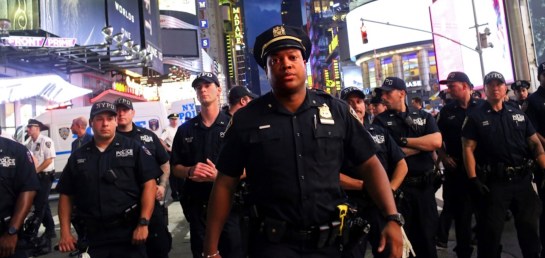
Policing in America is facing a PR crisis. Following the May 25th murder of George Floyd by Minneapolis police officer Derek Chauvin, the term “defund the police” has become a rallying cry for thousands across the country. Six months later, however, America has not defunded its police force––and in fact, has in some cases taken steps to give police departments even more money. Instead, police forces across America have taken an insidious approach: painting their departments in blackface.

After the January 6th Trump riot at the Capitol building , Yoganda Pittman, a Black woman, was named the new Chief of Capitol Police. Her appointment followed the resignation of former Chief Steven Sund and the arrest and firing of several white police officers who were found to be in attendance at the MAGA riot. Pittman’s appointment appeased many liberals who falsely believe that allowing Black folks to infiltrate or run law enforcement agencies will lead to higher levels of safety for Black Americans. The termination of several officers  who took part in the riot has convinced many that we are one step closer to “reforming” the police by weeding out the racist, bad apples within the department.

“Pittman’s appointment appeased many liberals.”

This is a nice narrative, but a false one; in order to understand why, we must look at the history of policing in this country. Modern policing in America was originally created as a replacement for America’s slave patrol system wherein squadrons made up of white volunteers were empowered to use vigilante tactics to enforce laws related to slavery. These “enforcers” were in charge of locating and returning enslaved people who had escaped, crushing uprisings led by enslaved people, and punishing enslaved workers who were found or believed to have violated plantation rules. After slavery was legally abolished in 1865, America created its modern police force to do the exact thing under a different name: maintain the white supremacist hierarchy that is necessary under racial capitalism. The purpose of policing––to jail and kill Black folks––remains the same regardless of the officers’ race.

Liberal media has also contributed to the recent valorization of Black cops. In the days after the January 6th riot, many news outlets aggressively pushed a story about Eugene Goodman, a Black capitol police officer who led several rioters away from the Congress people’s hiding places while being chased by a white supremacist mob. Several news outlets published testimonials of Black police officers disclosing instances of racism within the department. A January 14th article in ProPublica  notes that over 250 Black cops have sued the department for racism since 2001: some Black cops have alleged that white officers used racial slurs or hung nooses in Black officer’s lockers, and one Black cop even claimed he heard a white officer say, “Obama monkey, go back to Africa.”

“Modern policing in America was originally created as a replacement for America’s slave patrol system.”

These white officers’ racism is unsurprising, and I am not denying any of these claims. But focusing on these singular, isolated moments of racism wherein white cops are painted as cruel and Black cops are the sympathetic victims grossly oversimplifies the narrative of structural racism that modern American policing was built upon. After hearing these slurs that they were allegedly so disgusted by, these Black cops still intentionally chose to put on their badge, don their guns, and work alongside these white police officers who insulted and demeaned them, laboring under a violent system with the sole purpose of harming and terrorizing Black and low-income communities. Similarly, while Goodman’s actions most likely saved many lives during the riot, we cannot allow one moment of decency to erase centuries of racist violence.

The great Zora Neale Hurston once said: “All my skinfolk ain’t kinfolk.” Her words ring ever true today, and these Black police officers are an excellent example of why. It’s tempting to believe that putting Black folks on the force will solve racial violence, but this is a liberal myth we must break free of. Allowing Black people into inherently racist systems does not make those systems better, safer, or more equitable: a quick look at many Black folks in power today, such as Barack Obama, Kamala Harris, Lori Lightfoot, and Keisha Lance Bottoms immediately prove this to be the case. Everyone supporting racial capitalism must be scrutinized and held accountable, regardless of their identity. We cannot on the one hand say that ‘all cops are bastards’ and then suddenly feel sympathy when those cops are not white. If we want to defund and abolish the police, we must resist the narrative that Black cops have anything to offer us.

Mary Retta is a writer, virgo, cartoon enthusiast — a queer Black writer for sites like Teen Vogue, The Nation, Bitch Media, and Vice.

This article previously appeared in HoodCommunist .

Source: We Have To Stop Valorizing Black Cops | Black Agenda Report

August Wilson’s Uncompromising Vision “For Ma Rainey’s Black Bottom” | The New Republic

August Wilson’s Uncompromising Vision for Ma Rainey’s Black Bottom

It has taken decades for his Century Cycle plays to reach the screen—but not for lack of interest.

ADGER COWANS/GETTY
American playwright August Wilson (1945–2005), in New York in 2000

August Wilson had a magnificent ear. His supreme gift as a playwright was for transforming African American vernacular into crystalline poetry onstage. His sense for language was also evident in how he chose to be known. Growing up in the largely Black, poor, and working-class Hill District of Pittsburgh, dreaming of the sort of literary glory enjoyed by his idols Richard Wright and Langston Hughes, the young man must have known that “Frederick Kittel Jr., Great Black Writer” somehow didn’t have the right ring to it. At the age of 20, he rejected being the namesake of his father, a white, German-born, alcoholic baker who was, the playwright would later recall, “a sporadic presence” in his life. “August” was originally his middle name. “Wilson” was the maiden name of his Black mother, Daisy. Put the two together, and you had a moniker exuding steadfast wisdom, a name with gravitas, a name commensurate with its owner’s audacious ambition.

In the early 1980s, August Wilson embarked on a theatrical decathlon of his own design, aiming to write 10 plays, each set in a different decade of the twentieth century, that would reflect African American culture “in all its richness and fullness.” The time frames of the plays did not unfold chronologically. Take, for example, three of Wilson’s best: Ma Rainey’s Black Bottom (set in 1927) was followed by Fences (set in 1957), which was followed by Joe Turner’s Come and Gone (set in 1911). Collectively, the 10 plays would be called both the Pittsburgh Cycle and, perhaps more aptly since one of the works is set in Chicago, the American Century Cycle. Between 1982 and 2005, Wilson worked steadily, averaging a play every two and a half years. The tenth and final play in the Cycle, Radio Golf, premiered five days before his sixtieth birthday. Mission accomplished, he died of liver cancer six months later.

The plays are remarkable in both the depth of their historical exploration and their breadth of tone. The most emotionally wrenching are the two that take place earliest in the century. For many of the characters in Gem of the Ocean (set in 1904) and Joe Turner’s Come and Gone, slavery is a living memory and the Middle Passage an ancestral trauma that returns in nightmarish visions that, horrific as they are, can lead to a redemptive “washing of the soul.” Meanwhile, two of the plays set later in time border on satire in their caustic wit. In both Two Trains Running (set in 1969) and Radio Golf (set in 1997), Black folks strive to make it in America’s capitalist game only to find that, for them, the rules are subject to constant color-coded changes.

Wilson was showered with accolades, among them two Pulitzer Prizes, a Tony, two Drama Desk, and six New York Drama Critics’ Circle Awards. Even in his lifetime, the literary establishment was carving out his space on the Mount Rushmore of American Dramatists, alongside the monumental figures of Eugene O’Neill, Tennessee Williams, and Arthur Miller. Toni Morrison, in her foreword to the published text of The Piano Lesson (set in the 1930s), praised the epic grandeur of Wilson’s oeuvre and his genius for evoking the beauty of Black American speech—even while acknowledging “respectful reservations” that some critics had expressed about some of his plays: “their length (too much), a plethora of deus ex machina devices (ghosts; characters who live for centuries; sudden, senseless death) and sermonizing instead of storytelling.”

It is rarely noted today, but, in the last decade of his life, Wilson came to be seen—in the eyes of America’s theater establishment—as something a bit more fierce and troubling than a benign Broadway griot conjuring the history of his people onstage. In June 1996, at the peak of his fame and influence, Wilson gave a speech titled “The Ground On Which I Stand” that shocked and appalled prominent arbiters of the dramatic arts in America. Proudly proclaiming himself a “race man,” Wilson offered a blistering critique of “cultural imperialism” in the theater world and made a bold, blunt call for Black self-determination in the arts. Nine years later, in Radio Golf, Wilson would ridicule ambitious African Americans of the Clinton era who surrendered their principles for “a seat at the table” with high-status whites. With this speech, Wilson, who had been welcomed and fêted more enthusiastically than any other Black playwright, effectively knocked the table over. In his foreword to the text of Jitney (set in 1977), the always-iconoclastic Ishmael Reed wrote that Wilson wanted to distance himself “from the neo-cons and neo-liberals who had claimed him as a member of their ranks.” As a character in an August Wilson play might put it: Them white folks thought he was they boy. But he wasn’t studying them.

Wilson’s insistence that African Americans “have control over our own culture and its products” explains why it has taken several decades for any of his plays to make the journey from stage to screen. A compelling film version of Ma Rainey’s Black Bottom premiered on Netflix in December, arriving four years after a superb adaptation of Fences. Both films showcase illustrious Black talent in front of and behind the cameras. A generation ago, Wilson’s demand for Black artistic independence led some to call him a “separatist”; his stance was considered at best unrealistic. Today, he seems more like a visionary.

In the late 1980s and early 1990s, I sensed that a lot of older white theatergoers I spoke with felt a bit virtuous about attending August Wilson plays. They would say, “I loved The Piano Lesson” with the same sort of self-regard as the dad in Get Out when he declares he would vote for Obama a third time if he could. Seeing an August Wilson play wasn’t just a great night out at the theater—it was an edifying anthropological excursion.

“Don’t never let nobody tell you there ain’t no good white people,” the former slave Solly says in Gem of the Ocean. But good white people are hard to find anywhere in the Century Cycle. In a cumulative dramatis personae numbering in the 70s, I counted a grand total of four white characters onstage, and all of these are men with dubious motives. Of the countless offstage white characters mentioned, they are overwhelmingly cheats, murderers, and rapists, or, as is the case in Jitney, in which a young white woman falsely accuses her Black boyfriend of rape, deadly liars. The widespread white villainy in the plays either did not register with Wilson’s white admirers or did not trouble them. After all, he wasn’t writing about people like them, was he?

At some point in every one of the 10 plays, Black characters engage in a debate that could be boiled down to Personal Agency vs. Systemic Racism. Are they masters of their own destiny or eternally limited in their aspirations by the legacy of slavery? Sometimes the conflict is roiling within a single character. In Two Trains Running, a restaurant manager named Memphis rails against Black Power activists “talking about freedom, justice and equality and don’t know what it mean. You born free. It’s up to you to maintain it.” Yet this same character had to flee the South when a gang of white men wanted to take over land he had bought and paid for. “Got home and they had set fire to my crop,” Memphis recalls. “To get to my house I’d have to walk through fire. I wasn’t ready to do that.”
It’s possible that the “neo-cons and neo-liberals” that Ishmael Reed invoked did not absorb the complexity and ambiguity of the debates among Wilson’s characters when they claimed the playwright as “a member of their ranks.” But for Black Americans, even success is often stigmatized. In March 1996, August Wilson sat at the wooden table in the dark void of the Charlie Rose Show set. “Some have said,” the host drawled unctuously, “that, in a sense, your success keeps other Black playwrights in the shadows,” as if it were somehow Wilson’s fault that he had been anointed the Chosen One by the theater establishment. Wilson looked dismayed by the suggestion and said, “I don’t understand the logic behind that.” Three months later, he would offer a more full-throated response on the situation of Black dramatists in America.

“I am what is known … as a ‘race man,’” August Wilson declared in his keynote address to the Theatrical Communications Group national conference at Princeton University, in June 1996. “That is simply that I believe that race matters—that it is the largest, most identifiable, most important part of our personality.” This pronouncement came after he had, earlier in the speech, cited among his influences, “Marcus Garvey and the Honorable Elijah Muhammad,” two names that Wilson certainly knew would raise the hairs on many an American neck.

He then turned to his métier. “If you do not know, I will tell you,” Wilson said. “Black theater in America is alive, it is vibrant, it is vital … it just isn’t funded.” In the theater world, financial resources were “reserved as privilege to the overwhelming abundance of institutions that preserve, promote, and perpetuate white culture.” As a remedy, he called for the creation and funding of institutions that would be dedicated exclusively to African American works: “We need theaters to develop our playwrights. We need those misguided financial resources to be put to better use. Without theaters we cannot develop our talents.… We need some theaters.”

Wilson went on to criticize the sort of white theatergoers who flocked to his plays, saying “the subscription audience holds theaters hostage to the mediocrity of its tastes, and impedes the further development of an audience for the work that we do.” He added: “While intentional or not, it serves to keep Blacks out of the theater. A subscription audience becomes not a support system but makes the patrons members of a club to which the theater serves as a clubhouse.” Finally, for good measure, Wilson slammed reviewers, most of whom had lavished praise on his work. “A stagnant body of critics,” he said, “operating from the critical criteria of 40 years ago, makes for a stagnant theater without the fresh and abiding influence of contemporary ideas.… The critic who can recognize a German neo-Romantic influence should also be able to recognize an American influence from the blues or Black church rituals.”

The speech was instantly controversial. Perhaps no one was more offended by it than Robert Brustein, then director of the American Repertory Theater at Harvard and drama critic for, ahem, The New Republic. In “The Ground On Which I Stand,” Wilson called out Brustein for suggesting that theatrical institutions were lowering their aesthetic standards in their zeal to produce more culturally diverse works. Wilson stated that “works by minority artists may lead to a raising of standards and a raising of the levels of excellence, but Mr. Brustein cannot allow that possibility.”

Brustein and Wilson went at it in a series of written exchanges in American Theatre magazine. Criticizing the playwright for employing “the language of self-segregation,” Brustein said, “I fear Wilson is displaying a failure of memory—I hesitate to say a failure of gratitude” for the support his work had received in the theater world. Wilson responded: “To suggest that I owe a debt of gratitude to the theaters that have done my work is to suggest my plays are without sufficient merit to warrant their production other than as an act of benevolence.”

The Brustein brouhaha culminated in a public debate at New York’s Town Hall in January 1997, an event that the chattering classes greeted with an excitement usually reserved for Ali-Frazier prizefights. The moderator, Anna Deveare Smith, had to ask for order in the crowd after Brustein mocked Wilson for considering himself “African” and said that the playwright had “probably the best mind of the seventeenth century.” Wilson replied: “These are some of the most outrageous things I’ve ever heard.” After that, the evening got really contentious. You can listen to excerpts of the debate on YouTube.

“The Ground On Which I Stand” was most widely attacked for the opposition August Wilson expressed in it to nontraditional or color-blind casting. “To mount an all-Black production of Death of a Salesman,” he declared, “or any other play conceived for white actors as an investigation of the human condition through the specifics of white culture is to deny us our own humanity, our own history, and the need to make our own investigations from the cultural ground on which we stand as Black Americans.”

Wilson did not mention that he had, in fact, written a brilliant African American retort to Arthur Miller’s masterpiece. It’s called Fences, and the parallels between the two plays are fascinating. Instead of Miller’s lowly Willy Loman, Wilson presented a Black Everyman, the sanitation worker Troy Maxson. Willy is unfaithful to his wife and has a difficult relationship with his athlete son. Ditto for Troy. Both plays end with bittersweet eulogies. And both plays were immediately appreciated, each winning both the Tony Award and the Pulitzer Prize. But Troy Maxson’s American journey is profoundly different from Willy Loman’s, his travails inextricably intertwined with his race. And Loman and Maxson have strikingly opposite views on life. Take, as just one juicy example, Willy’s obsession with being “well-liked.” He tells his sons: “Be liked and you will never want.” By contrast, Troy advises his son: “Don’t you try and go through life worrying about if somebody like you or not. You best be making sure they doing right by you.”

When Paramount Pictures approached Wilson about buying the film rights to Fences, the playwright had a fundamental request, one he used as the title for an op-ed piece he published in The New York Times in 1990: “I Want a Black Director.” As Wilson recounted in the article, his wish was “greeted by blank, vacant stares and the pious shaking of heads as if in response to my unfortunate naiveté.” Wilson even turned down “a well-known, highly respected” white filmmaker. “White directors are not qualified for the job,” he insisted. “The job requires someone who shares the specifics of the culture of Black Americans.” August Wilson stuck to his guns. And when he died 15 years later, none of his plays had been turned into movies.

Today, Wilson’s decision to hold out is reaping luscious fruit. In 2010, Denzel Washington starred in a Broadway revival of Fences, bringing a febrile energy to the role of Troy Maxson, reimagining James Earl Jones’s original, more somber, and seemingly definitive portrayal. Wilson’s widow, Constanza Romero, approached Washington about a film adaptation. At last, Wilson would get his Black director. Arguably the all-time biggest Black star of stage and screen, Washington had won his first Oscar for playing a runaway slave turned Union soldier in Glory and had incarnated Malcolm X. He had portrayed not only action heroes but also (Hooray for nontraditional casting!) Richard III. The film version of Fences that he starred in and directed is a master class in “opening up” a piece of theater. With clever changes of settings and dynamic camera work and editing, Washington made the stagiest of dramas thrillingly cinematic. He also respected the cultural integrity of Wilson’s work. The playwright’s estate has entrusted him to produce film versions of all 10 plays in the Century Cycle.

The second film adaptation, Ma Rainey’s Black Bottom, features Viola Davis in a bravura performance as the title character, “the Mother of the Blues.” Davis has become the preeminent interpreter of Wilson’s women. She won her first Tony Award for playing the fiery Tonya in King Hedley II (set in 1985) and nabbed a Tony and an Oscar for her portrayal of Troy’s wife, Rose, the most soulful of the wounded warriors in the Maxson family battleground, in Fences. In addition to her towering talent, Viola has the most expressive pair of eyes in American cinema since that other dazzling Davis: Bette.

Wilson’s demand for Black artistic independence led some to call him a “separatist.” Today, he seems more like a visionary.

Most of the film’s action takes place in a Chicago recording studio on a sweltering day in 1927. Ma Rainey and her four-man band are scheduled to record several tracks, including the song that Wilson took as the title of his play. As in all of Wilson’s Cycle, the script is bursting with sublime language: boasting and jiving, tall tales and philosophical debates, angry clashes and painful confessions, all rendered with an uncanny eloquence that is uniquely African American. Wilson garners tremendous suspense from the power struggle between Ma Rainey and the two white men who are ostensibly in charge of the recording session. Throughout the long, hot afternoon, the blues singer wages a battle for both her artistic integrity and her personal dignity. “They don’t care nothing about me,” she says of her manager and the record company chief. “All they want is my voice. Well, I done learned that, and they gonna treat me like I want to be treated no matter how much it hurt them.”
Chadwick Boseman as Levee, Viola Davis as Ma Rainey, and Colman Domingo as Cutler, in “Ma Rainey’s Black Bottom”

DAVID LEE/NETFLIX

The leaders of the Ma Rainey creative team embody August Wilson’s vision of Black self-determination in the arts. The film’s director, George C. Wolfe, began his long and distinguished theatrical career with the piquant satire The Colored Museum and the musical drama Jelly’s Last Jam, about jazzman Jelly Roll Morton. The screenwriter, Ruben Santiago-Hudson, was a frequent Wilson collaborator. While remaining faithful to Wilson’s text, they have added a prologue and an epilogue to the film version that only enhance the power of the work. The casting of Glynn Turman as the pianist Toledo will warm the hearts of Black film lovers who have revered the actor since his role in the 1975 classic Cooley High. Finally, after portraying such Black icons as Thurgood Marshall, Jackie Robinson, James Brown, and the superhero T’Challa, Chadwick Boseman capped his career with a scorching performance as the trumpeter Levee, his last appearance on-screen before his tragic death at 43.

By insisting on a Black director for a movie adaptation, August Wilson proved himself to be as much of a badass as his Ma Rainey, who knows that, aside from her talent, her greatest power as an artist is the power to say “no,” and to keep on saying it, until she gets exactly what she wants. As producer of the Century Cycle, Washington has approached an array of acclaimed Black directors, including Ava DuVernay, Ryan Coogler, and Barry Jenkins, to helm future adaptations.

Thanks to the movies, people worldwide will get to discover August Wilson’s extraordinary poetry, grounded in the intensity of his listening to his Black elders in Pittsburgh. In his introduction to Seven Guitars (set in 1948), he paid tribute to his mother, Daisy, saying that the everyday content of her life was “worthy of art.” During that heated Town Hall debate in 1997, an audience member asked August Wilson about his mixed racial heritage, in effect, raising the specter of Frederick Kittel Sr. The playwright’s response was swift and to the point: “My father was German. What about it? … The cultural environment of my life is Black. I make the self-definition of myself as a Black man, and that’s all anyone needs to know.”

Source: August Wilson’s Uncompromising Vision “For Ma Rainey’s Black Bottom” | The New Republic

FHTE Reparationist Quick Guided (Volume 1 Issue 2)_.pdf – Google Drive

FHTE Reparationist Quick Guide
January 2021 – Volume 1 Issue 2

About Us
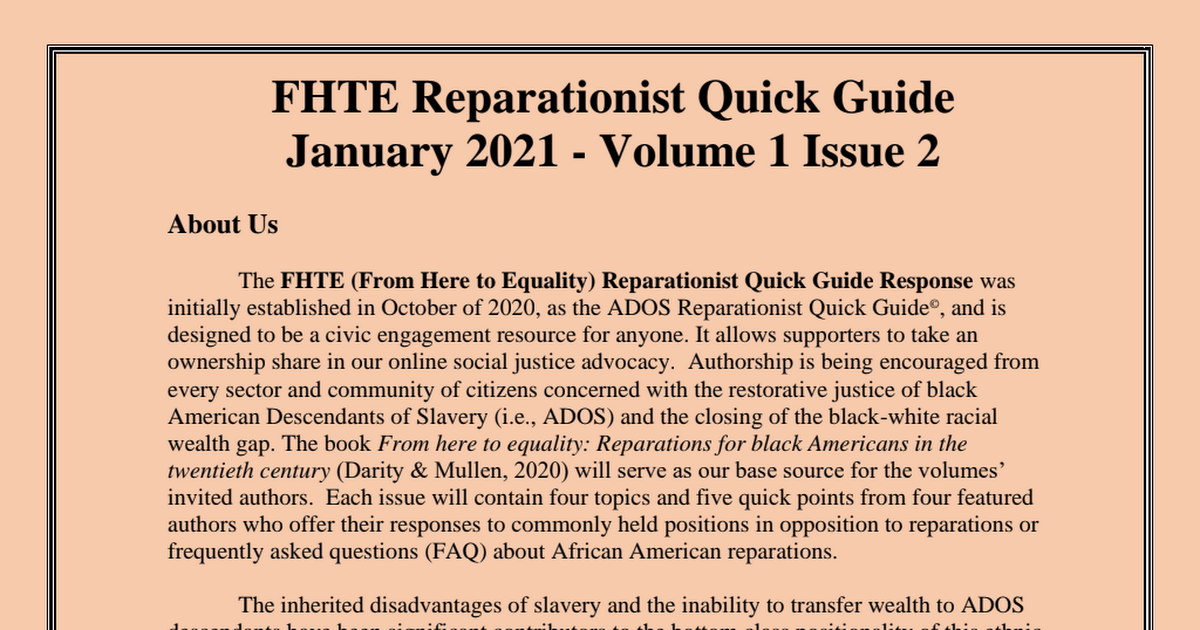
The FHTE (From Here to Equality) Reparationist Quick Guide Response was
initially established in October of 2020, as the ADOS Reparationist Quick Guide©, and is designed to be a civic engagement resource for anyone. It allows supporters to take an ownership share in our online social justice advocacy. Authorship is being encouraged from every sector and community of citizens concerned with the restorative justice of black American Descendants of Slavery (i.e., ADOS) and the closing of the black-white racial
wealth gap. The book From here to equality: Reparations for black Americans in the twentieth century (Darity & Mullen, 2020) will serve as our base source for the volumes’ invited authors. Each issue will contain four topics and five quick points from four featured authors who offer their responses to commonly held positions in opposition to reparations or frequently asked questions (FAQ) about African American reparations.

The inherited disadvantages of slavery and the inability to transfer wealth to ADOS descendants have been a significant contributor to the bottom class positionality of this ethnic group. This series is published to encourage study and dialogue. It is an instrument for personal empowerment. The guide creates a space for the civic engagement participation of Reparationist in national coalition-building, including petitioning for significant revision (or
replacement) of the bill H.R. 40 (S.1083) currently under consideration in the U.S. Congress.


Source: FHTE Reparationist Quick Guided (Volume 1 Issue 2)_.pdf – Google Drive

Global Right-Wing Extremism Networks Are Growing. The U.S. Is Just Now Catching Up. — ProPublica

ProPublica is a nonprofit newsroom that investigates abuses of power. Sign up to receive our biggest stories as soon as they’re published.

During the past two years, U.S. counterterrorism officials held meetings with their European counterparts to discuss an emerging threat: right-wing terror groups becoming increasingly global in their reach.

American neo-Nazis were traveling to train and fight with militias in the Ukraine. There were suspected links between U.S. extremists and the Russian Imperial Movement, a white supremacist group that was training foreigners in its St. Petersburg compounds. A gunman accused of killing 23 people at an El Paso Walmart in 2019 had denounced a “Hispanic invasion” and praised a white supremacist who killed 51 people at mosques in Christchurch, New Zealand, and who had been inspired by violent American and Italian racists.

But the efforts to improve transatlantic cooperation against the threat ran into a recurring obstacle. During talks and communications, senior Trump administration officials steadfastly refused to use the term “right-wing terrorism,” causing disputes and confusion with the Europeans, who routinely use the phrase, current and former European and U.S. officials told ProPublica. Instead, the FBI and Department of Homeland Security referred to “racially or ethnically motivated violent extremism,” while the State Department chose “racially or ethnically motivated terrorism.”

“We did have problems with the Europeans,” one national security official said. “They call it right-wing terrorism and they were angry that we didn’t. There was a real aversion to using that term on the U.S. side. The aversion came from political appointees in the Trump administration. We very quickly realized that if people talked about right-wing terrorism, it was a nonstarter with them.”

The U.S. response to the globalization of the far-right threat has been slow, scattered and politicized, U.S. and European counterterrorism veterans and experts say. Whistleblowers and other critics have accused DHS leaders of downplaying the threat of white supremacy and slashing a unit dedicated to fighting domestic extremism. DHS has denied those accusations.

In 2019, a top FBI official told Congress the agency devoted only about 20% of its counterterrorism resources to the domestic threat. Nonetheless, some FBI field offices focus primarily on domestic terrorism.

Former counterterrorism officials said the president’s politics made their job harder. The disagreement over what to call the extremists was part of a larger concern about whether the administration was committed to fighting the threat.

“The rhetoric at the White House, anybody watching the rhetoric of the president, this was discouraging people in government from speaking out,” said Jason Blazakis, who ran a State Department counterterrorism unit from 2008 to 2018. “The president and his minions were focused on other threats.”

Other former officials disagreed. Federal agencies avoided the term “right-wing terrorism” because they didn’t want to give extremists legitimacy by placing them on the political spectrum, or to fuel the United States’ intense polarization, said Christopher K. Harnisch, the former deputy coordinator for countering violent extremism in the State Department’s counterterrorism bureau. Some causes espoused by white supremacists, such as using violence to protect the environment, are not regarded as traditionally right-wing ideology, said Harnisch, who stepped down this week.

“The most important point is that the Europeans and the U.S. were talking about the same people,” he said. “It hasn’t hindered our cooperation at all.”

As for the wider criticism of the Trump administration, Harnisch said: “In our work at the State Department, we never faced one scintilla of opposition from the White House about taking on white supremacy. I can tell you that the White House was entirely supportive.”

The State Department focused mostly on foreign extremist movements, but it examined some of their links to U.S. groups as well.

There was clearly progress on some fronts. The State Department took a historic step in April by designating the Russian Imperial Movement and three of its leaders as terrorists, saying that the group’s trainees included Swedish extremists who carried out bombing attacks on refugees. It was the first such U.S. designation of a far-right terrorist group.

With Trump now out of office, Europeans and Americans expect improved cooperation against right-wing terrorists. Like the Islamist threat, it is becoming clear that the far-right threat is international. In December, a French computer programmer committed suicide after giving hundreds of thousands of dollars to U.S. extremist causes. The recipients included a neo-Nazi news website. Federal agencies are investigating, but it is not yet clear whether anything about the transaction was illegal, officials said.

“It’s like a transatlantic thing now,” said a European counterterror chief, describing American conspiracy theories that surface in the chatter he tracks. “Europe is taking ideology from U.S. groups and vice versa.”

The Crackdown

International alliances make extremist groups more dangerous, but also create vulnerabilities that law enforcement could exploit.

Laws in Europe and Canada allow authorities to outlaw domestic extremist groups and conduct aggressive surveillance of suspected members. America’s civil liberties laws, which trace to the Constitution’s guarantee of free speech spelled out in the First Amendment, are far less expansive. The FBI and other agencies have considerably more authority to investigate U.S. individuals and groups if they develop ties with foreign terror organizations. So far, those legal tools have gone largely unused in relation to right-wing extremism, experts say.

To catch up to the fast-spreading threat at home and abroad, Blazakis said, the U.S. should designate more foreign organizations as terrorist entities, especially ones that allied nations have already outlawed.

A recent case reflects the kind of strategy Blazakis and others have in mind. During the riots in May after the death of George Floyd in Minneapolis, FBI agents got a tip that two members of the anti-government movement known as the Boogaloo Bois had armed themselves, according to court papers. The suspects were talking about killing police officers and attacking a National Guard armory to steal heavy weapons, the court papers allege. The FBI deployed an undercover informant who posed as a member of Hamas, the Palestinian terrorist group, and offered to help the suspects obtain explosives and training. After the suspects started talking about a plot to attack a courthouse, agents arrested them, according to the court papers. In September, prosecutors filed charges of conspiring and attempting to provide material support to a foreign terrorist organization, which can bring a sentence of up to 20 years in prison. One of the defendants pleaded guilty last month. The other still faces charges.

If the U.S. intelligence community starts using its vast resources to gather information on right-wing movements in other countries, it will find more linkages to groups in the United States, Blazakis and other experts predicted. Rather than resorting to a sting, authorities could charge American extremists for engaging in propaganda activity, financing, training or participating in other actions with foreign counterparts.

A crackdown would bring risks, however. After the assault on the Capitol, calls for bringing tougher laws and tactics to bear against suspected domestic extremists revived fears about civil liberties similar to those raised by Muslim and human rights organizations during the Bush administration’s “war on terror.” An excessive response could give the impression that authorities are criminalizing political views, which could worsen radicalization among right-wing groups and individuals for whom suspicion of government is a core tenet.

“You will hit a brick wall of privacy and civil liberties concerns very quickly,” said Seamus Hughes, a former counterterrorism official who is now deputy director of the Program on Extremism at George Washington University. He said the federal response should avoid feeding into “the already existing grievance of government overreach. The goal should be marginalization.”

In recent years, civil liberties groups have warned against responding to the rise in domestic extremism with harsh new laws.

“Some lawmakers are rushing to give law enforcement agencies harmful additional powers and creating new crimes,” wrote Hina Shamsi, the director of the ACLU’s national security project, in a statement by the organization about congressional hearings on the issue in 2019. “That approach ignores the way power, racism, and national security laws work in America. It will harm the communities of color that white supremacist violence targets — and undermine the constitutional rights that protect all of us.”

The Pivot Problem


There is also an understandable structural problem. Since the Sept. 11 attacks in 2001, intelligence and law enforcement agencies have dedicated themselves to the relentless pursuit of al-Qaida, the Islamic State, Iran and other Islamist foes.

Now the counterterrorism apparatus has to shift its aim to a new menace, one that is more opaque and diffuse than Islamist networks, experts said.

It will be like turning around an aircraft carrier, said Blazakis, the former State Department counterterrorism official, who is now a professor at the Middlebury Institute of International Studies.

“The U.S. government is super slow to pivot to new threats,” Blazakis said. “There is a reluctance to shift resources to new targets. And there was a politicization of intelligence during the Trump administration. There was a fear to speak out.”

Despite periodic resistance and generalized disorder in the Trump administration, some agencies advanced on their own, officials said. European counterterror officials say the FBI has become increasingly active in sharing and requesting intelligence about right-wing extremists overseas.

A European counterterror chief described recent conversations with U.S. agents about Americans attending neo-Nazi rallies and concerts in Europe and traveling to join the Azov Battalion, an ultranationalist Ukrainian militia fighting Russian-backed separatists. About 17,000 fighters from 50 countries, including at least 35 Americans, have traveled to the Ukrainian conflict zone, where they join units on both sides, according to one study. The fighting in the Donbass region offers them training, combat experience, international contacts and a sense of themselves as warriors, a theater reminiscent of Syria or Afghanistan for jihadis.

“The far right was not a priority for a long time,” the European counterterror chief said. “Now they are saying it’s a real threat for all our societies. Now they are seeing we have to handle it like Islamic terrorism. Now that we are sharing and we have a bigger picture, we see it’s really international, not domestic.”

Galvanized

The assault on Congress signaled the start of a new era, experts said. The convergence of a mix of extremist groups and activists solidified the idea that the far-right threat has overtaken the Islamist threat in the United States, and that the government has to change policies and shift resources accordingly. Experts predict that the Biden administration will make global right-wing extremism a top counterterrorism priority.

“This is on the rise and has gotten from nowhere on the radar to very intense in a couple of years,” a U.S. national security official said. “It is hard to see how it doesn’t continue. It will be a lot easier for U.S. officials to get concerned where there is a strong U.S. angle.”

A previous spike in domestic terrorism took place in the 1990s, an era of violent clashes between U.S. law enforcement agencies and extremists. In 1992, an FBI sniper gunned down the wife of a white supremacist during an armed standoff in Ruby Ridge, Idaho. The next year, four federal agents died in a raid on heavily armed members of a cult in Waco, Texas; the ensuing standoff at the compound ended in a fire that killed 76 people.Both sieges played a role in the radicalization of the anti-government terrorists who blew up the Oklahoma City federal building in 1995, killing 168 people, including children in a day care center for federal employees. Oklahoma City remains the deadliest terrorist act on U.S. soil aside from the Sept. 11 attacks.

The rise of al-Qaida in 2001 transformed the counterterrorism landscape, spawning new laws and government agencies and a worldwide campaign by intelligence agencies, law enforcement and the military. Despite subsequent plots and occasionally successful attacks involving one or two militants, stronger U.S. defenses and limited radicalization among American Muslims prevented Islamist networks from hitting the United States with the kind of well-trained, remotely directed teams that carried out mass casualty strikes in London in 2005, Mumbai in 2008 and Paris in 2015.

During the past decade, domestic terrorism surged in the United States. Some of the activity was on the political left, such as the gunman who opened fire at a baseball field in Virginia in 2017. The attack critically wounded Rep. Steve Scalise, a Republican legislator from Louisiana who was the House Majority whip, as well as a Capitol Police officer guarding him and four others.

But many indicators show that far-right extremism is deadlier. Right-wing attacks and plots accounted for the majority of all terrorist incidents in the country between 1994 and 2020, according to a study by the Center for Strategic and International Studies. The Anti-Defamation League reported in 2018 that right-wing terrorists were responsible for more than three times as many deaths as Islamists during the previous decade.

“There have been more arrests and deaths in the United States caused by domestic terrorists than international terrorists in recent years,” said Michael McGarrity, then the counterterrorism chief of the FBI, in congressional testimony in 2019. “Individuals affiliated with racially-motivated violent extremism are responsible for the most lethal and violent activity.”

During the same testimony, McGarrity said the FBI dedicated only about 20% of its counterterrorism resources to the domestic threat. The imbalance, experts say, was partly a lingering result of the global offensive by the Islamic State, whose power peaked in the middle of the decade. Another reason: Laws and rules instituted in the 1970s after FBI spying scandals make it much harder to monitor, investigate and prosecute Americans suspected of domestic extremism.

The Trump Administration and the Europeans

Critics say the Trump administration was reluctant to take on right-wing extremism. The former president set the tone with his public statements about the violent Unite the Right rally in Charlottesville, Virginia, in 2017, they say, and with his call last year telling the far-right Proud Boys group to “stand back and stand by.”

Still, various agencies increased their focus on the issue because of a drumbeat of attacks at home — notably the murders of 11 people at a synagogue in Pittsburgh in 2018 — and overseas. The Christchurch massacre of worshippers at mosques in New Zealand in March 2019 caught the attention of American officials. It was a portrait of the globalization of right-wing terrorism.

Brenton Tarrant, the 29-year-old Australian who livestreamed his attack, had traveled extensively in Europe, visiting sites he saw as part of a struggle between Christianity and Islam. In his manifesto, he cited the writings of a French ideologue and of Dylann Roof, an American who killed nine people at a predominantly Black church in South Carolina in 2015. While driving to the mosques, Tarrant played an ode to Serbian nationalist fighters of the Balkan wars on his car radio. And he carried an assault rifle on which he had scrawled the name of an Italian gunman who had shot African immigrants in a rampage the year before.

Christchurch was “part of a wave of violent incidents worldwide, the perpetrators of which were part of similar transnational online communities and took inspiration from one another,” said a report last year by Europol, an agency that coordinates law enforcement across Europe. The report described English as “the lingua franca of a transnational right-wing extremist community.”

With its long tradition of political terrorism on both extremes, Europe has also suffered a spike in right-wing violence. Much of it is a backlash to immigration in general and Muslim communities in particular. Responding to assassinations of politicians and other attacks, Germany and the United Kingdom have outlawed several organizations.

Closer to home, Canada has banned two neo-Nazi groups, Blood and Honour and Combat 18, making it possible to charge people for even possessing their paraphernalia or attending their events. Concerts and sales of video games, T-shirts and other items have become a prime source of international financing for right-wing movements, the European counterterror chief said.

During the past two years, officials at the FBI, DHS, State Department and other agencies tried to capitalize on the deeper expertise of European governments and improve transatlantic cooperation against right-wing extremism. Legal and cultural differences complicated the process, American and European officials said. A lack of order and cohesion in the U.S. national security community was another factor, they said.

“There was so little organization to the U.S. counterterrorism community that everybody decided for themselves what they would do,” a U.S. national security official said. “It was not the type of centrally controlled effort that would happen in other administrations.”

As a result, the U.S. government has sometimes been slow to respond to European requests for legal assistance and information-sharing about far-right extremism, said Eric Rosand, who served as a State Department counterterrorism official during the Obama administration.

“U.S.-European cooperation on addressing white supremacist and other far-right terrorism has been ad hoc and hobbled by a disjointed and inconsistent U.S. government approach,” Rosand said.

The semantic differences about what to call the threat didn’t help, according to Rosand and other critics. They say the Trump administration was averse to using the phrase “right-wing terrorism” because some groups on that part of the ideological spectrum supported the president.

“It highlights the disconnect,” Rosand said. “They were saying they didn’t want to suggest the terrorism is linked to politics. They didn’t want to politicize it. But if you don’t call it what it is because of concerns of how it might play with certain political consistencies, that politicizes it.”

Harnisch, the former deputy coordinator at the State Department counterterrorism bureau, rejected the criticism. He said cooperation with Europeans on the issue was “relatively nascent,” but that there had been concrete achievements.

“I think we laid a strong foundation, and I think the Biden administration will build on it,” Harnisch said. “From my perspective, we made significant progress on this threat within the Trump administration.”

Get the latest news from ProPublica every afternoon.
Portrait of Sebastian Rotella

Sebastian Rotella

Sebastian Rotella is a senior reporter at ProPublica. An award-winning foreign correspondent and investigative reporter, Sebastian’s coverage includes terrorism, intelligence and organized crime.

Source: Global Right-Wing Extremism Networks Are Growing. The U.S. Is Just Now Catching Up. — ProPublica

Why History Matters: the Legacy of Slavery – CounterPunch.org

Why History Matters: the Legacy of Slavery


Slave auction block, Green Hill Plantation, Campbell County, Virginia, Historic American Buildings Survey – Public Domain

Many Americans watched as Joe Biden marked his Inauguration Day celebration with a brief presentation before the statue of Abraham Lincoln, invoking the Civil War as an historical moment when the nation triumphed over deep division.

When recalling Lincoln, many New Yorkers may remember the famous speech he gave at Cooper Institute (aka Cooper Union) in February 1860 calling to limit the extension – but not the end – of slavery.  It was a critical campaign speech that helped him secure the Republican Party nomination for President.  In November, he was elected, and, in December, South Carolina was the first state to secede from the Union.

Unfortunately, few American – and likely very few New Yorkers – will recall that Lincoln’s speech was strongly attacked by city business leaders and the Democratic Party, many assailing him with the racist slogan, “Black Republican.” More important, Lincoln’s election sparked a strong movement in the city, led by Mayor Fernando Wood, to join the South and secede from the Union.

This is one of the many important historical stories retold in an informative new book by Jonathan Daniel Wells, The Kidnapping Club: Wall Street, Slavery and Resistance on the Eve of the Civil War (Bold Type Books). Slavery was formally abolished in New York State in 1827, but the slave trade lived on in the city until the Civil War. Wells argues that the slave trade persisted in New York City in the decades before the Civil War because it was the capital of the Southern slave economy.

The city’s business community of major banks, insurance companies and shipping industry financed and facilitated the cotton trade. Many of the leaders of this community played a decisive role in city social life and politics, including control over the powerful Democratic Party. Together, they backed the authority of the Constitution’s “Fugitive Slave Clause” – and later Fugitive Slave Acts (1793 and 1850) — guaranteeing slavery. Equally critical, city police, leading lawyers and judges (state and federal), with the support of the growing Irish immigrant community, colluded with organized slave “kidnappers.”

The slave trade functioned in two complementary ways. First, northern free Blacks — including young children — as well as self-emancipated former slaves who fled to New York from the slave states lived in fear of being kidnapped by organize slave catchers (often city police officers) and transported south into slavery. Second, “slaver” ships regularly stopped in New York harbor with numerous African slaves hidden on board as cargo to be sold as part of a lucrative, if illegal, business.

In pre-Civil War New York, the police were underpaid and made money through accepting bribes as well as by securing lucrative rewards from seizing and sending alleged “fugitive” Black people to the South or a fee for the sale of a captured free Black person into slavery. Because the courts were run by the Democrats, graft and corruption were accepted judicial procedures. Any Black person could be seized — walking on the street, working on the docks, at home in the middle of the night and even kids on their way to school – and accused of being an allegedly run-away slave. Most judges were notorious racists who thought little of Black people and were eager to go along with police charges.

The city’s powerful pro-slavery movement based its support for Southern slavery and slave kidnapping on the Constitution’s “Fugitive Slave Clause” (i.e., Article 4, Section 2, Clause 3). It stipulated that “no person held to service or labor” would be released from bondage in the event they escaped to a free state, thus requiring northern free cities like New York to return the self-emancipated to their southern enslavers.

In 1793, Congress passed the Fugitive Slave Act that added more enforcement teeth to the original Clause, explicitly stating that owners of enslaved people and their “agents” had the right to search for escapees within the borders of free states. Henry Clay promoted what was known as the “Compromise of 1850” that strengthened the Fugitive Slave Act to forestall growing talk of Southern secession. The revised act compelled citizens to assist in the capture of runaways and denied escaped people the right to a jury trial, among other actions.  The new act was met by fierce resistance in many anti-slavery states, including upstate New York. The new act was adopted as the Underground Railroad reached its peak as many self-emancipated former slaves fled to Canada to escape U.S. jurisdiction.

The author grounds much of his narrative around the life of David Ruggles, a courageous Black abolitionists and journalist.  He was born in Connecticut in 1810 when the spirit of the Revolution still glowed. At age 16, he moved to New York and became an abolitionist activist. He was a prolific contributor to newspapers, including his own paper Mirror of Liberty, published numerous pamphlets and contributed to abolitionist papers like The Liberator. He named “The New York Kidnapping Club” and published a list those he believed participated in kidnappings. Going further, he boarded ships in the harbor in search of Black captives or for signs of participants in the illegal slave trade.  He also hosted the wedding of Frederick Douglass and Anna Murray at his New York home after they fled Maryland.

Ruggles helped forge the Underground Railroad, thus assisting self-liberated fugitives to safety in the north or to freedom in Canada. He was joined by a small but activist antislavery community that included Horace Dresser, Arthur Tappan, Charles B. Ray and Elizabeth Jennings. He ran a bookstore and was physically attacked, his store burned; he was hounded by the police and even briefly jailed. Sadly, by his 30s, he was nearly blind and moved to Massachusetts.

In 1837, Ruggles helped found the New York Committee of Vigilance, a biracial organization opposed to the kidnapping of innocent Black residents as well as self-liberated former slaves. The abolitionists were a small but activities community that regularly protested when a Black person was kidnapped and petitioned for jury trials in the cases of those arrested as fugitives. Not unlike today’s supporters of Black Lives Matter, Black and white activists in pre-Civil War New York claimed that law enforcement was mostly little more than legalized racism.

The Kidnapping Club reminds readers that New York was a pro-slavery city even as the nation was engulfed in the Civil War. Wells recounts how the city’s leadership joined with the growing movement in the South to promote secession. While the South seceded and New York (white) citizen voted against Lincoln’s election, the city remained part of the Union.

However, built-up anti-abolitionist sentiments exploded in the 1865 Draft Riot that saw Union soldier from the recent Battle of Gettysburg march on the city to suppress the uprising in which the Negro Orphan Asylum burned, numerous churches destroyed and about 100 people died, many of them Blacks.

Without acknowledging the racial conditions of New York during pre-Civil War era, especially the horrors inflicted by the “kidnapping club” and the role of the police and judiciary, one cannot fully understand – nor can society truly address – the complaints raised by the Black Lives Matter movement today. Racial oppression and suffering leave a deep and enduring scar that only true social change can remedy.

David Rosen is the author of Sex, Sin & Subversion:  The Transformation of 1950s New York’s Forbidden into America’s New Normal (Skyhorse, 2015).  He can be reached at drosennyc@verizon.net; check out www.DavidRosenWrites.com.

Source: Why History Matters: the Legacy of Slavery – CounterPunch.org

An FBI Agent Went Undercover to Study White Supremacists. He’s Now Speaking Out About Racist Police. – Mother Jones

One Capitol Police officer was caught taking a selfie with a member of the white supremacist mob that overtook the US Capitol last week. A second officer has been suspended for wearing a “Make America Great Again” hat and directing insurrectionists around the building rather than handcuffing them. The storming of the Capitol has revived concerns about the ties between police and white supremacists, in part because officers arrested far more Black Lives Matter protesters this summer than they did Trump supporters who broke into the legislative building with weapons, at least one Confederate flag, and bundles of zip ties.

It wasn’t just on-duty cops who raised eyebrows: Off-duty law enforcement officers were allegedly part of the mob itself, with some flashing their badges and identification cards as they rushed through the doors, according to an on-duty DC Metro Police officer who saw them. “If these people can storm the Capitol building with no regard to punishment, you have to wonder how much they abuse their powers when they put on their uniforms,” the officer wrote later on Facebook, according to Politico.

Police departments around the country are now investigating officers who are suspected of attending the rally in DC, or were caught posting racist messages on social media. Days after the attack, New York Rep. Jamaal Bowman introduced a bill that would require a commission to examine whether Capitol Police officers have white supremacist ties.

For some experts, these investigations are far too little, too late: Police departments and federal agencies have long understood that certain cops are connected to racist groups, and have largely looked the other way. “We’ve known for decades that there are racial disparities in every step of the criminal justice process, from who gets stopped to who gets arrested to who police use force against to how they get charged,” says Michael German, a former FBI agent who now studies white supremacist infiltration of police departments as a fellow at the liberal Brennan Center for Justice, a think tank. “It’s treated as implicit bias or structural bias without an acknowledgment that there’s a lot of explicit bias driving these disparities.”

As an FBI agent in the 1990s, German went undercover with white supremacist and militia groups to thwart their bomb plots. At the time, the Justice Department warned him to be careful about sharing details of his investigations with cops, because some of them had ties to white supremacist groups themselves. Even so, in the decades since then, he says the FBI has not prioritized investigating those police officers and getting them off the streets, allowing them to continue their jobs. I caught up with German this week to ask how law enforcement agencies have fallen short in identifying and firing racist officers, and what they should be doing now, in the wake of the Capitol siege, to root them out.

Do we know roughly how many cops have ties to white supremacists? 

Unfortunately we don’t have a sense of the scope of the problem because no entity has made it their mission to identify the scope. But the FBI regularly warns its agents who are investigating white supremacists and far-right militants that the subjects of those investigations will often have active links to law enforcement, and that they need to alter their methodology to protect the integrity of their investigations. Those were warnings I received in the 1990s when I worked these cases, and they appear in published leaked FBI materials, including the 2015 counterterrorism policy guide.

When you say FBI agents alter their methodologies, do you mean they’re not supposed to collaborate as much with police while investigating white supremacists? 

Exactly. The counterterrorism policy guide recommends that the FBI put the subjects of these investigations on a watch list with what’s called the silent-hit function; if a police officer pulls over the subject of your investigation, a silent-hit function would not tell the officer that he’s interacting with someone who’s the subject of a terrorism investigation.

If the FBI knows this is a problem of such significance that it has to alter its methodologies of investigating cases, I would argue it also has to have a strategy to protect the public from these white supremacists and far-right militants who carry a badge. The fact that they don’t even document who these police officers are shows an inexcusable lack of attention to their mission to enforce the civil rights laws of this country as well as the counterterrorism laws.

In 2006, the FBI warned that for decades, white supremacist groups had been attempting to “recruit” police officers. Can you talk about the history of this?

It’s important to understand that the United States was founded as a white supremacist nation, so our laws enforced white supremacy, so those who were sworn to enforce the law were enforcing white supremacy. After slavery ended, you had Jim Crow. After the civil rights era, you still had sundown towns, where the police enforced unwritten rules about who could stay in town past dark. To imagine there was somehow a miraculous event that cured the police of that problem is foolish.

The most egregious are examples where police officers were actually members of white supremacist groups and would go to public events representing themselves as police officers. And their membership was known to law enforcement for years and unaddressed, and it was only when the public learned about it that the police department took action.

We do so little examination of police violence in this country, but we know it disproportionately targets people who are Black or brown. How much of that is driven from actual white supremacist ideology rather than isolated incidents that happen on the job is something the Justice Department has a responsibility to investigate.

What kind of recruitment techniques do white supremacist groups use with police?

Having spent time as an FBI undercover agent, I think the term [“recruit”] doesn’t accurately describe what’s happening. It’s not so much that this group will put a pamphlet together and make a recruiting pitch and approach officers. In many cases, these are people who grew up affiliating with white supremacists. One guy went to work as a prison guard, one guy went to work in factories, and the other guy went to work as a police officer. And they are just carrying on attitudes and associating with the same people they associated with when they weren’t a police officer.

Are there any police departments that have tried themselves to root out racist cops, and any that did a good job?

The departments tend to be reactive to public outrage. Part of the problem is that most law enforcement agencies don’t have written policies specifically addressing the issue. So when the public identifies somebody who’s operating in league with a white supremacist group or far-right militant group, they end up disciplining them under broad prohibitions against engaging in public conduct detrimental to the public interest, or similarly worded policies.

Sometimes this doesn’t stand up to the due process scrutiny that’s designed to protect innocent officers from being treating unfairly. So they end up getting their jobs back after they’re fired.

What I argue is that even where the conduct is not sufficient to terminate that officer, the police department still has an obligation to mitigate the threat they pose to the community. There are plenty of jobs in police departments that don’t regularly interact with the public. Or perhaps some extra level of supervision of that officer would be warranted.

What’s the main legal barrier to firing them? Police union contracts?

Right. Or just the lack of policy, or disparate treatment, where other officers known to engage in racist behavior weren’t fired in the past, so it’s unfair to fire this officer. Often, if the police department knew about your involvement with this white supremacist group for five years but is now trying to fire you, you can argue: “I’m not being fired because of the conduct, because the department knew about the conduct; I’m being fired because the public demanded it, and that’s not appropriate.” That’s the problem with the way we have just turned a blind eye to this problem for so many decades.

Is there anything else that government can do to address this problem?

What we need is to empower prosecutors and defense attorneys. When these [white supremacist] officers are identified by the agency or by the public, that information should be provided to prosecutors and they [the officer] should be put on no-call lists or Brady lists. Today these no-call lists are lists of officers who are known to have previously engaged in some kind of dishonest conduct that a defense attorney could use to impeach their testimony. My argument is that racist behavior is one of those categories that should be available to the defense attorney. [This can] force those agents off the street.

In an ideal world, what do you think the Justice Department or FBI’s role would be in rooting out white supremacist police officers?

What I would recommend is for the Justice Department to implement a national strategy to identify these officers, document the scope of the threat, and design programs to mitigate it. It’s a matter of priorities. If the FBI heard through the grapevine that a police officer was affiliating himself with Al Qaeda or ISIS, we can be confident the FBI would react quickly. They should act just as quickly when the police officer is associated with white supremacist and far-right militant groups.

Some people have expressed the idea that we need to create a list of designated domestic terrorist groups, but that’s a silly approach because these groups change their names regularly. In other words, writing a list of groups that are banned is not going to help. Because officers can look at the list and say, “Okay, I won’t join this group, but I’ll join this other group. Or I’ll be part of a group that previously called itself the KKK but now calls itself something else.” But it’s the same people engaged in the same racist conduct. It takes an understanding of how these groups actually organize before you can write a policy.

The officers and agents within these federal, state, and local law enforcement departments know who the racists are among them. What we need to do is make sure officers who see racist misconduct or far-right militancy within law enforcement are protected when they report it. We need to strengthen whistleblower protection laws.

You wrote in a recent report about a man in Anniston, Alabama, who applied to be a police officer, and listed on his application that he was part of the League of the South, a white supremacist secessionist group. He was hired anyway. Are cops’ racist ties often that obvious? 

Yes, often it is that obvious. So it’s not that they can’t be seen, it’s that nobody is looking for them.

Update (January 15): The Capitol Police officer who wore a MAGA hat claims he put on the cap as part of a plan to save some of his colleagues who were in danger, according to a new Wall Street Journal report.

Source: An FBI Agent Went Undercover to Study White Supremacists. He’s Now Speaking Out About Racist Police. – Mother Jones

How Insurance Companies Used Bad Science to Discriminate | JSTOR Daily

After the Civil War, the United States searched for ways to redefine itself. But by the 1880’s, the hopes of Reconstruction had dimmed. Across the United States there was instead a push to formalize and legalize discrimination against African-Americans. The effort to marginalize the first generation of free black Americans infiltrated nearly every aspect of daily life, including the cost of insurance.

Initially, African-Americans could purchase life insurance policies on equal footing with whites. That all changed in 1881. In March of that year Prudential, one of the country’s largest insurers, announced that policies held by black adults would be worth one-third less than the same plans held by whites. Their weekly premiums would remain the same. Benefits for black children didn’t change, but weekly premiums for their policies would rise by five cents.

Prudential defended the decision by pointing out that the black mortality rate was higher than the white mortality rate. Therefore, they explained, claims paid out for black policyholders were a disproportionate amount of all payouts. Most of the major life insurance companies followed suit, making it nearly impossible for African-Americans to gain coverage. Across the industry, companies blocked agents from soliciting African-American customers and denied commission for any policies issued to blacks.

The public largely accepted the statistical explanation for unequal coverage. The insurer’s job was to calculate risk. Race was merely another variable like occupation or geographic location. As one trade publication put it in 1891: “Life insurance companies are not negro-maniacs, they are business institutions…there is no sentiment and there are no politics in it.”

Companies considered race-based risk the same for all African-Americans, whether they were strong or sickly, educated or uneducated, from the country or the city. The “science” behind the risk formula is credited to Prudential statistician Frederick L. Hoffman, whose efforts to prove the genetic inferiority of the black race were used to justify the company’s discriminatory policies.

Hoffman had plenty of bad science to work with. Most of the available data on African-American health statistics came from Civil War-era studies of black and white soldiers. Hospital administrator J.F. Miller and other researchers consistently claimed to have proof of the inherent weakness of the black race, reporting that the internal organs, including the lungs and brain, weighed less in blacks than in whites, making them more susceptible to diseases like pneumonia, tuberculosis, and syphilis. Since most white physicians held the common belief that enslaved blacks had been relatively healthy, this proved that the constitution of the black race was incompatible with freedom:

These laws affect him in the air he breathes, the food he eats, the clothes he wears and every circumstance surrounding his habitation. In the wholesale violation of these laws after the war…was laid the foundation of the degeneration of the physical and mental constitution of the negro.

Black Americans were more likely to live in poverty and often lacked access to medical care, among many other hardships. Still, little credence was given to the theory that environmental factors were the reason for the higher black mortality rate. Hoffman’s work received widespread coverage in respected journals, including that of the American Statistical Association, a professional society where Hoffman later served as president.

Hoffman predicted that African-Americans would eventually die off like the Native Americans before them. He surmised that they wouldn’t be able to survive in “civilized” society, outside the bonds of slavery. The theory didn’t gain any traction, but Hoffman’s broader work on the racialist science behind black mortality rates did have lasting effects. Discriminatory policies based on race were standard in the insurance industry well into the twentieth century. In a 1940 survey, over forty percent of companies did not accept black policyholders.

Source: How Insurance Companies Used Bad Science to Discriminate | JSTOR Daily

The 10 Best Political Books of 2020 by Black Women – The Atlantic

Last year, Black women called upon themselves, made themselves heard, and shared their political talents and minds.

Source: The 10 Best Political Books of 2020 by Black Women – The Atlantic

“White Collar Crime: How Whiteness Presides” ∴ Jennifer Taub, Esq. ∴ Author, “Big Dirty Money” ∴ January 23, 2021 ∴ 10 pm EST

““White Crime: When Whiteness Presides”

LIVE and Call-In

Saturday, January 16, 2021 ∞ 10 pm EST ∞ LIVE

Tune In LIVE Here: http://bit.ly/OCGTruthTalk

We all witnessed how whiteness protects white criminals at the nation’s Capitol Building and in DC. Law enforcement and the judiciary operate from principles that are formed from the public perspective of who should be arrested, charged, and prosecuted. For this reason, 100s of criminals were able to break the law and breach the building, and will not face the consequences. We all know what Black people would have faced under the same circumstances. Whiteness is a protection.

   – Janice

In a controversial 1975 article, titled “White Racism, Black Crime, and American Justice,” criminologist Robert Staples argued that discrimination pervades the justice system. He said the legal system was made by white men to protect white interests and keep Blacks down. (At the time this was received as “outlandish and untrue”). Staples charged that the system was characterized by second-rate legal help for Black defendants, biased jurors, and judges who discriminate in sentencing. No matter, study after study demonstrates how extreme racial disparities address for Blacks in the judicial system, no matter the income strata or available resources.

Unwarranted disparity is defined as different treatment of individual offenders who are similar in relevant ways, or similar treatment of individual offenders who differ in characteristics that are relevant to the purposes of charging and sentencing. Whiteness is honored, it is protected and it blinds much of the judicial process. We can no longer deny, racial disparities exist because the system protects whiteness for the most part. It is clear that in sentencing especially, “departure” from the guidelines is reserved for mostly whites, and rarely extended to Blacks. Fair sentencing is individualized sentencing and it is mostly decided by people who value whiteness, having a value system of what crimes are punishable with distinct stereotyping of criminals.

Our guest, Professor Jennifer Taub, in her book, “Big Dirty Money” suggests we first attempt to measure white-collar crime as a whole. Then we need to measure the harm to victims in terms that go beyond the economic costs. She points out that “The wealthy have the resources either to exert political influence or become lawmakers themselves”. But Taub explicitly and persuasively places the breakdown of enforcement and accountability in the context of money and class.

What happens when a group of wealthy bankers fraudulently bring foreclosures on an entire class of people, as they did after the crash of 2008? Unlike a loss of, say, $210, the loss of a person’s home affects their life and well-being in ways that cannot be assigned a dollar amount. Thousands of people have spent the years since the recession uprooted from their communities. Taub posits that “the elite class had the power to define what was criminal.”

What happens when the President of the United States pardons criminals who have violated security, foreign interference, sedition, and treason laws? Trump is a stark illustration of why so few wealthy malefactors are held accountable. Like other members of the .01 percent, he can act with seeming impunity, able to buy or influence his way out of trouble. He empathizes with rich people who run afoul of the law. He minimizes their guilt, suggesting white-collar crimes aren’t really crimes, especially when the accused are white men, as the vast majority of all rich white-collar criminals are. Yet Trump is a symptom, not the cause. What happens when white politicians create laws to intentionally suppress and violate voters? How can we measure the social and political costs of mass dispossession because the defendant and violator are protected by a cloud of whiteness?

We will talk with Professor Taub who clearly articulates in her book, the cause and effect of white-collar crime “blinded by the whiteness” that plagues the judicial system. Leaving white-crime bosses to their devices operated by their money and “white card”.   

ABOUT Jennifer Taub, Esq.

Her newest book is, Big Dirty Money: The Shocking Injustice and Unseen Cost of White Collar Crime (Viking). Taub was a co-founder and organizer of the April 15, 2017 Tax March where more than 120,000 people gathered in cities nationwide to demand President Donald Trump release his tax returns. She is a professor of law at the Western New England University School of Law where she teaches Civil Procedure, White Collar Crime, and other business and commercial law courses, and was the Bruce W. Nichols Visiting Professor of Law at Harvard Law School during the fall 2019 semester. She formerly was a professor at Vermont Law School.

An authority on the 2008 mortgage meltdown and related financial crisis, Taub is also an emerging expert in white collar crime. In addition to Big Dirty Money, she is co-author with the late Kathleen Brickey of Corporate and White Collar Crime: Cases and Materials, 6th edition (Wolters Kluwer 2017). Relatedly, she has appeared on cable news programs including MSNBC’s Morning Joe and CNN Newsroom to discuss the Special Counsel investigation into links between Russia and the Trump presidential campaign.

In the area of banking and financial market regulation, Taub’s book Other People’s Houses: How Decades of Bailouts, Captive Regulators, and Toxic Bankers Made Home Mortgages a Thrilling Business was published in May 2014 by Yale University Press. Recognized as accessible and informative, OPH was honored by the Massachusetts Center for the Book as one of the 2015 finalists in the nonfiction category. Other People’s Houses was favorably mentioned by Nobel Laureate, Robert Shiller in his 2015 edition of Irrational Exuberance. Taub testified as an expert before the United States Senate Banking Committee and a United States House Financial Services Subcommittee. She also co-organized a conference and co-lead a panel discussion at the Financial Stability Law Workshop at the U.S. Treasury Department, hosted by the Office of Financial Research.

In addition to Other People’s Houses, Taub has written extensively on the financial crisis. Her publications include “The Sophisticated Investor and the Global Financial Crisis” in the peer-reviewed Corporate Governance Failures (UPenn Press, 2011) and a case study on AIG in Robert A. G. Monks and Nell Minow’s fifth edition of Corporate Governance (Wiley, 2011). In response to Roberta Romano, she presented and wrote “Regulating in the Light: Harnessing Political Entrepreneurs’ Energy for Post-Crisis Sunlight Hearings” (St. Thomas L. Rev. 2015). Additional works include the chapter “Delay, Dilutions, and Delusions: Implementing the Dodd-Frank Act” in Restoring Shared Prosperity (2013) and “What We Don’t Talk About When We Talk About Banking,” in the Handbook on the Political Economy of the Financial Crisis (Oxford, 2012). She wrote entries on “Shadow Banking” and “Financial Deregulation” for the Oxford Encyclopedia of American Business, Labor and Economic History (Oxford, 2013) and the chapter “Great Expectations for the Office of Financial Research,” in Will it Work? How Will We Know? The Future of Financial Reform (2010). In addition, she has published Reforming the Banks for Good in Dissent (2014). Her article, “The Subprime Specter Returns: High Finance and the Growth of High-Risk Consumer Debt,” was published in the New Labor Forum (2015). And, she recently wrote a book chapter on “New Hopes and Hazards for Social Investment Crowdfunding” in Law and Policy for a New Economy (Edward Elgar, 2017).

Taub’s corporate governance work often focuses on the role of institutional investors, including mutual funds. Her article “Able but Not Willing: The Failure of Mutual Fund Advisers to Advocate for Shareholders’ Rights,” published in the Journal of Corporation Law (2009) was presented at a conference jointly sponsored by the Millstein Center for Corporate Governance and the Oxford Said Business School. Her article “Managers in the Middle: Seeing and Sanctioning Corporate Political Spending after Citizens United” was presented at the Brennan Center for Justice at NYU and later published in the NYU Journal of Legislation and Public Policy (2012). Taub’s article, “Is Hobby Lobby a Tool for Limiting Corporate Constitutional Rights,” was presented at Harvard Law School and later published in a symposium issue of Constitutional Commentary in 2015 on Money, Politics, Corporations, and the Constitution (2015).

Taub has also ventured into the area of legal education and pedagogy. This includes her article “Unpopular Contracts and Why They Matter: Burying Langdell and Enlivening Students,” published in the Washington Law Review (2013). She is a co-author with Martha McCluskey and Frank Pasquale of “Law and Economics: Contemporary Approaches,” published in Yale Law & Policy Review (2016). With McCluskey and Pasquale, Taub is a co-founder of APPEAL (the Association for the Promotion of Political Economy and the Law), a research network linking economists, legal scholars, and policy makers concerned with inequality and instability who view markets and the government as mutually constituted. She has also developed a model syllabus for a course on Financial Stability.

In 2017, Taub received the Vermont Law School, Women’s Law Association Phenomenal Woman Award in the faculty category. She also served as chair of the Section on Financial Institutions and Consumer Financial Services for the 2017 AALS annual meeting. Prior to joining academia, Taub was an associate general counsel with Fidelity Investments. She received her BA degree, cum laude, from Yale University, with distinction in the English major, and her JD, cum laude, from Harvard Law School where she was the Recent Developments Editor at the Harvard Women’s Law Journal. She was a visiting professor at the University of Illinois College of Law for a short course in 2015 and a visiting fellow at the Yale School of Management during the 2016 spring semester. She was a visiting professor at the University of Connecticut School of Law during the 2019 spring semester.

Taub has written pieces for a variety of platforms including The Washington Post, CNN opinion page, Slate, the New York Times Dealbook, Dame Magazine, The Baseline Scenario, Race to the Bottom, Pareto Commons, The Conglomerate, and Concurring Opinions.

“I’ll Be Listening for You”

Janice

Join us LIVE: http://bit.ly/OCGTruthTalk

Call & Listen Line: (347) 838-9852