The Limitations of Rebellion in “Django Unchained” l

The Limitations of Rebellion in “Django Unchained”

Jennifer Epps's picture
by Jennifer Epps | February 24, 2013

The spirited antebellum western Django Unchained is nominated for five Oscars including Best Picture, and it could win for Quentin Tarantino’s screenplay and for Christoph Waltz’s supporting performance as bounty-hunter Dr. King Schultz. (It has won in these categories at the Golden Globes and at the BAFTAs.) Indeed, the script is clever and compelling, with moments that induce giddy delight – like the fact that a notorious, lethal plantation is ironically named “Candieland”, and like the way Django makes known that “the ‘d’ is silent” in his name. These are interwoven with scenes of gripping, slowly-mounting tension. Also, it is true that Waltz is endlessly enjoyable as a wryly articulate, understated assassin. Though not nominated, Jamie Foxx also adds a great deal to the film’s strengths, being undeniably charismatic as the proud, sharp-shooting titular slave who turns the tables on his oppressors, while Leonardo DiCaprio steps outside his normal range of positive role models and portrays cruel, wrathful plantation owner Calvin Candie with surprising gusto. And in a classic, inspired bit of Tarantino casting, Don Johnson puts in a cameo as a genteel, paternalistic slave-owner (whose minions carry out the brutal side of slave-owning while he dresses in white).

There is much that the movie does very well. Most importantly, the fact that Django single-handedly takes on the apparatus of slavery feels thrillingly subversive. Django’s resourcefulness, strength, and sense of dignity are immensely appealing. Though there has been much controversy over Tarantino’s prolific use of the n-word (110 times during the movie, it is reported) the iconography of a heroic, brooding Django who simmers with moral outrage until the time is right to boil over is ultimately much stronger than the word is. We are all encouraged to identify with the iconic, brave Django, to want to be like him, to leave the theater thinking “I am Django” — to paraphrase the famous “I am Spartacus” line in Dalton Trumbo’s 1960 slave revolt epic.

But as political philosophy, Django Unchained is the opposite of Spartacus. Tarantino is fully committed to the Western movie trope of the stoic lone gunfighter. His hero, like the Western archetype, faces down a horde of villains, dispenses justice, and then, ever self-sufficient, rides off into the picturesque sunset. In this case, he takes his beloved (Kerry Washington), but it is still likely that they are going to live on the edge of society. For one thing, Django’s going to have to go into hiding after all he has done.

Though Tarantino shows plenty of horrors in the system of slavery, making it clear that power over other human beings was maintained by savage violence, he celebrates the rugged individualist principles of the Western genre above all; when Django and his lady ride off together, it doesn’t seem to matter to them that, in the larger world, that system is still in place and slaves all over the South are still suffering.

Tarantino really has no interest in the collective action that forms the backbone of the slave revolt in the sword-and-sandal epic Spartacus. None of the slaves inDjango are inspired by the titular character to throw off their own chains. (An astonished chain-gang at the beginning of Django does decide to gain freedom by killing the slave-trader transporting them, but it is white Dr. Schultz who gives them that option.) Instead, pampered house slaves continue business as usual even after their master is gone; when they do eventually flee, it is because Django forces them to – and they look just as foolish running in their layers of petticoats as the landed gentry would. The slave women of Candieland are almost all depicted as courtesans – they dislike seeing male slaves murdered in front of them, but like gangsters’ molls, they accept it with an averted glance. Even the talented Washington is in the movie just to motivate Django with her beauty and fragility; her dialogue consists almost entirely of shrieking and crying over her abuses by whites. Though she is described as willful, we never get to see her will in action. She just waits passively and admiringly while Django wages his “unconventional and asymmetrical warfare” alone.

Understandably, Django cares more about his wife than he does about other slaves. His romantic quest to rescue her provides an urgent throughline to the movie, and is overtly likened to the German legend of Siegfried and Brunhild. But this mission also brings out a kind of selfishness in Django. His first use of his new freedom is to strike back against wicked plantation overseers who are whipping a young female slave, but Schultz warns him that his wrath isn’t strategic. If he’s going to save his Brunhild, he has to play it cool and make sure he doesn’t cause trouble, no matter what he sees done to his brethren in front of him. In essence: to get what he wants for himself and his wife, Django has to betray his race. (It is worth noting that Schultz the reserved diplomat isn’t constrained by the same caution. When he explodes in moral indignation, Django and Broomhilda are on the threshold of freedom, and he recklessly destroys their chances.)

Spike Lee took issue with Django Unchained sight unseen because he didn’t think Tarantino could present slavery with sufficient gravitas. In my opinion, the fact that Tarantino tackled such a serious subject actually ought to be applauded, since it shows some personal growth, but it’s true that all that Tarantino panache and effervescence really ends up just in the service of entertainment, of mere diversion. And this is not too much of a surprise considering who made the film.

It was during Pulp Fiction that I began to suspect that Tarantino was not going to be the kind of director he seemed to be in Reservoir Dogs. When hit men John Travolta and Samuel L. Jackson were talking and a loose gesture with a pistol accidentally killed their back-seat passenger – and the audience guffawed – it occurred to me that Tarantino might not be interested in using his gifts, which are obviously prodigious, for a very serious purpose. And I realized that I couldn’t relate to the way he found movie violence so supremely amusing. Little did I know how high the body count would climb as his career went on.

The complexity and intensity of the bond between the Harvey Keitel and Tim Roth characters in Reservoir Dogs had been deeply moving – at the time, it seemed like Tarantino was going to make movies about human beings. It’s true that Pulp Fiction also had some of those strong relationships between characters – its assets weren’t only its boldness, wit, sense of fun, and structural ingenuity. By Kill Bill,however, he seemed to lose interest in genuine characters and in the human condition. He seemed more intrigued by aerodynamics (of bullets, swords, etc.) than by psychodynamics.

And so he ends up with Django Unchained, a film about an enduring American shame – and a film that frequently lacks insight. The bounty-hunter subplot aligns the picture early on with the Western genre; conveniently hooks Dr. Schultz up with Django; and provides a slave, who would otherwise have no marksmanship opportunities, with the training he needs to become an avenger. It also lets Tarantino have scenes of violence in the pre-plantation half of the movie without alienating audience sympathy from Schultz. This erudite German calmly announces himself as “an officer of the court” and assures us and whoever on-screen will listen that the people he kills deserve to die because it has been so decreed. Schultz comes across as a good guy, an enlightened free-thinker – he abhors slavery, he is willing to share Django’s quest to liberate Broomhilda from bondage, and he knows that novelist Alexandre Dumas’ grandmother was an Afro-Caribbean slave. But he also seems to have absolute trust in law and order, far beyond his appreciation of the money he collects from bounties. The movie doesn’t contradict this faith, either; while being trained as a sniper, Django dispatches, from a great distance, a farmer peacefully sowing his fields — because he is a ‘wanted man’. It looks not unlike a drone strike, but neither Django nor Schultz have any misgivings about whether the ‘intelligence’ on him is accurate.

This is odd, since Tarantino otherwise shows the society to be fundamentally corrupt and unjust. Not only did the society consider some human beings property, it was also rife with many other examples of oppression — unmentioned in the film — such as a centuries-long genocide against Native Americans; the disenfranchisement of women, slaves, and wage laborers; and a system that abused the workforce while it bucked up the railroad and mining companies. It is unlikely that those laws which Schultz prosecutes with such reasonableness and deadly aim were only used to target legitimate criminals like stagecoach robbers. Considering how much of the process was conducted behind closed doors – and how unequal the criminal justice system is even now, when it operates in relative sunlight – one can assume those ‘dead or alive’ warrants were issued, at least occasionally, in order to entrench the existing power structure. But credulity in the bounty-hunter’s legitimacy helps mark the film as a Western. The fact that the genre may have really been propaganda for the U.S.’ westward expansion, for the overpowering of those people who stood in the way (such as Native Americans and Mexicans) and the subjugation of the wilderness, doesn’t seem to bother Tarantino. He loves movies so much, he is tickled by them in such a pure, fan-like way, that it would actually be hard to imagine him coming from a more critical theoretical perspective.

But this issue is nothing compared to Candie’s right-hand man Stephen, a shuffling, obsequious ‘Uncle Tom’ played by Samuel L. Jackson, and a character criticized by many in the blogosphere as an offensive stereotype. I’m not sure that ‘stereotype’ is the right word, however, since Stephen is far from servile underneath his bent-over posture; he in fact turns out to be a power-hungry manipulator who relishes sitting in Candie’s armchair, calmly warming brandy in a glass for himself while he reveals to Candie what he has discovered about Django. He’s not one-dimensional, he’s actually deceptive; he’s a collaborator or colluder who loves to be on the winning side. Moreover, as the story proceeds, he becomes more and more eager to inflict pain on the powerless. His obsession seems to be to beat down anyone who dares raise their head.

Tarantino never asks why Stephen is like this. Is he so molded by his enmeshed relationship with his owner that he has developed a kind of Stockholm Syndrome emotional dependency? It’s hard to believe that, no matter how emotional he seems over Candie, since we’ve already seen him swiftly and slyly change tones. Is he so circumscribed in his own life that he has become an unthinking rule-enforcer? Again, there’s a sadistic gleam in his eye which belies this; he doesn’t seem panicked by Django’s liberated attitude, but merely full of hate. Is Stephen so proud and committed to doing his job well that he’ll vigilantly protect Candie from all blows, even threats which emanate from his own people? (A precedent for a character like that exists in Alec Guinness’ British colonel, a prisoner-of-war who loses perspective in The Bridge on the River Kwai.) But if he were delusional that way, you’d think that he’d whole-heartedly embrace the decisions of his Mr. and Mrs., not be disappointed when they interfere with his agenda of black-on-black violence.

Fundamentally, Tarantino doesn’t care what makes the head house slave tick. Stephen shows up because a villain is needed in Act 3 and he needs to be worse than the villains who came before; Django needs to go from the frying pain into the fire. Maybe there’s racism behind the portrait of Stephen (it’s worrying that the character’s name has some similarities to a famous black buffoon of early 1930’s films, the persona of ‘Stepin Fetchit’) or maybe Stephen is just a plot contrivance. It’s hard to know, because Django isn’t really about slavery or racism, it’s about Tarantino’s one abiding subject: movies.

He has certainly made no secret of his adoration of the blaxploitation genre. Since he’s such an expert on it, however, one would think he might be more concerned about the arguments that were made at the time against the blaxploitation tidal wave. 50 movies in the genre came out between 1971, when the success of the legitimately revolutionary Sweet Sweetback’s Baadasssss Song inspired Hollywood to cash in with a slew of imitations, and the fad’s end in 1975 – and this glut of cheap and quickly made flicks aimed at black audiences led the NAACP, National Urban League, and Southern Christian Leadership Conference to join forces in protest. When Junius Griffin, the head of the Hollywood NAACP, coined the term ‘black exploitation’ in a 1973 article, he called it a “form of cultural genocide.” He lamented the black community’s children being “exposed to a steady diet of so-called black movies that glorify black males as pimps, dope pushers, gangsters and super males with vast physical powers but no cognitive skills.” Perhaps in part because these movies operated outside the mainstream, however, Tarantino the former video store clerk has long been fascinated with them, as if he has discovered a secret. He differs from some other directors – like Peter Bogdonavich and the French New Wave filmmakers who started out by writing forCahiers du Cinéma – artists who embraced what they regarded as old cinematic treasures too, because he is really not a theorist. He doesn’t seem particularly adept at evaluating what the flicks he loves actually mean, or how they fit into a social context; he just gets excited about them. If he were not a director, perhaps he would be a film programmer. In fact, when Django Unchained screened at the repertory cinema he owns in L.A., the New Beverly, it was preceded by an assemblage of trailers for 1970s exploitation movies which he had hand-selected to show the audience some of his influences for the film.

If Tarantino actually was more of a theorist, perhaps he would pay more attention to the fact that for much of the film, Django has to squelch his impulses and allow other slaves to be horrifically murdered in front of him. Though these and similar moments do highlight the barbarism of slavery, at the end of Tarantino’s Grand Guignol opus, the code seems to be: successful revenge cancels out suffering experienced by victims. One can’t help wondering if the violent atrocities against slaves that are included in the film do really exist to condemn the brutality of the culture, or if they serve mainly as strong motivators for the climactic, massively bloody revenge sequence that may be Tarantino’s real aim.

As a paradigm of how to overcome oppression, Django happens to give the worst possible advice, and in an age where our real world is beset by a great many senseless shootings, some of it clearly influenced by on-screen mayhem, one wishes Tarantino had more awareness of what he’s doing. Django runs the danger of encouraging people like Chris Dorner – who, incidentally, saw the film — to believe that a) murder is justified as a response to injustice; b) it is not self-destructive to try to fight on its own terms a historically violent and richly well-equipped power structure; and c) it is nobler to go out in an attention-getting blaze of glory than to actually do painstaking and largely invisible work on the grassroots level.

Django only speaks to whites; he is never seen forming relationships with other slaves (he barely even has one with Broomhilda, despite all the self-conscious romanticism). He may be a rebel, but he’s no revolutionary — he doesn’t bond with others who are oppressed. Though a film about a slave rising up would seem on its face like a left-wing enterprise, Django could just as easily be seen to perpetuate the right-wing mantra that has spread so widely in America: that we are each on our own, that it’s only individual action that is a source of pride, that none of us should identify with any particular caste but should see ourselves as having gotten to where we are purely on our own merits.

Tarantino is in an unusual position because even if all he really wants to do is make movies celebrating B-movies, he is too creative a director and too captivating a writer to operate in counter-culture obscurity. He is instead very much a part of the mainstream – everyone knows his name, more so than they know the names of filmmakers of blandly formulaic fare – and what he puts out there is going to get analyzed. Whether he likes it or not, his films become part of the national conversation. Even if he is constantly signaling that it’s ‘just a movie’, he’s going to fall under fire, sometimes, precisely because he has made ‘just a movie.’
_______

OCG Black History Note l “Mighty Times: The Children’s March”

“Mighty Times: The Children’s March”

“Mighty Times: The Children’s March” reveals a never-before-told chapter in the Civil Rights movement, focusing on more than 4,000 black schoolchildren who deserted classrooms in Birmingham, AL, on May 2, 1963, touching off a week of mass demonstrations and rioting that shocked the nation and rocked the world. On May 2, 1963, the children of Birmingham, AL, flooded the city’s streets — and the city’s jail — to challenge segregation. With dogs and fire hoses, police tried to stop them. Yet, in ways their parents could not, the children prevailed, defying the police intimidation that long had plagued Birmingham’s black community.

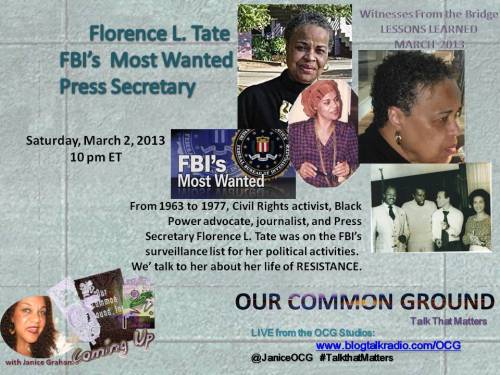
“Witnesses On the Bridge l Florence L. Tate, ” FBI’s Most Wanted Press Secretary” l March 2, 2013

MARCH 2, 2013

“Witnesses On the Bridge – Lessons Learned”

OUR COMMON GROUND with Janice Graham 

OUR COMMON GROUND kicks off “Witnesses On the Bridge – Lessons Learned”

March, 2013 Series

Florence L. Tate, ” FBI’s Most Wanted Press Secretary”

LIVE   10 pm ET

03-02 Tate

ABOUT Florence Tate
Many would think becoming an octogenarian reserves one the right to rest on her laurels — but Florence L. Tate, 81, says, “There’s still work to be done.”

The former Civil Rights activist, Dayton Daily News reporter, and press secretary for the historic 1984 Jesse Jackson Presidential campaign has lived through seven decades of American epochs – and now she’s writing about her impressive experiences and achievements in a new memoir – tentatively titled, The FBI’s Most Wanted Press Secretary Opens Her Files on Civil Rights, the Black Power Movement, and Black Partisan Politics.

At a time when our country should be experiencing a sense of accomplishment at realizing the fruits of Dr. Martin Luther King, Jr.’s work — evidenced by the election of the first African American President –Tate feels instead that the racial unease and tension revealed by events like the current drama surrounding the George Zimmerman/Trayvon Martin case signify America still has a long way to go in race relations.

“The country has gone backwards from the time of Dr. Martin Luther King’s ‘I Have a Dream’ speech; we have regressed. There’s been an attempt to take things back to the pre-Civil Rights days,” says Tate.

In her memoir, Tate draws upon her extensive experience integrating major companies like Bell Telephone, and Globe Industries, working with seminal civil rights groups including SNCC (Student Nonviolent Coordinating Committee) and CORE (Congress for Racial Equality).

As the first African American female journalist at the Dayton Daily News, she also covered current events — including the Dayton riots that occurred during the “summer of ‘68” race riots that swept across the country.

The work that brought her into close confidence with key activist figures — such as Stokely Carmichael and H. Rap Brown — also eventually brought Tate, a middle class Dayton housewife and mother of three children, under the surveillance of the Federal Bureau of Investigation – evidenced by the giant file she received from the FBI when she petitioned for them decades after her civil rights and Pan Africanist work.

Tate wasn’t all that surprised by her voluminous FBI file. “We suspected we were under surveillance because, for example, we would pick up the phone, to try to use the phone, and there would be a silence there… we didn’t know, but we suspected… We suspected there would be people in the meetings, sometimes people who gave off vibes that they were not there to work with us… they were there to spy on us. And figures like Stokely Carmichael were always being followed by the FBI; they didn’t even try to hide it. They would sit outside in cars – for example, if he were at a meeting at my house, or wherever he was, they would be sitting outside my house. When I got my FBI file, then I knew exactly when they had been watching, spying…or infiltrating.”

Tate’s memoir chronicles her journey — from growing up under segregation in the South from the 30s through the mid-50s — to moving north in the late 50s…to finally become an influential figure in the small but dedicated civil rights movement ground work happening in Mid Western cities like Dayton.

“The civil rights activists were working in parts of the country other than the south – where the ground work was well publicized. Little or no publicity was given to the work being done in Mid Western cities like Dayton, Ohio,” she shares.

Related experiences — as Communications Director of the National Urban Coalition, and National Information Coordinator for ’72 African Liberation Day Coordinating Committee — landed Tate the role of Press Secretary in Marion Barry’s first campaign in his successful bid for Mayor of Washington D.C. in 1978, and Press Secretary during his first two years in office. Later she would repeat that role for Jesse Jackson’s 1984 Presidential campaign — during which time she traveled with him to Damascus, Syria during his historic rescue mission to free downed U.S. Air Force pilotLt. Robert Goodman.

Tate also writes of another major life-defining segment of her journey: her experiences with mental and physical health issues. These include battling breast cancer, suffering a major stroke after the birth of her third child — and the subsequent 50-year-long battle with clinical depression triggered by that stroke.

Tate says she hopes her memoir will encourage young people – and especially young women – to understand and act on their power to impact the world around them. But like a true mother, grandmother – and now, great-grandmother — she admits her main reason for penning her memoir is for her children.

“My children and grandchildren have repeatedly asked me to write my biography — so they will know who I am…so they can

Learn more about Florence. Listen in on March 2, 2013.
The FBI’s Most Wanted Press Secretary

Where does Jesse Jackson’s family go from here? l KultureKritic

Where does Jesse Jackson’s family go from here?

By  David A. Love on Twitter at @davidalove

 February 22, 2013

jesse-jackson-family-16x9

Are we witnessing the end of the Jackson dynasty?  Where does this once beloved political family go from here?

With former U.S. Rep. Jesse Jackson Jr. pleading guilty to spending $750,000 in campaign funds on a personal spending spree—and his wife Sandra Stevens Jackson pleading guilty to knowingly filing false joint federal income tax returns—the couple is facing years of prison time.

Mrs. Jackson, who resigned as a Chicago alderman last month, failed to declare $600,000 to the feds.

For a man who was once considered a contender for mayor of Chicago, the fall from grace was swift and sudden.

But even more dramatic than the fraud and conspiracy charges against the son of the veteran civil rights leader is how so much was thrown away on so little, it seems.  Is one’s career and reputation worth a$43,000 Rolex watch, nearly $9,600 in children’s furniture, over $14,500 in dry cleaning, $5,800 in drinks and $5,150 in furs?  An even better question: Is the legacy of the civil rights movement worth a man benefiting from his father’s name and enjoying a lavish lifestyle in the process?

“Over the course of my life I have come to realize that none of us are immune from our share of shortcomings and human frailties,” the former congressman said in a statement.  “Still I offer no excuses for my conduct and I fully accept my responsibility for the improper decisions and mistakes I have made.”

“The guilty plea today is so tragic because it represents such wasted potential,” said U.S. Attorney Ronald C. Machen Jr. at a news conference.  “Jesse Jackson Jr. had drive, the ability and the talent to be the voice of a new generation, but he squandered that talent.  He exchanged that instead to satisfy his personal whims and extravagant lifestyle.”

Meanwhile, in light of his brother’s political woes, Jonathan Jackson, a professor at Chicago State University, was viewed as a possible replacement for Jesse Jr. in Congress, but declined to run for the seat due to a lack of interest in politics.

So, now what?  As for Rev. Jesse Jackson, Sr., who may have had hopes of building a political dynasty that once knocked on the White House door, just as another prominent black Chicago family moved into the White House, it would appear that dynasty has ended.  And maybe that’s not such a bad thing.

Empires and dynasties decline and crumble for a variety of reasons, including corruption, greed and excess, mission creep, and mediocre successors to the throne.  Old dynasties are replaced, and time goes on.  The senior Jackson, known for his role in the civil rights movement working with Martin Luther King, became a power broker with his 1984 and 1988 presidential runs. He has a long track record of fighting for economic and social justice for the poor and disenfranchised, and for his international activism, including aiding in the release of Americans captured in foreign countries.

His accomplishments are to be honored and appreciated, personal foibles, stumbles and all. After all, no one is perfect, and we are all human beings with imperfections.  But that otherwise great legacy does not translate into a right to cash in the chips of past civil rights struggles for personal fame and perpetual power.

Read More

Follow David A. Love on Twitter at @davidalove

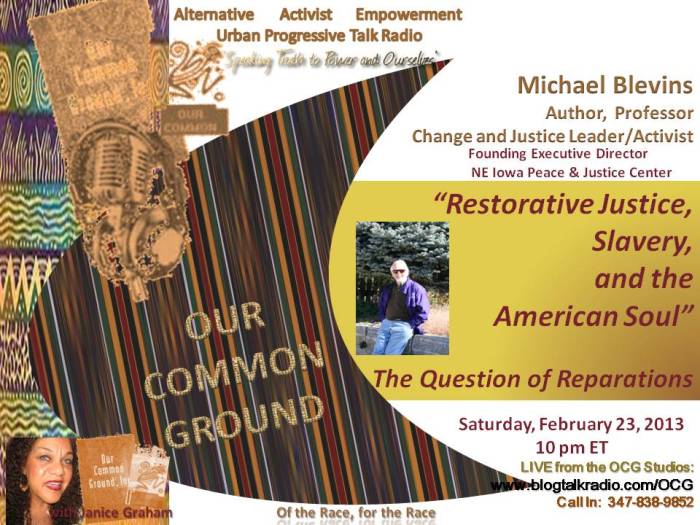
“Restorative Justice, Slavery, and the American Soul” . . . The Question of Reparations” l This Week on Our Common Ground

OUR COMMON GROUND with Janice Graham

“Restorative Justice, Slavery, and the American Soul”
. . . The Question of Reparations”

February 23, 2013 10 pm ET

02-23 Blevins

OUR Guest: Michael BlevinsAuthor, Professor, Change and Justice Leader/Activist

 Founding Executive Director, NE Iowa Peace & Justice Center

ABOUT Michael Blevins

Mike Blevins fall.2012.Michael Blevins, JD, M.Div, LL.M (Intercultural Human Rights) works from Decorah, IA. He was a defense attorney for ten years in the state of Kansas and is an ordained pastor. He currently is a human rights advocate and activist who teaches Ethics and Philosophy at the college level and was recently the founding Executive Director of the NE Iowa Peace & Justice Center in Decorah, Iowa.

Mike is a Diversified Social Change and Non-Profit Professional with over twenty years experience in law, ministry, classroom teaching, community organizing, non-profit leadership, conflict resolution services, strategic planning, human rights advocacy and non-profit community development–including non-profit leadership, human rights education and advocacy.

He authored “Restorative Justice, Slavery, and the American Soul, A Policy-Oriented Approach to the Question of Reparations”, which was awarded the 2005 Institute of Policy Sciences Best Graduate Student Paper prize; the paper was presented by the author at the Annual Symposium of the Institute of Policy Sciences at Yale University Law School in October, 2005; Published by the Thurgood Marshall Law School Journal (Volume 31, No.2, pp. 253-322, Spring 2006.

Our discussion with Mike with focus on the following topics:

  • What is Restorative Justice and how might it apply to the evil of White Supremacy
  • Mass Incarceration and other aspects of the New Jim Crow
  • The Question of Reparations 
  • Reparations Initiatives including HR 40 (Conyers) and other proposals for approaching reparations 

HIS WORK
Blevins, Michael F. (2005). Restorative Justice, Slavery, and the American Soul, A Policy-Oriented Intercultural Human Rights Approach to the Question of Reparations. Thurgood Marshall Law Review. 31:253-322. Summary by Restorative Justice.Org:
“Blevins provides an overview of how past slavery has an effect on present society; reparations have not been paid to the African American community and injustice remains. Reparations, Blevins states, should come in the form of aid, not charity, and that the United States owes reparations to both Africa and African-Americans. The current theories and laws addressing slavery reparations are centered on a litigation approach. This approach is ineffective and inhibits justice from being served. Blevins then discusses the Restorative Justice approach, briefly mentioning the Truth and Reconciliation processes in Africa, the Truth Commission established in Peru, and other Restorative Justice initiatives around the world. The article states that if nothing is done in the United States to address the past and present problems with slavery and racism, these problems will continue. To be successful, the reparations movement must occur within the academic, professional, civic, and religious sectors. Blevins suggests that an African American Redress Commission should be established by the House and Senate. Additionally, a commission would then be established in each district, with the purpose of conducting investigations and research, holding hearings, and holding community forums. The most important aspect of these commissions being the forums because the community would have a chance to be heard and to come up with solutions for the present problem. Each district would then submit a plan to the executive Commission, complete with legislative recommendations, entitled “America’s 21st Century Contract with African Americans.” Blevins ties this whole process to the commencement of slavery in Jamestown Virginia, comes up with an outline of a possible payment plan from the United States government to both African Americans and Africans, and challenges individual States to take action.”OUR COMMON GROUND with Janice Graham

“Speaking Truth to Power and Ourselves”
BROADCASTING BRAVE BOLD BLACK

BTR Show Note banner

Community Forum: http://www.ourcommonground-talk.ning.com/
Twitter: @JaniceOCG #TalkthatMatters
Web: http://www.wordpress.ourcommongroundtalk.com/

How the media tried to assassinate Chris Dorner Claims of ‘mental illness’ are in the mind of the beholder l Thandisizwe Chimurenga

How the media tried to assassinate Chris Dorner Claims of ‘mental illness’ are in the mind of the beholder

Published on Thursday, 21 February 2013 15:55

 Thandisizwe Chimurenga

LAWatts Time  Contributing Writer


Christopher Jordan Dorner is dead but his words and actions will continue to impact the Los Angeles area and beyond for quite some time. The former U.S. Navy lieutenant and Los Angeles police officer who is alleged to have shot and killed four people earlier this month was the subject of the largest manhunt in Southern California history.  Authorities say that manhunt ended on Feb. 12 with Dorner, surrounded by law enforcement in a cabin in the Big Bear area of San Bernadino, committing suicide as highly flammable tear gas canisters ignited the cabin and burned it to the ground.

Dorner’s ‘manifesto’, in which he declared war on the Los Angeles Police Department and his subsequent actions were horrifying to many.  In an effort to understand the reason behind his rage and actions, many mainstream media outlets posited that Dorner must have suffered from some sort of mental illness.

Appearing on “Piers Morgan Tonight” on Feb. 7 Dr. Xavier Amador, a regular commentator for CNN, said there was “absolutely no basis in reality for [Dorner’s] complaints that he was mistreated, that there was any kind of police corruption,” that Dorner had “clear signs of mental illness,” and that his ‘manifesto’ was “delusional.”

Amador’s analysis was based on a review of Dorner’s LAPD case file, he said.

According to Neon Tommy the online news site of the University of Southern California, Los Angeles Mayor Antonio Villaraigosa declared that “Whatever problem [Dorner] has is mental,” while speaking at a press conference on proposed gun safety legislation. Villaraigosa’s comments were part of a Feb. 7 news article entitled “Christopher Dorner’s Navy Service Record And Mental Health Scrutinized.”

On Feb. 9, The Associated Press ran a news brief on Dorner’s unsuccessful attempt to obtain a restraining order in 2006 against his then-girlfriend Ariana Williams.  The story quotes court documents filed in the case that called Dorner “severely emotionally and mentally disturbed.”  The court documents also link Williams to a post about Dorner on a website that was signed anonymously, calling Dorner “twisted” and “super paranoid.”

Also on Feb. 9, The Christian Science Monitor, in “Christopher Dorner: Experts look for clues to alleged cop killer’s mental state,” quotes a retired FBI profiler who said Dorner’s actions were “completely over the top.” Dorner, who claimed in his manifesto that he simply wanted to “clear his name,” had a “personality disorder” according to Mary Ellen O’Toole.

While it can be considered normal to search for answers in a case such as this, attempting to make a mental health diagnosis of Christopher Dorner without ever having physically examined him is not.

“It is difficult to make a diagnostic conclusion given how little any of us know about Dorner’s mental health history, having no audio transcripts to review, no testing and assessment instruments to analyze, and no clinical interview data, said Thomas Parham, PhD.  Parham is past president of the national Association of Black Psychologists and a co-author of “Psychology of Blacks: Centering Our Perspectives in the African Consciousness.”

“All we have is a so-called “manifesto” (that I have not read) that is selectively presented in the media.  So, for the press and media to be making a statement in absence of that kind of information is just interesting, if not useless chatter,” he said.

Clive D. Kennedy, a clinical forensic psychologist and president of the Los Angeles Chapter of the Association of Black Psychologists, echoes Parham’s comments on evaluating Dorner’s mental state.  “I believe no professional has indicated he or she is aware of Mr. Dorner’s mental health status and therefore, we are unlikely to ever know, including those in the media who have been so forthcoming of his psychiatric condition,” he said.

Dorner claimed in his manifesto clearly and explicitly that not only was he a victim of racism but that his attempts to “blow the whistle” on the racism of the LAPD against him and other officers are why he believes he was fired.  According to Dorner retaliation against “snitching” on other police officers was one of several corrupt practices within the, department.  Despite this, much of the media coverage of Dorner’s mental state has conveniently left this fact out.

Are Charges of Racism Enough to Push One Over The Edge?

In her Feb. 9 Los Angeles Times op-ed, civil rights attorney Connie Rice recalls a conversation she had with former Los Angeles Police Department Deputy Jesse Brewer. Describing him as “wise and classy,” Rice states that Brewer, the first African American president of the Los Angeles Police Commission that oversees the LAPD, “came to my law office in 1990. He described to me his own ordeals on the force, in which white officers illegally blocked his entrance to the Police Academy, tried to plant false evidence on him, blocked all of his promotions and set him up for ambush in the field. He also described how viciously the department retaliated against him and other officers who tried to stand up for fellow officers or civilians who suffered abuse from cops. The LAPD never did allow whistle-blowers of any kind to survive, no matter how righteous they were,” wrote Rice.

Chillingly, Rice goes on to write that Brewer told her that Black LAPD officers had to resort to accepting abuse from white police officers and  “outsmarting” them because, “If you let them get to you, you’ll become homicidal.”

In her 1995 work “Killing Rage, Ending Racism,” noted political and cultural critic bell hooks wrote: “the conditions of racism can ‘drive one mad.’

Referring to an outbreak of violence in New York City in which a Black man opened fire randomly on a subway train, hooks states that “ … most Black folks can recognize that it is ethically and morally wrong to kill folks even as we can also sympathize with mental illness that is either engendered or exacerbated by life in [the United States].”

Psychologist Thomas Parham echoed that sentiment.  “We must extend our prayers for those who lost their lives in this rampage (both victims and perpetrator) and for the families who are left to grieve. There is never a justification for the taking of innocent lives, no matter what the level of unfairness one believes has impacted their own life.  There is nothing more sacred in the African tradition than life, so to be so callous in the taking of innocent lives would seem to be the most fundamental violation of an African centered worldview.”

Parham continued, “Clearly, the actions Dorner engaged in are very “out of the ordinary,” and beyond the realm of most standards of normalcy and decency that society embraces. Yet, like all of us, he is a product of a social system that makes an implicit contract with its citizens that says if you work hard and play by the rules, including doing the right thing on your job, then success should be the reward for one’s hard work, dedication, and commitment … I suspect that if he embraced this implicit social contract with the rigidity of a very concrete thinker, and then believes that his life was ruined by some unfair and discriminatory treatment when he called himself trying to do the right thing and report abuse by a fellow officer, then the violation and betrayal he feels might evoke that type of anger, rage, and desire for retribution that we all witnessed…”

Paul Harris, a San Francisco-based attorney and author, says that “ … even in cases where the perpetrator of the crime is mentally ill, one must look at the concrete experiences of racism (and other environmental hardships) to understand the resulting behavior.”  Harris is the author of “Black Rage Confronts the Law,” a 1971 book based on a case in which Harris was successful in defending a young Black man accused of bank robbery.  “Too many people cry racism in explaining these crimes without combining the underlying mental problems, with the specific life experience with racism the person has suffered,” said Harris.

Joy DeGruy, author of “Post Traumatic Slave Syndrome,” uttered similar  comments as Harris.  “I would think that any serious response would include consideration of the obvious and blatant differential treatment of African Americans by a dysfunctional justice system and the structural inequalities inherent in that system.”  DeGruy holds degrees in social work and clinical psychology and is an assistant professor at Portland State University.

More than 1,000 sightings of Christopher Dorner were reported to police during the manhunt to apprehend him.  The overwhelming majority of those tips were based on faulty identifications of Black men whose appearance was similar to Dorner.  What we do not know for sure is how many of those tips were from individuals that were simply Good Samaritans interested in assisting law enforcement, and how many were from individuals who were genuinely frightened that Dorner might attack them.

As we continue to ponder Dorner’s mental state we might also take into account the words of bell hooks:  “White supremacy is frightening.  It promotes mental illness and various dysfunctional behaviors on the part of whites and non-whites.  It is the real and present danger – not black rage.”

Read the LAWT Here


Ella Baker and the Limits of Charismatic Masculinity l Black Agenda Report

Ella Baker and the Limits of Charismatic Masculinity

 Pascal Robert

Tue, 02/19/2013

by Pascal Robert

Ella Baker, the consummate organizer, “was very critical of the hot shot Black preachers who would seem to mesmerize their audience with soaring oratory, then leave and expect others to implement an agenda.” She put forward a grassroots critique of overwhelmingly male Black leadership, and showed “more wisdom, courage, and vision then almost all of them.”

Ella Baker and the Limits of Charismatic Masculinity

by Pascal Robert

This article originally appeared on Mr. Robert’s website, Thought Merchant.

She believed in giving people the power to choose their direction and make demands.”

In perhaps one of the most important biographies of a civil rights leader published, Professor Barbara Ransby has conveyed the epic life and struggle of a woman whose sheer skill, leadership, and ability to mobilize the marginalized and dispossessed to full participation in their fight for human dignity is almost unprecedented in American history. In her book, Ella Baker & The Black Freedom Movement, Professor Ransby documents the life of Ella Baker, a Black woman born to a middle class family in North Carolina in 1903 who, after witnessing the staunch spiritually based dedication of her mother to serving the poor in the South, transforms into a sheer force of will that worked with all the major civil rights organizations of her time, and helped mobilize to create two of the most crucial to the Civil Rights Movement: The Southern Christian Leadership Conference (SCLC) and the Student Nonviolent Coordinating Committee (SNCC).

Before we continue to heap praise or Hosannas on men like Dr. Martin Luther King, Jr., Wyatt T. Walker, Stokely Carmichael, Malcolm X, Paul Robeson, Thurgood Marshall, W.E.B. DuBois, or any of these other gentlemen we idolize as embodiments of masculine heroism, we should know about one woman, of many, who had more wisdom, courage, and vision then almost all of them: Ms. Ella Baker.

Baker believed in empowering the most common person, whether a sharecropper, teenager, or illiterate vagrant with skills to make demands on the political establishment.”

What made Baker’s method of organizing both effective and revolutionary is that it completely dismissed the traditional paradigm of leadership that had plagued the Black community from its earliest history in North America, stemming mostly from the Black Church: charismatic masculine leadership based on oratory and exhibitionism. Baker believed in empowering the most common person, whether a sharecropper, teenager, or illiterate vagrant with skills to make demands on the political establishment. Baker believed that people did not need fancy leaders with degrees and pedigree to tell them what was best for them. She believed in giving people the power to choose their direction and make demands, and put pressure on institutions without depending on big shots with fancy suits. In her book Professor Ransby notes:

At every opportunity [Ella] Baker reiterated the radical idea that educated elites were not the natural leaders of Black people. Critically reflecting on her work with the NAACP, she observed, “The Leadership was all from the professional class, basically. I think these are the factors that have kept it [the NAACP] from moving to a more militant position.”

Moreover, Ella Baker was very critical of the hot shot Black preachers who would seem to mesmerize their audience with soaring oratory then leave and expect others to implement an agenda. As Ransby further notes at one point Ella Baker asked Dr. King directly “…why he allowed such hero worship, and he responded simply, that it was what people wanted. This answer did not satisfy Baker in the least.”

Ella Baker did not mince words on her thoughts of Dr. King’s leadership style and vocally spoke out on its limitations:

Baker described [Dr. King] as a pampered member of Atlanta’s black elite who had the mantle of leadership handed to him rather than having had to earn it, a member of a coddled ‘silver spoon brigade.’ He wore silk suits and spoke with a silver tongue.

…In Baker’s eyes King did not identify enough with the people he sought to lead. He did not situate himself among them but remained above them.

“…Baker felt the focus on King drained the masses of confidence in themselves. People often marveled at the things King could do that they could not; his eloquent speeches overwhelmed as well as inspired.”

Obama has been as anemic in delivering real change and effective at stifling progress as Ella Baker worried Dr. King would have been.”

The limitations of this charismatic masculinity noted by Ella Baker are profound, particularly in today’s political age when we have a president like Barack Obama who often tries to channel the traditions of charismatic leadership and oratory from the Black tradition. Ironically, Obama has been as anemic in delivering real change and effective at stifling progress as Ella Baker worried Dr. King would have been. So perhaps in a strange twist, we have found a similarity between King and Obama after all.

Often in America, when discussing prominent Black trailblazers who fought the injustices of segregation and racial oppression, we see the same images of a variety of men. I somewhat jokingly call them our superhero black male icons. This phenomenon mimics the more noxious western patriarchal fascination with viewing history as a series of events being shaped and guided by the hands of a strong capable man embodying all our fantasies about leadership, masculinity, and sometimes fatherhood.

The danger of such imagery is that it often both obscures and denies the scope of nuanced factors, issues, and circumstances in shaping the events from which our societies were born. Furthermore, such narratives often exclude any consideration of female agency in effecting the great events that have transpired over time.

Barbara Ransby should be applauded for putting a halt to this tradition and setting the record straight with her towering biography Ella Baker & The Black Freedom Movement. As a man still troubled with patriarchal sexist notions, this book opened my eyes to ways in which the roles of women are often neglected and intentionally obscured. Let us all read the story of Ella Baker and make sure such injustices do not continue.

Pascal Robert is an Iconoclastic Haitian American Lawyer, Blogger, and Online Activist for Haiti. For years his work appeared under the Blog Thought Merchant: http://thoughtmerchant.wordpress.com/ You can also find his work on the Huffington Post here: http://www.huffingtonpost.com/pascal-robert/ He can be reached via twitter at: https://twitter.com/probert06 @probert06 or thoughtmerchant@gmail.com


Related Links

In Conversation with Dr. Gerald Horne l Commentaries On the Times Radio l Thursday, February 21, 2013

“Commentaries On the Times Radio” with Playthell Benjamin


Commentaries gen 6

In Conversation with Dr. Gerald Horne John J. and Rebecca Moores Chair of History and African American Studies at the University of Houston


Gerald Horne is an African American historian who currently holds the John J. and Rebecca Moores Chair of History and African American Studies at the University of Houston. He received his PhD from Columbia University and a J.D. from theUniversity of California, Berkeley. He is a frequent contributor to Political Affairs magazine.

He is a prolific author, Horne has published on W. E. B. Du Bois and has written books on a wide range of neglected but by no means marginal or minor episodes of world history. He specializes in illuminating previously obscure or misrepresented struggles of humanity for social justice, in particular communist struggles and struggles against imperialism, colonialism, fascism and racism. Individuals whose lives his work has highlighted in their historical contexts have included the blacklisted Hollywood screenwriter John Howard LawsonFerdinand Smith (Jamaican-born communist, sailor, labor leader), the perplexing Lawrence Dennis, an African-American fascist and racist who passed for white, and the feminist, anti-colonialist, internationalist intellectual Shirley Graham DuBois whose own career was overshadowed by that of her famous husband. While many of Horne’s books use a celebrated, intriguing or politically engaged individual as a prism to inspect the historical forces of their times, Horne has also produced broad canvas chronicles of infrequently examined periods and aspects of the history of white supremacy and imperialism such as the post-civil war involvement of the US ruling class—newly dispossessed of human chattels—with slavery in Brazil, which was not legally abolished until 1888, or the attempts by Japanese imperialists in the mid-20th century to appear as the leaders of a global war against white supremacy, thus allies and instruments of liberation for people of color oppressed by Anglo-American Empire.

Manning Marable said, “Gerald Horne is one of the most gifted and insightful historians on racial matters of his generation.”


02-21 2nd amend Commentaries2

PREMIERING Thursday, February 21, 2013 10 pm ET LIVE  Joins TruthWorks Network

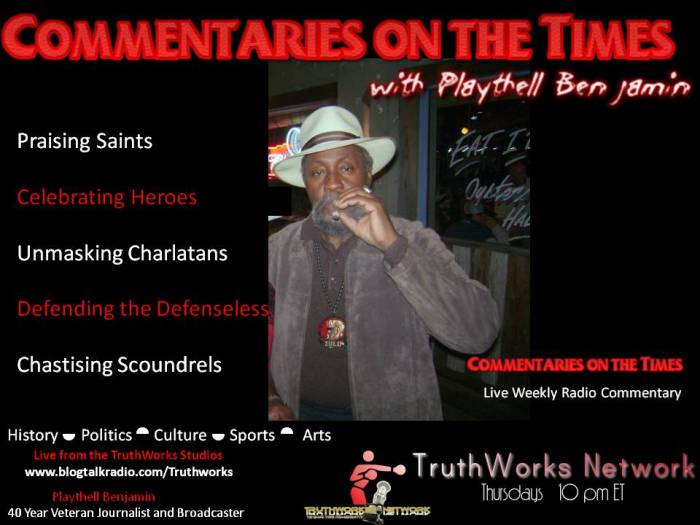
TruthWorks welcomes Playthell Benjamin with “Commentaries On the Times Radio” to our exciting Black Voice Collaborative line up.

This weekly program features the best of the writings of Playthell Benjamin with commentary from his renowned virtual magazine, “Commentaries On the Times”http://commentariesonthetimes.wordpress.com/.

The program will broadcast Thursday, 10 pm ET. “Commentaries On the Times“, a compilation of many years of essays, commentary and analysis of world and domestic issues. They include commentary with carefully researched historical background of the issues of day, including Black history, art, music and current events and people.

Benjamin brings a scope of 40 years of outstanding journalism and broadcasting to TruthWorks. As a former pioneer in the development of Black Studies programs and pundit broadcasting, he comes to a microphone with tremendous knowledge, insight and passion. Of his products, he labels his wordsmith products as, “Praising Saints, Celebrating Heroes, Unmasking Charlatans, Defending the Defenseless and Chastising Scoundrels”. We expect that his show will be no less.

With a lively wit to compliment a broadly learned mind, Playthell is a great guest on television or radio and has shared the mike with some of the biggest host in television, including Geraldo Rivera and Bill Mahr, which can be soon viewed on You Tube. At Present he is completing two books :Quantum shift: Commentaries on the Obama Phenomenon and Jazz at Lincoln Center: Magic Moments In the House Of Swing, a collaboration with the renowned photographer Frank Stewart. Playthell has held a professorship in History/Afro-American Studies at the University of Massachusetts and recently held an adjunct professorship in journalism at Long Island University.

His essays on music criticism have appeared in a wide variety of publications and his interest range from classical music to Jazz to Latin and Hip hop. He writes program notes for Jazz at Lincoln center concerts and is an accomplished Latin percussionist who can be viewed playing with the group Zon Del Barrio on You Tube.

A regular reader of ”Commentaries On the Times” recently commented on one of his essays, “READ the top notch researched work that Brother Playthell George Benjamin is providing for Us. It doesn’t get any better and knowledge is a beautiful thing to share with your family and friends! Several hundred articles await your READING COMPREHENSION and you get what I consider a full PHD worth of knowledge nuggets. Go get that information and become the intelligent person you’ve always wanted to be amongst your crew of friends. Speak with intelligence and knowledge to support your points of view. In spoken and written dialogue, The FACTS tell who you are and as my grandmother used to say, “All Things in Life Change, but Not The TRUTH!” Let’s tell Our Story! I salute YOU Brother Playthell George Benjamin for “Enlightening Us All With Your Knowledge” in so many fields of Interest”.

playthellABOUT PLAYTHELL BENJAMIN

Playthell George Benjamin is the producer of “Commentaries On the Times”, which he writes and delivers on WBAI radio in New York City, and a producer with The Midnight Ravers, a long running show exploring the world of art and politics which has won several radio awards for excellence in programming. He is an award winning journalist who has been nominated for the Pulitzer Prize in two different categories: Explanatory Journalism, Village Voice 1988, and Distinguished Commentary, New York Daily News1995. As part of the production team for The Midnight Ravers, Mr. Benjamin won a 2011 award for excellence in radio programming, given for The Curtis Mayfield Special.

Playthell has won several prizes ranging from The Unity Award presented by the School of communications at Lincoln University in Missouri for distinguished commentary on race relations; the Griot Prize for excellence in covering a story requiring an exploration of African American history and culture: “Who is Listening to LouisFarrakhan?” It was awarded by the New York chapter of the Association of Black Journalist in December 1989. In 1991 Mr. Benjamin won the NYABJ Magazine Awards for Feature Stories,and in 1996 he won the first Annual Tom Forcade Award “for honesty and accuracy in drug reporting” awarded by High Times magazine for his columns on drug use and abuse in the New York Daily News.

His book, “Witnessing the Motion of History” is expected to publish in the Summer of 2013. His e-magazine covering analysis, commentary and presentation of issues and events is available here: http://commentariesonthetimes.wordpress.com/

On Christopher Doner, the former LAPD officer, he recently wrote,

A REAL LIFE DJANGO? As I write a black gunman is terrorizing the Los Angeles Police Department, wreaking murder and mayhem upon the cops and their loved ones. Judging from comments online a growing number of people are beginning to see him as a real life Django Unchained! The broadcast media has been treating him like the crazy white boys who are going off all over the place – the macho paranoids like Dirty Dick Popolovsky in Pittsburgh, or pootbutt nerds suffering from pant worm and need a gun to feel like a man. But Christopher Dosner is neither one. When I saw his military record and the fact that he was once a member of the LAPD, I decided to do some investigation, beginning with reading his “Manifesto,” then reading a variety of materials on him. It was a revelation. I think it is a representative anecdote on the state of racism, corruption and brutality in contemporary police community relations in the great American cities. Here is my take on the man and what motivated his murderous mission. See: More Dangerous than Django! And he’s All the Way Live!!!!

As a former pioneer in the development of Black Studies programs and pundit broadcasting, he comes to a microphone with tremendous knowledge, insight and passion. Of his essays and commentaries, he labels these tremendously illuminating wordsmith products as, –

“Praising Saints, Celebrating Heroes, Unmasking Charlatans, Defending the Defenseless and Chastising Scoundrels”.
. . . Commentaries on the Times Radio will be no less.

Commentaries On The Times Radio with Playthell Benjamin
TruthWorks Network
Premiering Thursday, February 21, 2013 10 pm ET

Like us on Facebook https://www.facebook.com/CommentariesOnTheTimesRadio
On the Web/Program Notes http://www.commentariesonthetimeradio.wordpress.com/

Beneath the Spin*Eric L. Wattree l THE MAN

THE MAN

Beneath the Spin*Eric L. Wattree

Young and curious, crusin= the street, my partner and I, with life at our feet. Beautiful days of summer=s ilk, and beautiful ladies with legs of silk. Miles on the box with Thelonious in tow, playin’ “Round Midnite”, with nothin=but soul. Miles was moanin=, Thelonious was Monk, our senses were spinnin=- our top in the trunk.
.
Down Century Boulevard, past Sportsman Park, North on Crenshaw, Can=t wait til it=s dark. Crenshaw was jammin=, not like today, with cognitive people, who went their own way. Cadillacs gleamin=, prosperity galore, Ladies a struttin=, that gait I adore. The hood left behind, no denial or shame, among my kind of people, who=d mastered the game.
.
Dreamin= and crusin=, yet, chained to the hood, but into an element we both understood. Jazz was the thing that had lured our route, and no chain of poverty was keepin= us out! Cause THE MAN was in town, with his mighty ax, and he was jammin= that night at Dynamite Jack=s.
.
So anxious to worship THE MAN in the flesh, the first thing that mornin= we started to dress. In our youthful exuberance we saw nothin= wrong, with the hours to kill before HE would go on. Hence, there we were with nothin= to do, THE MAN=S first note at 9, and it was now only 2.
.
So we went to a park on Rodeo Road and proceeded to get in our Mack-daddy mode. We needed two women with presence and class, who were progressive, and sexy, and dug modern jazz.
.
We lucked-out, no doubt, with Debra and Gwen, two sisters on cruse in their step-father=s Benz. These women were ladies we soon recognized, not only quite lovely but exceedingly wise. We spoke of Dizzy, Dexter, Thelonious and Bird, and all of the monsters of jazz that we=d heard. Then just as our session was starting to end, Gwen mentioned Dolphy, and we were at it again.
.
We partook of the bush, we had a few beers, by 8 it was like we=d been partyin= for years. But now it was time to hit Dynamite Jack=s, to hear THE MAN blow, sip Scotch and relax.
.
So we followed the ladies up into the hills, to a fabulous pad, must=ve cost a few bills. We dropped off my car, then got in the wind. We split to see HIM, and my journey began.
.
Dynamite Jack=s was the place to be, there seemed to be thousands of new things to see. Doctors, lawyers, pimps and Awhoes@, dope fiends with their nostrils froze; Perverts, politicians (one and the same), everyone seemed to have some kind of game.
.
At 16 years old I was really impressed, with this flash, this glitz, this flamboyant success. I knew before long, that my turn would come, I=d shoot for the stars, at least, out of the slum.

Then HE came on stage to a mighty roar, as bustling humanity hung all out the door. A quiet MAN, of knowledge and taste, yet HIS presence sent a chill through the place!
.
Then flash became silence, and glitz bled to awe. Pure greatness just glistened from THIS MAN we saw. No posturing, no swagger, no hipster-like Mack, Just unfettered greatness, the essence, in fact….
.
On that one precious moment, as I gaped at the stand, my young reckless mind would take hold as a man. That moment estranged from the kid that I=d been. Life’s door was flung wide, and a new man would step in.
.
Now, many years later, assessing my life, with the dues of raising two kids with a wife. THE MAN is long gone from this earthly plain, but HIS unflaunting manhood stays etched in my brain.
.
A kid on that night gave birth to a plan, that night when I looked up in awe at THE MAN. Revealed was a path that would color my life, that shunned the flamboyance and glitz of the night. To shoot for the stars! That was my plan – the stardom that=s found in just being A MAN!
.
I’ve taken two souls, and molded their lives, away from the flash, and the glitz, of the night. Two college age kids now view ME with awe. I now see in their eyes what that night HE saw.
.
Greatness is relative, I learned from THE MAN, through the glint in HIS eye, and HIS demeanor on stand. You don’t have to be famous to be someone grand, just pull up your trousers, and stand tall like a man.
.
It was KNOWLEDGE and WISDOM that night that I saw; the EXCELLENCE of DISCIPLINE that put awe in awe, of one humble spirit, so sweet and sublime, but a spirit that=ll speak to all man for all time!
.
So a droplet of beauty, from this “kid” to mankind; a pearl of wisdom, a wistful rhyme; some insight he gained as he bat away tears; might his essence endure through the unfolding years?
.
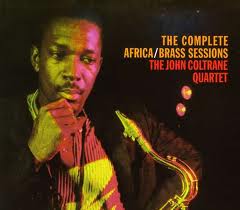
A journey began, on that faithful night, that moment a young set of eyes saw AFirst Light.@When HE tapped out the rhythm to Africa Brass . . .
.
and my dream to see COLTRANE had come true at last.

.
.

Eric L. Wattree
Http://wattree.blogspot.com
Ewattree@Gmail.com
Citizens Against Reckless Middle-Class Abuse (CARMA)

Religious bigotry: It’s not that I hate everyone who doesn’t look, think, and act like me – it’s just that God does.