US police are allowed to confiscate property without having to secure a conviction or obtain a warrant. It also helps finance police departments across the country. And there’s even a certain wish list. Cash and expensive cars are the most wanted, when officers pull drivers over for sometimes minor violations. Flat screen TVs are also popular. And, if you are unlucky enough, you could even lose your house to the cops.
Thanks to Max Parthas of “Abolisitionist Radio” for sharing this. He commented, ” We tried to tell you these “cops” are robbing people blind. Entire counties budgets are funded by search and seizures. SWAT teams in Mass. have even become 501c3 non profit corporations. On New Abolitionists Radio we’ve reported extensively on police in FLA who are getting nearly 200 thousand dollar a year salaries boosted up by search and seizure acquisitions. Where do you think the money to buy all these new military toys comes from?”
I want to respond to a question that was posed: where we go from here when far too many Black people are in the theological and Christological grip of white right wing Christians. Chip Berlet, author and political, analyst calls this group the theocrats. He tells us, “Theocrats support a form of government where the actions of leaders are seen as sanctioned by God-where the leaders claim that they are carrying out God’s will.” This is a very dangerous claim that gives divine meaning and sanction to their actions no matter how racist, sexist, militaristic or homophobic. Moreover, this brand of Christofacism is designed to shut down critique by creating one legitimate Christian voice. Without a doubt for theocrats, the legitimate Christian voice is white, and more than likely a heterosexual male.
Berlet goes on to tell us that theocrats promote a brand of Christianity that proclaims, “People are basically sinful and must be restrained by harsh punitive laws. Social problems are caused by satanic conspiracies aided and abetted by liberals, homosexuals, feminists and secular humanists. These forces must be exposed and neutralized. “They see themselves in a holy war against the forces of evil and conspirators who are determined to destroy the divine destiny of the white American Empire. However, they do not see all white men as standard bearers for the Empire. Nor do they mean people of color when they use the term American Empire.
As we move forward in this reflection, it is critical that we make a distinction between Empire Christianity and Liberation Christianity. Empire Christianity beats in the veins and hearts of theocrats and their Reconstructionist allies. It is essential to realize that conservatism stands in direct opposition to the mission of Jesus which is a radical call to “turn the society upside down” and create a just society.
Liberation Christianity begins with the assertion that God is on the side of the oppressed rather than the side of the Empire. This is the good news of the radical Jew Jesus who challenged the Roman Empire. Jesus made clear the radical nature of his mission: (1) to bring sight to the blind, i.e. to bring a new consciousness that freed his community and others from the false consciousness of identifying with the goals of the Roman Empire; (2) to feed the hungry, i.e. a systemic redistribution of resources that is not charity, but systemic economic justice; and (3) to set the prisoners free, i.e., a recognition that the Empire uses law and order as tools of oppression and domination.
This message of liberation galvanized the Southern Freedom Movement in the United States, South African liberation movement, and liberation movements around the world. It is a dynamic message that changes the status quo and rearranges our relationship with God and others. It is a justice message of non violence. It is a message that reminds us that we are not entrapped by history. We have the collective power to free ourselves from the bonds of a tyrannical state. It reminds us that we have the power to make a new history and a new world. The view of our collective power challenges the notion that history begins and ends with the Empire.
For the Tea Party members and their allies God is the keeper of the status quo. Theirs is a cynical status quo view of God that allows them to be “on the wrong side of history and issues” without taking moral responsibility for their actions. Their God talk also obscures the nature of their radical wrongs by hiding behind liberation and freedom sounding language that they stole from the Southern Freedom Movement and other popular struggles for justice.
The Empire religion espoused by the Tea Party and their white Christian conservative allies and their misled colored allies is headed by a white supremacist patriarchal upper class God who stood on the side of enslavement and the genocide of native peoples throughout the globe, including North and South America. Their God issued a direct order to destroy the Iraqi people and their culture. In their eyes, Iraq is a pagan Babylonian culture that worships a false God. They root their religion in an over and against paradigm that tears down the world and relationships, gobble up resources and relationship. Although they claim to stand for law and order, they operate from a theology of chaos where God summons them that to tears down the world rather than build it up.
Like their forefathers, right wing and conservative militaristic, white supremacist, and homophobic Christians believe that God is on their side and gives them the theological authority to build an oppressive white supremacist patriarchal world. They misuse scripture to justify this, and they hide their intentions behind self-centered and pious God talk that under girds and propels exclusion and domination whether it is about the inferiority of women, black people or lesbians and gays.
Nor is their Jesus the Jesus who wept over the oppression and suffering of his people. Nor is there Jesus the Jesus who came from a colonized community where the Roman Empire used violent measures to stifle unrest and resistance. Or the Jesus who was executed by the Roman Empire for proclaiming that God and not the Empire owns the world or the people in it. This Jesus who acted in history for those people whom the Empire minimized moved generations of enslaved Black people to assert, in the face of an Empire that said they were property without any civil or spiritual rights, “I have a right to the tree of life.”
What Black Christian conservatives must understand is that the God of the Empire can never be our God. Nor can their Jesus be our Jesus. Nor can their Empire Theology or Christology be ours. The Empire Jesus is their emissary and the messenger of war and oppression. For them, Jesus is not as the Black old folk understood, a poor little shepherd boy, outcast and belonging to a people whose backs were “up against the wall.”
The next step is to unveil the lies of White Christian Conservatives so that Black folk understand that these lesbian and gay hating folk come out the same tradition of the people who broke and battered Emmett Till’s fourteen-year-old body and threw it into the Tallahatchie River. Their teachings birthed and fermented the hatred that poisoned the minds and spirits of the killers of Samuel Younge and Jonathan Daniels. Their God can never be our God. Nor can their theology or Christology be ours. They are inheritors of a Biblical tradition that believed that Black oppression was ordained by God because of a curse where God proclaims, “Canaan shall be the lowest of slaves to his brothers.”
We must unveil their hypocrisy and slight of theological hands by remembering that these right wing conservatives barred Martin Luther King, Jr. and other southern freedom workers from the doors of white churches even as they proclaimed their connection with God. They stand today in the doorways of Christian academies and universities like Bob Jones University. In these spaces Christian conservatives still see Blacks as inferior and the bearers of a theological taint that places us on the lowest rung of humanity.
Our job is to have these conversations that help Black Christian conservatives remember so that we as a community do not fall prey to demagoguery. For those of us who remember, we are called upon to stir within Black Christian conservatives the reminder we serve a God that brought us out of the tyranny of enslavement and southern apartheid. This same God enabled Black southern sharecroppers and their allies during the Southern Freedom Movement to bring down southern apartheid, one of the most powerful governments in history, without firing a shot.
There is a great spiritual and social danger of not remembering this God and what God has been with us and for us. When we forget we allow other people to reconstruct God in their own image and to make us believe that their God of hate and injustice is our God. When we bow down to their God, we bow down at the altar of the Empire and men who believe that they are God and the overseers of creation.
Finally, it is important to remember that our ancestors, these magnificent and ordinary people had a vision of God that broke with the enslavers’ view of God. Their view of God moved them to a theology of agape that enabled them to say in the midst of enslavement: “I love everybody, I love everybody, and you can’t make me hate you in my heart; you can’t make me hate you in my heart.”
Following the murder of two NYPD officers in New York City, much of the political right moved to blame Mayor de Blasio and other progressive critics of police brutality for inciting the violence, claiming that the mentally ill man who was behind the attack was motivated by left-wing rhetoric.
That narrative doesn’t fit very well with a terror case brought this week by the FBI against three Georgia men, all members of a right-wing militia that plotted to attack police and others. Yesterday, Terry Peace, Brian Cannon and Cory Williamson pleaded not guilty to a charge of domestic terrorism, as well as charges of conspiring to defraud the government. Northwest Georgia News explains:[3]
Peace, Cannon and Williamson — all members of a militia in Georgia — participated in online chat discussions between Jan. 23 and Feb. 15, 2014, that were monitored by the FBI.
During the conversations online, they discussed using guerilla war tactics and planned to launch attacks against a metro Atlanta police station and several government agencies in February 2014.
The three men attempted to “recruit other individuals to join them and to carry out similar operations in those individuals’ home states.”
Peace allegedly told other militia members to choose targets including “road blocks, TSA checkpoints, sheriffs/police conducting operations outside the Constitution” as well as to participate in the “removal of government people who support extra-Constitutional activities.”
In other words, the men plotted to launch large-scale explosive attacks against local government and police that, if successfully carried out, would have been the largest terror attacks on U.S. soil since 9/11.
Only two news outlets, the Rome News-Tribune and Northwest Georgia News, have reported the charges.
As a filmmaker, you put the film out there, and you just want it to be okay,” says director Ava DuVernay. “You don’t want to let people down; you don’t want to embarrass yourself.” She’s done much better than that with Selma, a dramatization of the 1965 protests in Alabama led by Martin Luther King, Jr.; the movie, considered to be a leading Oscar contender, has already received four Golden Globe nominations. Peter Travers said in his rave review in Rolling Stone that DuVernay “blows the dust off history to find its beating heart.”
DuVernay, 42 years old, grew up in Compton, but spent summers in Alabama. A film publicist before she shifted careers to directing, she had actually signed up to do publicity for an earlier version of Selma. The screenplay had bounced around for over five years, attached to directors such as Lee Daniels. “It was looked at as an unmakeable movie,” says executive producer Paul Garnes. But British actor David Oyelowo — who had appeared in DuVernay’s Sundance award-winner Middle of Nowhere — very much wanted to play King, and unbeknownst to DuVernay, was lobbying for her with an international team of producers. Despite a resumé that was limited to two microbudget features, a half-dozen documentaries, and an episode of Scandal, she got the job, and a $20 million budget.
Ava on the set of ‘Selma.’ (Photo: Atsushi Nishijima/Paramount)
Our conversation with DuVernay in a vegan Mexican restaurant in Hollywood happened three days before Joseph A. Califano, Jr., a former Lyndon B. Johnson aide, wrote a Washington Post op-ed complaining not only that Selma gave Johnson (played by Tom Wilkinson) short shrift, but that the president had come up with the idea for the protests himself. As it happens, earlier versions of the script focused on the relationship between King and the commander-in-chief, and how their joint efforts led to passage of the 1965 Voting Rights Act. She discussed why she had chosen to place less emphasis on Johnson, her casting philosophy and why it helps to have Oprah on your film set.
Let’s talk about reducing LBJ’s role in the events you depict in the film.
Every filmmaker imbues a movie with their own point of view. The script was the LBJ/King thing, but originally, it was much more slanted to Johnson. I wasn’t interested in making a white-savior movie; I was interested in making a movie centered on the people of Selma. You have to bring in some context for what it was like to live in the racial terrorism that was going on in the deep south at that time. The four little girls have to be there, and then you have to bring in the women. So I started adding women.
This is a dramatization of the events. But what’s important for me as a student of this time in history is to not deify what the president did. Johnson has been hailed as a hero of that time, and he was, but we’re talking about a reluctant hero. He was cajoled and pushed, he was protective of a legacy — he was not doing things out of the goodness of his heart. Does it make it any worse or any better? I don’t think so. History is history and he did do it eventually. But there was some process to it that was important to show.
Many presidents couldn’t have done it.
Absolutely. Or wouldn’t have even if they could.
I thought Tim Roth’s performance as George Wallace was very nuanced, when it would have been easy to play him as Snidely Whiplash.
I wanted to try to make everyone as human as possible. That trap that I see so many non-black filmmakers do with black characters, where everything is surface and stereotypical…I didn’t want to be the black filmmaker that does that with the white characters. Tim has talked about every actor has to love the character that they’re playing in some way, and in the time that we’re talking about, there’s not a lot to love in Wallace if you believe in justice and dignity. But he found a videotape or an article of his son talking about him, and so he was able to tap into the father doing what he thought was right.
I WASN’T INTERESTED IN MAKING A WHITE-SAVIOR MOVIE; I WAS INTERESTED IN MAKING A MOVIE CENTERED ON THE PEOPLE OF SELMA.
Whether it was Roth or Tom Wilkinson — or Giovanni Ribisi, Stephen Root and Alessandro Nivola — all these characters represented a real diversity of thought about this issue from the white perspective, from the dominant culture. I wanted to create an array of folks who all thought about it in a different way because white thought wasn’t a monolith at that time, just as black thought wasn’t a monolith.
What was your philosophy when you were casting?
To work with people who fascinate me. Oprah being in the cast allowed me to have flexibility because she is such a big name. Her fame and her power created space for me to be able to hire Stephan James, a 19-year-old from Canada, for John Lewis instead of the hot young guy who was just in The Fast and the Furious,or whatever. I was able to pick and choose cool people.
What was it like having Oprah on the set?
Her first day of shooting was the day that Maya Angelou died. I had just driven up to the set in Marietta when I got a call on my cell phone from Andrew Young, the real Andrew Young: “Sister Maya has passed on.” And all I could think of was Oprah was on her way to the set. I immediately called her and said don’t come, we’ll do it another day. Tight schedule, a 32-day shoot, not a lot of room to move things around — but we’ll figure it out. She said, “No, I can do this, it’s okay.” She had the same trailer as everyone else. I spoke with her briefly, and I should’ve stayed, but I had to go out back to the set: I had 200 extras out there. So I called Tyler Perry, he sneaked onto the set, they had their moment, and she came out ready to go. I’m grateful to him; most people see us as very different filmmakers, but in that moment we were united around Oprah.
Ava and Oprah on the set of ‘Selma.’ (Photo: Atsushi Nishijima/Paramount)
How did your old job as a publicist prepare you to do this?
To make a film?
As opposed to eating guacamole, yes.
[Laughs] Just being able to talk to people. I used to coordinate and develop and execute really big campaigns for studios with a lot of moving parts. But the main thing is just articulating what’s in your head, which we overestimate that people can do — how do you get that out in a way that’s clear and un-muddled with the intention of producing a result?
What was the hardest scene to shoot, emotionally?
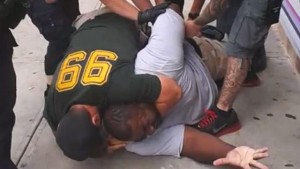
When Jimmy Lee Jackson was murdered in the cafe. At that time there was no Mike Brown murder, there was no Eric Garner murder — but there were so many others that are just ambient. It’s part of the atmosphere as a black person growing up in this country: You know that’s it’s happening somewhere on that very day. And a month later Mike Brown was killed. [Cinematographer] Bradford Young, [editor] Spencer Averick, and I, we designed that scene in a really specific way. It was really important that we have all that stuff worked out in advance because I knew it was going to be a rough, emotional day. This wasn’t a day for improvisation.
King’s tactics imply that his supporters are going to have to get hurt: Nonviolence doesn’t work unless the other side overreacts.
Being passive doesn’t mean sitting there and getting hit for the sake of getting hit. And it wasn’t all faith-based, either. There were some very practical reasons why it was used. You talk to most people about King now and they only know “I Have a Dream,” and that he believed in peace and then he died. Really? That’swhat he’s been reduced to? And we’ve allowed it to happen. And if there is anything that Selma does, it reinvigorates the narrative around him to be more full-bodied and more truthful about what his tactics were.
Are you religious yourself?
No, not religious. But I love God.
Can you talk about the aesthetics of violence of Selma? When the church blows up and kills those four little girls, it’s harrowing, but it’s also filmed in a beautiful way. How do those two things work together? I don’t know if my intention was to make it beautiful. How do you film four little girls being blown apart? There’s a way to do it with a certain reverence and respect for who they were. That’s why it was important for me that you hear their voices before it happens.
There’s a sinking feeling in that scene — I counted five little girls, so I was hoping maybe it wasn’t going to happen.
There were five girls and one lived. And I put in a boy, to misdirect you on purpose. The violence throughout the film follows the same pattern. I resisted the idea of just it being a physical blow. That spectacle has been done: All we do in this industry is blow people up. But how does the hit feel and what does the face do after? What happens to that broken body and what happens to the people that have to tend to that broken body? It’s important to have the morgue scene after Jimmie Lee Jackson’s death, to show the mother and slow down on her face, to slow down the girls, to slow down Annie Lee Cooper when the men put their hands on her and take her down. It was about having a reverence for that was the idea behind it instead of, say, making it beautiful. You’re saying: This is worth taking a closer look at. Everybody stop and pay your respects to this.
Can you pinpoint a moment of joy that happened while you were making this movie?
So many things come to mind, but there was a day that we were filming in Richie Jean Jackson’s house, doing that scene when they all walk into the kitchen. We’re at this house in Atlanta, we had shut down the street. That was the day that Tim Roth and Giovanni Ribisi were coming for their hair and makeup tests. They have to come to see me, ’cause I can’t get away. So they come to the set, and I thought, “Look at all my guys, they’re all together — the White House guys, Wallace, the black guys.” Those characters never cross, right? The chance to see them all together was so fun. Then a black SUV starts coming up the street, going around cones. Our assistant directors and our production assistants are running down, saying, don’t go, they’re shooting. The door opens and out comes Oprah. She’s not supposed to be there; we thought she wasn’t even in the state that day! She starts walking towards me and I just run up to her and give her a big old hug. It was like a house party in the street.
A surprise visit from Oprah on the set of ‘Selma.’ (Photo: Instagram/@directher)
How was it having people like the actual Andrew Young on the set?
So cool. And it easily could not have been if they were grouchy curmudgeons. But there’s still a spark about them. These are our greatest minds, our greatest radicals. Time has not done them in. If you look John Lewis in the eye and he’s talkin’ to you about something, you’re like “Uh huh, let’s go do it!” When I sat down with them, I was really clear that we weren’t asking for anybody’s permission.
RELATED
Best Overlooked Performances of 2014
But this [film] is not called “King”; this is Selma. This was as much the story about the band of brothers and sisters that were around him as it was King’s story. There haven’t been great pains taken to show that he was a leader among leaders — all of them could’ve probably done it. Why him? He could talk the best. He was an orator who was able to synthesize all these ideas in a way that spoke to the masses and also that spoke to people in power. But they were there and they were the masterminds behind it. I tried to show the strategy, the tactics, the arguments. That’s how history is made, not by consensus, but by people freakin’ battling it out, right? That’s how change happens.
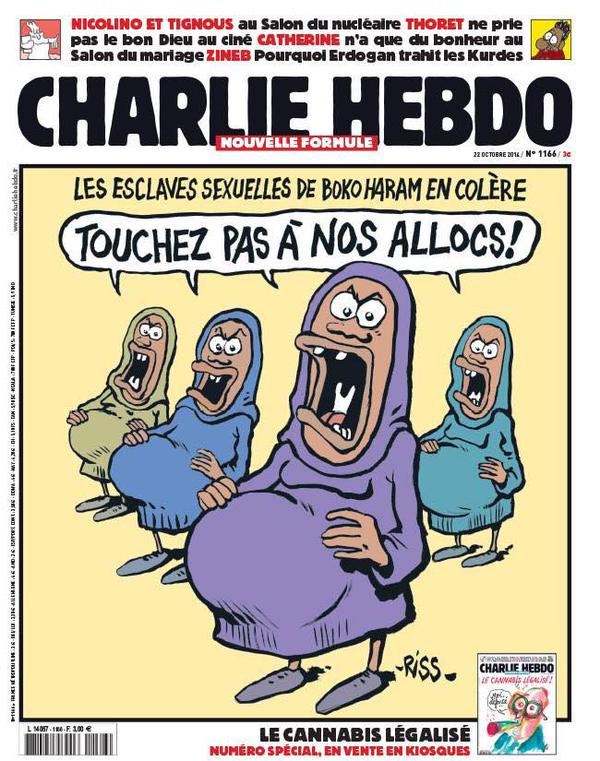
Today, I mourn with French society, especially the families who have lost their loved ones to violence during yesterday’s attack at Charlie Hebdo. I also stand in solidarity with all of the Brown people in France, who, because of media fear-mongering, and Islamist-blame-gaming, will be further excluded from French society by State-condoned racism.
I’m not French, but one doesn’t need to be in order to see how deeply racism runs throughout French, and Western, societies. The ruthless murders of cartoonists– cultural producers who were questionably using their art to dispel (or perpetuate?) racism to an already discriminatory public in the name of free speech–and the counter-attacks against everyday Muslims, who would prefer this incident not be blamed on their entire, diverse, multi-faceted community, provides us with another opportunity to think through solutions to violence issued on behalf of the State and those retaliating to such violence in the form of extremism.
France, like every Western country, ruthlessly excludes Brown/Black people by using discourses of exceptionalism to dispel claims of State-perpetuated racism in order to protect racist hatred under the guise of free speech. Take a look at the Parisian suburbs, Clichy-sous-Bois and Seine-Saint-Denis. Look back at France’s imperialist occupation of Algeria, or the French parliament, and one can easily tease out how obviously anti-Black/Brown French culture has been and become.
But France is not alone, anti-blackness runs deep throughout the West, most particularly among White people who have enslaved Brown/Blacks, have deprived us, murdered us, appropriated our cultures and claimed them as their own, lynched us, isolated us, and tortured us, in the name of the State.
I do not condone the killings of any sentient being, and, yet, the same people trending the popular, #JeSuisCharlie hashtag are the same people trending #KillAllMuslims. The same people who are throwing grenades at French mosques in counter-attacks are the same people who believed Charlie Hebdo wasn’t racist, but satirical. In fact, what we really need to question is why satirizing non-White cultures is seen as harmless, especially when Black and Brown people of these particular cultures have been murdered time-and-time again in the name of the State because of the maintenance of anti-Black, White racial supremacist ideologies.
However, what troubles me the most is the fact that the same activists who have been protesting police violence against people of color, especially here in the United States, are the same people who are shamelessly posting sympathies with Charlie Hebdo.
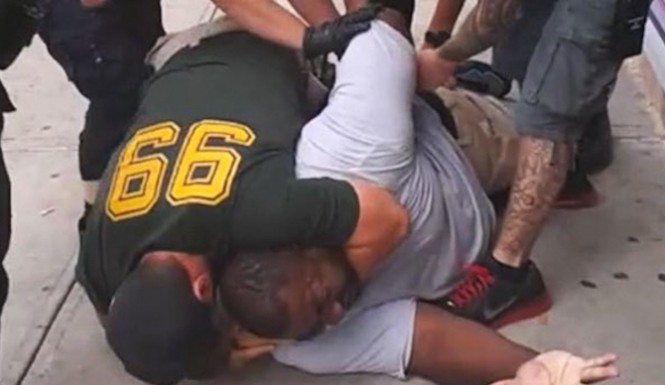
Let me be frank. Islamophobia runs deeply within Western culture. The same activists who are screaming Eric Garner’s last words “I can’t breathe” throughout all of the world’s metropoles should be the same people taking a stand against the rampant Islamophobic now proliferating via media. State-sanctioned cultural violence against Brown Muslims in France, is connected to the State-sanctioned violence exacted upon Black bodies in the United States.
Let us not forget that when Michael Brown was murdered in the streets of St Louis, when Tamir Rice was murdered in front of a park in Cleveland, when Aiyana Jones was murdered while asleep in her bed in Detroit, that across the ocean, Bouna Traoré and Zyed Benna were murdered after being chased by Parisian police into an electrical substation where they were ultimately electrocuted to death.
Let us not forget that Western culture does not believe that the murders of Black/Brown people are worthy enough to be considered national tragedies.
Let us not forget that Charlie Hebdo cartooned racist caricatures of deprived Brown cultures in the name of free speech.
Let us not forget that no one became Christianphobic when White KKK members and other White racial supremacists burned crosses and murdered Black people throughout the United States in the name of Christianity.
Let us not forget the cowardice of Western media as they’ve attempted to focus on Black on Black crime or the recent, tragic, murders of NYPD officers by one Black man as a way of reminding Black and Brown people that we are capable of killing, too.
Media outlets are guilty of igniting the already fiery racial hatred that has been ablaze and guilty of forgetting to fully narrate the ways racial supremacy harms all of us. White people can bomb NAACP offices in Colorado or Mosques in France, and the United Kingdom, and not even get close to the same coverage as did the stories of the two police officers murdered in Brooklyn or that of the cartoonists murdered in Paris.
Let us not forget the pregnant Muslim woman who was attacked for wearing a Niqab in the Parisian suburb of Argenteuil. She not only suffered from anti-Islamic taunts by her attackers, but also had her veil ripped, hair cut off, and most depressingly of all, her soon-to-be born baby murdered via miscarriage.
Let us not forget the White couple who caricatured Eric Garner’s death on ABC Live but did not receive any backlash from Western media.
Let us not forget the Turkish Muslims in Germany fearing for their lives, as Neo-Nazi’s paraded through the streets of German cities, while being excluded from the folds of German society.
Let us not forget that Islamophobia is not just about religion, but more particularly about race, and that even though Charlie Hebdo caricatured France’s White right-wing sensibilities, White people are the only one’s who benefit from racism.
Let us not forget that racism kills, too.
_______________________
Malik Nashad Sharpe is a queer experimental choreography, poet, writer, and radical thinker from New York, who is now based in Chicagoland. His choreographic works have been showcased in London, Tokyo, and in Williamstown, MA, and his poetry has been published with New Bourgeois. He graduated from Williams College with a BA in Experimental Dance and Live Art, and also studied radical performance theory, choreography, and contemporary dance at the Trinity Laban Conservatoire for Music and Dance in London, UK. His artistic work can defined specifically as a form of politics, using the organization of time, space, bodies, and words to formulate radical commentary and resistance.
Horrific hate crime that prompted SPLC lawsuit in Mississippi concludes with final guilty pleas
It was a vicious hate crime that shocked the country – a black man in Jackson, Mississippi, attacked by a group of white teens and killed when he was deliberately run down by a pickup truck.
Captured by a motel security camera and broadcast on CNN, the murder of 47-year-old James C. Anderson in June 2011 prompted an SPLC lawsuit against the seven teens involved. That case ended with a confidential settlement.
This week, the criminal case came to an end when two men – John L. Blalack, 20, and Robert H. Rice, 24 – became the last of 10 defendants to plead guilty in connection with Anderson’s murder and other, earlier hate crimes against African Americans in Jackson. Convicted under the Matthew Shepard-James Byrd Jr. Hate Crimes Prevention Act, they each face up to 10 years in prison.
“This case was a sickening reminder of the consequences of racism and hate,” said SPLC Founder Morris Dees. “James Anderson was brutally murdered for no other reason than the color of his skin. And the lives of these young people have been ruined. As a nation, we must work even harder to confront the legacy of white supremacism that continues to haunt us.”
In 2012, Deryl Paul Dedmon, 22, the driver of the truck that ran over Anderson and the alleged ringleader of the group, pleaded guilty to murder and hate crime charges. He was sentenced to life in prison after Anderson’s family urged the prosecutor to not seek the death penalty.
In court yesterday, according to The Clarion–Ledger, Blalack admitted that he and the others had cruised the streets of Jackson, which they called “Jafrica,” on at least 10 occasions to harass and attack African Americans. On one trip, they beat a man near a golf course until he begged for his life.
On the night of June 25, 2011, seven of them left a party in nearby Puckett, armed with beer bottles to throw. Sometime after midnight, they found Anderson, an autoworker and the lead tenor in his church choir, in a motel parking lot. One of the teens knocked him to the ground as the assault began. One reportedly shouted “white power” during the attack.
Blalack recounted how he left the scene with three others and later received a phone call from Dedmon saying, “I just runned that n—-r over.” He said he returned to see people huddled around Anderson’s body.
Anderson, who worked at a nearby Nissan plant, was described by U.S. Attorney Gregory Davis as a “wonderful human being” and loving family man – “a father, a son who called his mother every morning, a brother and a partner.”
Others who pleaded guilty earlier were John Aaron Rice, 21; Dylan Wade Butler, 23; Jonathan Kyle Gaskamp, 22; and Joseph Paul Dominick, 23, all from Brandon; William Kirk Montgomery, 25, from Puckett; Shelbie Brooke Richards, 21, from Pearl; and Sarah Adelia Graves, 21, from Crystal Springs.
Source:
The Southern Poverty Law Center is dedicated to fighting hate and bigotry and to seeking justice for the most vulnerable members of our society. Using litigation, education, and other forms of advocacy, the Center works toward the day when the ideals of equal justice and equal opportunity will be a reality. Founded by civil rights lawyers Morris Dees and Joseph Levin Jr. in 1971, the SPLC is internationally known for tracking and exposing the activities of hate groups. Our innovative Teaching Tolerance program produces and distributes – free of charge – documentary films, books, lesson plans and other materials that promote tolerance and respect in our nation’s schools. We are based in Montgomery, Ala., the birthplace of the modern civil rights movement, and have offices in Atlanta, New Orleans, Miami, Fla., and Jackson, Miss.
Being poor has an adverse effect on one’s health and poorer communities have a higher mortality rate. That’s no secret, admits Amani Nuru-Jeter, associate professor at University of California Berkeley.
What is less well known is how race plays into it. It appears that living in poverty takes a harsher toll on black Americans than white Americans, according to the conclusions from Nuru-Jeter’s research.
“When we did the statistical analysis, the databases showed us that for one unit increase in income inequality … [there] were 400 to 500 fewer deaths among whites and 27 to 37 [more deaths] among African Americans,” Nuru-Jeter told the Guardian.
This means that living in poverty can lead to more deaths for blacks communities, but not white ones.
Nuru-Jeter and her team spent eight months combining data from the US census bureau, the National Center for Health Statistics and the Lewis C Mumford Center for Comparative Urban and Regional Research for 107 metropolitan areas with a black population of at least 10%.
The difference between mortality rates for black and white Americans was much greater than she expected. The team especially did not expect to see fewer deaths in white communities as income inequality went up. That, however, can be attributed to economic segregation, which is more prevalent in black neighborhoods, Nuru-Jeter theorized.
She said that poor white Americans are more likely to reap the benefits of living near areas with better resources and higher incomes, while poor black Americans tend to live in relatively isolated inner-city neighborhoods.
“When low-income whites can reside in close proximity to higher-income whites then they reap the benefits of living in a higher-income area and everything that goes along with that,” Nuru-Jeter said.
In black communities, economic segregation is much higher. Higher-income black people are more likely to move away from low-income black people. Poor black communities often struggle with higher crime rates, fewer grocery stores, a higher proportion of liquor stores and less green space such as parks.
“In terms of opportunity to lead the healthy life, the environment doesn’t really support that,” Nuru-Jeter said.
In November, the unemployment rate for black Americans was 10.6%, more than twice the unemployment rate of white Americans, which was 4.6%.
A college education, commonly believed to be a ticket out of poverty, is expensive. In fact, about half of black college students graduate withmore than $25,000 in student loans. Yet even a college degree doesn’t guarantee that they will be better off. In fact, a recent Demos analysis of Americans’ net worth revealed that white high school dropouts have about the same wealth that black college graduates do.
As a result, some black Americans are often stuck in poverty.
What is killing black Americans?
The mortality rate in the study considers all types of death, from homicide to cardiovascular disease to infant mortality.
“It’s a crude measure of population health, but a very reliable and sensitive indicator of the well-being of the population,” Nuru-Jeter said.
“We were interested in population health as opposed to the health of individual people. As income inequality in the area increases, what does that say about how well the population in general is doing?”
The black communities were doing much worse than the white ones, she found.
Facebook
Twitter
Pinterest
expand
Black Americans are 21 times more likely than whites to be shot by cops. Photograph: Aaron Lavinsky/AP
In general, the black population in the US has poorer health.
A recent Gallup poll showed that black Americans are more likely to be obese and have high blood pressure. More than a third of black Americans surveyed by Gallup are obese.
The survey – for which more than 272,000 Americans were interviewed – found that for every age group, black Americans were more likely to be obese than their white, Asian and Hispanic counterparts. Almost half of black Americans 45 to 64 years old were also being treated for high blood pressure. For those 65 and older, 70% were receiving such treatment. Black Americans are also twice as likely to be diagnosed with diabetes.
Advertisement
Not only are black Americans more likely to suffer from these chronic conditions, but they are also more likely to be uninsured. According to a census survey from 2011, the uninsured rate for black Americans was 20.8%; for whites, it was 11.7%.
The Affordable Care Act has made a dent in the number of uninsured Americans, but many still remain. Overall, the uninsured rate for black Americans is 17.3%,according to Kaiser Family Foundation.
While many uninsured black Americans might qualify for Medicaid expansion, the states where they live might not have expanded their Medicaid yet. Nearly 60% “of uninsured African Americans with incomes below the Medicaid expansion limit reside in states that were not planning to expand Medicaid as of late June 2013”, according to the Department of Health and Human Services.
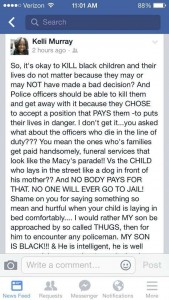
Kelli Murray is currently an employee of the Baltimore County Government who works as a dispatcher. She is a wife and mother. After the non-indictment of Daniel Pantaleo in New York City (the officer who killed Eric Garner), she posted a Facebook status that expressed her fear of her children interacting with law enforcement. This is a fear that has been expressed by many people in light of the increased coverage of issues of police brutality. She went out of her way to express that she appreciates the job that good police officers do, but that in light of the current events her fears persist. This was the text of her actual post:
“UPDATE: 12/29: Since this article has been published, Kelli has been continued to be bullied online and in the media. She will likely have to move and find new employment. Kelli is a wife and mother of six who needs support. Please click here to donate to her family and support them during this time. Kelli has also released a video public statement about her comments (at the bottom of this article).
Unfortunately most people who are talking about racism in the mainstream political discourse are not sufficiently literate in the dynamics of racism to properly apply it to the events that have dominated the mainstream news media. Racism is about the power that white dominated and controlled institutions have over the livelihood of Black people and other people of color. In the context of police brutality what we are seeing is racism as it exist in our society.
Racism does not exist in a form that requires ill intent of a white person against Black people. We are not seeing evil white people conspiring to kill young Black people. What we are seeing is police officers operationalizing their feelings of Black criminality and worthlessness that our society has been saturated with. They are acting on impulses that all of us are socialized to have. Black criminality and worthlessness are notions that have been with us since America’s inception. From the 3/5’s compromise, to the system of Jim Crow, American civil society has been structured on popular narratives that justify our dehumanization. It’s latest iteration has been embodied in the war on drugs that has decimated Black communities.”
“
“Instead of society admitting that there is a deep seeded problem of racism in our country beyond the rudimentary discourse of unfair treatment, our conversation about police brutality has been muddled. Admitting that law enforcement (like all of the major institutions of society) is an institutions that perpetuates institutional racism doesn’t mean that you are anti-cop. All it means is that you acknowledge that the criminalization of Black people has caused law enforcement officials to engage in behaviors that dehumanized Black people. And if you are serious about effectively serving the people that you are designated to protect then you would take the time to take seriously the ways that internalized racism effects how you interact with Black people.”








 It was a vicious hate crime that shocked the country – a black man in Jackson, Mississippi, attacked by a group of white teens and killed when he was deliberately run down by a pickup truck.





 OCG
OCG 