2013 Academy Award Nominations: “And the Winner is … The CIA” l Centre for Research on Globalization

2013 Academy Award Nominations: “And the Winner is … The CIA”

The Oscars: Extraordinary and glaring contradictions

Global Research, January 13, 2013
oscar

This year’s Academy Award nominations were announced Thursday morning during a media event at the Samuel Goldwyn Theater in Beverly Hills, California.

The award ceremony itself will take place February 24 at the Dolby Theater in Hollywood.

In 2012 the American film industry presented an extraordinary contradiction, between those showing an interest in social life and history, on the one hand, and those eagerly endorsing the “dark side” of imperialist policy, on the other. In their own inimitably muddle-headed fashion, the Oscar nominations reflect this divide.

With twelve, Steven Spielberg’s Lincoln received the largest number of nominations, including those for best picture, actor (Daniel Day-Lewis), supporting actor (Tommy Lee Jones), supporting actress (Sally Field), director (Spielberg), adapted screenplay (Tony Kushner), cinematography (Janusz Kaminski), costume design (Joanna Johnston), editing (Michael Kahn) and original score (John Williams).

This film about a social revolution, one of the most immense struggles for social progress of the 19th century, shared in the awards nomination bounty with Zero Dark ThirtyKathryn Bigelow’s quasi-fascistic glorification of the role played by the CIA in the so-called “war on terror,” which was tapped for five awards; Django Unchained, Quentin Tarantino’s foul and racialist fantasy about the antebellum period, also nominated in five categories; and Argo, another tribute to the CIA, directed by Ben Affleck, this one concerning the Iran hostage crisis of 1979-80, which was named for seven possible awards.

Opposed groupings and factions within the film industry may back the different works, but it doesn’t take any stretch of the imagination to suppose that a fairly representative figure in contemporary Hollywood might well favor both Lincoln and, say, Bigelow’s deplorable film. The degree of bewilderment, willful or otherwise, about both artistic and political matters is that great.

The nominations overall demonstrated an effort to cover every possible base.

Life of Pi, a murky, semi-religious ode to the little things in life, which also preaches ethnic and religious tolerance, won eleven nominations, second most to Lincoln. One of David O. Russell’s weaker films, Silver Linings Playbook, about a semi-dysfunctional working class couple in Philadelphia, one of this year’s official “tributes to the human spirit,” was nominated in eight categories. An obligatory big-budget action picture, Skyfall the latest James Bond, was nominated for five awards. A sentimental (and musical) depiction of poverty and oppression in 19th century France, Les Miserables, carried off eight nominations.

Beasts of the Southern Wild

Also receiving recognition, somewhat surprisingly, were the independent Beasts of the Southern Wild, a poetical consideration of post-Katrina Louisiana (four nominations), and Austrian filmmaker Michael Haneke’s Amour, about an elderly couple confronting disease and the approach of death (five nominations). The interesting Searching for Sugar Man was nominated in the best documentary feature category.

Searching for Sugar Man

The Academy Awards process is always a peculiar one. The combination of confusion, liberal good intentions, semi-philistinism, self-congratulation and political blindness is a particular expression, refracted through the peculiarities of the entertainment business, of the thinking and feeling of sections of the better-paid professional middle classes in America. This is not the best crowd, and it is not the worst.

To the extent that such people, including of course Spielberg himself, remain in thrall to the Democratic Party and Barack Obama, they are both politically and artistically limited. The subordination to the Democrats speaks to and ensures their distance from the concerns and needs of the overwhelming majority of the working population. Insulated from the economic hardships facing tens of millions and all too ignorant of history and the social process, prominent figures in the film world tend to accept the view self-servingly advanced by the media that the mass of the American people is backward and conservative. To a shameful extent they cower before the right-wing media, terrified of being attacked as “un-American” and unpatriotic.

This is bound up with the ongoing consequences of the anti-communist purges of the 1950s, which still haunt Hollywood. The most “radical” and “controversial” work today remains firmly within the framework of an acceptance of the present social and economic order.

Events will help clarify the best elements in filmmaking. One can even imagine a day when considerable numbers in Hollywood may be able to distinguish between a work that celebrates the cause of human liberation and one that identifies with its bitterest and most murderous enemies.

__________________________________________________________________________________________________________________________

ANNEX

The Complete List of Nominations

Here is the complete nominations lists:

Best Motion Picture

Argo
Amour
Beasts of the Southern Wild
Django Unchained
Les Misérables
Life of Pi
Lincoln
Silver Linings Playbook
Zero Dark Thirty 

Achievement in Directing

Ang Lee, Life of Pi
Benh Zeitlin, 
Beasts of the Southern Wild
David O. Russell, Silver Linings Playbook
Michael Haneke, 
Amour
Steven Spielberg, Lincoln

Performance by an Actor in a Leading Role

Bradley Cooper, Silver Linings Playbook
Daniel Day-Lewis, Lincoln
Denzel Washington, Flight
Hugh Jackman, Les Misérables
Joaquin Phoenix, The Master

Performance by an Actress in a Leading Role

Emmanuelle Riva, Amour
Jennifer Lawrence, Silver Linings Playbook
Jessica Chastain, Zero Dark Thirty
Naomi Watts, 
The Impossible
Quvenzhané Wallis, Beasts of the Southern Wild

Performance by an Actor in a Supporting Role

Alan Arkin, Argo
Christoph Waltz, Django Unchained
Phillip Seymour Hoffman, The Master
Robert De Niro, Silver Linings Playbook
Tommy Lee Jones, Lincoln

Performance by an Actress in a Supporting Role

Amy Adams, The Master
Anne Hathaway, Les Miserables
Helen Hunt, The Sessions
Jacki Weaver, Silver Linings Playbook
Sally Field, Lincoln

Best Animated Feature Film

Brave
Frankenweenie
ParaNorman
The Pirates! Band of Misfits
Wreck-It Ralph

Original Screenplay

Amour, Michael Haneke
Django Unchained, Quentin Tarantino
Flight, John Gatins
Moonrise Kingdom, Wes Anderson and Roman Coppola
Zero Dark Thirty, Mark Boal

Adapted Screenplay

Argo, Chris Terrio
Beasts of the Southern Wild, Lucy Alibar and Benh Zeitlin
Life of Pi, David Magee
Lincoln, Tony Kushner
Silver Linings Playbook, David O. Russell

Best Foreign-Language Film

A Royal Affair (Denmark)
Amour
 (Austria)
No (Chile)
War Witch (Canada)
Kontiki (Norway)

Original Score

Anna Karenina, Dario Marianelli
Argo, Alexandre Desplat
Life of Pi, Mychael Danna
Lincoln, John Williams
Skyfall, Thomas Newman

Original Song

“Before My Time,” J. Ralph; Chasing Ice
“Everybody Needs a Best Friend,” Walter Murphy and Seth McFarlane; Ted
“Pi’s Lullaby,” Mychael Danna and Bombay Jayashri; Life of Pi
“Skyfall,” Adele Adkins and Paul Epworth; Skyfall
“Suddenly,” Claude-Michel Schönberg, Herbert Kretzmer and Alain Boulil; Les Misérables 

Achievement in Production Direction

Anna Karenina
The Hobbit: An Unexpected Journey
Les Misérables
Life of Pi
Lincoln

Achievement in Cinematography

Anna Karenina, Seamus McGarvey
Django Unchained, Robert Richardson
Life of Pi, Claudio Miranda
Lincoln, Janusz Kaminski
Skyfall, Roger Deakins

Achievement in Costume Design

Anna Karenina, Jacqueline Durran
Les Misérables, Paco Delgado
Lincoln, Joanna Johnston
Mirror Mirror, Eiko Ishioka
Snow White and the Huntsman, Colleen Atwood

Best Documentary Feature

5 Broken Cameras
The Gatekeepers
How to Survive a Plague
The Invisible War
Searching for a Sugar Man

Best Documentary Short Subject

Inocente
Kings Point
Mondays at Racine
Open Heart
Redemption

Achievement in Film Editing

Argo
Life of Pi
Lincoln
Silver Linings Playbook
Zero Dark Thirty

Achievement in Makeup & Hairstyling

Hitchcock
The Hobbit: An Unexpected Journey
Les Misérables

Best Animated Short Film

Adam and Dog
Fresh Guacamole
Head Over Heels
Maggie Simpson in “The Longest Daycare”
Paperman

Best Live-Action Short Film

Asad
Buzkashi Boys
Curfew
Death of a Shadow
Henry

Achievement in Sound Editing

Argo
Django Unchained
Life of Pi
Skyfall
Zero Dark Thirty

Achievement in Sound Mixing

Argo
Les Misérables
Life of Pi
Lincoln
Skyfall

Achievement in Visual Effects

The Hobbit: An Unexpected Journey
Life of Pi
Marvel’s The Avengers
Prometheus
Snow White and the Huntsman


From Global Research Center for Research on Globalization

Centre for Research on Globalization (CRG)
PO Box 55019
11 Notre-Dame Ouest,
MONTREAL, Qc, H2Y 4A7
CANADA

GLOBAL RESEARCH RADIO

Michael Welch, Radio Producer, Winnipeg, Manitoba

The Global Research News Hour hosted by Michael Welch airs on CKUW 95.9FM in Winnipeg, Manitoba, Thursdays at 10am CDT. and on Canadian community radio networks.

The weekly programme is available for download on the Global Research website.

Consult Past GR Radio Programmes

How Did the Gates of Hell Open in Vietnam?

How Did the Gates of Hell Open in Vietnam?

Posted on Jan 17, 2013

Ron Cogswell (CC BY 2.0)

By Jonathan Schell, TomDispatch

This piece originally appeared at TomDispatch. Read Tom Engelhardt’s introduction here.

For half a century we have been arguing about “the Vietnam War.” Is it possible that we didn’t know what we were talking about? After all that has been written (some 30,000 books and counting), it scarcely seems possible, but such, it turns out, has literally been the case.

Now, in Kill Anything that MovesNick Turse has for the first time put together a comprehensive picture, written with mastery and dignity, of what American forces actually were doing in Vietnam. The findings disclose an almost unspeakable truth.  Meticulously piecing together newly released classified information, court-martial records, Pentagon reports, and firsthand interviews in Vietnam and the United States, as well as contemporaneous press accounts and secondary literature, Turse discovers that episodes of devastation, murder, massacre, rape, and torture once considered isolated atrocities were in fact the norm, adding up to a continuous stream of atrocity, unfolding, year after year, throughout that country.

It has been Turse’s great achievement to see that, thanks to the special character of the war, its prime reality—an accurate overall picture of what physically was occurring on the ground—had never been assembled; that with imagination and years of dogged work this could be done; and that even a half-century after the beginning of the war it still should be done. Turse acknowledges that, even now, not enough is known to present this picture in statistical terms. To be sure, he offers plenty of numbers—for instance the mind-boggling estimates that during the war there were some two million civilians killed and some five million wounded, that the United States flew 3.4 million aircraft sorties, and that it expended 30 billion pounds of munitions, releasing the equivalent in explosive force of 640 Hiroshima bombs.

Yet it would not have been enough to simply accumulate anecdotal evidence of abuses. Therefore, while providing an abundance of firsthand accounts, he has supplemented this approach. Like a fabric, a social reality—a town, a university, a revolution, a war—has a pattern and a texture.  No fact is an island. Each one is rich in implications, which, so to speak, reach out toward the wider area of the surrounding facts. When some of these other facts are confirmed, they begin to reveal the pattern and texture in question.

Turse repeatedly invites us to ask what sort of larger picture each story implies. For example, he writes:

“If one man and his tiny team could claim more KIAs [killed in action] than an entire battalion without raising red flags among superiors; if a brigade commander could up the body count by picking off civilians from his helicopter with impunity; if a top general could institutionalize atrocities through the profligate use of heavy firepower in areas packed with civilians—then what could be expected down the line, especially among heavily armed young infantrymen operating in the field for weeks, angry, tired, and scared, often unable to locate the enemy and yet relentlessly pressed for kills?”

Like a tightening net, the web of stories and reports drawn from myriad sources coalesces into a convincing, inescapable portrait of this war—a portrait that, as an American, you do not wish to see; that, having seen, you wish you could forget, but that you should not forget; and that the facts force you to see and remember and take into account when you ask yourself what the United States has done and been in the last half century, and what it still is doing and still is.

Scorched Earth in I Corps

My angle of vision on these matters is a highly particular one. In early August 1967, I arrived in I Corps, the northernmost district of American military operations in what was then South Vietnam.  I was there to report for the New Yorker on the “air war.” The phrase was a misnomer.  The Vietnamese foe, of course, had no assets in the air in the South, and so there was no “war” of that description.

There was only the unilateral bombardment of the land and people by the fantastic array of aircraft assembled by the United States in Vietnam.  These ranged from the B-52, which laid down a pattern of destruction a mile long and several football fields wide; to fighter bombers capable of dropping, along with much else, 500-pound bombs and canisters of napalm; to the reconfigured DC-3 equipped with a cannon capable of firing 100 rounds per second; to the ubiquitous fleets of helicopters, large and small, that crowded the skies. All this was abetted by continuous artillery fire into “free-fire” zones and naval bombardment from ships just off the coast.

By the time I arrived, the destruction of the villages in the region and the removal of their people to squalid refugee camps was approaching completion. (However, they often returned to their blasted villages, now subject to indiscriminate artillery fire.) Only a few pockets of villages survived. I witnessed the destruction of many of these in Quang Ngai and Quang Tinh provinces from the back seat of small Cessnas called Forward Air Control planes.

As we floated overhead day after day, I would watch long lines of houses burst into flames one after another as troops moved through the area of operation.  In the meantime, the Forward Air Controllers were calling in air strikes as requested by radio from troops on the ground. In past operations, the villagers had been herded out of the area into the camps.  But this time, no evacuation had been ordered, and the population was being subjected to the full fury of a ground and air assault. A rural society was being torn to pieces before my eyes.

The broad results of American actions in I Corps were thus visible and measurable from the air. No scorched earth policy had been announced but scorched earth had been the result.  Still, a huge piece was missing from the puzzle.  I was not able to witness most of the significant operations on the ground firsthand. I sought to interview some soldiers but they would not talk, though one did hint at dark deeds.  “You wouldn’t believe it so I’m not going to tell you,” he said to me. “No one’s ever going to find out about some things, and after this war is over, and we’ve all gone home, no one is ever going to know.”

In other words, like so many reporters in Vietnam, I saw mainly one aspect of one corner of the war.  What I had seen was ghastly, but it was not enough to serve as a basis for generalizations about the conduct of the war as a whole. Just a few years later, in 1969, thanks to the determined efforts of a courageous soldier, Ron Ridenhour, and the persistence of a reporter, Seymour Hersh, one piece of the hidden truth about ground operations in I Corp came to light.

1         NEXT PAGE >>>

CrossTalk On Haiti: Failed Aid l Ezili Danto‘ , Haiti Liberation and Freedom Activitist

CrossTalk On Haiti: Failed Aid

CrossTalk on Haiti: failed aid – interview with Ezili Dantò, Nick Rossier and Stanley Lucas

Source: CrossTalk (CT on Facebook)
Broadcast date: January 12, 2011

Despite the army of NGOs and a strong commitment of the international community, Haiti is still broken and its prospects are dim. Is something fundamentally wrong with the aid programs? And can Haitians break out of it? Ezili Dantò, Stanley Lucas and Nicolas Rossier share their first-hand experience on CrossTalk.

About Ezili Danto‘

Learn More

The Revolution which created the nation of Haiti was inspired by the divine decree of the warrior love goddess known as Ezili Dantò who danced in the head of the great Haitian priestess, Cecile Fatiman, on that famous Haitian night in 1791, on a red hilltop, at a forest thicket in Haiti called Bwa Kayiman.

Led by the powerful warrior spirit of Ezili Dantò, Cecile Fatiman crowned the African warrior Boukman with her royal red Petwo scepter, ushering in the Haitian war which forever slashed the chains of European slavery in Haiti to create Africa’s sacred trust, Manman Ayiti – the first Black nation in the Western Hemisphere.

Ezili Dantò is the symbol of the irreducible essence of that ancient Black mother, mother of all the races, who holds Haiti’s umbilical chord back to Africa, back to Anba Dlo*. Calling on her essence, breath, vision and cosmic power brought forth Haiti’s release from 300-hundred years of brutal European enslavement.

Ezili Dantò of HLLN performs the banda dance as Gede for Breaking Sea Chain. See also Intro to Breaking Sea Chains and RBM Video Reel

Ezili Dantò is the spiritual mother of Haiti and the preeminent cosmic symbol of Black independence, unity, self-determination, justice, equality and freedom.

The Ginen root – Haitian identity – forged at Bwa Kayiman is THE UNITY that’s never wavered in Haiti. One people, one African culture, one language, one Vodun spiritual imperative – to live free or die. That’s the consensus, the- “Linyon Fè la Fòs” – Haitian union, that’s never wavered.

One of Joseph Campbell’s most famous quotes is that “If you want to change the world, you have to change the metaphor.” The power of myth, metaphor and archetypal psychology are no longer disputed. If we were to look upon Ezili Dantò as a major African-Haitian archetype, myth, metaphor or narrative and note Vodun’s major role in the Haitian revolution and that during the Haitian revolution, this archetype was the only spirit principle or hero who was injured, who actually lost her voice, then it would be easier to understand why our work at Ezili’s HLLN has used Vodun lexicon to describe modern pathologies and given the great mother Goddess, Ezili Dantò, her tongue back. Supposedly, after Bwa Kay Iman, in the course of the war for liberation and freedom, Ezili Dantò was the only higher spirit and the only female symbol of love and nurture that was mutilated. Her tongue was cut out. And thus, in some sections of Haiti when this intangible, invisible, untouchable and eternal energy manifests into form through a living Haitian being, it can’t talk. This generation of Haitians at Ezili’s HLLN are not willing to continue putting life into that particular neocolonial metaphor. At Ezili’s HLLN, our work intends to change the world, Haiti’s world, by changing the metaphors and colonial narratives and uplift the warrior mother Goddess Ezili Dantò’s spirit, Dessalines’ three Ideals and the Haitian paradigm for universal freedom. We understand the psychological warfare, neocolonialism, racism and paternalism that would silence the feminine warrior, Ezili Dantò and the role archetypes and archetypal psychology plays in the liberation, life, values and culture of a people. Haiti doesn’t have superman, batman, Tarzan or any vampire heroes in its cultural narrative or popular folklore. But there’s Jean Jacques Dessalines, Toya, Sanit Belè, Defile, Kapwa Lamò, Ezili Dantò, Danbala, Ayida Wedo, Papa Legba, Simbi, Ogou Feray, Gede yo, et al. To witness to the African-Haitian ancestors’ original and untrammeled inherited pattern of thought or symbolic imagery derived from the collective past African experience is to counter the distasteful, inferior, neocolonial patterns inculcated, over two centuries of colonial/French ecclesiastic and other re-education, present in the individual conscious and unconscious of many modern Haitians.

There’s much work to done to counter the colonial narrative. Ezili Dantò’s HLLN focuses mainly on two archetypes – Ezili Dantò and the historical Papa Jan Jak. There’s nothing more important than putting our life force behind the re-MEMBERment of Ezili Dantò and Jean Jacques Dessalines to counter our African/Haitian dismemberment. Just as, there is also a move to not use the pictures of the white Catholic saints to stand for the African principles, values and irreducible Vodun essences – Lwa yo. The twenty-one nations who gathered at Bwa Kay Iman in 1791, the amalgamated African tribes who became African-Ayisyen in the land of the Taino-Ayisyen formed the only nation in the Americas not named by the white settlers and not founded upon colonial imperatives and values. Our imperative, their descendants, is to extend the universal freedom they fought for, live free or die.

The powerful nations’ constant attack on Haiti’s poor has not changed much. Haiti’s is still an international crime scene where the Haitian Oligarchs/mercenary families act for the neocolonialists. But Haitian resistance is deep with too many creative and spititual roots for capitulation to be a factor. Haitians use the power of the enemy to bend the enemy, never living by the values of the enemy. For, there are some things worst than death. Haiti’s masses refuse to submit to the colonizing nations’ mindset. What does it profit a (wo)/man to gain the whole world but to lose her/his soul. Nature recycles all form, including the tyrant’s form and profits, back to source even as the universal energy warehoused in all form is eternal and always safe, so why lose virtue or bother assist these others fearful and small enough to wish to shatter you for earthly profit.

During the Haitian Revolutionary War, this was the white nations’ “enlightenment” mindset Haitians faced:

“It is not everything to have removed Toussaint, there are two thousand other chiefs here to have taken away…Here is my opinion of this country. It is necessary to destroy all the negroes of the mountains, men and women, sparing only children under the age of twelve, and destroy half of those of the plain, without leaving a single colored man in the colony who ever wore an epaulette. Without that, the colony will never be at peace.” —French General Charles Victor Emmanuel Leclerc

The Haitian revolution helped the United States double its size and gain 15 extra States through the Louisiana Purchase. The Haitian people got rid of physical enslavement but were forced, after the assassination of Haiti’s founding father, into the Independence Debt. Today, economic enslavement reigns unfettered with the UN occupation, endless debt, free trade, privatization and wage slavery.

But, to the colonizing nations’ everlasting dismay, the great triumph of Ezili Dantò’s Haitian warriors, where Dessalines did what Spartacus couldn’t, cannot be equaled or erased in world history. No matter the tyranny imposed over the last two centuries of Haiti’s existence, Haiti’s invisible essence still cannot be colonized.

During the great Haitian war of liberation, the old Haitian ancestors burnt down all the port cities and retreated INLAND, knowing that if they valued any property, family, children or valuables above their freedom and liberty, that that would be used by the more powerful white tribes and their enforcers to re-enslave Africa’s masses. The African warrior Henri Christophe burnt his great mansion down first and then went to meet Lerclerc’s 50,000 French soldiers come to commit genocide and re-enslave the African masses. That courage, that single-minded focus, that ultimate Haitian sacrifice, after 300-years of Euro-enslavement, allowed for the eventual freedom for all the Blacks in the Americas and ended racial slavery. It is evidence that living from the unseen center where Haitians meet the primordial energy that has always been and is behind everything, where they stand together with the vital African Ancestors and Ezili Dantò, the warrior mother’s invisible but tangible and eternal love – is and has always been the core protection, faith and sustenance of the Haitian people. It used to be “Grenadye alaso, sa ki mouri zafè ya yo, nanpren manman, nanpren papa, sa ki mouri zafè ya yo. The revolutionary song, because African-Haitians are still here despite all powerful efforts to silence Ezili Dantò and her warriors, is updated: Grenadye alaso, sa ki mouri na vanje yo!

The Goddess Remembered at Bwa Kayiman

There was a time when women were the primary religious figures on this planet. A pre-historical time, long ago. (See Ezili Dantò/Aset/Isis (photos) and Ezili, Aset, Isis -Mother God and Black Woman: Mother of All the Races.)

Haiti, the first Black nation in the Western Hemisphere, is the pioneer in ushering back the reign of the goddess and of women as religious figures equal with men in performing religious ceremonies.

On August 14, 1791 Haitians remembered their dark, African mothers and honored Her culture. August 14, 1791 Boukman remembered Mother Africa. Cecil Fatiman remembered Mother Africa. All the “Feys” – leafs – at Bwa Kayiman remembered Mother Africa. Then, the amalgamated African tribes, in Haiti, found and took hold of Ezili Dantò who said, “Kanga Mundele” – Kill the stranger amongst us, meaning both the brutal enslavers as well as mental colonization. Over two hundred delegations of Blacks from various plantations throughout the North of Haiti where present.

The Haitians had stretched their heart, nerve and sinew way back to call on this authentic pagan (or the pre-Judeo-Christian, pre-Muslim described) spirits of ancient and pre-colonial Africa – they called on – Ezili Dantò (along with Danbala, Atibon Legba, Ogou Feray, Manman Lasirene, ect). But Ezili Dantò appeared first at that Petwo ceremony on August 14, 1791 day on that red clay hilltop in Haiti.

performance

Performance poet, Ezili Dantò of HLLN (in RBM) onstage as Ezili Dantò performs Anba Dlo, Nan Guinen (See also Bwa Kayiman (texts) and PhotoGallery)

All the Africans at Bwa Kayiman, all, be they Muslim or Christians converts, went HOME that day, back to Vodun and, that, has been the road less traveled by any African nation to date. That Movement has made ALL the difference to Africans in the New World and around the world, globally, for it initiated and propelled forward universal human rights as well as initiating the first sparks for Pan-Americanism and Pan-Africanism in modern world history. For, the Haitian people were the first Blacks and enslaved workers taken in shackles out of Africa to the “New World”, the first treated as savages and as subhumans and the first to respond to this treatment definitively and forever, by validating themselves as human beings entitled to equality, self-defense and entitled to their own African religious beliefs. For those days, as well as for today, that was REVOLUTIONARY. (See Video excerpt of Bwa Kayiman playand the Bwa Kayiman performance texts).

But a Black nation inspired by an African goddess/liberator was a bad omen for the white European settlers who claimed themselves superior to Blacks and certainly to free Black women. Yet, the Haitian people, without arms, allies or financial resources where so inspired by their Vodun gods and goddesses and the powers of their Ancestors that, led by the warrior goddess, Ezili Dantò, and after 300-years of Christian-based enslavement in the Americas and over one thousand years of Islamic conquest and enslavement incursions all over Africa, they decided to “live free or die” – liberte ou lamò! and set themselves free in Haiti, defeating all the mighty European powers of that time – France, Spanish and British, in combat.

Today, Haitian women and men follow the long legacy of the warriors of Haitian independence. They are tireless fighters, beholden to no-one – heroic leaders on the cutting edge of the human rights struggle.

Ezili Dantò of HLLN
(See also info on: Ezili Dantò/Aset/Isis (photos) and Bio of Ezili Dantò, 1791 and Ezili, Aset, Isis and Black Woman: Mother of All the Races and Vodun: The Light and Beauty of Haiti.)
**********************************************

Ezili Dantò performs the banda dance as Gede for Breaking Sea Chain. See also Intro to Breaking Sea Chains and RBM Video Reel

The Haitian struggle – the greatest David vs. Goliath battle being played ou on this planet

***********************

*Anba Dlo literally means “beneath the ocean, the waters.” It is that primordial, cosmic space where all potentiality lives. It’s the mythological “Haitian Heaven” (to use a non-African point of reference). It’s where all that ever lived, will live and is living will end up. It is, to the African warriors who founded Haiti, the road back to Manman “Africa” – Nan Guinen, that cosmic space where the world began with “Lè Marasa, lè Mò e lè Mistè.”

Anba Dlo to the Haitian is where the great African Ancestors’, where our sacred energies, our strengths and force – the “Lwa yo,” – those sacred irreducible essences of the Haitian/African/Black soul – reside. Anba Dlo is the sacred stillness, cosmic place, where life sources issue from and return to.

************************

Performance poet, Ezili Dantò of HLLN (in RBM) onstage as Ezili Dantò performs Anba Dlo, Nan Guinen (See also Bwa Kayiman (texts) and PhotoGallery)

************
More info on the sacred energies, light and beauty of Haiti and Haitian culture and on the Haitian Lwa – Gods and Goddesses, the irreducible essences.

The Case Against Rwanda’s President Paul Kagame

The Case Against Rwanda’s President Paul Kagame

by Jan 14, 2013 

Why the celebrated Rwandan president really deserves an indictment.

When Rwandan-backed rebels recently took Goma, the biggest city in the eastern part of the Democratic Republic of the Congo, Paul Kagame had every reason to think the world would give him a pass. That, after all, has been the pattern for years.
Paul Kagame
Does the celebrated Rwandan president really deserve an indictment? (Sven Torfinn/Panos Pictures)Frequently lauded by people such as Bono, Tony Blair, and Pastor Rick, the Rwandan president enjoys some extraordinary backing in the West—support that is particularly remarkable given his alleged hand in ongoing regional conflicts believed to have killed more than 5 million people since the mid-’90s. 

On the aid and awards circuit, Kagame is known as the man who led Rwanda from the ashes of the 1994 genocide—one of the late 20th century’s greatest atrocities—to hope and prosperity: a land of fast growth and rare good economic governance with enviable advances in health care, education, and women’s rights. Bestowing his foundation’s Global Citizen Award on Kagame three years ago, Bill Clinton said: “From crisis, President Kagame has forged a strong, unified, and growing nation with the potential to become a model for the rest of Africa and the world.”

But that model narrative seems to be shifting in the aftermath of the Goma takeover. After a United Nations report found that Rwanda created and commands the rebel group known as M23, important European friends such as Britain and Belgium partially suspended aid donations to Rwanda, and President Obama called Kagame to warn him against any continued military adventurism.

Leading observers say the reevaluation of Kagame and his legacy is long overdue. Filip Reyntjens, a Belgian scholar whom many consider the world’s foremost expert on Rwanda, describes Kagame as “probably the worst war criminal in office today.” In an interview, Reyntjens told me that Kagame’s crimes rank with those perpetrated by former Iraqi president Saddam Hussein or Sudanese leader Omar al-Bashir, who is wanted by the International Criminal Court on charges of genocide, war crimes, and crimes against humanity.

Washington and London have long supported Kagame as a bulwark of stability in a volatile region. But a recent U.N. report accused his government of instigating trouble across the border in the Democratic Republic of the Congo. Meanwhile, specialists in African affairs say a regime like Kagame’s, an ethnic dictatorship built along unusually narrow lines, represents a political dead end. And international human-rights organizations, including Human Rights Watch, have raised serious questions about violence committed against journalists and opposition figures. Kagame has generally been dismissive of such accusations of abuse.

Tall, gaunt, and almost professorial in manner, Kagame cuts an unusual figure for a former African guerrilla leader. His rise to power began in 1990, when as head of the Rwandan Patriotic Front, an exiled movement made up primarily of Tutsis, he launched a war to take over his native country from bases in neighboring Uganda.

Four years later, the course of history took a dramatic turn: on April 6, 1994, an airplane carrying Rwanda’s president, Juvénal Habyarimana, an ethnic Hutu, was mysteriously shot down on its approach to the capital, Kigali, unleashing the murder spree that became known as the Rwandan genocide. In the space of 100 days, about 800,000 people—most of them members of the Tutsi minority—were killed at the instigation of Hutu extremists. As Kagame and his army gained control of the country, ending the genocide, the Hutu extremists, along with hundreds of thousands of ordinary people, fled to neighboring states, in particular Zaire, as it was then known.

Pasteur Bizimungu, a Hutu, was named president in what seemed an effort at providing representation for the roughly 84 percent Hutu majority in Rwanda’s new national unity government. However, Kagame, a Tutsi and the nominal vice president, kept control of the Rwandan Army, becoming the country’s de facto leader. And by 2000, after numerous cases of forced exiles, disappearances, and assassinations of politicians, Bizimungu resigned the presidency, bringing a definitive end to the illusion of ethnic balance in high office. (The government now prohibits the use of ethnic labels.)

Since then, former Rwandan officials say, almost every position of meaningful power in the country has been held by a Tutsi. In 2001, when Bizimungu began organizing a political party in order to run for president, it was outlawed on charges of being a radical Hutu organization. The following year, Bizimungu was arrested on charges of endangering the state, and later he was sentenced to 15 years in prison.

(Bizimungu, whom Amnesty International called a prisoner of conscience, was pardoned by Kagame in 2007, but the methods used to sideline him have been applied broadly ever since, with critics of the regime of all stripes being prosecuted for promoting “genocide ideology,” which has become an all-purpose charge.)

Congo Rwanda Troubled Neighborhood

Troubled Neighborhood: For years Rwandan government forces and their proxies have operated in Congo, setting off conflicts that have killed millions.

Theogene Rudasingwa, a Tutsi who was appointed Rwanda’s ambassador to Washington after serving as an officer in Kagame’s army, puts it bluntly: “If you differ strongly with Kagame and make your views known from the inside, you will be made to pay the price, and very often that price is your life.”

Rudasingwa, who now lives in exile in the United States, describes Kagame as an extreme control freak who has concentrated power in the hands of a select group of Tutsis who, like Kagame himself, returned to Rwanda from years of exile in Uganda after the genocide.

“When you look at the structure of key parts of government, leadership is occupied almost entirely by Tutsis from the outside, and this is especially true in the military,” Rudasingwa says. “As for the Hutus, they are completely marginalized, and things [for them] have never been as bad as they are today. Almost the entire Hutu elite that was built up since 1959 is either outside the country or dead. They are marginalized and banished, forced into exile when they haven’t simply been killed.”

Kagame tightly controls the country and its citizens through the Tutsi-
dominated Army and the Rwandan Patriotic Front, the country’s dominant political party. Throughout Rwanda—in every town and tiny village—the RPF is present, not unlike the Stasi in East Germany during the Cold War. While a town may have a Hutu mayor, under Kagame’s system government officeholders have little authority compared with the RPF representatives who work in parallel to them and often pull rank.

RPF regulations—enforced by local commissars with vigor and steep fines—govern almost every aspect of daily life. There are laws requiring peasants to wear shoes and good clothes when not working their fields and prohibition of drinking banana wine from shared straws—a traditional gesture of reconciliation—and myriad other rules, generally resented as gratuitous and insulting.

“The RPF saturates every aspect of life in Rwanda,” said Susan Thomson, a longtime Rwanda expert at Colgate University. “They know everything: if you’ve been drinking, if you’ve had an affair, if you’ve paid your taxes.” Everything is reported on, Thomson says, and there is no appeal.

From the beginning, Kagame’s legitimacy was founded on his image as the man who had halted the genocide committed by the Hutu-led government and extremist militias. While the vast majority of the 800,000 people killed in the frenzy were Tutsis and moderate Hutus, there are profound flaws in what is usually a rather simplistic telling of the country’s history.

Pointing to the origins of the war and its bloody aftermath, Scott Straus, a political scientist at the University of Wisconsin, said: “An honest analysis … would show that the reasons for what happened were much more complicated than the idea that the Hutus hate the Tutsis and want to wipe them out.”

For one thing, there is abundant evidence that Kagame’s forces in the early days carried out targeted executions of the Hutu elite, followed later by much larger extermination campaigns that killed tens of thousands of people.

A year after the genocide had ended, blood was still being spilled, recalls Timothy Longman, then the country director for Human Rights Watch. “People would take me around and say, ‘There’s mass grave right over here,’ and you would ask, ‘From when?’ And they would say, ‘Just from a few weeks ago—not from the genocide,’” says Longman, who now directs the African Studies Center at Boston University.

One of the earliest investigations was undertaken by a U.N. team led by the American Robert Gersony in the fall of 1994. The team conducted research by interviewing people in refugee camps and the countryside. In a report later suppressed by the U.N., partly as a result of American political pressure aimed at supporting the new RPF government, Gersony’s team concluded that four provinces had seen “systematic and sustained killing and persecution of their civilian Hutu populations by the RPA,” the armed wing of the RPF.

Furthermore, the report estimated that the RPA killed between 15,000 and 30,000 people in just four of its survey areas in the summer of 1994. Years later a key member of Gersony’s team told me that the real number of Hutus killed during this period was likely much higher, but that a low estimate had been published because of fears of a political backlash within the U.N. so soon after its failure to stop the larger-scale killing of Tutsis. “What we found was a well-organized military-style operation, with military command and control, and these were military-campaign-style mass murders,” the team member told me.

(In one notorious incident in April 1995, the RPA attacked an internally displaced people’s camp in Kibeho using automatic weapons, grenades, and mortars. A team of Australian medics listed more than 4,000 dead when the RPA forced them to stop counting. France’s leading researcher on the region, Gérard Prunier, estimates that at least 20,000 more people from the camp “disappeared” after the massacre.)

Many people inside the country know this history well but have been prevented from talking about it as the political space has narrowed.

Paul Kagame
Almost professorial in manner, Kagame cuts an unusual figure for a former guerrilla leader. (Fred Dufour/AFP/Getty)

In the run-up to the 2010 election in which Kagame was declared the winner, there was widespread violence, with several journalists and figures from the opposition attacked or killed, including a politician who was beheaded. Amnesty International condemned the violence and the “killings, arrests, and the closure of newspapers and broadcasters [which] reinforced a climate of fear.”

The case of Victoire Ingabire, a politician from the opposition, was instructive. When she returned to Rwanda that year, having lived 16 years in exile, to prepare a run for president, her first stop was at the official genocide memorial. “We are here honoring at this memorial the Tutsi victims of the genocide. There are also Hutu who were victims of crimes against humanity and war crimes, not remembered or honored here,” she said in a prepared statement. “Hutu are also suffering. They are wondering when their time will come to remember their people. In order for us to get to that desirable reconciliation, we must be fair and compassionate towards every Rwandan’s suffering.”

Ingabire was promptly arrested and accused of “genocide ideology.” During her trial, President Kagame publicly declared that she was guilty.

Tiny Rwanda is called the land of a thousand hills because of its verdant, rolling countryside of strikingly fertile farmland. It is a land of beauty and unrelenting order. But unlike its much larger neighbor Congo, it is not endowed with any mineral wealth to speak of. Yet Rwanda’s economy depends on the exploitation of Congolese resources.

Through mafialike networks reportedly run by the Rwandan Army and the RPF, huge quantities of Congo’s minerals are siphoned out of the country, experts say.

As early as 2000, Rwanda was believed to be making $80 million to $100 million annually from Congolese coltan alone, roughly the equivalent of the entire defense budget, according to Reyntjens, the Belgian expert.

Pillaging the Congo obscures Rwanda’s giant military budget from foreign donors who provide as much as 50 percent of the country’s budget every year. It also provides a rich source of income to the urban elites, especially returnees from Uganda, who form the regime’s core.

“After the first Congo war, money began coming in through military channels and never entered the coffers of the Rwandan state,” says Rudasingwa, Kagame’s former lieutenant. “It is RPF money, and Kagame is the only one who knows how much money it is—or how it is spent. In meetings it was often said, ‘For Rwanda to be strong, Congo must be weak, and the Congolese must be divided.’”

Congo looms large in the story of Kagame in other ways as well. For years Rwandan government forces and their proxies have operated in Congo. Twice Rwanda has invaded the country outright, in September 1996, when with U.S. acquiescence it successfully waged war to overthrow Mobutu Sese Seko, and again beginning in August 1998, when it mounted a repeat operation to depose Laurent-Désiré Kabila. This second operation, to replace the very man Kagame installed to replace Mobutu, ended in failure but established a pattern of intervention and meddling aimed at undermining its much larger neighbor. The ensuing war, involving several African nations, is believed to have cost the lives of 5 million people.

As early as 1997, the U.N. estimated that Rwandan forces had caused the deaths of 200,000 Hutus in Congo; Prunier, the French expert, has since estimated that the toll is closer to 300,000. According to the U.N. report, these deaths could not be attributed to the hazards of war or to collateral damage. “The majority of the victims were children, women, elderly people and the sick, who were often undernourished and posed no threat to the attacking forces.” The report concluded that the systematic and widespread attacks, “if proven before a competent court, could be characterized as crimes of genocide.”

Two years ago, Kagame delivered a lecture in London on “The Challenges of Nation-Building in Africa: The Case of Rwanda.” When confronted with a U.N. report that was then making headlines with the suggestion that his forces had committed genocide in Congo, he dismissed such allegations as “baseless” and “absurd.” Clearly he was keener to talk about economic indicators and repeat the oft-told success story of his country.

But even that is a truth with modification. Social inequality in Rwanda is high and rising, experts say. Despite an average annual growth rate of about 5 percent since 2005, poverty is soaring in the countryside, where few Western journalists report without official escort.

“The rural sector has suffered enormous extraction under the post-genocide government, far more than what had happened before,” said one longtime researcher who spoke on the condition of anonymity. “There is a real increase in misery. When you speak of Rwanda as a volcano, that’s what’s involved.”

Will Rwanda explode again? The big, looming issue is whether Kagame will leave office in 2017, as the Constitution calls for. With so much to answer for, few expect a straightforward exit.

The Daily Beast on Facebook and follow us on Twitter for updates all day long.

Howard W. French is the author of A Continent for the Taking: The Tragedy and Hope of Africa and Disappearing Shanghai. He is completing a forthcoming book about China and Africa, titled Haphazard Empire. He teaches at Columbia University’s Graduate School of Journalism.

For inquiries, please contact The Daily Beast at editorial@thedailybeast.com.

Lisa Kristine photographs slavery

Lisa Kristine photographs slavery


This former child slave forced to fish in Ghana was reunited with his family after Lisa Kristine took his portrait. Photo: Lisa Kristine, Lisa Kristine © / SF This former child slave forced to fish in Ghana was reunited with his family after Lisa Kristine took his portrait. Photo: Lisa Kristine, Lisa Kristine © / SF After his photo was taken, he was reunited with his family, and abolitionists taught his parents to turn away traffickers who come knocking with false promises of good jobs for their children.

Meredith May
Updated 2:31 pm, Saturday, January 5, 2013


A young girl in India is among the many children forced into slavery that Lisa Kristine has photographed throughout the world. Photo: Lisa Kristine, Lisa Kristine Photography / SF

A young girl in India is among the many children forced into slavery that Lisa Kristine has photographed throughout the world. Photo: Lisa Kristine, Lisa Kristine Photography / SF


Humanitarian photographer Lisa Kristine of Mill Valley had captured the dignity of indigenous people in 100 countries on six continents, yet never realized that modern-day slavery was in the shadows everywhere she traveled.

That all changed when Kristine, whose color-saturated photos are set to go on world tour this year, met an abolitionist while exhibiting her work at the 2009 Vancouver Peace Summit. The advocate told Kristine that 27 million people are enslaved worldwide – more than twice the estimated number of people taken from Africa during the Atlantic slave trade between the 16th and 19th centuries.

“I almost fell over,” said Kristine, whose images hang in the Palace of Bhutan, have been auctioned at Christie’s to benefit the United Nations, and have drawn accolades from the Dalai Lama. “It blew me away that I, whose whole job is to see, didn’t know.”

Within a week, she was in the Los Angeles offices of the advocacy group Free the Slaves, offering to use her 19th century, 4-by-5 camera to expose slavery: the impoverished children and adults given false promises of money, education and a better life, only to be tricked into indentured labor and held in captivity by fear, force and coercion.

Illegal mine

In Ghana, Kristine climbed 200 feet down an illegal gold-mine shaft to find men with crude flashlights tied to their heads, forced to endure dust and dark for 72-hour stretches.

Escorted by local representatives from Free the Slaves, she found children in the Himalayas lugging slabs of slate heavier than themselves down the mountains, via crude harnesses attached to their foreheads made from sticks, rope and torn cloth.

At a brick kiln in Nepal, she photographed workers in 130-degree heat and choking dust, stacking 18 bricks on their head at a time and walking the loads to waiting trucks.

“All I could see was Dante’s ‘Inferno,’ ” Kristine said.

She saw trafficked children in tattered shirts reeling in 1,000-pound fishing nets on the shore of Lake Volta in Ghana, freezing in the early dawn after all-night fishing expeditions.

Avoiding patrolmen with automatic weapons, she quickly snapped off a few shots with her 35mm camera of men, women and children panning for gold in huge, watery pits contaminated by mercury in Ghana.

‘No end in sight’

“These slaves are in plain sight, some are hidden deep in the jungles – some of them don’t even understand they are enslaved because they have been laboring all their lives – with no pay, and with no end in sight,” Kristine said.

The images she brought back stunned the world, including Archbishop Desmond Tutu, who wrote in the preface to her 2010 book, “Slavery”:

“On behalf of God, (I have a hotline), thank you for all the people you are going to liberate and thank you for all the rest of us who will be truly free only when those in bondage are finally free.”

After visiting her Sonoma gallery, a young girl started a lemonade stand to fight slavery, and collected money for Free the Slaves, Kristine said.

Soon, her slavery images will embark on a multiyear, world exhibition, “Enslaved,” in conjunction with several nongovernmental organizations, including Voices for Freedom and Free the Slaves. (The tour locations have not been revealed yet.)

A film in production about a Nepalese girl trafficked to India includes a character based on Kristine, played by Gillian Anderson.

Kristine is often asked whether any of the people she photographed has been set free.

“Kofi,” she says.

She photographed Kofi taking a bath at a rescue center for trafficked children in Ghana after he had been forced into fishing. After his photo was taken, he was reunited with his family, and abolitionists taught his parents to turn away traffickers who come knocking with false promises of good jobs for their children.

False promises

Such promises are also made in this country, Kristine said, describing what she found in shopping malls in Washington, D.C., where affable men approach young girls and sweep them off their feet – and right into the sex trade.

“That’s why I won’t ever let my children hang out at the mall,” said Kristine, who along with her partner has adopted a son, 6, from Guatemala, and a daughter, 4, from Ethiopia.

In addition to her global slavery exhibit, Kristine also has a new book coming out, “Bhutan – Repository of the Spirit,” with a forward by the Queen Mother of Bhutan, Tshering Pem Wangchuck. She has a flight booked to India this month to document a gathering of neuroscientists and 10,000 monks interested in studying the effects of contemplation and compassion on the brain.

It’s a subject close to Kristine’s heart. The day after she graduated from the Fashion Institute of Design and Merchandising in San Francisco, the city native spent the next five years photographing and meditating in Europe and Asia.

“I photographed every day. I did tai chi. I spent 30 days in silence, the last 1o in a cave – a lot of sitting on pillows to ultimately confront myself,” she said.

And the trip left her with a four-word mantra: “I am a photographer.”

“I would do this anyway, even if nobody paid me for it. It’s just worked out that photography has been very gracious to me.”

(This article has been corrected since it appeared in print editions.)

The photography of Lisa Kristine: www.lisakristine.com.

Meredith May is a San Francisco Chronicle staff writer. E-mail: mmay@sfchronicle.com

Read more: http://www.sfgate.com/art/article/Lisa-Kristine-photographs-slavery-4167748.php#ixzz2HAqmUk4s

Wicked African Leaders Are Selling-Off Africa

Wicked African Leaders Are Selling-Off Africa

Source: Modern Ghana

Updated January 3, 2013 at 5:11 am GMT |

Killing our own African brothers and sisters for political power

Killing our own African brothers and sisters for political power

By Naiwu Osahon

A new form of neo-colonialism has since surfaced in Africa. It is land grabbing by foreign companies and governments. It is probably not new. Arabs began grabbing Northern Africa and eliminating the native African owners of the land from 638 CE and is continuing this today in Southern Sudan, particularly now in Darfur. Europeans grabbed the rest of Africa, settled significant populations in Southern Africa, and hijacked most of the arable land in Zimbabwe and South Africa. Land is still the issue between Africa and the West in these countries even now.

The new land grabbing phenomenon started in earnest in the year 2000, and began to spiral out of control from 2004. The deals that have been concluded so far, place no obligations on the land grabbers. Agreements concerning thousands of hectares of farm land are generally just two to four pages long, and lack transparency, oversight regulations and environmental safeguards. They do not protect the small holding native farmers who lose their customary rights to their land in the deals.

The size of the deals so far is mind boggling. Foreigners are buying off Africa for pittance from ill-informed, selfish African political leaders, looking for personal gains. They put the tokens they collect from the deals, in their private accounts in Switzerland. A 2008 study of the media reports on foreigners’ recent land acquisitions in Africa by GRAIN, a non-governmental organization, and others, suggest that some 40mn hectares of farm land have been or are being grabbed by foreign interest groups. Some 10mn hectares of these have been given away for a variety of food crops and live stock farming in the Republic of Congo. Another 6mn hectares have been signed off in neighbouring countries. The International Institute for Environment and Development (IIED), a UK research outfit, estimates that at least 2.5mn hectares have been grabbed by foreign entities since 2004 in Ethiopia, Ghana, Madagascar, Mali and Sudan. The report claims that the scale of the leases is unprecedented and that they do not have complete data on the cases because of the secrecy surrounding the deals. Commercial enterprises, many of them European as well as Chinese companies have been in the lead in cultivating Jatropha, Sorghum, and other bio-fuels, in countries such as Madagascar, Mozambique and Tanzania.

In Mozambique, Tanzania and Zambia, for example, only some 12 per cent of arable land is actually cultivated, so the political leaders feel they can give the rest away cheaply and without safeguards, to foreign entities. The Chinese are at the moment negotiating to lease 2.8mn hectares in the Democratic Republic of the Congo to grow oil palm, and a further 2mn hectares in Zambia, to grow Jatropha (a crop used for bio-fuels). In Mozambique, local opposition to a Chinese project to develop 100,000 hectares was based on plans to import Chinese labour.

China sees Africa as virgin land to relocate some of her teaming population. Indians too are moving into Africa. Their companies, backed by their government, have invested $1.5bn in Ethiopia, to meet rising domestic food and animal feed demand in India.

A deal by South Korea’s Daewoo Corporation to lease 1.3mn hectares of land was a key factor in building support for the overthrow of Madagascar’s President, Marc Ravalomanana, in March 2009. Sudan has agreed to lease 690,000 hectares of land to South Korea to grow wheat.

In Kenya, the government leaders there are trying to bend the rules to overcome local opposition to a proposal to give Qatar, right over some 40,000 hectares of land, in the Tana River Valley, in return for building a deep-sea port. Saudi Arabia has not been left out of all these. Saudi has already grabbed 100,000 hectares to grow corn and wheat in Toshika, Southern Egypt, and yet unspecified size of land, (because of on-going pogrom), from the displaced or eliminated African owners of the land in Southern Sudan. They have moved their peasant farmers into all the land seized from the native Africans driven out of Darfur.

Naiwu Osahon: is a renowned author, philosopher of science, mystique, leader of the world Pan-African Movement.


The Last Askari » Counterpunch: Tells the Facts, Names the Names

DECEMBER 31, 2012

The Death of Aboy Welday

The Last Askari

by THOMAS C. MOUNTAIN

One of, if not the last, Eritrean askari, aboy Welday Tecle Weldekidan Melkai Tensai of the village of Damba Minche in the Serai region has passed away at the age of 93.

Aboy Welday was drafted into the Italian African Colonial Army, or “askaris” as they were known, in the first round of national conscription instituted by the Italian colonialist regime in Eritrea in 1937.

Italy began its invasion and occupation of Eritrea in the 1880’s but due to a half a century of armed resistance to Italian colonialism by the Eritrean people, had not dared to conscript, train and arm Eritreans in fear that they would revolt, turn their guns on their oppressors and go over to the anti colonialist resistance.

It wasn’t until the last remnants of the armed resistance had been suppressed in the early 1930’s and several years had passed did the Italians dare to enforce the creation of the the Eritrean askari military, of which aboy Welday was conscripted in the first round.

The Italians had carried out a census of sorts and set up a system whereby every village in Eritrea was required, depending on its population, to provide a number of its young boys for conscription by the Italian colonial military and at the age of 18 aboy Welday was choosen by the village elders to meet their quota.

Shortly after completing his military training aboy Welday was selected to be in the Elite 100 Tigrinia company, a program whereby every major ethnic group in the Italian Colonial African Army provided 100 of its tallest, handsomest conscripts to participate in the Italian Expo held in Italy in 1938.

So aboy Welday, along with thousands of other east Africans from Eritrea, Somalia and Ethiopia, boarded ships and set sail for Italy, where the arrival of such handsome young Africans in their smart uniforms caused quite a sensation, especially amongst the young Italian women.

All this excitement was broken by the advent of WW2 and aboy Welday’s unit was seconded to an artillery brigade and sent to the Italian colony of Libya to fight against the British and American armies on behalf of their Italian rulers.

via The Last Askari » Counterpunch: Tells the Facts, Names the Names.

How Human Rights Can Save Haiti » Counterpunch: Tells the Facts, Names the Names

JANUARY 01, 2013

Jistis ak reparasyon! Justice and reparations!

How Human Rights Can Save Haiti

by FRAN QUIGLEY

Last month, United Nations Secretary-General Ban Ki-moon announced a new initiative to address the cholera epidemic in Haiti. The plan includes a variety of measures, most notably the building of desperately-needed water and sanitation infrastructure.

This is not yet cause for celebration. The UN and the international community have so far committed to pay only a fraction of the estimated $2.2 billion cost of the program. And the 10-year plan lacks an appropriate sense of urgency, with many more Haitians sure to die needlessly while it is being carried out.

But the announcement is definitely promising news, because it shows that the United Nations is responding to the pressure of a relentless global human rights campaign. Multiple experts, including a member of an investigatory panel appointed by the UN itself, have concluded that the cholera outbreak was triggered by the UN’s own reckless disregard for the health and safety of the Haitian people. Those investigations establish that, in October, 2010, untreated human waste from cholera-infected UN troops was dumped into a tributary of Haiti’s main waterway, leading to a gruesome wave of chaos and death that claimed 7,800 lives and sickened 600,000 more.

via How Human Rights Can Save Haiti » Counterpunch: Tells the Facts, Names the Names.

OpEdNews – Article: The revealingly substance-free fight over Susan Rice

The revealingly substance-free fight over Susan Rice

By Glenn Greenwald (about the author)     Permalink

OpEdNews Op Eds 12/11/2012 at 23:38:02

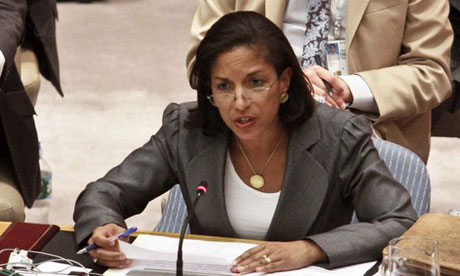
US United Nations Ambassador Susan Rice speaking at the United Nations on 30 August 2012. Photograph: Bebeto Matthews/AP

(Updated below – Update II)

Over the last months, Democrats and Republicans have been engaged in an intense fight over the suitability of UN Ambassador Susan Rice to replace Hillary Clinton as Secretary of State. Democratic Party institutions and pundits have steadfastly devoted themselves to defending her from GOP criticisms.

Virtually all of this debate has concerned Rice’s statements on a series of Sunday news shows in September, during which she claimed that the Benghazi attack was primarily motivated by spontaneous anger over an anti-Islam film rather than an coordinated attack by a terrorist group. Everyone now acknowledges that (consistent with the standard pattern of this administration’s behavior) Rice’s statements were inaccurate, but in a majestic display of intellectual dexterity, progressive pundits claim with a straight face that public officials should be excused when they make false statements based on what the CIA tells them to say, while conservatives claim with a straight face that relying on flawed and manipulated intelligence reports is no excuse.

All of that is standard, principle-free partisan jockeying. It goes without saying that if this were Condoleezza rather than Susan Rice, the two sides would have exactly opposite positions on whether these inaccurate statements should be held against her. None of that is worth examining.

But what is remarkable is how so many Democrats are devoting so much energy to defending a possible Susan Rice nomination as Secretary of State without even pretending to care about her record and her beliefs. It’s not even part of the discussion. And now that some writers have begun examining that record, it’s not hard to see the reason for this omission.

via OpEdNews – Article: The revealingly substance-free fight over Susan Rice.

UPDATES l President Nelson Mandela’s failing health

About Madiba

Nelson Rolihlahla Mandela (Xhosa pronunciation: [xoˈliːɬaɬa manˈdeːla]; born 18 July 1918) is a South African anti-apartheid revolutionary and politician who served as President of South Africa from 1994 to 1999. He was the first black South African to hold the office, and the first elected in a fully representative, multiracial election. His government focused on dismantling the legacy of apartheid through tackling institutionalised racism, poverty and inequality, and fostering racial reconciliation. Politically an African nationalist and democratic socialist, he served as the President of the African National Congress (ANC) from 1991 to 1997. Internationally, Mandela was the Secretary General of the Non-Aligned Movement from 1998 to 1999.

A Xhosa born to the Thembu royal family, Mandela attended Fort Hare University and the University of Witwatersrand, where he studied law. Living in Johannesburg, he became involved in anti-colonial politics, joining the ANC and becoming a founding member of its Youth League. After the Afrikaner nationalists of the National Party came to power in 1948 and began implementing the policy of apartheid, he rose to prominence in the ANC’s 1952 Defiance Campaign, was elected President of the Transvaal ANC Branch and oversaw the 1955 Congress of the People. Working as a lawyer, he was repeatedly arrested for seditious activities and, with the ANC leadership, was prosecuted in the Treason Trial from 1956 to 1961 but was found not guilty. Although initially committed to non-violent protest, in association with the South African Communist Party he co-founded the militant Umkhonto we Sizwe (MK) in 1961, leading a bombing campaign against government targets. In 1962 he was arrested, convicted of sabotage and conspiracy to overthrow the government, and sentenced to life imprisonment in the Rivonia Trial.

Mandela served 27 years in prison, first on Robben Island, and later in Pollsmoor Prison and Victor Verster Prison. An international campaign lobbied for his release, which was granted in 1990 amid escalating civil strife. Becoming ANC President, Mandela published his autobiography and led negotiations with President F.W. de Klerk to abolish apartheid and establish multiracial elections in 1994, in which he led the ANC to victory. He was elected President and formed a Government of National Unity in an attempt to diffuse ethnic tensions. As President, he established a new constitution and initiated the Truth and Reconciliation Commission to investigate past human rights abuses. Continuing the former government’s liberal economic policy, his administration introduced measures to encourage land reform, combat poverty and expand healthcare services. Internationally, he acted as mediator between Libya and the United Kingdom in the Pan Am Flight 103 bombing trial, and oversaw military intervention in Lesotho. He declined to run for a second term, and was succeeded by his deputy Thabo Mbeki, subsequently becoming an elder statesman, focusing on charitable work in combating poverty and HIV/AIDS through the Nelson Mandela Foundation.

Controversial for much of his life, right-wing critics denounced Mandela as a terrorist and communist sympathiser. He has nevertheless received international acclaim for his anti-colonial and anti-apartheid stance, having received over 250 awards, including the 1993 Nobel Peace Prize, the US Presidential Medal of Freedom and the Soviet Order of Lenin. He is held in deep respect within South Africa, where he is often referred to by his Xhosa clan name of Madiba or as tata; he is often described as “the father of the nation”.

Official says Nelson Mandela on life support; Zuma cancels travel plans

By Faith Karimi and Robyn Curnow, CNN
updated 11:14 PM EDT, Wed June 26, 2013
Watch this video

Reports: Nelson Mandela on life support

STORY HIGHLIGHTS
  • NEW: South African president cancels Thursday’s trip to Mozambique
  • Mandela is now on life support, an official says
  • Family collects some of the items left outside the hospital by well-wishers

Pretoria, South Africa (CNN) — South Africans lit candles outside the hospital where anti-apartheid icon Nelson Mandela lay Wednesday night amid a report that the former president was on life support.

An official briefed on his condition said he was on life support, but government spokesman Mac Maharaj declined to comment on the report, citing doctor-patient confidentiality.

Mandela, 94, considered the founding father of South Africa’s multiracial democracy, has been hospitalized since June 8 for a recurring lung infection.

Authorities have described his condition as critical since Sunday, and after visiting him late Wednesday night, President Jacob Zuma canceled his visit to Mozambique where he was supposed to attend a summit Thursday on infrastructure investment.

As the nation remained on edge, police barricaded the street leading to the hospital’s main entrance. Well-wishers hung balloons, stuffed animals and messages of support along the wall, and crowds hovering nearby sang “Where is Mandela?”

Revolutionary and politician Nelson MandelaRevolutionary and politician Nelson Mandela

Reports: Nelson Mandela on life support

Daughter: He is at peace

The whole world prays for one man

“We need you!,” one sign read. “We love you tata, get well soon!” said another, referring to Mandela by the Xhosa word for father.

Several relatives came out to collect some of those items Wednesday.

“He’s going to feel a lot better when he sees these signs,” said David Manaway, Mandela’s grandson-in-law.

Why Mandela has six names

His former physician and the nation’s ex-surgeon general, Dr. Vejay Ramlakan, also visited the hospital Wednesday, said the national news agency, South African Press Association.

Mandela became an international figure while enduring 27 years in prison for fighting against apartheid, the country’s system of racial segregation. He was elected the nation’s first black president in 1994, four years after he was freed.

Nelson Mandela Fast Facts

“He is our hero. He is my mentor, my father. He is everything to me,” said Kuda Nyahumzvi, 36. “But when it is his time, we wish his soul could just rest. He spent so long in jail and struggling.”

Even as he has faded from the spotlight, he remains popular and is considered a hero of democracy worldwide.

As South Africans steeled themselves for the worst, details emerged about the family’s meeting in his boyhood home of Qunu on Tuesday. An archbishop also stopped by the hospital and conducted prayers, calling for “a quiet night and a peaceful, perfect end” for the former president.

Archbishop Thabo Makgoba joined the family at the hospital where Mandela remained in critical condition, the South African Press Association reported.

“Fill them with your holy courage and the gift of trusting faith, and take away their fears so that they may dare to face their grief,” he said, according to a copy of the prayer posted on the bishop’s website.

“And uphold all of us with your steadfast love so that we may be filled with gratitude for all the good that he has done for us and for our nation, and may honor his legacy through our lives.”

7 Things You Can Learn From Nelson Mandela’s Life

During the meeting in Qunu, funeral arrangements were not part of the talks, family friend Bantu Holomisa said, according to SAPA.

As a former head of state, plans for Mandela’s funeral are spearheaded by the government, according to Holomisa.

Mandela turns 95 in July.

Nelson Mandela in critical condition days before Obama visit

CNN’s Faith Karimi wrote and contributed from Atlanta. CNN’s Brent Swails, Matt Smith, Catherine E. Shoichet, John Raedler and Michael Martinez contributed to this report.

Mandela Is Suffering From a Lung Infection

Alexander Joe/Agence France-Presse — Getty Images

In Soweto, an area of Johannesburg, a resident walked past images of Nelson Mandela, the 94-year-old former president of South Africa and hero of the antiapartheid movement, who remained hospitalized on Tuesday.

By 

Published: December 11, 2012

JOHANNESBURG — Former President Nelson Mandela, who has been hospitalized since Saturday, is suffering from a recurrence of a lung infection and is responding to treatment, the office of South Africa’s current president, Jacob Zuma, announced on Tuesday.

It was the first indication of Mr. Mandela’s medical condition since he was flown to Pretoria and taken to the hospital for unspecified tests over the weekend. It was his second hospitalization this year; in Februaryhe was checked into a hospital for tests to address a chronic stomach complaint, the government said at the time.

Mr. Mandela, who is 94 and increasingly frail, was said by Mr. Zuma’s office to be “receiving appropriate treatment and he is responding to the treatment.”

Mr. Mandela, South Africa’s first black president, retired from public life some years ago, and was last seen publicly at the celebrations for the World Cup soccer tournament in 2010, although he receives frequent visits from old friends and visiting dignitaries.

In January 2011, he was hospitalized for an acute respiratory infection, and the news of that illness set off a panic about his health.

When Secretary of State Hillary Rodham Clinton visited South Africa in August, she stopped by his home in the rural Eastern Cape village of Qunu to see him. In a photograph of the two of them Mr. Mandela beamed his trademark grin, but looked frail seated in an armchair and dressed in a gray cardigan.

^^^^^^^^^^^^^^^^^^^^^^^^^^^^^^^^^^^^^^^^^^^^^^

Nelson Mandela suffering from lung infection and ‘sparkle fading’

Nelson Mandela is losing his trademark “sparkle”, according to his wife, as the South African government announced he is suffering from a recurrence of a lung infection.

Nelson Mandela suffering from lung infection and 'sparkle fading'

Nelson Mandela, the former South African president Photo: AP

9:18AM GMT 11 Dec 2012

A government statement said the South African former president is responding to treatment for the infection.

Separately, his wife Graca Machel said in an interview it was painful to see the anti-Apartheid hero “ageing.”

“I mean, this spirit and this sparkle, you see that somehow it’s fading,” she told ENews Central Africa (ENCA) on Monday in her first interview since Mr Mandela was admitted to hospital at the weekend.

South African government officials have said the former president is comfortable and does not face immediate danger, but they refuse to speculate on when he is likely to be discharged from a Pretoria military hospital.

Mr Mandela, 94, was at the weekend admitted to hospital for tests that authorities say are expected of people of his age.

“To see him ageing, it’s something also which pains you … You understand and you know it has to happen,” said Graca.

Mr Mandela’s granddaughter Ndileka told the same TV network that he has taken to accept his condition.

“I think he takes it in his strides, he has come to accept that it’s part of growing old, and it’s part of humanity as such. At some point you will dependent on someone else, he has come to embrace it,” she said.

Nosiviwe Mapisa-Nqakula, the defence minister, visited Mr Mandela on Monday and said the revered statesman was “doing very, very well”.

The presidency said it was too early to give an update as they have to hear first from the doctor.

^^^^^^^^^^^^^^^^^^^^^^^^^^^^^^^^^^^^^^^^^^^^^^^^^^^^^^^^^^^^^^^^^^^^^^^^^

Nelson Mandela ‘has stopped talking’

South African leaders issued assurances about the health of former president Nelson Mandela on Sunday night after the 94 year-old was airlifted to hospital having reportedly stopped speaking amid a deterioration in his condition.

Mandela hospitalised after he stops talking

Nelson Mandelahas spent a second day at the Pretoria hospital Photo: REUTERS

By Erin Conway-Smith, Cape Town

4:28PM GMT 09 Dec 2012

The Sunday Times, a South African newspaper, quoted an unnamed person close to the Mandela family as saying: “He has not been talking … he is not looking good. It’s clear that something is troubling him.”

Mr Mandela, the country’s first black president, spent a second day at the Pretoria hospital where he is said to be undergoing tests. On Saturday he was flown from his rural home in the Eastern Cape to the capital Pretoria to receive medical attention.

President Jacob Zuma visited Mr Mandela, whose health has been frail in recent years, and “found him comfortable, and in good care,” a statement said.

No details have been released about the specific reason for Mr Mandela’s admission to hospital, or when he will be discharged.

Mac Maharaj, a spokesman for Mr Zuma, on Saturday said the anti-apartheid icon was “doing well”.

Mr Mandela, affectionately known in South Africa as “Madiba,” his Xhosa clan name, “will receive medical attention from time to time which is consistent with his age,” a statement on Saturday said.

Former wife Winnie Madikizela-Mandela and daughter Zindzi seemed to not view it as an emergency, or else were unaware that Mr Mandela had been transferred to Pretoria. They attended a football match in Soweto between the Orlando Pirates and Kaizer Chiefs on Saturday, local media reported.

The Congress of South African Trade Unions, allied with the ruling African National Congress party, responded in a statement: “We hope that it is true – as reported by the presidential spokesperson – there is no cause for concern or alarm.”

Deputy president Kgalema Motlanthe had been scheduled to visit Mr Mandela in Qunu on Friday, but the meeting was cancelled.

A South African military plane crashed Wednesday after disappearing en route from a Pretoria air base to Mthatha, the nearest airport to Mr Mandela’s home in Qunu village.

There have been persistent rumours that the aircraft was carrying medical personnel or medical supplies for Mr Mandela.

Mr Mandela was last hospitalised in February for what was described as “routine tests,” and later turned out to have been a minor surgical procedure to determine the cause of abdominal pain.

His last public appearance was at the final match of the 2010 FIFA World Cup, which South Africa hosted, where he toured the stadium on a golf cart with third wife Graca Machel.

^^^^^^^^^^^^^^^^^^^^^^^^^^^^^^^^^^^^^^^^

http://www.telegraph.co.uk/news/worldnews/nelson-mandela/9733036/Nelson-Mandela-has-stopped-talking.html

^^^^^^^^^^

Nelson Mandela Health Concerns Grow

By JON GAMBRELL 12/14/12 11:26 AM ET EST AP

Share on Google+
Nelson Mandela
69
13
121
GET BLACK VOICES ALERTS:

JOHANNESBURG — Where is Nelson Mandela?

As the 94-year-old patriarch of South Africa’s democracy entered his seventh day of hospitalization Friday for a recurring lung infection, confusion grew as government officials appeared to contradict themselves over where he is being treated.

With the government refusing to say where Mandela is, concern grew across this nation of 50 million people about the health of the anti-apartheid icon.

Mandela, admitted Saturday to a hospital, was thought to have been at 1 Military Hospital near South Africa’s capital, Pretoria, after Defense Minister Nosiviwe Mapisa-Nqakula said she visited the leader there Monday. But when local media reported that Mandela wasn’t at that hospital Thursday night, presidential spokesman Mac Maharaj declined to give the whereabouts of the ailing politician.

“President Mandela is being treated at a Pretoria hospital as said from the first statement we issued,” Maharaj said. “We have refrained from disclosing the hospital in order to ensure privacy and also to allow doctors space to do their work of caring for (him) without interruptions or undue pressure.”

It was not immediately clear if Mandela had been moved or if he had been at a different facility during his entire seven-day hospitalization, his longest since 2001, when he underwent radiation therapy after being diagnosed with prostate cancer.

On Monday, addressing journalists after her visit, Mapisa-Nqakula said: “We confirm that former President Mandela is in (the) hospital, 1 Military Hospital, and he’s doing very, very well.”

Sonwabo Mbananga, a defense department spokesman, said Friday that “the minister is not going to clarify anything” about her remarks Monday and declined to comment further.

On Friday, journalists saw a convoy of presidential security cars and an ambulance leave a private Pretoria hospital and later arrive at 1 Military Hospital. However, it could not be immediately determined if the convoy had anything to do with Mandela’s care.

Speaking to The Associated Press on Friday afternoon, Maharaj again declined to identify which hospital Mandela was staying at, saying officials are “trying to protect his privacy.” When asked about the defense minister’s comments, Maharaj said the presidency had been consistent in avoiding identifying the hospital and declined to comment further.

Mandela “has been comfortable the past 24 hours and continues to receive care,” Maharaj said.

South Africa’s government has said Mandela, initially admitted for medical tests, was being treated for a lung infection. Mandela has a history of lung problems, after falling ill with tuberculosis in 1988 toward the tail-end of his 27 years in prison before his release and being elected president. While doctors said at the time the disease caused no permanent damage to his lungs, medical experts say tuberculosis can cause problems years later for those infected.

Mandela had an acute respiratory infection in January 2011 and following the chaos surrounding Mandela’s stay at a public hospital the South African military took charge of his care and the government took over control the information about his health.

___

Jon Gambrell can be reached at . www.twitter.com/jongambrellAP