Black Rage, Gender, and Allyship
Aya de Leon
Black people are angry. Anyone who is going to be our ally in the fight against racism needs to understand that. Not every black person walks around angry, or is aware of their anger. Fury looks and sounds and hangs differently on people of African heritage  with differences of class, ethnicity, generation, geography, gender, sexuality, and trauma history. But for many of us, we’re angry, and we have good reason after hundreds of years of slavery, racism, colonization, jim crow, neo-colonialism, exploitation, and degradation. This is not an abstract, academic, intellectual racism; this is about hundreds of years of our ancestors bringing racist violence home. In the US, slave masters beat us with whips and we beat our children with belts. Slave masters raped and incested African women, and sexual abuse became epidemic in black families. Slave masters worked us to death and now we work ourselves to death, and we are furious. For hundreds of years, we have had to swallow the rage or risk getting killed by white people. And we swallowed it, and killed each other and ourselves. Men take the rage out on each other, on women and children, women take the rage out on each other and on children, and children take the rage out on each other, particularly those younger. Shit rolls down hill. We have a hard time loving ourselves and a hard time building loving, lasting relationships with each other.
In order to heal from racism, black people need hardcore healing spaces with a big, safe, container to do rage work, to get it out of our bodies. It’s not about sitting and talking about it in a nice middle class therapist’s office, or going for a jog, it’s about finding a safe place to scream our voices raw, kick and flail, and let that beast out. One black woman who does this work is Ruth King, author of Healing Rage – Women Making Inner Peace Possible.
Men need spaces to work on rage, as well. My partner is an African heritage man who doeshealing work with black men. When I asked him to talk to me about black men’s rage, he said that black men are filled with sorrow. But they are culturally prohibited from expressing sorrow, because such displays of vulnerability make them targets of violence and homophobia. So the society has shown them that rage is their best option for pushing back against racism—the only option other than acquiescence. So many of them take the only option that is offered. He said that men need to work with other men to face these feelings. Men have the breakthroughs when other men let them know it’s okay to be vulnerable and they can actually show and get in touch with the sorrow. Women can be allies to this process, but the key is for men to be emotionally vulnerable with each other, not for women to be vulnerable.
Black rage is a response to racism. White guilt is a response that many white people have to racism, and the two have a dynamic interaction. White guilt doesn’t reflect a principled stance against racism, and a commitment to end it and undo its effects. White guilt is more of a childlike uh-oh, we’re in trouble, where the white person goes around feeling bad and expecting/projecting some sort of anger or punishment from people of African heritage. This can lead to fawning and accommodating behaviors in communities and relationships. Again, this is not about a principled stance against racism, this is about an anxious wish to avoid conflict with an individual person of African heritage. At other times, part of the racist gaze is to project anger onto black people regardless of their emotional reality at any given moment.
If you plan to be an ally to people of African heritage, you need to be able to handle black rage. Big, heaping truckloads of it. And by handle, I mean be able to keep thinking clearly and act decisively in the presence of rage.
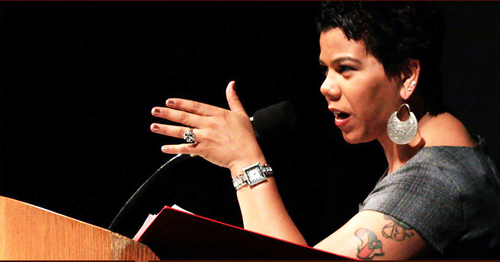
This is precisely what did not happen last week at the Brecht Forum in Brooklyn at a panel titled “What Do We Mean When We Say Privilege, Ally & Comrade? Exploring the Difficulty of Difference & Movement Building.” I first read the account of one black woman panelist, Dr. Brittney Cooper, who challenged a black male panelist, Kazembe Balagun about his sexism. He yelled at her, menaced her, and threw a glass of water on her. An entire room full of people sat silent in the face of this gendered violence.
Here’s Cooper, in her own words:
Left to sit there, splashes of water, mingling with the tears that I was embarrassed to let run, because you know sisters don’t cry in public, imploring him to “back up,” to “stop yelling,” to stop using his body to intimidate me, while he continued to approach my chair menacingly, wondering what he was going to do next, anticipating my next move, anticipating his, being transported back to past sites of my own trauma, traumas that have been especially fresh and difficult this Domestic Violence Awareness Month…
I waited for anyone to stand up, to sense that I felt afraid, to stop him, to let him know his actions were unacceptable…
I learned a lesson: everybody wants to have an ally, but no one wants to stand up for anybody.
Eventually three men held him back, restrained him, but not with ease. He left. I breathed. I let those tears that had been threatening fall.
One black man further berated Professor Cooper, and the biggest gesture of solidarity was when the third panelist, a white woman, silently inched her chair closer to Cooper.
Many others have expressed solidarity with Cooper after the fact.
By way of compassion, I suspect that the entire crowd was completely triggered and regressed to some childhood state in the face of black male rage unleashed. White allies need to work on whatever childhood baggage they bring to the table. Perhaps it is the terrified memories of their own parents’ rage. Or maybe they are still stifled by the frequent middle/upper class prohibitions against strong feelings that meant their own childhood rage got shut down. While I have compassion for anyone who is triggered, I hope that everyone in that room who can see clearly in hindsight that they should have said/done something decisive to intervene. I hope they can tell that because they were far too scared to act in integrity with their values, they need to go seek some kind of emotional help.
But beyond the emotional shortcomings of the community, I want to challenge some of the underlying thinking that often allows this kind of thing to go unchecked. White people feel guilty, and will refuse to take principled stands against expressions of black rage. It’s one thing for black people to take responsibility for our rage and find an appropriate therapeutic or healing context (could be counseling, could be ritual, could be somatics, could be any number of things). This is a situation where the person or group of people have agreed to be witness and container to the rage you are prepared to express in an attempt to heal yourself, that is rage with consent. It is, however, a completely different proposition for black people to go around leaking and firing their rage at anyone in range, anyone who challenges them, anyone who is vulnerable, or anyone who unwittingly pushes the wrong button. As Audre Lorde said, “use without the consent of the used is abuse.”
Starting with the Black Power Movement, some black men have had a narrative that black liberation is about their freedom to express rage. So-called allies have co-signed this, from former Black Panther Eldridge Cleaver writing about going around raping white women as a revolutionary act (he “practiced” on black women first, to get it right) to the Brecht forum allowing a black man with a history of verbal and physical raging to be on a challenging panel about allyship. Our allies need to take a principled stand that rage is understandable, but rage needs to be healed and patterns of venting rage without consent need to be interrupted. There is no noble political principle being served by allowing people to abuse others. This doesn’t mean that all displays of anger need to be shut down. It’s important to allow emotional space outside of white, middle class cultural norms (sometimes people get angry, and that can be a good thing) but it’s different for people to have a pattern of raging as part of how they work in community. Our allies need to be able to tell the difference, offer resources, set limits, and hold lines against abusive behavior.
There is a particular historical dynamic that can happen sometimes with black men’s rage and white women’s guilt. In this particular dynamic, black men express rage about racism and white women feel guilty, and offer themselves (sexual access, emotional caretaking, free labor) to black men in some sort of private reparations campaign. Clearly there is no larger agenda being served about ending racism, but it’s easy for women’s training as caretakers and fear of violence to get ignited in these situations. In reality, I have seen this dynamic happen in relationships between black and white women, and even occasionally between black women and white men, as long as the white person has strong childhood socialization to respond to rage by feeling responsible and offering caretaking.
So while the pattern is primarily one of black men, it is not exclusive to black men. I have seen this same pattern run with powerful black women in white dominated organizations, as well. Confused white leaders have been liberal with abusive patterns, convinced that it was somehow good for white people to be targeted with this rage. Those same white leaders were somehow unconvinced that there was a problem with the raging, when the black women targeted black people, as well.
I have also seen black rage, particularly African American rage (from the people whose ancestors were enslaved in the US South) target other people of color or of African heritage, whom they deemed as somehow not black enough, not really of color, somehow closer to white people, deserving of being targeted with rage, disdain, dismissal, or disregard. This rage has undermined or destroyed many coalitions with other people of color, not to mention destroying untold numbers of black organizations.
It is not allyship if white people think we can’t possibly control ourselves; white racism holds that this is the best we are capable of. There’s a particular way that this liberalism and confusion works with regard to black women and men, that white people/organizations generally can’t manage to be allies to both black women and men. Starting in the 70s, feminist organizations notoriously would ally with black women’s mistreatment at the hands of black men in a way that was a little too gleeful about black men’s monstrosity. Or, like the Brecht forum, would tolerate black men’s rage in ways that left black women targeted and alone.
I have also been part of community organizations that are predominantly white and have trouble hanging on to black men. Instead of addressing systemic racism in the organization, they use a strategy of placating and lowering their standards to keep black men involved. No matter how unaccountable African heritage men in the community or organization may be (missing meetings, not communicating, thoughtlessly inconveniencing leaders), it seemed the bar could always be lowered, the expectations could always be revised, so no one expressed displeasure at this lack of accountability. The black men meet a wall of complacent white compassion. Leaving the black women in the community to be the bad cops, the ones who actually have some expectations.
In my personal life, I remember when my partner and I went to couples’ counseling. We had a white, middle class, gentile therapist. He and I are both physically big people and were quite emotionally angry. I used to joke that we were 500 lbs of angry blackness on that poor white woman’s couch. The therapist was completely frozen in the face of our black rage. The two of us would sit in the sessions and fight, and she had very little to say. We didn’t progress much until we started seeing a Jewish therapist, the child of Holocaust survivors. She wasn’t even remotely scared of us. She could think and act decisively in the face of black rage. I celebrate her work with us, not only because it saved our marriage, but also because it helped us through our common trauma so that we could both become people capable of being loving to each other.
Coming out of these and other experiences, I have high standards for white allies. In both of these spaces, I have met white people who can stand up to black rage, to black hopelessness, and to black sorrow. If we aim to end racism, white allies need to start getting themselves in better shape. Do the emotional work; never leave a sister unsupported in the face of such violence. Interventions don’t have to be perfect, but they do need to happen. Speak the truth. Even if your voice shakes.
About the Author: Aya de Leon

Photo: betto rodrigues /Shutterstock.com