Ta-Nehisi Coates’s Essay on Reparations Is A Heartbreaker

See on Scoop.itOUR COMMON GROUND Informed Truth and Resistance

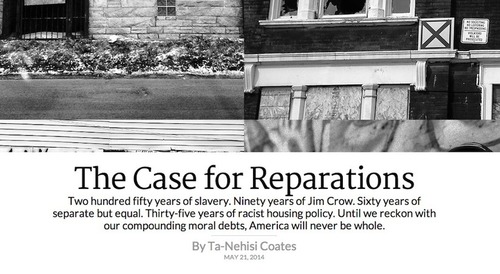
A few weeks ago, in the middle of a rhetorical battle he was already very clearly winning, The Atlantic’s Ta-Nehisi Coates published a long, lovely piece called “The Blue Period: An Origin Story.” In it, he remarked that “historians are heartbreakers.” I thought of that remark last night when he published a long, long piece, “The Case For Reparations,” that is clearly the result of that sort of heartbreak, too.

OUR COMMON GROUND Omnibus‘s insight:

"Is it even possible for this essay to be the speech act that will break that taboo? I’m not even sure Coates expects that, because so much of what he reports here suggests that this is not a problem a single essay can solve. Like his historians, he must know that insisting on the harder truths now makes him a heartbreaker, too."

See on gawker.com

OUR COMMON GROUND Voice, Goldie Taylor » On Ta-Nehisi Coates

See on Scoop.itOUR COMMON GROUND Guest Profiles

OUR COMMON GROUND Omnibus‘s insight:

OUR COMMON GROUND Voice, Goldie Taylor writes, " Without a doubt, Ta-Nehisi Coates is one of the most brilliant, prolific social and political philosophers of our time.  His compelling prose, lyrical and breathtaking by its nature, often leaves me without words. My soul quakes with every measure of every line."

See on goldietaylor.com

The Economics of Reparations: Why Congress Should Meet Ta-Nehisi Coates’s Modest Demand

MAY 21, 2014

The Economics of Reparations: Why Congress Should Meet Ta-Nehisi Coates’s Modest Demand

By  @dannyvinik

IIn the newest issue of The Atlantic, Ta-Nehisi Coates makes the case for slavery reparations. “The idea of reparations is frightening not simply because we might lack the ability to pay,” Coates writes. “The idea of reparations threatens something much deeper—America’s heritage, history, and standing in the world.” The piece is provocative, but short on details: It doesn’t put a number to what black Americans are owed, and it doesn’t provide a specific prescription for how to make reparations. Rather, Coates simply recommends that Congress passRepresentative John Conyers’s bill for a “Congressional study of slavery.”

But now that Coates has re-ignited this debate, it’s worth considering the practical implications. How much money, for instance, is due to black America? How should that money be distributed? Who should be eligible for it? Perhaps those are questions that a Congressional study could answer. What academic evidence we have provides an incomplete but sobering assessment of the costs of centuries of slavery, Jim Crow, and state-sanctioned discrimination.

How much should reparations be?

As Coates explains in his piece, reparations must compensate African Americans for more than just the centuries of slavery in the United States. After slavery was abolished, whites frequently lynched black Americans and seized their property. A 2001 Associated Press investigation, which Coates cites, found 406 cases where black landowners had their farms seized in the early-to-mid 20th century—more than 24,000 acres of land were stolen. Housing discrimination, which has been one of the largest obstacles to African Americans’ building wealth, still exists today.

Larry Neal, an economist at the University of Illinois, calculated the difference between the wages that slaves would have received from 1620 to 1840, minus estimated maintenance costs spent by slave owners, and reached a total of $1.4 trillion in 1983 dollars. At an annual rate of interest of 5 percent, that’s more than $6.5 trillion in 2014—just in lost wages. In a separate estimate in 1983, James Marketti calculated it at $2.1 trillion, equal to $10 trillion today. In 1989, economists Bernadette Chachere and Gerald Udinsky estimated that labor market discrimination between 1929 and 1969 cost black Americans $1.6 trillion.

These estimates don’t include the physical harms of slavery, lost educational and wealth-building opportunities, or the cost of the discrimination that persists today. But it’s clear the magnitude of reparations would be in the trillions of dollars. For perspective, the federal government last year spent $3.5 trillion and GDP was $16.6 trillion.


What form should reparations take?

In a 2005 article, economists William A. Darity Jr. and Dania Frank proposed five different ways to make reparations. The first approach is lump-sum payments. This is the most direct form of reparations, but it does not correct for the decades of lost human capital. The second is to aggregate the reparation funds and allow African Americans to apply for grants for different asset-building projects. These projects could promote homeownership or education, for instance. Under this thinking, reparations should be more than one-time payments, but should build the human and wealth capital that black Americans struggled to gain over the past few centuries.

A third approach would be to give vouchers for a certain monetary value to black Americans. This mirrors the goal of the second approach, but with a focus on building financial assets. “Thus reparations could function as an avenue to undertake a racial redistribution of wealth akin to the mechanism used in Malaysia to build corporate ownership among the native Malays,” Darity and Frank write. “In that case, shares of stock were purchased by the state and placed in a trust for subsequent allocation to the native Malays.”

Fourth, the government could give African Americans in-kind reparations—free medical insurance or guaranteed college education, for instance. Finally, the fifth approach “would be to use reparations to build entirely new institutions to promote collective well-being in the black community.” Darity and Frank don’t elaborate on the potential structure for those institutions. Congress could also combine any or all of these approaches.

Who should be eligible to collect reparations?

READ THE FULL ARTICLE

Byron Hurt

See on Scoop.itOUR COMMON GROUND Guest Profiles

OUR COMMON GROUND Omnibus‘s insight:

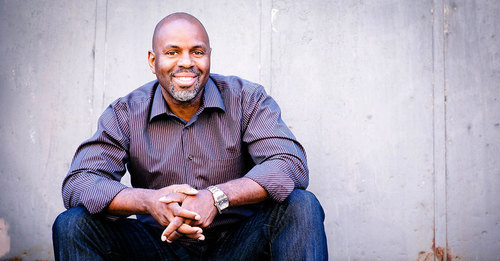
OUR COMMON GROUND Voice, Byron Patrick Hurt is an American activist, lecturer, writer, and award-winning documentary filmmaker. In 2010, he hosted the Emmy-nominated television show, REEL WORKS with BYRON HURT

See on www.bhurt.com

Malcolm X Center

See on Scoop.itOUR COMMON GROUND Guest Profiles

OUR COMMON GROUND Omnibus‘s insight:

OUR COMMON GROUND Voice,  EFIA NWANGANZA

Efia Nwangaza is a lifelong civil/human rights activist and freedom fighter who tirelessly works for the liberation of African/Black people. She is the Founder/Coordinator/President of the Malcolm X Center and Radio Manager and Broadcaster.

See on wmxp955.webs.com

OUR COMMON GROUND Voice, Kevin Alexander Gray l New Liberator

See on Scoop.itOUR COMMON GROUND Guest Profiles

  Kevin Alexander Gray Cultural name – Khalid Aikiiki Gamba “Eternal friend & warrior” Political-Cultural writer, activist & organizer ~ Harriet Tubman Freedom House Project Hear me Sunday …

OUR COMMON GROUND Omnibus‘s insight:

OUR COMMON GROUND voice, Kevin Alexander Gray is currently organizing the Harriet Tubman Freedom House Project which focuses on community based political and cultural education. Organizer — National Mobilization Committee Against the Drug War.  Former managing & contributing editor of Black News inColumbia.  Now serves as contributing writer to other minority newspapers in South Carolina.  He served as a national board member of the American Civil Liberties Union for 4 years & is a past eight-term president of the South Carolina affiliate of the ACLU.  Advisory board member of DRC Net (Drug Policy Reform Coalition).

In 1997, Gray was an organizer for the Rainbow/PUSH Coalition’s anti-Proposition 209 marches in San Francisco & Sacramento, California.

South Carolina coordinator for the 1988 presidential campaign of Jesse Jackson & 1992 southern political director for the presidential campaign of Iowa Senator Tom Harkin.  2002 SC United Citizens’ Party & Green Party Gubernatorial candidate.

Founding member of the National Rainbow Coalition in 1986.  Former co-chair of the Southern Rainbow Education Project — a coalition of southern activists.  Former contributing editor – Independent Political Action Bulletin. 

See on thenewliberator.wordpress.com

Mark Anthony Neal | New Black Man (in Exile) l Professor of AFAM Studies

See on Scoop.itOUR COMMON GROUND Guest Profiles

http://newblackman.blogspot.com/

OUR COMMON GROUND Omnibus‘s insight:

OUR COMMON GROUND Voice, Dr. Mark Anthony Neal is Professor of African & African American Studies at Duke University where he was the 2010 Winner of the Robert B. Cox Teaching Award. The author of several books including the recently published Looking for Leroy: Illegible Black Masculinities (NYU Press, 2013), Neal is also the co-editor of the acclaimed That’s the Joint: The Hip-Hop Studies Reader (Routledge), now in its second edition. Neal is the host of the weekly webcast Left of Black, which is produced in conjunction with the John Hope Franklin Center for Interdiciplinary and International Studies at Duke. You can follow Neal on Twitter at @NewBlackMan

See on hutchinscenter.fas.harvard.edu

Joanne Griffith | Redefining Black Power: Reflections on the State of Black America

See on Scoop.itOUR COMMON GROUND Guest Profiles

OUR COMMON GROUND Omnibus‘s insight:

OUR COMMON GROUND Voice, Joanne Griffith is an award winning broadcaster, journalist and writer,  Griffith’s work is fueled by the oxygen of compelling storytelling and truth. Never one to follow the obvious angle on stories that make up the media menu, Joanne has spent almost two decades uncovering the real gems behind the headlines — what’s left unsaid and often ignored.

See on redefiningblackpower.com

Dr. Marsha Coleman-Adebayo Biography

See on Scoop.itOUR COMMON GROUND Guest Profiles

Dr. Marsha Coleman-Adebayo received her BA degree from Barnard College/Columbia University and her doctorate degree from the Massachusetts Institute of Technology (MIT). Dr. Coleman-Adebayo was a S…

OUR COMMON GROUND Omnibus‘s insight:

OUR COMMON GROUND Voice, Dr. Coleman-Adebayo was a Senior Policy Analyst in the Office of the Administrator at the US Environmental Protection Agency. She has held various academic positions as Adjunct Professor at the Georgetown University – School of Foreign Studies and Visiting Scholar in the Department of African-American Studies at George Mason University.

See on thenofearinstitute.wordpress.com

Educational Innovation | Dr. Chris Emdin

See on Scoop.itOUR COMMON GROUND Guest Profiles

OUR COMMON GROUND Omnibus‘s insight:

OUR COMMON GROUND Voice, Dr. Christopher Emdin is an Associate Professor in the Department of Mathematics, Science and Technology at Teachers College, Columbia University; where he also serves as Director of Science Education at the Center for Health Equity and Urban Science Education. He is currently a Caperton Fellow and Hip-Hop Archive Fellow at the WEB DuBois Institute at Harvard University.

See on chrisemdin.com